
Jul 28, 2026
greens in regulation by handicap, GIR benchmarks, golf handicap improvement, Live Tourney, golf scoring
Greens in regulation by handicap explained with benchmark rates, scoring impact, and drills to improve your game.

A scratch golfer hits 52% of greens in regulation, about 9.36 greens per round, while a 25-handicap golfer hits only 15%, about 2.7 greens per round. That gap is why greens in regulation by handicap is one of the clearest ways to see where scoring changes come from, because a small move in handicap can mean a big jump in real birdie and par chances.
Why Golfers Track Greens in Regulation
A 15-handicap player can walk off the course feeling like the swing was decent, the driver was stable, and the putter behaved well enough. Then the scorecard still shows the same old number. That's exactly where greens in regulation cuts through the noise, because it tells you whether you gave yourself a real scoring look often enough to matter.
For many golfers, GIR becomes the missing link between practice and scoring. Hitting the ball “pretty well” is not the same as landing on the green in the number of shots the hole allows, and that difference shows up fast in the handicap bands. A useful way to think about it is simple, if you're not reaching enough greens, you're asking your short game to rescue too many holes.
Practical rule: if your handicap is changing but your GIR count is not, your scores are probably being held together by scrambling rather than by repeatable approach play.
That's why this stat matters to players and to golf course operators alike. It gives a stable benchmark for performance, helps identify where a round is being won or lost, and points directly to the kind of practice that can move scores. For readers who want a broader understanding of handicap itself, this handicap primer from Live Tourney is a useful companion.
Defining Greens in Regulation Clearly
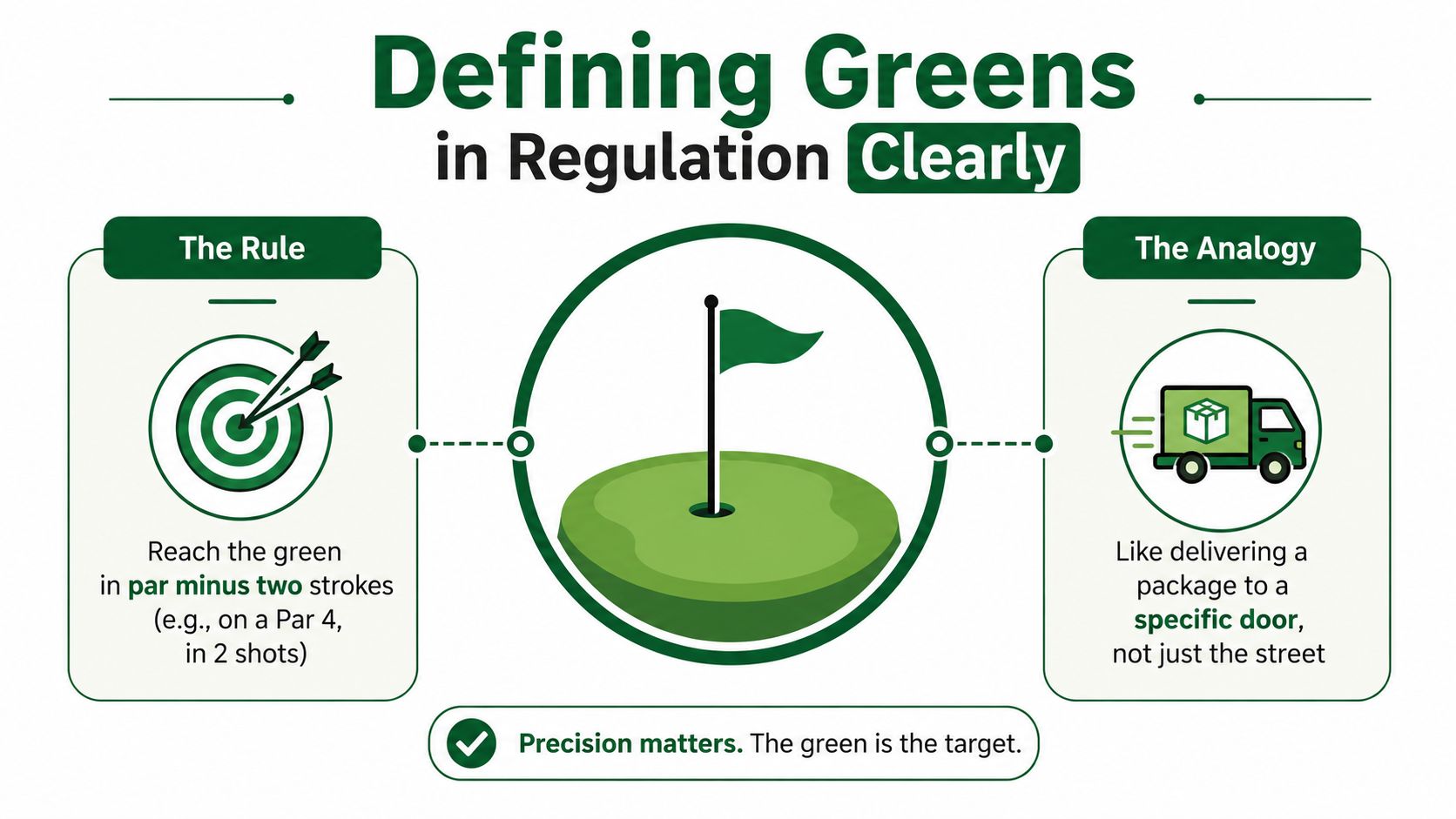
Greens in regulation means reaching the putting surface in two strokes fewer than par. On a par 3, that means getting there in 1. On a par 4, it means 2. On a par 5, it means 3. That rule is the whole stat.
If you aren't reaching enough greens, your short game has to rescue too many holes. GIR measures how often your tee shot and approach leave you in position to score, which is why it is more useful than a simple look at the final score on each hole.
A delivery target gives a clear comparison. Reaching the street means the ball is nearby, but the job is not finished. GIR works like getting the package to the right door, on time, and in a spot where the next step is realistic instead of desperate.
Why the distinction matters
A GIR is not about whether you two-putt, one-putt, or three-putt. It is about whether your approach shot did its job and gave you a legitimate scoring chance. That makes it a clean measure of approach quality, not putting skill.
A green in regulation is the setup, not the finish.
A player can miss a green and still save par. Another player can hit the green and still make bogey. The stat does not judge the final score on the hole. It measures how often the tee shot and approach put the player in position to score. That separates opportunity creation from opportunity conversion.
Greens in Regulation Benchmarks by Handicap
The gap between handicap groups shows up fast in greens in regulation, and that makes GIR a useful benchmark for where a player really stands. One 2024 summary found that a scratch player hit 52% of greens, about 9.36 greens per round, while 5-handicaps hit 37% (6.66), 10-handicaps 32% (5.76), 15-handicaps 23% (4.14), 20-handicaps 19% (3.42), and 25-handicaps 15% (2.7) (Golf Monthly). The same source also shows a 10-handicap averaging 6.3 greens per round and a 15-handicap averaging 4.14, which works out to roughly one GIR every 3 holes for a 10-handicap and one every 4 holes for a 15-handicap.
GIR Rates by Handicap Band
Handicap | GIR % | Greens per Round |
|---|---|---|
Scratch | 52% | 9.36 |
5 | 37% | 6.66 |
10 | 32% | 5.76 |
15 | 23% | 4.14 |
20 | 19% | 3.42 |
25 | 15% | 2.7 |
That table matters because handicap bands do not feel evenly spaced on the course. Moving from 15 handicap to 10 handicap means about 1.6 more greens a round in the benchmark data, and that is a noticeable change in how many birdie looks or par-saving looks a player creates. A small shift in GIR often looks bigger on the card than golfers expect.
A separate score-improvement guide says golfers around 15 to 20 handicap usually hit 4 to 6 GIRs per round, or about 20% to 30% of greens (Partee of 18). That lines up with the broader pattern above and gives golfers a practical target band instead of a vague instruction to hit more greens.
A benchmark only becomes useful when you know what kind of golf produced it. Course rating and tee setup change the length and difficulty of the approach shots you face, so a player can look better or worse without swinging differently. A clear explanation of how course rating works helps put those GIR numbers in context.
The main point is simple. GIR is one of the clearest ways to compare skill levels because even modest handicap changes show up in how often a player reaches the green in regulation. For a coach or tournament director, that makes it a more reliable reference point than a casual guess about who is “striking it well.”
Beyond Raw Totals Miss Quality and Course Context
Raw GIR totals can mislead you if you treat them like the whole story. A player can hit more greens and still score worse if the misses are in the wrong places, while another player can miss more often and stay competitive by controlling the damage. That's why the smarter question is not just “How many greens did you hit?” It's “What kind of misses did you leave yourself?”
One useful low-handicap idea is the 6/6/6 framework, which balances greens hit, greens missed, and up-and-down chances instead of worshipping GIR alone. The point is not to lower the importance of GIR, it's to stop pretending every miss is equal. A chip from a bad side of the hole is very different from a simple pitch with room to work.

Course setup changes the target
GIR expectations also shift with tee choice and hole length, which is why the same handicap can look very different from one course setup to another. A player moving back a set of tees faces longer approaches, more long-iron shots, and less margin for error. Move forward a tee, and the same player may see a very different GIR pattern without changing swing mechanics at all.
A benchmark without course context can be accurate and still be incomplete.
That's where course rating comes into the discussion. Course setup influences scoring demands, so it's useful to understand how the course rating context from Live Tourney fits into the broader picture of performance. Longer holes and harsher recovery spots can make a decent GIR total more valuable than the raw number suggests.
This matters most for golfers who get discouraged by an uneven round. A missed green is not automatically a failed hole. A missed green from a safe side of the fairway with a manageable chip is a very different outcome from a miss that leaves a dead-side recovery. If you start classifying misses by quality and not just by count, your scoring picture gets much clearer.
How to Measure and Track Your GIR
Tracking GIR is simple if you keep the process boring. Mark each hole as green hit or green missed, then total the hits for the round. At the end, divide the number of greens hit by holes played if you want a percentage, or just count the total greens if that's more useful for your own practice log.
The important part is consistency. If one round counts a fringe putt as a green and the next round doesn't, your numbers stop telling the truth. GIR only works when you apply the same standard every time, the ball must finish on the actual putting surface.
A simple way to keep score without overcomplicating it
Before the round: decide whether you're tracking total GIR, GIR by hole type, or missed-green zones.
During the round: mark each approach result immediately, so you're not guessing later.
After the round: total the hits and note whether misses were long, short, left, or right.
That last note is where the value lives. Two golfers can both hit four greens, but one might repeatedly miss by a yard on the high side, while the other misses fat, right, and into trouble. The first golfer has a repeatable pattern to work on. The second golfer has a contact problem.
For organizers running events and leagues, modern scoring platforms can automate that same process instead of relying on paper scorecards and spreadsheets. App-free live scoring is especially useful because players can enter scores from a phone link without downloading anything, which keeps participation simple and makes live leaderboards easier to manage. For a closer look at handicap tracking workflows, the best-app-for-golf-handicap guide from Live Tourney is a helpful reference point.
Drills to Improve GIR for Every Handicap
The best GIR practice matches the player, not the fantasy. A 20-handicap doesn't need the same drill emphasis as a 5-handicap, because their scoring leak is usually different. A player around 15 to 20 handicap already has a useful benchmark band of 4 to 6 GIRs per round (Partee of 18), so the first goal is often cleaner contact and a tighter target pattern, not a fancier swing thought.
Build the drill around your handicap band
Handicap 15 to 20: Hit a narrow target with irons and hybrids, then check how often your miss stays playable. Focus on center-face contact and start line, because a better strike often turns a fringe miss into a true green hit.
Handicap 10 to 15: Use distance ladder work with mid-irons. Rotate between three yardages, and keep your eyes on carry distance rather than total flight, so your approach control becomes less guessy.
Handicap 5 to 10: Practice trajectory control with the same club from different lies. Learn to flight one shot lower and one shot higher, since course conditions often decide whether a green is reachable.
Handicap 0 to 5: Spend practice time on aim, hole location, and decision-making. A tighter player gains more from choosing the correct side of the green than from chasing every flag.
A good drill is the one that makes the next round less random. If you're a high handicapper, that means building a reliable strike pattern before worrying about pin-seeking. If you're already in the low single digits, the gains usually come from smarter misses and more disciplined targets.
Best practice: don't measure improvement by one hot range session, measure it by whether your missed shots start landing in safer, more predictable places.
A clean practice block can be short. Pick one target, one club, and one ball flight, then repeat until your misses start clustering instead of spraying. That's the sign your GIR is moving in the right direction.
Your Next Steps to More Greens
Greens in regulation by handicap only makes sense when you treat it as a live benchmark, not a static label. A golfer's number changes with setup, with miss quality, and with how often approach shots create playable putts instead of recovery work. The best players don't just ask whether they hit the green, they ask whether the miss left a simple next shot.
Start by finding your current band and writing it down. Then track one full round with the same definition every time, note where the misses go, and match practice to the pattern you see. That gives you a far better improvement plan than trying to copy someone else's benchmark.
If you run tournaments, leagues, or outings, you can also make this data part of the event experience instead of a post-round afterthought. Live scoring and simple score capture help players stay engaged while giving staff cleaner data to review.
If you want a cleaner way to track performance, manage live scoring, and keep golf events moving without extra friction, visit Live Tourney. It's built for golf courses and event organizers who want straightforward scoring, live results, and less time spent wrestling with setup.





