
Feb 4, 2026
Run flawless golf tournaments with this guide to stroke play golf. Learn the rules, scoring, and strategies essential for any golf event organizer.

If you’ve ever watched a major golf championship on TV, you’ve seen stroke play in action. It’s the most common format in the sport, and the rules are beautifully simple: the winner is the player who takes the fewest total shots over a set number of holes.
Think of it as a race against the course itself. Every swing, putt, and penalty adds to your final score, making every single moment count.
Understanding the Fundamentals of Stroke Play

Unlike its more direct rival, match play, stroke play is a straightforward test of individual consistency and endurance. You’re not just trying to beat the person you’re playing with; you’re competing against every other golfer in the field at the same time. The goal is simple: finish the round with the lowest score possible.
This format is also known as medal play, a term you’ll often hear at club competitions and amateur events.
Because every shot has a direct impact on your final score, there are no "gimmies" or conceded putts. You have to play every hole until the ball is in the cup, no matter how close it is. This relentless nature is why stroke play is considered the purest test of a golfer's skill over 18 holes.
Gross Score vs. Net Score
Two key terms define scoring in stroke play, especially in events using handicaps:
Gross Score: This is your actual score—the total number of strokes you took during the round, plain and simple. If you shot an 85, your gross score is 85.
Net Score: This is your gross score minus your handicap. It’s the great equalizer, leveling the playing field so players of all abilities can compete fairly against each other.
Stroke play demands a totally different mental game. It’s not about beating a single opponent on one hole; it’s about managing your game against the course for the entire round. A single bad hole can be costly, making patience and damage control essential skills.
While some argue that match play was golf's original format, stroke play has been the standard for major championships from the very beginning. The first Open Championship in 1860 was a 36-hole stroke play event, cementing it as the premier format for professional competition right out of the gate. You can learn more about this foundational event and its history.
Getting the Scoring Rules Right
In stroke play, your scorecard is everything. It’s the official, un forgiving record of your round, and unlike other formats, you can't just pick up on a bad hole. Every single shot counts toward your final score, which is why knowing the basic rules is so important for keeping the competition fair.
The absolute number one rule is that you have to hole out on every single hole. There's no conceding a putt or picking up your ball because you're out of the running. If you do, you're disqualified. Simple as that. Every drive, every chip, and every last tap-in has to be recorded.
How Penalties Add Up
Trouble is a part of golf, and in stroke play, it always comes at a cost. Penalty strokes are added directly to your score for a given hole, which can send you tumbling down the leaderboard in a hurry. The most common ones you'll see are:
Lost Ball or Out of Bounds: Can't find your ball within three minutes? Hit it over the white stakes? That's a stroke and distance penalty. You'll add one stroke to your score and have to hit again from your original spot.
Unplayable Lie: If your ball ends up somewhere you just can't play it (think deep in a thorny bush), you can take relief. But that relief will cost you one penalty stroke.
These penalties go straight onto your gross score, which is exactly why smart course management—playing away from trouble—is the key to a good stroke-play round.
Your scorecard isn't just a piece of paper; it's a signed affidavit of your performance. You are responsible for its accuracy, and any error, even an honest one, can get you disqualified if you hand it in without making a correction.
Signing the Card: The Attestation Process
Once the round is over, it's time to make things official. Each player is ultimately responsible for making sure their own scorecard is correct, even if someone else in the group was marking it down. This is called attestation, and it’s a two-step process.
First, you need to review your score for every single hole. Then, both you and your marker (the person who kept your score) have to sign the card to confirm it's accurate. If you sign for a score on a hole that's lower than what you actually shot, you're looking at a disqualification. You can dive deeper into the right way to handle this in our complete guide to golf tournament scoring.
For anyone running a tournament, this part of the day can be a major headache. A single scorecard dispute can create delays and frustration. This is where modern digital scoring really shines. A platform like Live Tourney gets rid of the manual work and potential for math errors, letting players enter scores electronically for a smooth, transparent, and argument-free verification process.
Applying Handicaps for a Fair Competition
How can a scratch golfer and a weekend player go head-to-head in the same tournament with both having a real shot at winning? The magic is in the handicap system, which levels the playing field by turning a simple gross score into a competitive net score.
This brilliant system isn't about giving handouts. It’s about measuring how well you played against your own potential on that specific day. It makes the competition about performance, not just raw ability.
Calculating Your Net Score
The whole system is governed by the World Handicap System (WHS), which calculates a Playing Handicap for every competitor. Think of this number as the head start you get based on your demonstrated skill. It tells you how many strokes you can subtract from your total score.
But here’s the clever part: you don't just chop those strokes off at the end. They're strategically applied to specific holes based on difficulty. Every hole on the course is ranked from 1 (hardest) to 18 (easiest), a ranking known as the Stroke Index.
Let's say your Playing Handicap is 14. You'll get one stroke on each of the 14 most difficult holes (those with a Stroke Index of 1 through 14). If you shoot a 5 on a hole with a Stroke Index of 8, your net score for that hole is a 4. Simple as that.
This process is repeated hole-by-hole, with scores carefully recorded before the final card is signed and attested.
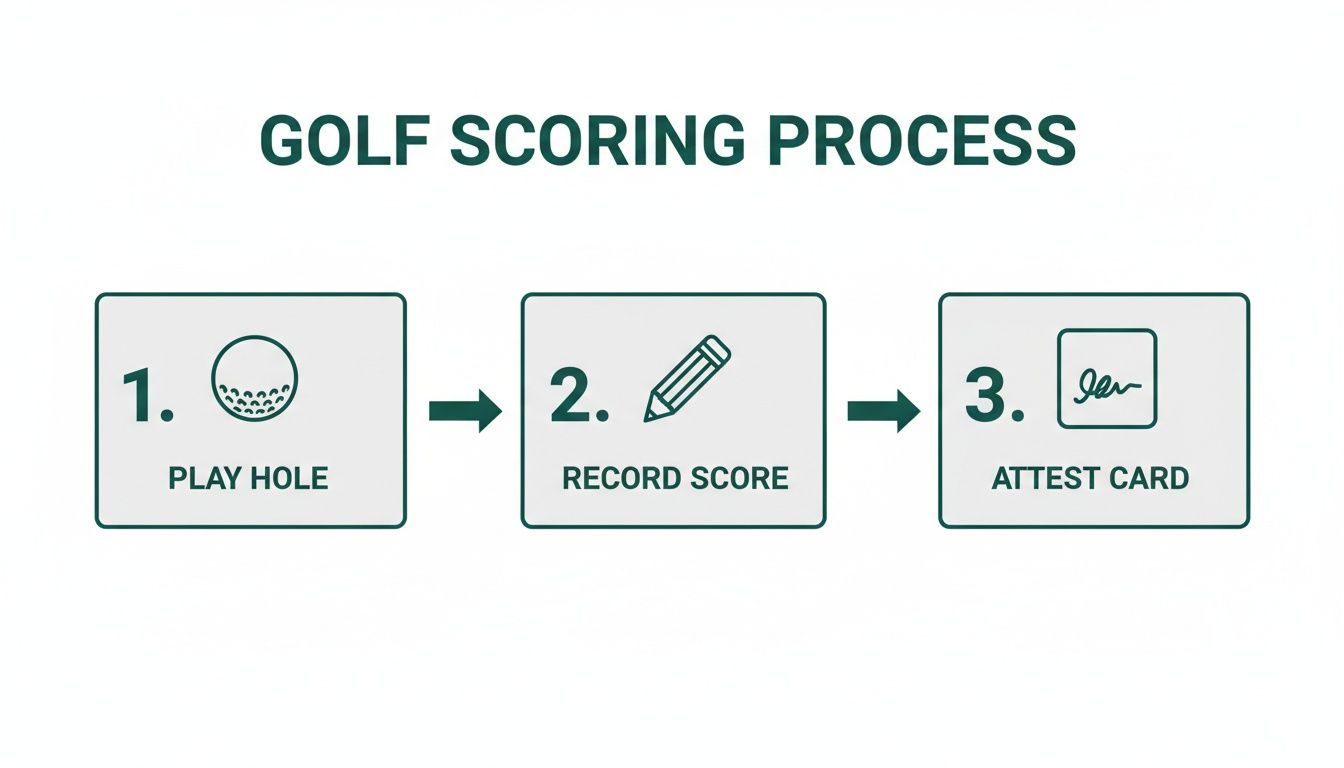
Getting the scorecard right is non-negotiable in stroke play. For a deeper dive into that final step, check out our guide on the best golf scorecard practices.
A player's net score is their gross score minus their Playing Handicap. That's the number that truly matters. In a handicapped event, it’s what determines the winner.
And don't think the Stroke Index is just some random numbering. The USGA uses massive score databases and a triad method to cluster holes and spread the toughest ones evenly across the front and back nines, ensuring a fair challenge for everyone.
For tournament organizers, managing all these calculations by hand can be a massive headache. It’s exactly why platforms like Live Tourney are so valuable—they automate the entire process, calculating every player's net score instantly and accurately so you can focus on running a great event.
Winning Strategies Every Player Should Know
Winning a stroke play tournament isn't just about how many great shots you hit. It’s about how many terrible ones you avoid.
In match play, one catastrophic hole means you just lose that hole and move on. But in stroke play, a single "blow-up" hole can completely torpedo your chances. The whole mindset has to shift toward consistency, patience, and just playing smarter golf.
Every decision you make on the course needs to be weighed against the potential for disaster. Sure, that heroic shot over the water to a tucked pin looks great on TV, but a simple layup to the fat part of the green is what actually saves strokes over 72 holes. The real goal is to get those big numbers—the double and triple bogeys—off your scorecard for good. A round full of pars with a few birdies sprinkled in will almost always beat a rollercoaster of eagles and "others."
This takes a tough mental game. You have to learn to treat every shot as its own little event, completely forgetting the last one—good or bad—and focusing only on what's right in front of you.
The Power of Conservative Play
Playing conservatively doesn't mean you're playing scared. It means you're playing smart. It’s all about knowing your own game, recognizing your limits, and picking the highest-percentage shot for the situation.
Here are a few practical ways to do it:
Aim for the Middle of the Green: Just ignore the sucker pins. Forget about the flag tucked behind a bunker or just over the water. Hitting the center of the green every time guarantees you'll have a putt for birdie or a simple two-putt for par.
Use Less Club Off the Tee: If the fairway is tight or there’s trouble lurking, hitting a 3-wood or a hybrid is often the better play. Keeping the ball on the short grass is far more important than an extra 20 yards in the rough.
Play for a Safe Miss: When you do need to be a bit more aggressive, you have to know where you can afford to miss. Always aim for a spot where a slight miss still leaves you with a manageable next shot.
The heart of stroke play strategy is damage control. You're going to hit bad shots—everyone does. The trick is making sure those mistakes only cost you one stroke at a time, not three or four.
Learning from the Best with Modern Analytics
You don't have to take my word for it. Modern golf analytics prove that minimizing big mistakes is the key to winning.
The Strokes Gained (SG) statistic is a perfect example. It measures a player's performance against the rest of the field, showing exactly where they gain or lose shots. The data is crystal clear: the best players in the world win not because they make a ton more birdies, but because they make far fewer costly errors.
Nobody did this better than Tiger Woods, who absolutely dominates the all-time SG: Total rankings. His insane 2006 season, where he gained an average of 3.443 strokes on the field per round, was a masterclass in avoiding bogeys and playing efficient golf. You can discover more about how Strokes Gained breaks down player performance to see just how powerful this approach is.
By understanding these principles, you can help your players build a smarter, more effective strategy for their next stroke play event.
How to Run a Flawless Stroke Play Tournament
Pulling off a great stroke play tournament is a lot like conducting an orchestra—every moving part has to be in sync. The goal is to create an experience so smooth that players can forget about the logistics and just focus on their game.
That process starts way before the first ball is in the air. You need a solid game plan for handling registrations, collecting entry fees, and getting a final player roster put together. Get this foundation right, and everything else falls into place much more easily.
From there, it’s all about the on-course details. You have to create the pairings and assign tee times, which can feel like solving a complex puzzle with a big field of players. The trick is to group everyone logically while keeping a good pace of play for the entire course.
Setting the Stage for Competition
With the logistics handled, you need to clearly spell out the rules of competition. This is especially important for handling ties, which happen all the time in stroke play. The go-to method is a scorecard playoff, where you compare scores on the back nine.
If players are still tied, you can break it down further by comparing scores on the last six holes, then the last three, and finally, hole-by-hole from the 18th backward. Making these tie-breaker rules crystal clear from the start saves a ton of confusion later on.
A well-run event feels effortless to the players, but that’s only because of the meticulous planning happening behind the scenes. Your ability to nail the details is what separates a good tournament from a great one.
Trying to manage all this manually—the rosters, pairings, tee times, and handicap calculations—is a recipe for headaches. It's not just time-consuming; it's also incredibly easy to make a simple mistake that throws things off.
Thankfully, modern tools have completely changed the game for tournament organizers.
The right software can automate all those tedious jobs, turning hours of work into a few clicks. Platforms like Live Tourney are built to handle everything from registration to the final results. To see what's out there, check out our guide on finding the right golf tournament management software.
Bringing the Event to Life with Technology
If there's one thing you can do to elevate the player experience, it's adding live, real-time leaderboards. Instead of waiting until the last putt drops to find out where they stand, players can follow the action right from their phones.
This single feature builds a ton of excitement and makes any club event feel like a professional tour stop. It transforms a simple round of golf into a dynamic, competitive experience that keeps everyone locked in.
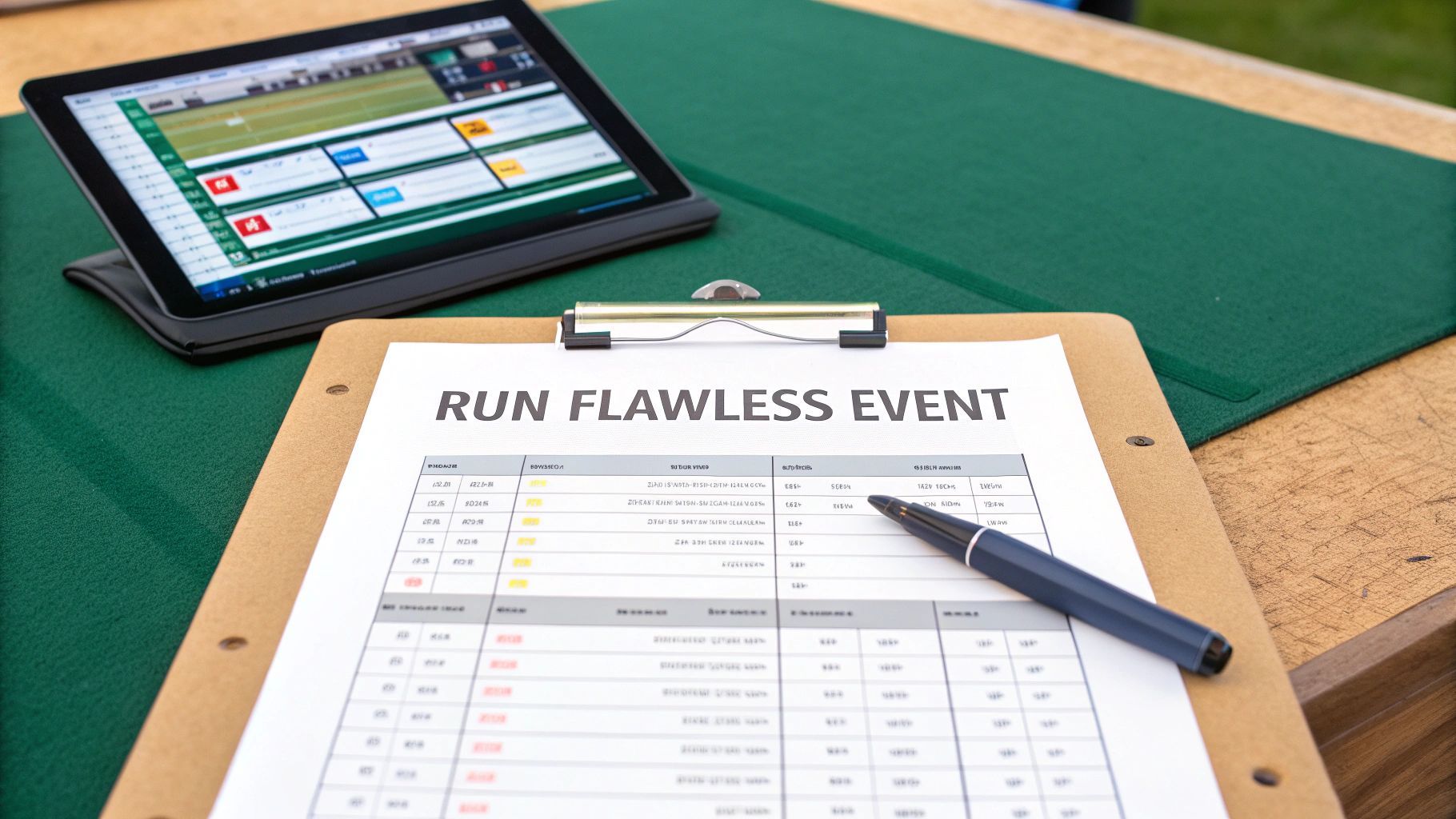
The best part is how simple it can be for the players. They get instant access to scores and leaderboards without having to download an app. You just share a link, and they’re in. It’s a professional touch that boosts engagement and makes everyone feel more connected to the event.
With a system like this, you can get a flawless stroke play golf event up and running in minutes, not days.
Diving Into Popular Stroke Play Variations
While classic stroke play is the ultimate measure of a golfer's skill, its "every shot counts" pressure isn't always the right vibe for every event. To make things more fun and get more people involved, organizers often turn to different versions of stroke play that keep the core idea alive but add a fun twist.
These formats are perfect for charity outings, corporate events, or member-guest tournaments where having a good time is just as important as posting a low score. They shake things up and make the game more approachable for players of all stripes.
Formats That Are All About Teamwork
One of the most popular variations you'll see is the Scramble. In a Scramble, everyone on the team tees off, the team picks the best shot, and then everyone plays their next shot from that spot. You repeat this all the way to the hole, ending up with one team score. It’s a brilliant format for casual events because it takes the pressure off any one player.
Another go-to is Best Ball, sometimes called Fourball. In a two-person team, each golfer plays their own ball from tee to green. At the end of the hole, the team simply writes down the lower of the two scores. This setup rewards great shots without crushing a player who has a blow-up hole.
The real beauty of these stroke play formats is their flexibility. You can shape the competition to fit your event's goal, whether that’s a serious tournament, a team-building day, or just a fun round with friends.
Individual Formats with a Twist
If you want to stick with individual play but prevent a single bad hole from ruining a round, the Stableford system is a fantastic choice. Instead of just counting strokes, players earn points based on their score relative to par. For example, a birdie might be worth 3 points, a par 2 points, and a bogey 1 point. A double bogey or worse? You just get zero points for that hole and move on—no card-wrecking 8s or 9s.
Finally, there’s the Chapman format, a two-person game that mixes teamwork with individual shot-making. Both players hit a tee shot, then they walk over and hit each other's ball for the second shot. After that, they choose the better of the two shots and play alternate shots from there until the ball is in the cup. It’s a fun, strategic format that really depends on good communication.
To give you a clearer picture, here’s a quick breakdown of these common formats and where they shine.
Common Stroke Play Variations Explained
This table summarizes some of the most popular stroke play formats, how they're scored, and what kind of event they're best suited for.
Format Name | Scoring System | Best For |
|---|---|---|
Scramble | Team selects the best shot, and all players play from that spot. One team score per hole. | Charity events, corporate outings, mixed-skill groups. |
Best Ball (Fourball) | Each player plays their own ball. The lower score of the two partners is the team score. | Member-guest tournaments, team competitions, leagues. |
Stableford | Players earn points based on their score relative to par (e.g., Birdie = 3 pts, Par = 2 pts). | Individual events where you want to reduce the penalty of a "blow-up" hole. |
Chapman (Pinehurst) | Partners both tee off, switch balls for the second shot, then select the best ball and play alternate shot from there. | Partner events, club championships, strategic team play. |
These variations offer something for everyone, making it easy to create an event that’s both competitive and enjoyable.
And the best part? Modern tournament software from platforms like Live Tourney handles all the scoring calculations for these formats automatically. This lets you focus less on the logistics and more on creating a great day on the course for your players.
Common Questions About Stroke Play
Even golfers who have been playing for years can get tripped up by the specific rules of stroke play. Let's clear up a few of the most common questions that pop up during tournaments.
What Happens if There’s a Tie?
Ties happen all the time in stroke play, so it's smart to have a plan baked into your event rules from the start. The most common method is a scorecard playoff.
Here’s how it usually works: you break the tie by comparing scores on the back nine. If the players are still tied, you can narrow it down to the last six holes, then the last three, and finally, the very last hole. While the pros get the excitement of a sudden-death playoff on the course, a scorecard playoff is just more practical for most events. The good news is that modern tournament software can handle all of this for you automatically based on the rules you set.
Can I Just Pick Up My Ball on a Bad Hole?
In a traditional stroke play event, that’s a hard no. You absolutely must hole out—meaning your ball has to end up in the cup on every single hole. If you pick it up before you're finished, you’ll unfortunately be disqualified from the competition. This rule really gets to the heart of the format: you have to face every single challenge the course throws at you.
That said, some variations are a bit more forgiving. Formats like Stableford, or any event using a "Maximum Score" rule (like net double bogey), are designed to keep the game moving. In those cases, once you hit the max score for that hole, you can—and should—pick up your ball. Just be sure to confirm the specific rules before you tee off.
Gross score is your total, raw number of strokes. Net score is what’s left after you subtract your handicap. In any handicapped tournament, the net score is what really matters—it’s the great equalizer that makes the competition fair for everyone.
Ready to run a flawless stroke play golf event with less work? Live Tourney provides an intuitive, app-free platform with real-time scoring and leaderboards that players love. See how easy it is to manage your next tournament at https://livetourney.com.





