
Jun 1, 2026
stpga prestige tour, junior golf, golf tournaments, tournament software, live tourney
Your complete guide to the STPGA Prestige Tour. Learn what it is, how to qualify, and how organizers can run similar elite junior events with modern tools.

A lot of junior golfers hit the same point at roughly the same time. They've played enough local events to know they can compete. Their parents can see the progress. The scores are getting steadier, the expectations are higher, and the question changes from “Where can we play next weekend?” to “Where do serious players in South Texas test themselves?”
That's usually when the STPGA Prestige Tour enters the conversation.
It matters because some junior schedules are built for participation, while others are built for development under pressure. Those are not the same thing. A player who wants to see where their game really stands needs stronger fields, longer formats, tighter administration, and a setting where every decision carries weight for more than a single afternoon.
Families also start paying attention to details that seemed small before. Practice rounds. pace expectations. multi-day stamina. Equipment prep. Even something as basic as packing well becomes part of performance, which is why resources like junior tour essentials can be useful once a player starts moving into more demanding event schedules.
For organizers, there's another lesson in the STPGA Prestige Tour. Well-run junior golf doesn't happen by accident. It takes structure, communication, and systems that make the event feel bigger than a simple tee sheet and score posting. If you've followed other regional models such as Sun Country junior golf pathways, you've probably seen the same pattern. The tours players remember are the ones that feel organized from registration through the final leaderboard.
Your Guide to Elite Junior Golf in South Texas
A parent asks the question in the parking lot after another solid local finish. “What's the next step if my kid needs tougher competition?”
That's the right question, because junior golf progress usually stalls when the schedule stays too comfortable. Good players need events that ask for more than one hot round. They need a setting where preparation, patience, and consistency show up over multiple days.
In South Texas, the STPGA Prestige Tour is the circuit most families point to when a player is ready for that kind of test. It carries the feel of a higher standard before the first tee shot is hit. The players know it. Parents know it. Coaches know it.
Why players and parents pay attention
Local one-day events can teach plenty. They teach routine, etiquette, and basic tournament habits. But they don't always expose the weak spots that show up when a player has to sleep on a score, come back the next day, and do it again.
That's where a stronger junior circuit separates itself:
Longer competitive exposure: Players have to manage nerves for more than one round.
Real season context: Results don't disappear after one weekend. They feed into a broader race.
Stronger peer benchmark: You learn quickly whether your current game travels.
A junior golfer usually improves fastest when the tournament asks for discipline on the bad holes, not just birdies on the easy ones.
Why organizers should study it too
Tournament directors can learn a lot from tours like this. The standard isn't just about field quality. It's about how the event feels to everyone involved. Registration is clear. Expectations are defined. Scoring and standings matter. Communication has a professional tone.
That combination is what players read as legitimacy. If you run junior events at a club, association, or public facility, studying the STPGA Prestige Tour gives you a practical model for how elite junior golf is presented and managed.
What Is the STPGA Prestige Tour
A junior tour starts to feel different when a player arrives knowing every shot will be measured against a stronger field, a longer format, and a season that means something. That is the role of the STPGA Srixon Prestige Tour, which the Southern Texas PGA describes on its official Prestige Tour overview as its top junior circuit.
For players, that means fewer soft landings. For parents and coaches, it usually marks the point where tournament golf shifts from participation to performance.
The tour is built for ages 11 to 18, and it runs on a season-long points race with separate Boys and Girls standings. That structure matters because it changes how results are viewed. One solid weekend helps. Repeated good finishes against quality fields carry real weight.
Why the tour carries weight
Prestige-level junior golf is not only about who enters. It is about how the competition is framed.
The STPGA built this tour to give stronger juniors a clearer proving ground, and its growth over time shows that families, coaches, and players responded to that need. A circuit does not earn respect just by adding dates. It earns respect by producing an environment where scores, standings, and finishes mean something from month to month.
That is why coaches pay attention to this level. A player who performs well here is usually showing more than a polished swing. They are showing course management, patience, and the ability to recover after a poor stretch without letting the tournament get away.
STPGA Prestige Tour at a Glance
Feature | Details |
|---|---|
Circuit status | Southern Texas PGA's most elite and competitive junior golf circuit |
Age range | Designed for players ages 11 to 18 |
Season structure | Year-round points challenge |
Standings | Points count toward Boys and Girls standings |
Typical format | Multi-day tournaments |
Daily play | 18 holes per day |
Competitive role | Pathway for higher-level competition, exemption opportunities, and rankings exposure |
What that means in practice
Multi-day junior events expose habits that one-day tournaments can hide. A player has to warm up again after a good round. They have to post a number after a bad start. They have to handle pace, weather, travel, food, rest, and expectations. That is much closer to the standard serious junior golfers eventually face at the next level.
From an organizer's side, that is the lesson worth studying. The professional feel comes from structure. Clear divisions. Published standings. Defined eligibility. Event information that answers questions before families have to ask them. Strong tours make those details look routine, but they take work to get right.
That gap between watching a polished junior tour and building one at your own club is smaller than many directors think. If you want your event to carry the same kind of credibility, Live Tourney helps you run registration, pairings, scoring, leaderboards, and communication with the consistency players and parents expect.
Practical rule: A prestige-level event feels professional because the operations are disciplined before the first group tees off.
Understanding the Tour Structure and Rules
Elite junior golf feels different because the structure forces players to manage more variables. A one-day event asks for readiness. A multi-day event asks for readiness, recovery, focus, and restraint.
The STPGA Prestige Tour is built around that second kind of test. Players aren't only trying to shoot one good score. They're working through a tournament environment that rewards consistency over a longer stretch and puts value on how they handle the routine between rounds as much as the swings during them.
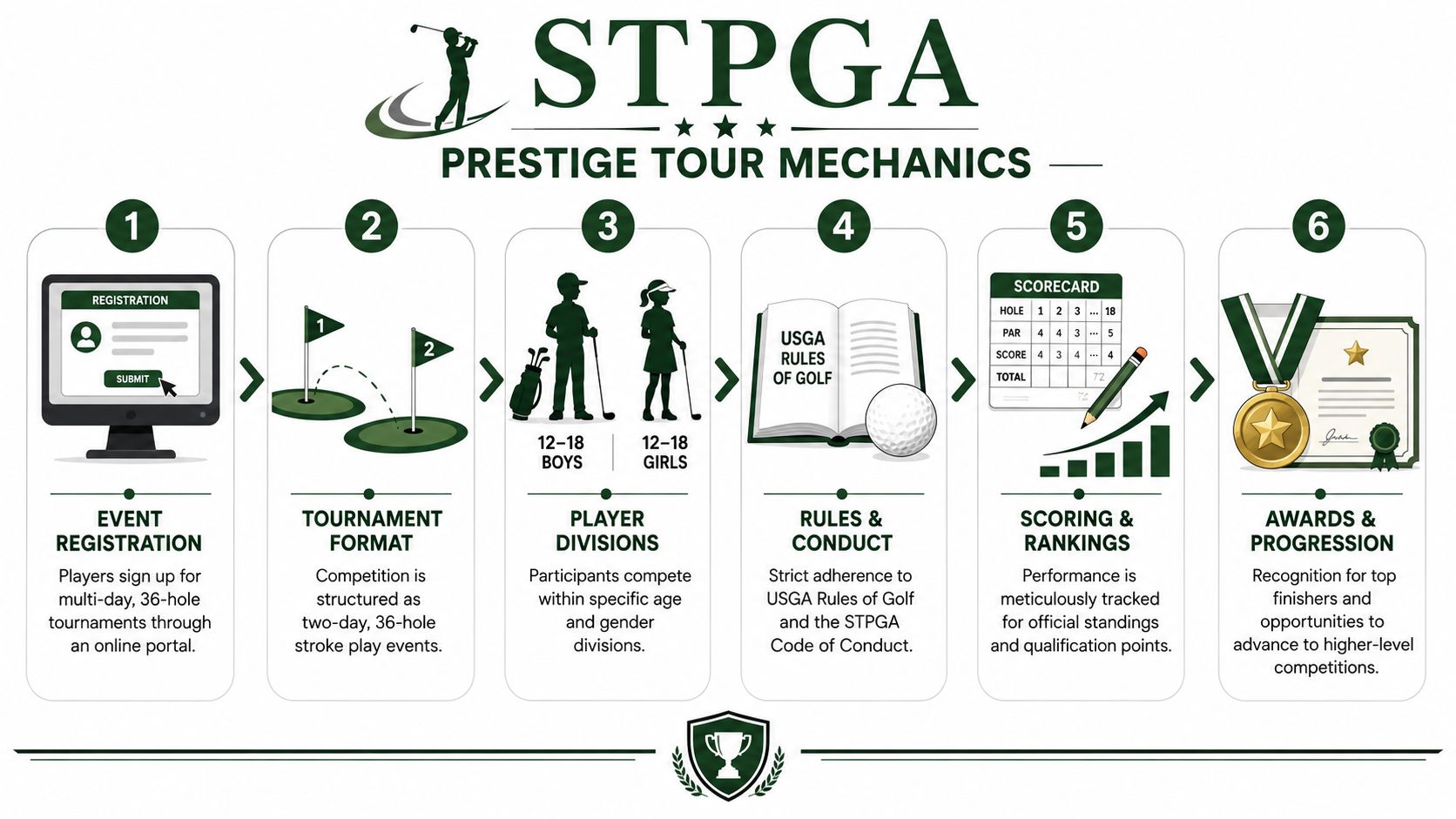
What players actually face
Once a junior starts competing at this level, the event week changes shape. There's more planning before the tournament and less margin for sloppy habits once play begins.
A typical player experience usually includes:
Registration and acceptance
Families need to watch deadlines, eligibility notes, and event logistics closely. Missing a detail can mean missing the start entirely.Multi-round competition
The challenge isn't only the opening round. It's responding to that opening round. Good start, bad start, average start. All three require a plan for the next day.Division-based competition
Players compete against peers in appropriate age and gender groupings, which keeps the competitive environment focused and relevant.
Why the rules matter more than most families expect
Higher-level junior tours separate themselves through administration as much as through field strength. When the conduct standard is firm, the event feels legitimate. That includes pace, scorekeeping, player behavior, and adherence to the Rules of Golf.
Most experienced junior golf families eventually learn the same lesson. The player who treats every tournament as a casual round with stakes will struggle once the environment turns more formal. Players who know how to play by procedure usually settle faster.
Good junior tournaments don't just identify talent. They identify who can stay organized, calm, and accountable when the pressure rises.
The points race changes how decisions are made
A season-long points structure creates a different mindset than an isolated weekend event. Every start feeds a larger standing, so players begin to think beyond one round or one finish. They learn when to stay patient, when to avoid the big number, and when a steady result is better than a reckless one.
That's useful development. Young players need to understand that tournament golf isn't always about chasing a perfect round. Often it's about preserving position, limiting damage, and giving yourself a chance over the full season.
Here are the trade-offs that show up most often:
Aggression helps when a player is swinging freely. It hurts when they're forcing a comeback on every hole.
Preparation pays off in long formats. Players who guess their way through yardages and routines usually fade.
Emotional control becomes visible. Frustration after one poor stretch can ruin the rest of the event.
What makes the environment feel professional
The difference between a standard junior event and a polished one often comes down to details:
Tournament element | Basic event feel | Prestige-level feel |
|---|---|---|
Player communication | Minimal updates | Clear instructions before and during event |
Scoring process | Delayed or informal | Tight, visible, and accountable |
Rules enforcement | Inconsistent | Firm and predictable |
Season context | One-off result | Part of a larger standings race |
That last point matters more than people think. When players know the event fits into a broader competitive ladder, they prepare more seriously.
How to Qualify and Register for Events
The most common mistake families make is assuming that stronger junior events work like a local open. They usually don't. A prestige-level circuit asks players and parents to pay attention to membership details, eligibility requirements, tournament notices, deadlines, and event-specific instructions.
That's not bureaucracy for its own sake. It's part of how a serious junior tour protects its standard.
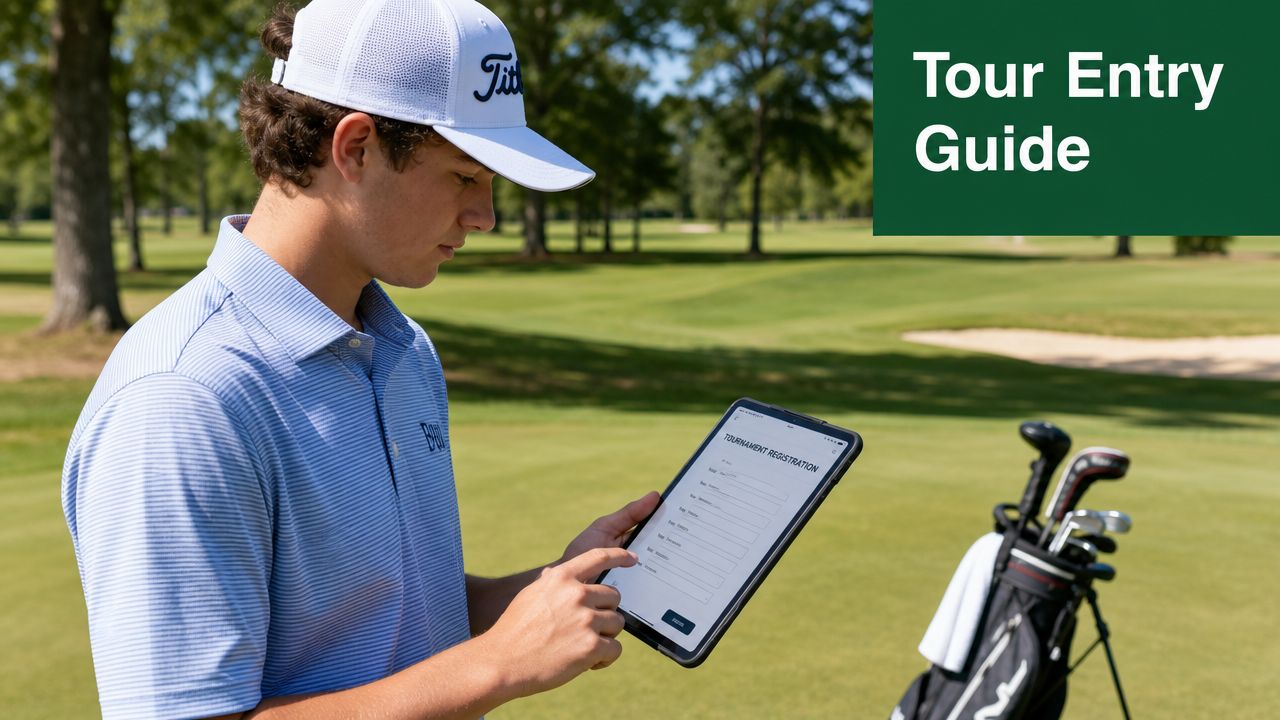
Start with the official event information
Families should always begin with the official Southern Texas PGA junior golf resources for current eligibility and event procedures. Tour requirements can change by season, and no player should rely on secondhand explanations from a friend, coach, or another parent.
A practical approach is to treat registration like a checklist, not a casual sign-up.
Confirm player eligibility: Make sure the player fits the age range and any event-specific requirements.
Review the annual schedule: Build a realistic calendar around school, travel, and recovery.
Track competitive priorities: Don't enter events just because they're available. Enter the events that fit the player's current level and goals.
If you're comparing how other national junior schedules are organized, the Junior PGA tournament schedule guide is a useful reference point for how families can think about season planning rather than one-off entries.
What a smooth registration process looks like
Good tournament registration usually has four parts. Families who handle each part early tend to avoid the last-minute problems that create unnecessary stress.
First, collect the basics before the portal opens. Player information, parent contact information, and any required membership or profile details should already be organized.
Second, read the event notice fully. A lot of avoidable mistakes happen because families skim. They miss withdrawal policies, practice round guidance, arrival notes, or competition expectations.
Third, register early when the event permits it. Waiting rarely helps. Strong fields don't get easier because a family delayed the decision.
Fourth, keep every confirmation email and event communication in one place. Tournament week gets busy. The family that can quickly find tee time details, course notes, and weather communication is always in a better position.
What players should do after they get in
Entry isn't the finish line. It's the start of preparation.
A serious event week usually calls for:
Course prep: Study the setup, likely trouble spots, and the kind of shots the course demands.
Routine planning: Decide how the player will warm up, eat, recover, and reset between rounds.
Expectation control: The goal is to compete well, not to force a result.
The best junior tournament prep usually looks boring from the outside. Bags are packed early, timing is settled, and nothing important is left for tournament morning.
Families should also use official event resources for schedule updates, tee times, results, and standings. When a tour is run well, those touchpoints become part of the competitive experience. Players can follow the event without chasing information from text chains or the practice green.
How to Run Your Own Prestige-Level Junior Event
A lot of clubs want to host better junior events, but they try to upgrade the experience in the wrong order. They focus on branding first, trophies second, and operations last. Players notice the opposite. They care most about whether the event runs cleanly, starts on time, communicates clearly, and delivers a leaderboard they can trust.
That's a key lesson in a tour like the STPGA Prestige Tour. Prestige isn't decoration. It's operational discipline.
Build the event from the player's point of view
Tournament directors sometimes design an event around staff convenience, then wonder why it feels flat. Junior players and parents judge the event from first contact to final result. If the sign-up process is clunky or communication is vague, confidence drops before anyone reaches the first tee.
Start with the obvious friction points:
Registration page quality: If the page looks unfinished or confusing, families assume the event may be the same.
Confirmation flow: Players should know they're in, what they owe, and what happens next.
Pre-event communication: Send one clear message with timing, expectations, and contact details.
For organizers looking at format design and participant experience more broadly, custom golf event planning ideas can help frame how to make an event feel intentional rather than assembled at the last minute.
What works and what doesn't
Some operational choices consistently raise the standard. Others create stress for everyone involved.
What works
Simple online entry that families can complete without calling the golf shop for help
Clear refund and withdrawal policies so staff aren't improvising rulings
Defined competition terms including format, divisions, scoring method, and conduct expectations
Visible leaderboards that keep players, parents, and coaches informed throughout the event
What doesn't
Manual paperwork chains that require repeated data entry
Late-night pairing edits because roster information wasn't organized from the start
Unclear scoring responsibilities that leave players uncertain about who records what
Results bottlenecks where everyone waits on one person in the shop to post standings
Use live scoring without making players fight the technology
Many otherwise good events break down at this point. Organizers want a modern tournament feel, but they choose tools that add friction. If players have to download an app, create an account, verify another account, and learn a complicated interface, participation drops.
The smoother model is web-based live scoring that works through a simple link on any device. That's closer to how players already use their phones, and it lowers resistance for parents, volunteers, and staff too. When scoring is easy to access, the leaderboard becomes part of the event's energy instead of an afterthought.
Players don't remember the software category. They remember whether scoring felt fast, clear, and easy to trust.
A strong junior event should make live information visible without turning the player into a tech support case. That means score entry should be intuitive, leaderboards should update in real time, and staff should be able to correct issues without rebuilding the event.
Back-office quality is what makes the front-end shine
The tournament may look smooth to families, but staff know the significant work sits underneath. Pairings, scorecards, tee sheets, cart signs, player communications, and final reports have to come together without chaos.
That's why the best event systems matter. A strong platform should help a tournament director do these jobs quickly:
Operational need | Why it matters |
|---|---|
Roster management | Prevents manual errors and last-minute confusion |
Tee sheet creation | Keeps pace and starting logistics under control |
Scorecard reporting | Produces clean, event-ready materials |
Email communication | Keeps players and parents aligned before and during play |
Results publishing | Gives the event a polished finish |
When clubs skip this foundation, staff absorb the pain manually. They patch things together with spreadsheets, texts, and pro shop printouts. That approach can survive a small field. It usually struggles once the event starts to resemble a true competitive junior tournament.
The standard is reachable
Organizers sometimes assume a prestige-level feel requires a giant staff or a complicated technology stack. It doesn't. What it does require is a commitment to clean workflows, firm expectations, and tools that remove unnecessary labor instead of adding to it.
If you can create a smooth registration path, manage pairings cleanly, communicate clearly, and deliver easy live scoring with accurate final reporting, your event already feels more professional than most junior tournaments players see. That alone can change how families talk about your program.
Elevating the Next Generation of Golf Talent
A strong junior tour changes the standard players expect. After a season on the STPGA Prestige Tour, juniors and families start to recognize the difference between a tournament that feels organized and one that leaves them guessing. They notice pace, communication, scoring, and how the day runs from check-in to final results.
That matters because junior golf development is not only about swing mechanics or scoring averages. Good competition teaches routines, resilience, and accountability. Players learn how to prepare for an early tee time, reset after a poor hole, and carry themselves in a field where every detail counts.
Organizers should pay attention to that lesson.
The biggest takeaway from a tour like this is simple. Professional feel comes from repeatable habits behind the scenes. Clear notices. Accurate pairings. Reliable scoring. Results posted without confusion. Parents trust events that run cleanly, and coaches pay attention to tournaments that produce fair, dependable outcomes.
There is also a practical side to confidence that starts before the first shot. Families are managing travel, weather, warm-up plans, and basics like dressing for golf with confidence, because juniors play better when they arrive prepared instead of distracted.
The good news for clubs and tournament directors is that this standard is not reserved for a major association. It can be built. If you want to give your players the same polished experience they see on respected junior tours, your operation needs tools that support registration, scoring, communication, and reporting without adding more work for staff.
Live Tourney helps organizers run junior events, member tournaments, and multi-round competitions with polished registration, app-free live scoring, real-time leaderboards, and clean back-office reporting. For directors trying to create a prestige-level experience without building everything by hand, it is a practical way to run a better event.





