Aug 5, 2026
southeast junior golf tour, junior golf tour, golf tournaments, junior golf, live tourney
Learn about the Southeast Junior Golf Tour schedule, divisions, eligibility, and how to host an event with Live Tourney.

The Southeast Junior Golf Tour was founded in 1994 in Atlanta, Georgia with 60 members. By its projected 31st season in 2025, it was expecting about 35 to 40 events and membership above 1,000 junior golfers.
That arc matters because it tells you what this tour really is, not just for players and parents, but for the courses that host it. A junior golfer gets a structured place to compete, and a facility gets a repeatable event format that can be plugged into a season instead of treated like a one-off outing.
What Is the Southeast Junior Golf Tour
A parent watching a child step onto a first tournament tee, or a golf course operator deciding whether a junior event is worth the calendar space, usually wants the same answer. The Southeast Junior Golf Tour, better known as SJGT, is a regional junior golf circuit built for organized competition across the Southeast. It began in Atlanta in 1994 with 60 members, and the tour says it is entering a projected 31st season with about 35 to 40 events and membership expected to top 1,000 junior golfers (SJGT about us).
What makes it different
SJGT runs as a competitive platform with a clear structure. The tour says its mission is to give junior golfers chances to compete in organized tournaments on quality golf courses under the USGA Rules of Golf, while building skill and knowledge of the game (SJGT information).
That matters on both sides of the tee sheet. Players learn how real competition works, from pace to penalties to finishing a round under pressure. Course operators get an event model that is already standardized, so there is less guesswork when the field arrives and the day has to run on time.
What readers usually need to know first
The practical questions are usually the same.
Practical rule: If a junior tour cannot explain its rules, divisions, and reporting clearly, it will create headaches for families and host clubs alike.
This article stays focused on the parts that matter in the field, including the schedule, divisions, registration, rankings, and what hosting looks like from a course operator's point of view. If you are trying to decide whether SJGT fits a player pathway or a facility calendar, start with this: it works as a real tournament ecosystem for junior golfers, parents, and the courses that host them.
History and Mission of the Southeast Junior Golf Tour
A junior tour that lasts is usually built on repeat business from families, steady relationships with host clubs, and a format that tournament staff can run without chaos. SJGT fits that pattern. It began in 1994 in Atlanta, then expanded outward as more clubs and players bought into the same basic structure. Growth like that does not come from hype. It comes from showing up with a clear schedule, consistent rulings, and a field that knows what to expect from one site to the next.
Built around tournament discipline
The tour's mission is straightforward, give junior golfers organized competition on quality golf courses under the USGA Rules of Golf (SJGT information). That matters because a player is learning more than how to swing well. They are learning how to handle rulings, scoring, pace, and conduct while the round is live.
That separation is what makes a circuit useful. A social junior outing can be friendly and still leave too much to chance. A structured tour gives players a real competitive setting, where tee times, divisions, and scoring procedures all carry weight. For a junior trying to get better, that pressure is part of the lesson. For a parent, it is part of the value. For a course operator, it means the event is built around a known operating model instead of a different setup every weekend.
Why centralized administration matters
SJGT operates like a centralized tournament program, and that is the right way to do it if the goal is consistency across many venues. The same office-driven structure has to support different host courses, different fields, and different divisions without forcing each event director to reinvent the wheel. That is the difference between a tour that scales and one that frays at the edges.
When a circuit reaches that point, administrative discipline matters as much as the golf itself. A host club needs clear instructions on tee sheet flow, scoring, and how the day will be managed. Families need to know the process will look familiar from one stop to the next. If you want a practical example of how a tour calendar is organized and why that matters to players and parents, this junior tournament schedule guide gives a useful comparison.
A junior tour only works at scale when the rules stay consistent from site to site.
That consistency helps both sides of the operation. Parents spend less time decoding new procedures, and tournament directors can focus on the actual field instead of patching together different systems every week. The bigger the circuit gets, the more it depends on structure that holds up under pressure.
Tournament Schedule and Divisions
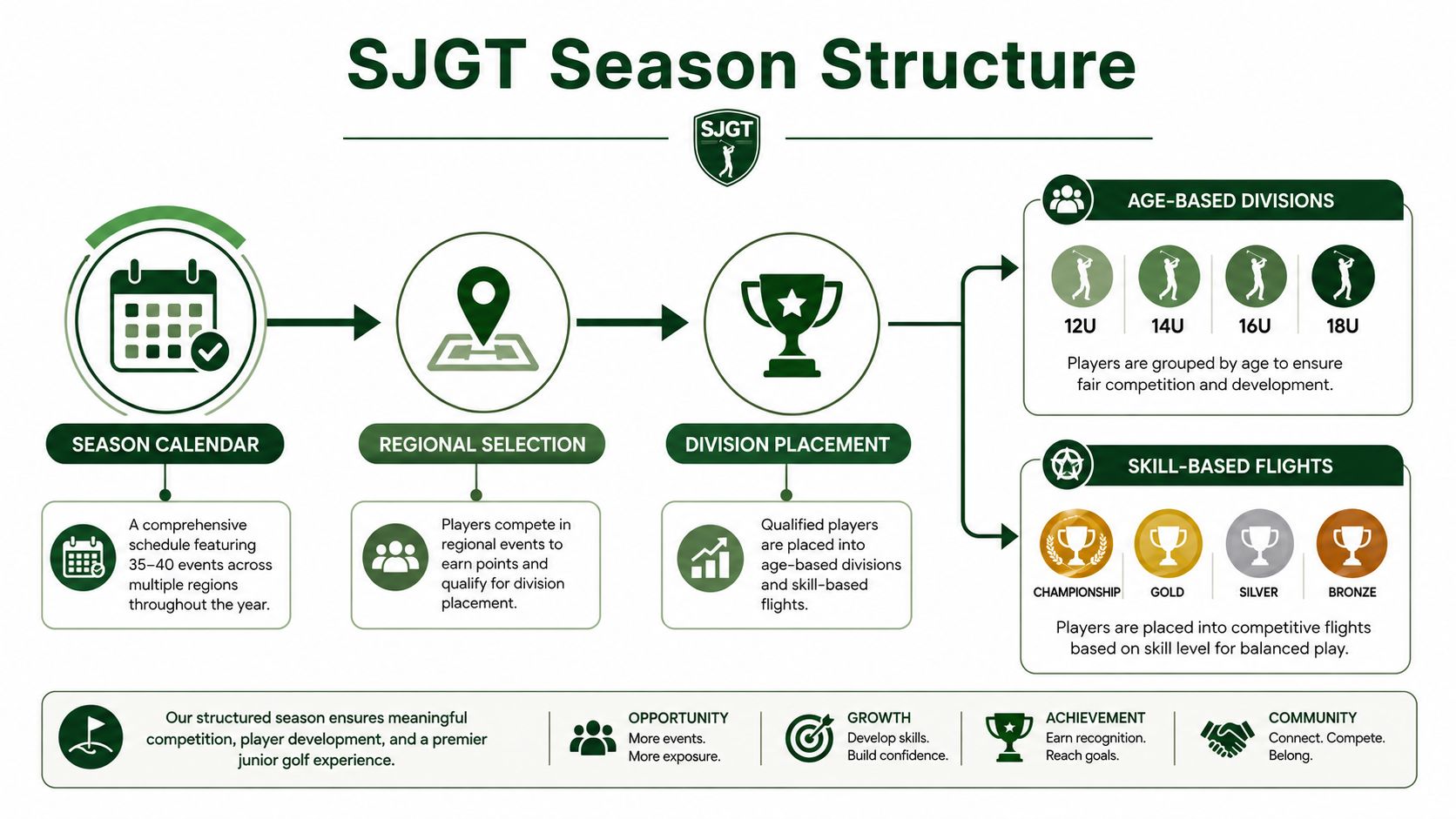
A season only works when the calendar gives players enough starts to build form and gives host clubs enough spacing to run events without constant turnover. SJGT's schedule runs across a broad set of tournaments, which is why division management has to be tight from the start. A field with multiple ages and tee sets cannot be handled like a single-bracket local event.
How the format works on the ground
SJGT tournaments run several divisions at once, and that structure is what makes the tour usable for a wide age range without forcing every player into the same competitive bucket. The Sea Palms event showed that clearly, with winning scores ranging from 68 to 72 (-4) in Boys 16 to 19, 70 to 76 (+2) in Girls 15 to 19, and 68 to 71 (-5) in Boys 14 to 15 (Sea Palms results coverage). Those groups are different for a reason. A 14-year-old and an older junior can play the same venue on the same day without being shoved into the same scoring race.
The operating flow is simple once it is set:
The season calendar is set.
Events are selected for the region.
Players are placed into divisions.
Tee sheets and results are handled by division, not as one flat field.
Why shot-tracking changes the conversation
The Sea Palms coverage also showed how tournament data can sit beside normal scoring without replacing it. One champion's shot-tracking numbers included a 172 mph driver ball speed and a 71% fairways-hit rate (Sea Palms results coverage). That kind of information gives coaches and parents more context, because a finish alone rarely explains how a round was built.
For players, the value is practical. A good round becomes more than a number on a board, and a rough round can be broken down into specific pieces that can be worked on later. For host courses, it shows the event is being run with enough structure to support both scoring and performance data. If you want a useful comparison point for how other junior calendars are organized, this junior golf tournament schedule comparison is worth a look.
Eligibility and How to Register
The cleanest way to think about eligibility is this, if a player is old enough and ready to compete in a structured junior event, the next question is whether they fit the right division and the tour's entry process. SJGT runs through centralized channels, so families shouldn't expect to sign up at the course counter or treat each venue like an independent local event. That's the right model for a circuit with standardized administration.
Start with the division
Age group is the first filter, then skill level or division assignment comes next where applicable. That approach keeps fields competitive without making every player compete in the wrong bracket. It also helps parents avoid the common mistake of assuming that “junior golf” means one big grouping. It doesn't.
Registration should be handled through the tour's official process, and that's where families need to pay attention to deadlines, player information, and event confirmation. Missing a detail can mean missing a tee time, and in a structured circuit that's usually the kind of problem that doesn't solve itself.
What to have ready
Before a family enters, they should have the basics organized.
Player information: Name, age, and the details needed to place the golfer in the right division.
Event choice: Pick the tournament that fits the player's schedule and competitive level.
Confirmation habits: Read the event details carefully so the player knows when and where to arrive.
Tour process: Use the official registration path rather than trying to route around it through the host course.
Good registration is boring. If the entry is clean, the event day usually is too.
For parents who want to compare how another junior circuit communicates entry and participation, this junior-golf registration resource can be a useful reference point. The main thing to remember with SJGT is that its structure is designed to keep registration, division placement, and tee-sheet planning in one controlled system.
Rankings, Results, and How They Are Tracked
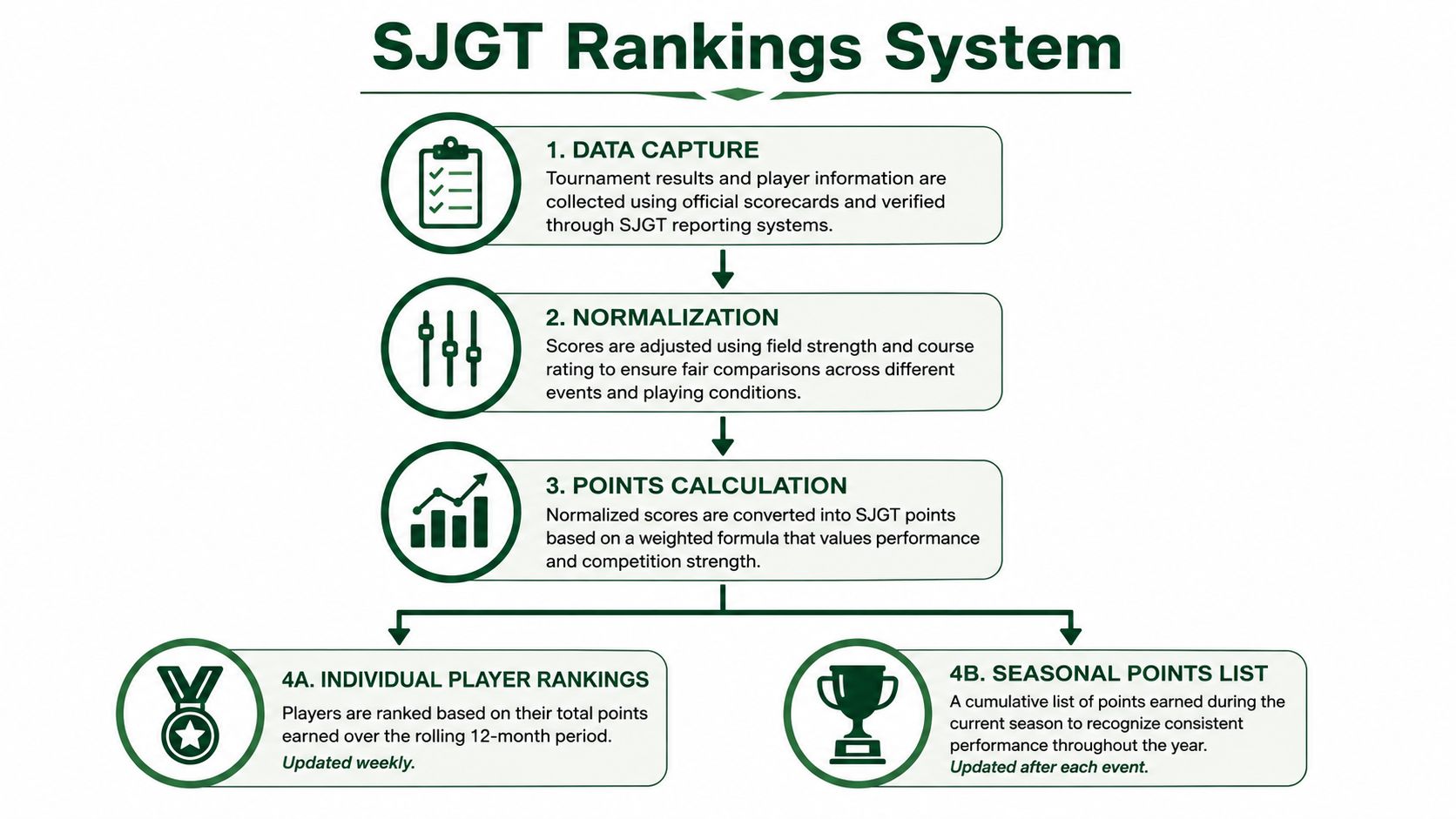
A junior tour rises or falls on the quality of its results data. If the scoring is messy, the rankings lose value fast. SJGT's tournament setup depends on multi-division events, regional scheduling, and centralized administration that keeps event formats and result capture consistent across venues. That is what lets a season behave like a season instead of a pile of disconnected tournaments.
Why normalized data matters
The tour has to record the same core details every time, course, division, and historical results. That standardization matters because junior fields change from site to site. One weekend the field might be split one way by age, the next weekend another way. Without clean metadata, someone ends up reconciling scoring by hand, and that is where errors slip in.
Parents do not always see that part, but it is what gives the rankings credibility. If event data is captured the same way every time, a player's result at one tournament can be compared fairly with the rest of the season. That supports rankings, qualification logic, and scheduling decisions without constant manual cleanup.
For course operators, the same discipline keeps the operation readable. A host facility needs to know which division played, what the setup was, and how the round was recorded, because those details affect results after the last putt drops.
What gets tracked
In a well-run junior circuit, the key inputs stay simple.
Data capture: Record the round correctly the first time.
Normalization: Match the result to the right course and division.
Points or ranking calculation: Apply the same rule set across events.
Season view: Keep the player's standing visible over time.
That structure helps host facilities as much as it helps families. When the course setup changes, the system still has to understand what happened, who played, and which division the result belongs to. Tournament software and event operations work best when they are built for structured event data, not one-off score posting.
Benefits for Players and Host Courses
A junior golfer gets two things from SJGT that matter on the course and at home, real competition and clear standards. The tour's mission ties play to USGA Rules of Golf and quality-course competition, so juniors build tournament habits. They learn to manage a round under real conditions, not just collect swings. For families, that matters because every event becomes a useful check on decisions, discipline, and how a player handles pressure.
What players get out of it
A strong junior tour teaches more than ball striking. It gives players a chance to compete in organized fields, see where they stand, and build a record that reflects actual tournament play. Juniors also see how modern events can layer in shot-tracking data alongside the leaderboard. As noted in the schedule section, that can include ball speed and fairways-hit rates, which gives families and coaches a clearer read on performance without turning the event into a practice session.
What courses get out of it
Host courses get something different, and in some ways more durable. A circuit with 1,000+ expected members and 35 to 40 events creates repeat demand instead of a single rental day (SJGT about us). That lets a facility treat junior golf as part of its calendar, not as a side project.
A course that hosts well also builds credibility. Parents notice whether the event runs on time. Juniors notice whether the tee sheet is organized. Staff notice whether the scoring and administration are clean. If all three are handled well, the course earns a reputation that can bring people back.
One practical difference is staffing. A junior event that looks simple from the parking lot can still create problems if score posting, pairings, and cart traffic are handled loosely. The courses that do this well usually rely on a structured event process, and hosting a tournament with a modern platform is one way to keep that work under control.
The best junior events feel professional to the family and manageable to the staff.
That is the business case. Good junior competition supports player development and gives the host facility a polished event it can repeat, market, and staff without rebuilding the operation each time.
How Courses Can Host or Partner with SJGT
A course that wants to host junior golf should start with one question, can the staff run a clean event without creating a long day of manual fixes. If the answer is yes, a structured tour partnership makes sense. If the answer is no, the facility needs better tooling before it invites players onto the property.
Hosting a tournament with a modern platform usually starts with calendar coordination, then field setup, then scoring flow. The old way made that feel heavier than it needed to be, because staff had to juggle pairings, score entry, and leaderboards across disconnected systems. A more current approach uses a web-based scoring and management layer that works on any device and doesn't require an app download.
What to look for operationally
The right setup should handle the basics without drama.
Fast event setup: Staff should be able to build the event in minutes, not spend the morning fighting the interface.
Multi-division scoring: The system has to support different age groups and fields cleanly.
Real-time leaderboards: Parents and players expect scores to update as the round unfolds.
Device flexibility: A web link is easier for juniors than making them install software.
Live Tourney is one option that fits that model because it provides web-based live scoring for golf tournaments, with setup, roster management, and real-time leaderboards designed for course operators and event staff. That matters in a junior tour setting because SJGT events depend on repeatable tee-sheet logic and standardized result capture across divisions.
Why modern tooling helps
Older systems often slow the staff down exactly when the field is trying to move. A cleaner platform reduces those friction points and makes it easier to run a professional event without a pile of training time. For a host course, that can be the difference between a junior tournament that feels smooth and one that drains the day.
A facility that wants to partner with SJGT should think less about “running a youth event” and more about running a structured competition well. That's the standard the tour already expects.
Frequently Asked Questions
Families usually want to know whether SJGT is hard to enter, and the answer is no if they follow the official process and choose the right division. The bigger issue is preparation, because junior golf tournaments reward players who know where they're going, when they're teeing off, and how the format works before they arrive.
Do players have to travel to every event? No. Junior tours are built for choice, and families typically select the events that fit their schedule and development goals. Missing one tournament doesn't erase the season, but consistency always helps a player build rhythm.
Are caddies or adult volunteers required? That depends on the event setup, but parents should expect to follow the tour's posted rules rather than making assumptions. In a structured circuit, the tournament office sets those standards, not the host club's normal weekend routine.
Where do you find the official schedule and registration portal? The best place is always the tour's own website, because that's where the current calendar, event details, and entry process live. For courses evaluating a hosting relationship, the same principle applies, work from the tour's official information first, then decide whether the event fits your staff and your calendar.
The simple takeaway is that SJGT has the shape of a serious regional circuit, not a casual side event. That's good for players who want real competition, and it's good for course operators who want a clean, repeatable tournament format.
If you're a course operator or tournament director, Live Tourney can handle live scoring, division-based leaderboards, and fast event setup for junior events like SJGT. If you're a parent or player, the same structure makes tournament day easier to follow and simpler to score. Visit Live Tourney to see how the platform supports organized golf events from registration through live results.