

Dec 31, 2025
Unlock the true slope rating meaning. This guide explains how it differs from course rating, impacts your handicap, and ensures fair play on any course.
You've probably seen "Slope Rating" on a scorecard and just skimmed past it. But that little number is one of the most important metrics for keeping a golf game fair and honest, no matter who you're playing against.
So, what exactly is it?
In the simplest terms, the Slope Rating tells you how much harder a course is for a regular amateur golfer compared to an expert (a scratch golfer). Think of it like a ski slope: a black diamond run is way more punishing for a beginner than it is for a seasoned pro. A high slope rating on a golf course means the same thing—the challenge ramps up significantly for the less experienced player.
What Does Slope Rating Actually Mean?
It’s easy to mistake slope for a measure of a course's overall difficulty, but that's not quite right. Slope rating is all about relative difficulty.
A high slope doesn’t mean the course is impossible for everyone. It just means the specific challenges on that course—like long forced carries over water, tight tree-lined fairways, or heavily contoured greens—are going to punish a higher-handicap player a lot more than a scratch player. The gap between what those two golfers might score widens dramatically on a high-slope course.
The Key Players in Course Ratings
To really get what a slope rating is all about, you have to understand the two types of golfers the whole system is based on:
Scratch Golfer: This is your expert player with a 0 Handicap Index. They are the baseline against which a course's fundamental difficulty is measured.
Bogey Golfer: This is your average amateur player with a Handicap Index of around 20.
The entire rating system is built around how these two golfers are expected to perform on the same course. The Slope Rating, which was introduced with the USGA's modern handicap system, zeroes in on this difference. It measures just how much tougher the course gets for the bogey golfer compared to their scratch counterpart.
The number itself can range from a low of 55 (less difficult for the bogey golfer) to a high of 155 (much more difficult). A course with a rating of 113 is considered to be of standard, or "average," difficulty.
Key Takeaway: Slope Rating isn’t about how hard a course is in total. It’s about how much harder it gets as a player's skill level decreases.
To help clear things up, here’s a quick breakdown of the key terms you'll see on a scorecard and what they actually tell you.
Key Golf Rating Terms at a Glance
Term | What It Measures | Player It's For | Example |
|---|---|---|---|
Course Rating | The predicted score of a scratch golfer under normal playing conditions. | Scratch Golfer (0 handicap) | A Course Rating of 72.1 means a scratch player is expected to shoot just over par. |
Slope Rating | The relative difficulty of a course for a bogey golfer compared to a scratch golfer. | Bogey Golfer (20 handicap) | A Slope Rating of 135 indicates the course is significantly harder for a bogey golfer than a scratch golfer. |
Handicap Index | A player's demonstrated skill, calculated as an average of their best scores. | All Golfers | A player with a 14.2 Handicap Index. |
Course Handicap | The number of strokes a player gets on a specific course, adjusted using the Slope Rating. | All Golfers | A player with a 14.2 Index might get 16 strokes on a course with a high Slope Rating. |
Understanding this distinction is the first step to properly using your handicap on any course you play. If you're looking to put this knowledge to the test, checking out different golf experience days can be a fantastic way to see how your game holds up on courses with varying ratings.
Understanding Slope Rating Versus Course Rating
To really get what Slope Rating is all about, you have to separate it from its partner, the Course Rating. They sit side-by-side on the scorecard, but they measure two completely different things about a course's difficulty. Mixing them up is one of the most common mistakes golfers make.
Think of Course Rating as the baseline challenge. It’s a simple number that predicts what a scratch golfer—a player with a 0 Handicap Index—should shoot on a given day. If a course has a 73.1 Course Rating, it means a top-tier player is expected to finish about one over par. Simple enough.
Slope Rating, on the other hand, adds a critical layer of nuance. It doesn't measure baseline difficulty at all. Instead, it measures how much tougher the course gets for an average amateur, or "bogey golfer," compared to that scratch player. It’s a measure of punishability.
A Tale of Two Courses
Let's imagine two different courses. On paper, they look identical because they both have a Course Rating of 72.0. For a scratch golfer, the challenge is pretty much the same.
But their Slope Ratings tell the real story.
Course A (Slope 110): This track is wide open. The fairways are generous, there aren't many hazards, and the greens are relatively flat. Here, the scores between a scratch player and a bogey golfer won’t be worlds apart.
Course B (Slope 140): This place is a beast. It's loaded with forced carries over water, narrow fairways choked by trees, and slick, multi-tiered greens guarded by deep bunkers.
On Course B, the bogey golfer’s score is going to explode compared to the scratch golfer's. That massive gap in difficulty is exactly what the high Slope Rating of 140 captures. The scratch player has the skills to navigate the trouble, but the bogey golfer is going to find it everywhere.
Key Takeaway: Course Rating is for the experts. Slope Rating is about how much harder the course gets for everyone else.
This difference is the heart and soul of a fair and portable handicap system. The Course Rating sets the floor, but the Slope Rating adjusts for the steepness of the climb. Without both, your handicap wouldn't mean much when you travel to play a new course.
Why Both Numbers Matter
Together, these two ratings ensure a level playing field. They work in tandem to calculate your Course Handicap—the actual number of strokes you get on a particular course on a specific day.
A high-slope course will give you more strokes to account for the extra challenge. A low-slope course will give you fewer. This is what allows a 15-handicap from a friendly home course to compete fairly against another 15-handicap whose home track is notoriously difficult. Their skill level is the same, but the system adjusts their strokes for the battlefield.
How a Course Gets Its Slope Rating
A course’s Slope Rating isn't just a number pulled out of thin air. It’s the result of a detailed, on-the-ground evaluation, and it all boils down to one simple idea: the performance gap between a scratch golfer and a bogey golfer on the very same 18 holes.
The whole system starts with two key metrics. First, you have the Course Rating, which is an estimate of what a scratch player should shoot. But the real star of the show here is the Bogey Rating—a separate evaluation predicting the score for a 20-handicap golfer.
The magic happens when you subtract the Course Rating from the Bogey Rating. The bigger the difference, the higher and more punishing the Slope Rating will be. Simple as that.
The Obstacles That Drive Up the Slope
So, what creates that gap? It’s all about the specific features on a course that trip up an average player far more than an elite one. A scratch golfer can often plan for or recover from these challenges, but a bogey golfer might see their score balloon.
Official rating teams look at dozens of factors, but a few obstacles really move the needle on the Bogey Rating, which in turn jacks up the slope.
Forced Carries: Think water hazards, ravines, or deep bunkers you absolutely have to hit over. A scratch player might not think twice, but a bogey golfer could easily lose a stroke (or a ball).
Fairway Width: Tight fairways lined with thick rough or out-of-bounds are a bogey golfer's nightmare. Mishits are punished severely, and higher-handicap players just aren't as consistent off the tee.
Green Contouring: Wildly sloped or multi-tiered greens demand incredible precision on approach shots. A scratch player might still two-putt, but a bogey golfer is looking at a three-putt or worse.
Bunker Depth and Placement: Getting out of a deep, strategically placed bunker is tough for anyone, but it's a true recovery shot for a bogey golfer.
This whole evaluation system has a fascinating backstory. It grew out of research in the late 1970s by a guy named Dean Knuth, who analyzed tons of scores to establish the Bogey Rating. He then figured out how to derive the Slope from the difference between the two ratings. You can learn more about his foundational work on the Pope of Slope website.
Key Takeaway: A high Slope Rating is a measure of a course's "punishability." It's not just that the course is hard—it's that its specific challenges amplify the mistakes of an average golfer way more than they do for an expert.
Ultimately, this detailed assessment gives real meaning to the final number. It quantifies just how much tougher a course plays for the average golfer, which is what makes a fair, portable handicap system possible in the first place.
Turning Your Handicap Index Into Strokes
Your Handicap Index is your golf DNA—it shows what you're capable of. But on its own, it's just a number. To put it to work, you need to convert it into a Course Handicap, which is the actual number of strokes you get on a specific course, from a specific set of tees.
And the key to that conversion? The Slope Rating.
It’s not a simple one-to-one swap. The system uses a specific formula to adjust your handicap based on how much harder a course plays for a bogey golfer compared to a scratch golfer. This is what makes your handicap portable and ensures you can have a fair game anywhere, against anyone.
The Course Handicap Formula
The official formula can look a little intimidating at first glance, but the idea behind it is simple. It's designed to give you more strokes on tough courses and fewer on easy ones.
Course Handicap = (Handicap Index x Slope Rating) / 113
So, what’s with the number 113? That’s the magic number. It represents the Slope Rating of a perfectly average golf course. By dividing by 113, the formula is essentially measuring the course you're about to play against that standard.
If the Slope Rating is higher than 113, your Course Handicap will be higher than your Index. If it's lower, your Course Handicap will be lower. It's that straightforward.
This calculation is the bedrock of net scoring, which is crucial for most golf tournament scoring formats where a level playing field is essential.
Seeing the Formula in Action
Let's make this real. Imagine you're a golfer with a 15.0 Handicap Index and you’re trying to decide where to play this weekend.
Example 1: The "Average" Course
Course Name: Oak Meadows Public Golf Course
Your Handicap Index: 15.0
Slope Rating: 113 (Standard difficulty)
Calculation: (15.0 x 113) / 113 = 15
On this course, your Course Handicap is 15 strokes. No surprises here. Because the slope is exactly average, your handicap doesn't change at all.
Example 2: The "Tough" Course
Course Name: Black Creek Championship Links
Your Handicap Index: 15.0
Slope Rating: 140 (Significantly more difficult)
Calculation: (15.0 x 140) / 113 = 18.58, which rounds to 19
Now we’re talking. On this beast of a course, the system gives you 19 strokes—four extra shots to help you survive the challenges that a mid-handicapper is going to feel way more than a scratch player.
This table gives a few more examples of how the same Handicap Index can change based on the course's difficulty.
Course Handicap Conversion Examples
Player Handicap Index | Course Slope Rating | Calculated Course Handicap (Approx.) |
|---|---|---|
10.0 | 105 (Easier) | 9 |
10.0 | 113 (Average) | 10 |
10.0 | 135 (Harder) | 12 |
20.0 | 105 (Easier) | 19 |
20.0 | 113 (Average) | 20 |
20.0 | 135 (Harder) | 24 |
As you can see, the higher the Slope Rating, the more strokes you get. And the impact is even more pronounced for higher-handicap players.
This is why Slope Rating matters so much. It’s the engine that makes handicap adjustments fair, ensuring a 15-handicap player gets the right number of strokes whether they’re teeing it up at the local muni or a U.S. Open venue. It’s what makes your handicap truly portable.
Why Slope Rating Is Essential for Fair Tournaments
If you're putting together a golf event, understanding Slope Rating is more than just knowing the rules—it’s the key to running a fair, competitive tournament. Get it wrong, and you risk creating an event where only a handful of players ever have a real shot at winning. That’s a fast track to a frustrated field.
Slope is what truly levels the playing field. In any net competition, from a casual company scramble to a serious club championship, the goal is to let a 25-handicap compete fairly against a 5-handicap. Slope makes this happen by adjusting handicap strokes to match the actual difficulty of the course they’re playing that day.
Think about it: a tough, high-slope course punishes a bogey golfer's mistakes far more than a scratch player's. By using the slope to convert each player's Handicap Index into a Course Handicap, you give the higher-handicap players the extra strokes they genuinely need on that specific course. This simple step prevents blowout scores and keeps the competition interesting for everyone.
Building Trust and Credibility
Properly applying slope ratings does more than just balance the numbers; it builds trust. When your players see that you're handling handicaps the right way, they have more confidence in the whole event. It shows you’ve put in the effort to create a real contest where skill—not just a low index—decides the winner.
This is how the process works. A player's general ability (Handicap Index) is converted into the specific strokes they get for the day (Course Handicap), with Slope Rating being the critical middle step.
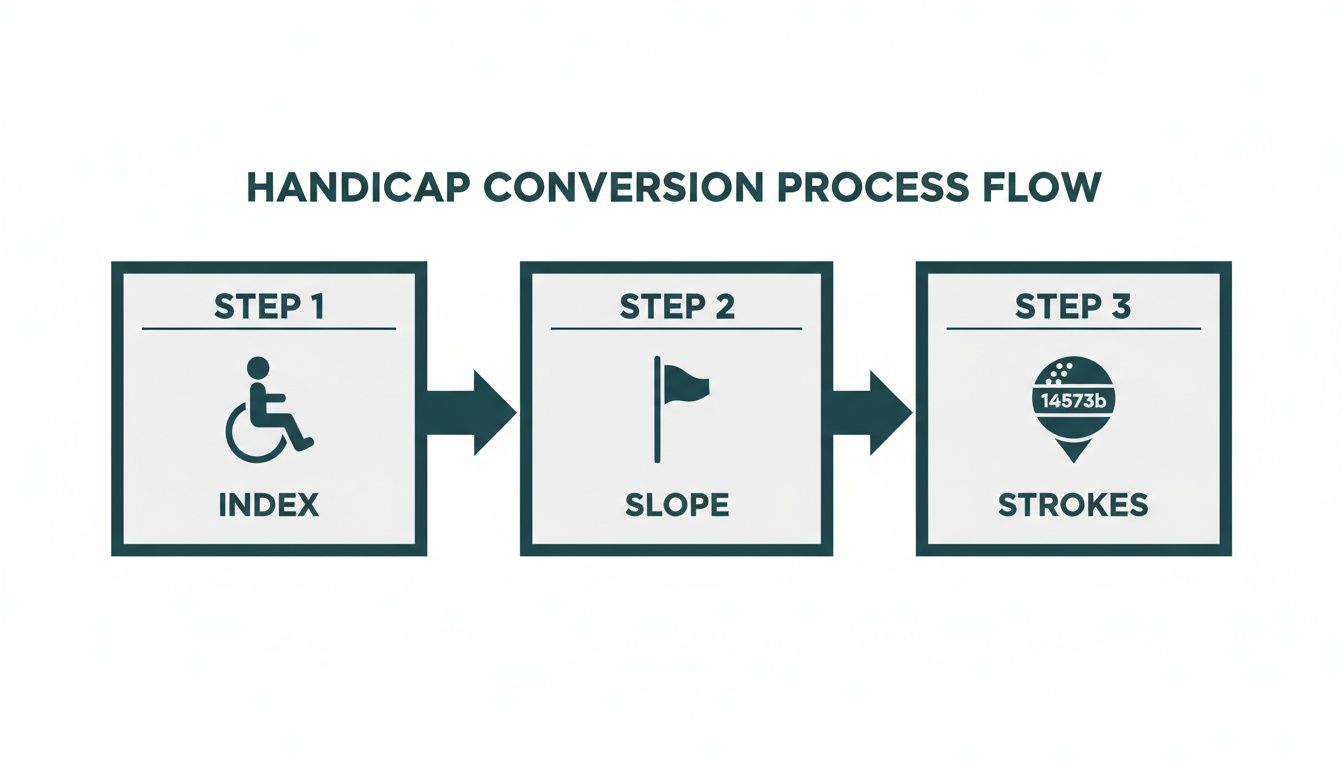
As you can see, the course's unique slope is what connects a player's potential to their on-course handicap.
Making Fairness Automatic with Tournament Software
Let's be honest, manually calculating Course Handicaps for a full tournament field is a headache waiting to happen. It’s tedious and incredibly easy to make a mistake. This is where anyone learning how to run a golf tournament can save themselves a massive amount of time and stress.
Modern software like Live Tourney automates the entire thing.
For tournament directors, grasping Slope is essential: it powers accurate Course Handicaps, ensuring equitable play in leagues or outings. A golfer with a 20 Handicap Index facing a 140 Slope course gets about 25% more strokes than on a 113 Slope track, preventing blowouts and boosting participation.
You just pick the course and the tees, and the software instantly pulls the correct ratings. As you add players and their Handicap Indexes, it does all the math for you, calculating the right number of strokes for every single person in the field.
It's not just about saving time. It's about elevating the entire experience. When scorecards, mobile scoring, and live leaderboards all reflect the correct, fair handicaps, your event just feels more professional. It gives every player the feeling that they have a legitimate chance to win.
Common Questions About Slope Rating Answered
Even after you get the basics down, a few questions about Slope Rating tend to pop up again and again. Let's walk through some of the most common points of confusion to make sure you have this thing dialed in.
One of the biggest misunderstandings is whether a high slope automatically means a course is harder for everyone. The answer? A hard no.
Does a Higher Slope Rating Always Mean a Course Is Harder?
Not for every player, and that's the key. A high slope rating specifically means the course gets disproportionately harder for a bogey golfer than it does for a scratch player. The important word there is proportionally.
Imagine two courses, both with an identical Course Rating of 72.0. For a scratch player, they might feel like an even match. But if one course has a gentle Slope Rating of 115 and the other has a brutal 140, the experience will be completely different for someone with a 20 Handicap Index.
The course with the 140 slope is going to have more trouble, forced carries, and hazards that punish mistakes, ballooning the scores of an average player. That's exactly why the handicap system gives that player more strokes to even things out.
Can I Use My Home Course Handicap Everywhere?
This one comes up all the time. You should never use your home Course Handicap at another course. The number that travels with you is your Handicap Index.
Think of your Handicap Index as your golfing passport—it’s a portable measure of your potential skill. When you show up at a new course, you "present" your index, and it gets converted into a Course Handicap using that specific course's Slope Rating. This is the entire point of the system: to create a fair game no matter where you tee it up.
Key Insight: Your Handicap Index is what you have. Your Course Handicap is what you get on a given day, on a given course, from a specific set of tees.
What Is Considered an Easy or Difficult Slope Rating?
The official baseline for a course of standard difficulty is a Slope Rating of 113. That number acts as the anchor for the entire system.
Here’s a general guide to what the numbers mean:
Below 113: Considered easier than average for a bogey golfer. Anything under 100 is very forgiving.
113: The standard for a course of average relative difficulty.
Above 113: More difficult than average for a bogey golfer. Most courses in the U.S. fall somewhere between 120 and 130.
145 and Higher: This is serious business. These courses are exceptionally tough, with the maximum possible rating capped at 155.
How Does Tournament Software Handle Slope Ratings?
Thankfully, modern tournament software automates all of this, which is a huge relief for organizers. Platforms just pull the official rating data from a national database when you select a course and a set of tees.
When you add players and their Handicap Index, the software instantly does the math to figure out the correct Course Handicap for everyone in the field. This doesn't just save you from a headache-inducing spreadsheet; it eliminates errors. It ensures everything from printing the best golf scorecard to updating the live leaderboards is built on a foundation of accurate, fair handicaps right from the start.
Running a golf tournament that is fair, competitive, and fun for everyone starts with getting the handicaps right. With Live Tourney, you can automate all Course Handicap calculations instantly, ensuring a level playing field without the manual work. Elevate your next event by visiting https://livetourney.com to start your free trial.





