
Jan 16, 2026
Unlock the true slope rating definition in golf. Learn how it measures course difficulty, differs from course rating, and impacts your handicap for fairer play.
A slope rating isn't about how hard a course is in total. That’s a common mix-up. Instead, it’s a number that tells you how much harder a course plays for a regular "bogey" golfer compared to an elite "scratch" golfer. It’s all about relative difficulty, making sure your handicap is adjusted fairly when you play different courses.
What a Slope Rating Actually Tells You

Let's cut through the jargon. At its core, a slope rating is a number that levels the playing field, making your golf handicap fair and portable no matter where you tee it up. Think of it as a difficulty equalizer.
It doesn’t measure how tough a course is in absolute terms; that's the job of the Course Rating. Instead, Slope Rating answers a more specific question: how much does the difficulty ramp up for a higher-handicap player?
This distinction is the key. Two courses could both have a Course Rating of 72.0, meaning a scratch golfer is expected to shoot par on each. But one might have a gentle slope of 110, while the other has a punishing slope of 135.
The Widening Gap
Why the huge difference? The course with the 135 slope has features that punish mistakes more severely. It might be loaded with things like:
Forced Carries: Water hazards or deep ravines that a scratch player clears without a second thought, but a bogey golfer sees as a nightmare.
Narrow Fairways: Tight, tree-lined corridors that offer zero room for error off the tee.
Complex Greens: Severe undulations and deep bunkering that can quickly turn a slightly missed approach into a double bogey.
These obstacles create a wider gap in scoring potential between a scratch golfer and a bogey golfer. The higher the slope, the wider that gap gets. On a high-slope course, a 20-handicap player will get more strokes to compete fairly because the course is relatively much tougher for them.
A slope rating is the great equalizer in golf handicapping. It acknowledges that a forced carry over water is a minor inconvenience for a scratch player but a major obstacle for a 20-handicapper, and it adjusts their handicaps accordingly.
Practical Implications for Tournaments
For anyone running an event, this concept is non-negotiable. Using the correct slope rating is fundamental to ensuring a fair competition, as it dictates how many strokes each player gets and directly impacts the net leaderboard.
This is where modern golf tournament scoring software becomes so essential. It automatically applies the correct slope for the chosen tees, wiping out manual errors and guaranteeing every participant is playing off the right handicap. Grasping this core concept shows why slope is the bedrock of any competitive and equitable golf event.
The Story Behind the Slope System
To really get why the slope rating matters, you have to rewind the clock a bit and understand the problem it was designed to solve. Before the slope system came along, a golfer's handicap didn't travel very well. A 15-handicap earned at a wide-open, forgiving home course just wasn't the same as a 15-handicap held by someone who battled a beast of a championship layout every weekend.
This created a massive fairness issue. When players from different clubs showed up for a tournament, their handicaps weren't truly comparable. The golfer from the easier course often had a huge, unearned advantage because their handicap simply didn't reflect their ability on a tougher track. The game desperately needed a better way to measure difficulty and make handicaps portable.
The Spark of a New Idea
The United States Golf Association (USGA) knew this was a problem. They saw that a course's difficulty didn't hit all golfers the same way. A tough hole for a scratch player might be downright impossible for a bogey golfer, but the old system had no way to account for this widening performance gap as a course got harder.
This was the "aha" moment that changed handicapping forever. The core idea was simple but powerful: what if there was a way to measure not just the raw difficulty for an elite player, but the relative difficulty for an average player? This concept became the bedrock of the slope system.
The slope system was born from the need to make a 15-handicap in California mean the same thing as a 15-handicap in New York. It’s the innovation that finally allowed a player’s skill, not their home course’s difficulty, to be the deciding factor in a match.
Creating a Fairer Game
The work began in earnest back in 1979 when the USGA put together a dedicated research team. A key figure in this was Dean Knuth, whose work was instrumental in creating a system that analyzed a course from two different perspectives: that of a scratch golfer and that of a bogey golfer.
This new approach was first tested in Colorado in the early 1980s and was a huge success. Following its official nationwide rollout by the USGA in 1987, the slope rating completely transformed how handicaps worked. By 1990, every golf association in the country had adopted it, bringing a level of fairness to the game that we all rely on today.
You can dive deeper into this pivotal change and the people behind it in this detailed history of the slope rating. It's a great reminder that slope isn't just a number—it’s a brilliant solution that brought true equity to modern golf.
How a Slope Rating Is Calculated
The math behind the Slope Rating might look a little intimidating at first glance, but the idea driving it is actually pretty simple. It all comes down to one question: how differently do a scratch golfer and a bogey golfer experience the same golf course?
The whole calculation hinges on two key numbers: the Course Rating and the Bogey Rating. Think of the Course Rating as the expected score for a scratch player (0 handicap), while the Bogey Rating is the predicted score for a bogey golfer (around a 20 handicap). The magic is in the gap between those two scores.
If that gap is wide, it means the course gets exponentially harder for the average player. That’s when you see a high Slope Rating.
The Core Calculation
Once you have the two base ratings, the formula itself is surprisingly straightforward. You just find the difference between the Bogey Rating and the Course Rating, then multiply it by a set number.
Slope Rating Formula: (Bogey Rating - Course Rating) x Constant = Slope Rating
The constant isn't just a random number; it's what scales the result to fit the standard 55 to 155 range we see on scorecards. For men's tees, the constant is 5.381, and for women's tees, it's 4.24.
Bringing the Numbers to Life
Let's walk through a quick example for a men's tee to see how this plays out in the real world.
Course A: Has a Bogey Rating of 92.0 and a Course Rating of 72.0.
The difference is 20.0 (92.0 - 72.0).
Calculation: 20.0 x 5.381 = 108 Slope Rating (pretty manageable).
Course B: Also has a Course Rating of 72.0 but a Bogey Rating of 96.0.
The difference jumps to 24.0 (96.0 - 72.0).
Calculation: 24.0 x 5.381 = 129 Slope Rating (a much tougher test for the bogey golfer).
This system didn't just appear out of nowhere. It was developed over years to solve a genuine problem with fairness in handicapping, as this timeline shows.
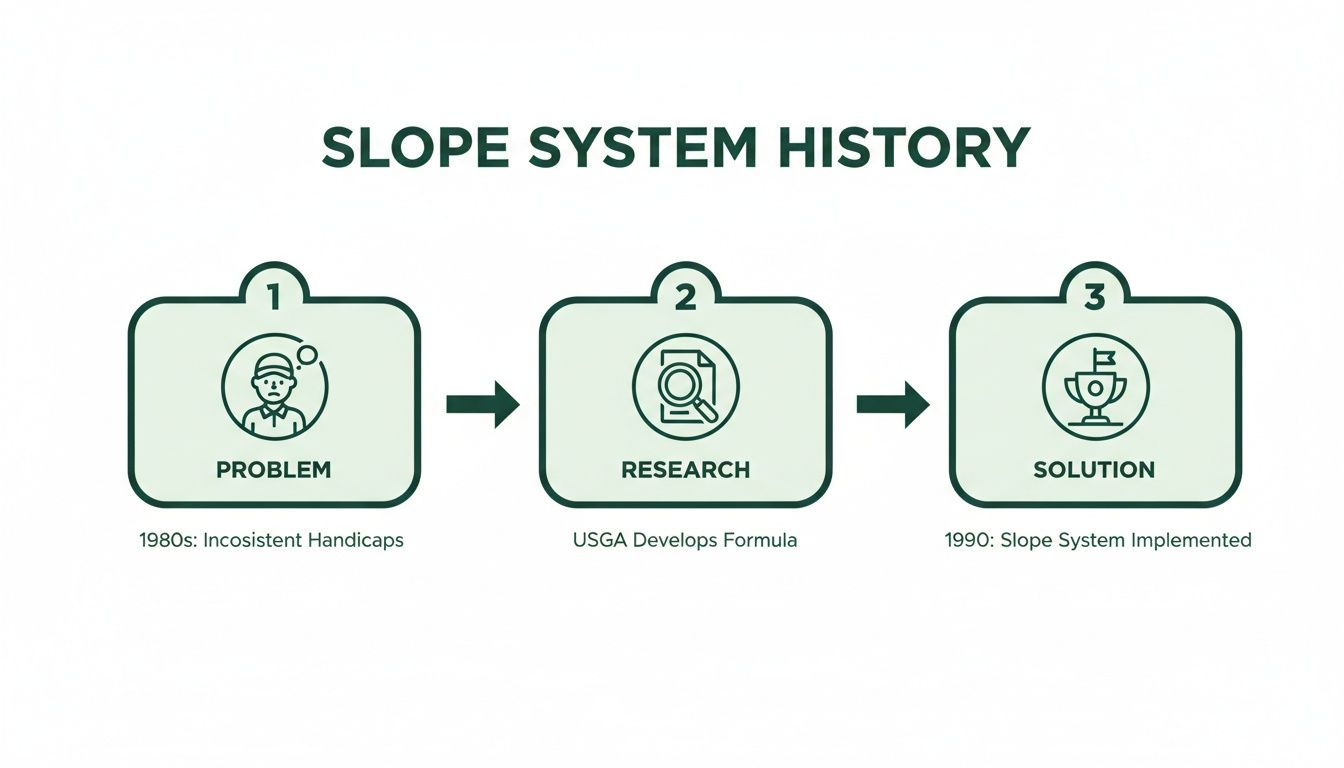
As you can see, the journey from identifying an issue to implementing a solution was a deliberate one. To make sure the system worked, the USGA started standardizing the rating process back in 1989, training volunteer raters to evaluate courses consistently—a practice that continues to this day. After all, the Slope Rating is only as good as the Course and Bogey Ratings it's built on.
These foundational ratings come from an on-course evaluation where raters analyze every hole from the perspective of both player types, considering everything from playing length to hazards. You can read more about the history of the Slope System and how the USGA created this robust framework.
Interpreting Slope Numbers From 55 to 155
So you know how the number is calculated, but what does it actually mean when you step onto the first tee? A course’s slope rating is a quick, powerful indicator of the challenge ahead—if you know how to read it. The scale runs from a bare-minimum 55 (think wide-open and flat) to a brutal 155 (bring extra balls).
Think of 113 as the neutral ground. This number represents a course of "standard" difficulty, where a bogey golfer's score is expected to increase at a predictable rate compared to a scratch player's. Of course, most courses aren't perfectly average.
What the Numbers Mean on the Course
To really get a feel for slope, it helps to put the numbers into practical buckets. Each range tells a different story about what a bogey golfer is in for.
Low Slope (55 - 95): These are the most forgiving courses you can find. Picture a flat par-3 or a beginner-friendly muni with hardly any trouble. A bad shot won't ruin your hole, making these courses perfect for new players or a casual afternoon.
Average Slope (96 - 120): This is the sweet spot where most local clubs and daily-fee courses live. They offer a solid, balanced test—a mix of gettable holes and a few that make you think. It's a fair fight for the majority of golfers.
High Slope (121 - 155): Welcome to the big leagues. These are the courses built to test the best, with forced carries, tight fairways, deep bunkers, and slick, undulating greens. On these tracks, the scoring gap between a scratch player and a bogey golfer widens in a hurry.
A course’s slope rating tells you how much harder a course is for a bogey golfer compared to a scratch golfer. We can break down the numbers to get a clearer picture of what to expect when you're standing on the first tee.
Interpreting Slope Rating Numbers | |||
|---|---|---|---|
Slope Rating Range | Difficulty Level | Typical Course Type | Impact on a Bogey Golfer |
55 - 95 | Very Forgiving | Beginner, Executive, Par-3 | Minimal penalty for mistakes; scores are less spread out. |
96 - 112 | Moderately Easy | Open, flat public courses | A fair challenge where good shots are rewarded. |
113 | Standard | The USGA baseline | The "neutral ground" for handicap calculations. |
114 - 125 | Challenging | Most private clubs, well-designed public courses | Mistakes start to cost you; course management matters. |
126 - 140 | Difficult | Championship-level courses | Every shot requires focus; bad holes can happen fast. |
141 - 155 | Extremely Difficult | Major tournament venues, top-tier private clubs | A relentless test of skill; survival is the main goal. |
Ultimately, a higher slope rating is a heads-up that you'll likely need more handicap strokes to compete on a level playing field.
The Real-World Average and Extremes
While 113 is the official "standard," the actual average slope for a course in the United States is closer to 120. This tells us that modern course design tends to bake in more features that challenge the average player.
Interestingly, some research shows that courses in coastal states often have higher slope ratings—frequently above 121—thanks to tougher terrain and windy conditions. You can discover more insights about course rating data and see how your region stacks up.
A slope rating of 135 doesn't just mean the course is "hard." It specifically means a bogey golfer will find it disproportionately harder than a scratch golfer, requiring more strokes to compete fairly.
The far ends of the spectrum are rare. A 55 rating is typically reserved for short executive or par-3 courses. The maximum 155, on the other hand, is only slapped on the most demanding layouts in the world—the kind of places that host major championships and humble the pros.
How Slope Rating Impacts Your Handicap
This is where the rubber meets the road. Your Handicap Index is a fantastic measure of your potential skill, but it’s a portable number—it doesn't mean much until you apply it to a specific course. Slope rating is the key that translates that potential into your actual Course Handicap: the number of strokes you get on this course, from these tees, on this day.
Think of it as an adjustment factor. The system uses a simple, universal formula to give you more strokes on a tough course and fewer on an easy one. It’s all about creating a level playing field, no matter where you play.
The Course Handicap Formula
At its heart, the formula simply compares the slope of the course you're playing to the "standard" slope of 113. If the tees you're playing are tougher than average (above 113), your Course Handicap will be higher than your index. If they're easier (below 113), it’ll be lower. Simple as that.
Here’s the official formula from the World Handicap System:
Course Handicap = (Handicap Index x Slope Rating) / 113
The final number is then rounded to the nearest whole number. This little piece of math is the engine that drives fairness in modern golf, making sure everyone is competing on equal footing. It's the absolute foundation of any net competition, so a solid grasp of it is critical for anyone involved in golf tournament scoring.
A Tale of Two Courses
Let's put this into practice. Imagine a golfer with a 15.0 Handicap Index who’s playing two very different courses over the weekend.
Scenario 1: The "Easy" Local Muni
Course: Fairway Fields Golf Club
Slope Rating: A friendly 105
Calculation: (15.0 x 10⁵) / 113 = 13.9
Result: The player’s Course Handicap rounds down to 14.
On this more forgiving layout, our golfer gets one less stroke than their index. The course's lower-than-average difficulty means they just don't need as much help to play to their potential.
Scenario 2: The "Tough" Championship Track
Course: Granite Ridge Golf Links
Slope Rating: A beastly 135
Calculation: (15.0 x 135) / 113 = 17.9
Result: The player’s Course Handicap rounds up to 18.
Here, our golfer gets three extra strokes. The high slope rating recognizes that this course is going to beat them up more than a scratch player, so the system gives them the strokes they need to compete fairly.
This automatic, logical adjustment is exactly why the slope system works so well. It adapts your handicap to the unique challenge you're facing that day. Thankfully, you don't need a calculator anymore—modern tournament software handles all of this instantly, so every player can tee off with the right handicap without a second thought.
Running Fairer Tournaments with Slope Rating
Knowing what Slope Rating is gets you started. But actually using it is what takes a tournament from good to great. For tournament directors and course operators, that number on the scorecard isn't just data—it’s the key to running a fair, credible, and fun event for everyone.
It all starts with clear communication. Players need to see and understand the numbers that determine their handicap strokes for the day. That simple act builds a ton of trust and transparency right from the start.
Best Practices for Golf Courses
If you're running the course, your main job is making this information easy to find. When players show up, they shouldn't have to guess or go on a hunt for the right ratings. Getting this right keeps the pace of play moving and ensures everyone is playing off the correct handicap.
A couple of simple actions make all the difference:
Update All Scorecards: Make sure every single scorecard clearly lists the Course Rating and Slope Rating for each set of tees. If you need inspiration, check out our guide on how to design the best golf scorecard.
Put Up a Sign: A simple sign near the first tee or in the pro shop with all the ratings is a game-changer. It's a quick, visible reference point for both players and organizers.
A Checklist for Tournament Organizers
For anyone running an event, accuracy is everything. One small mistake in the setup can throw off the entire competition and lead to a clubhouse full of frustrated golfers. Using the correct slope rating isn’t just a nice-to-have; it's a non-negotiable part of your pre-tournament routine.
The integrity of your tournament hangs on its fairness. When you double-check slope ratings and clearly communicate handicap adjustments, you’re not just running an event—you’re building a competitive environment people can trust.
Before your next tournament, run through this quick checklist:
Select the Right Tees: Use slope as your guide to assign different flights or divisions to the tees that best match their skill level.
Verify Ratings in Your Software: Manually confirm that the correct slope and course ratings for each tee box are punched into your tournament management platform. Never assume the defaults are correct.
Communicate the Adjustments: When you post tee sheets or print scorecards, show each player's Handicap Index and their adjusted Course Handicap. This way, everyone understands exactly why they're getting a certain number of strokes.
Common Questions About Slope Rating
Even after getting the basics down, a few common questions always seem to pop up about Slope Rating. Let's clear up those lingering points of confusion so you can use the system with total confidence.
Here are a few of the most frequent ones we hear.
Does a Higher Slope Always Mean a Harder Course?
Not necessarily, and definitely not for everyone. This is probably the biggest misconception out there.
A high slope rating just means a course is disproportionately harder for a bogey golfer than it is for a scratch golfer. You could have a course with a relatively low slope but a punishingly high Course Rating, making it an absolute beast for an elite player but less dramatic of a jump in difficulty for a higher handicapper.
Think of it like this: Course Rating measures raw difficulty for a scratch player. Slope measures how much more difficult the course gets as your handicap goes up.
Where Can I Find the Official Slope Rating?
You'll find the official ratings printed right on the course scorecard. Most clubs also post them on a sign near the first tee or on their website.
For the most reliable source, you can look them up in the official USGA course rating database or through the GHIN app.
For tournaments, always double-check you're using the rating for the exact set of tees in play. Mismatched data is one of the most common—and avoidable—sources of handicap errors.
Why Does My Handicap Change from the White to the Blue Tees?
Because from a ratings perspective, each set of tees is its own separate golf course. The blue tees are almost always longer and force you to take on tougher angles, which naturally results in both a higher Course Rating and a higher Slope Rating.
Your Course Handicap is calculated using the specific slope of the tees you're playing that day. When you move back to a more difficult set of tees, your handicap adjusts upward to give you the extra strokes you'll need to compete fairly.
Running a fair and professional tournament means getting these details right every single time. Live Tourney automates all the handicap calculations using the correct slope ratings, which eliminates errors and saves you a ton of time. You get to focus on creating a great event, not wrestling with a calculator.





