
Jan 9, 2026
Learn skins game rules golf: a clear guide to scoring, payouts, and strategy so you win more on the course.
A skins game in golf is all about turning every single hole into its own high-stakes showdown. The rules couldn't be simpler: to win a "skin"—the prize for that hole—you have to post the sole lowest score. If anyone ties you, the prize money carries over, and the pot gets bigger for the next hole.
What a Skins Game in Golf Actually Is
Imagine a format where grinding out a consistent 78 doesn't matter nearly as much as making one clutch birdie when nobody else does. That's the heart and soul of a skins game. Unlike traditional stroke play where your total score is all that matters, this is all about winning individual holes outright.
Think of it as 18 separate battles. Each hole is assigned a value, which we call a skin. To claim that skin and the cash that comes with it, you have to card a lower score than everyone else in your group. No points for second place here.
The Power of the Carryover
The real drama in a skins game comes from the ties. When two or more players tie for the low score on a hole, nobody wins the skin. Instead, it "carries over" or "pushes" to the next hole, instantly doubling the stakes. If the next hole also ends in a tie, that pot just keeps on growing.
This creates a thrilling snowball effect. A quiet front nine can suddenly erupt on a routine par-3, turning it into a pressure-packed showdown for five or six skins at once. This simple dynamic is why it's one of the most popular side games in golf.
A classic match involves 3–4 players, with each hole worth one “skin” tied to a set cash value. When players tie, the skin carries over, which can create huge swings where a single well-timed birdie on a late hole can decide the entire pot. You can dig a bit deeper into the format's history and variations over on MyScorecard.com.
Key Takeaway: The core principle of a skins game is simple but unforgiving: win the hole by yourself, or nobody wins it. This "winner-take-all" mentality on every single tee box is what makes the format so addictive.
To get a clearer picture, let's break down the essential rules and terms you'll encounter in a typical skins game.
Skins Game At-a-Glance Rules Summary
This table covers the fundamental concepts you'll need to know to get started.
Term | Definition | Example |
|---|---|---|
Skin | The prize assigned to each hole. | Each hole is worth $5, so there are 18 skins of $5 each up for grabs. |
Outright Winner | The only player with the lowest score on a hole. | Player A makes a birdie 3, while everyone else makes par or worse. Player A wins the skin. |
Tie (or "Push") | When two or more players share the lowest score on a hole. | Players A and B both make a birdie 3. No one wins the skin. |
Carryover | When a tied skin's value is added to the next hole's pot. | The $5 skin from a tied hole carries over. The next hole is now worth $10. |
Pot | The total value of skins being contested on a single hole. | After three consecutive ties, the pot for the fourth hole would be $20 ($5 x 4 skins). |
Validation | A local rule where a par cannot win a skin. | If the lowest score on a hole is a par 4, the skin automatically carries over, even if it's an outright win. |
Understanding these basics is all you need to jump into a game. The real fun comes from the strategy and the pressure that builds as those carryovers start to pile up.
How TV Made the Skins Game a Phenomenon
Most weekend golfers know the skins game as a friendly wager, but it wasn't born on your local muni. It exploded into the mainstream thanks to a wildly popular televised event that perfectly captured the format's nail-biting drama, launching a simple betting game into living rooms across America.
The format was practically made for television. Unlike the slow-and-steady pace of a 72-hole stroke play tournament, a skins game is all about instant gratification. It’s a series of high-stakes, one-hole battles where viewers don't need to track a crowded leaderboard—they just need to know who won the hole and pocketed the cash.
The Golden Age of Televised Skins
The secret sauce for TV was the carryover. When players tied a hole, the pot grew, and so did the tension. This created incredible pressure-cooker moments where a single putt could be worth hundreds of thousands of dollars. It was impossible to look away.
This thrilling format truly hit its stride with the launch of "The Skins Game" in 1983. The first event was a Mount Rushmore of golf legends: Arnold Palmer, Jack Nicklaus, Gary Player, and Tom Watson. It became a Thanksgiving weekend tradition almost overnight, making the skins format a household name.
The show ran until 2008, with purses swelling into the seven-figure range. Fred Couples, in particular, became "Mr. Skins," winning an incredible 77 skins and over $4.4 million in just 11 appearances. The Beezer Golf blog has some great details on the history of this iconic event.
The show's magic wasn't just the money. It was the atmosphere. You had a small, elite group of golf's biggest personalities competing in a relaxed setting that let their charisma and competitive fire shine through.
Why This History Matters for Your Event
Tapping into this history is a powerful tool for any tournament organizer. A skins game isn't just another format; it carries a legacy of nostalgia, reminding players of legendary golfers battling it out under immense pressure.
When you set up your own skins tournament, you're not just playing a game—you're channeling that classic drama. Framing your event with this context helps build excitement and gives your players a deeper connection to the format. It’s a chance for them to feel a piece of the action that made the skins game an unforgettable part of golf history.
Mastering Skins Scoring and Tiebreakers
The real magic of a skins game is in its beautifully simple scoring. Forget tallying up a total at the end of the round—skins is all about winning individual holes. The objective is crystal clear: post the single lowest score on a hole, and you win its "skin."
This creates a high-stakes dynamic where one fantastic shot can be worth more than a dozen solid pars. If you drain a birdie while everyone else gets par or worse, that skin is yours. But if even one other player matches your score, the hole is a "push," and nobody wins.
Gross vs. Net Skins Scoring
To keep things fair and interesting when players have different skill levels, most skins games use handicaps. This is where you decide between gross skins (based on raw scores) and net skins (scores adjusted with handicap strokes). A net game is the ultimate equalizer, giving a high-handicapper a legitimate shot at winning holes against a scratch player.
Gross Skins: This is the purest form. Only the actual number of strokes counts. It’s perfect for groups where everyone is playing at a similar level.
Net Skins: Here, players apply their course handicap to get strokes on the toughest-rated holes. Someone with a 10-handicap gets one stroke on each of the 10 hardest holes on the course.
For instance, if a 12-handicap golfer scores a 5 on the 7th hardest hole, their net score becomes a 4. That net score is what's used to find the outright winner for that hole. To dive deeper into different formats, check out our complete guide to golf tournament scoring.
The famous televised version of the game really cranked up the excitement, which you can see in the timeline below.
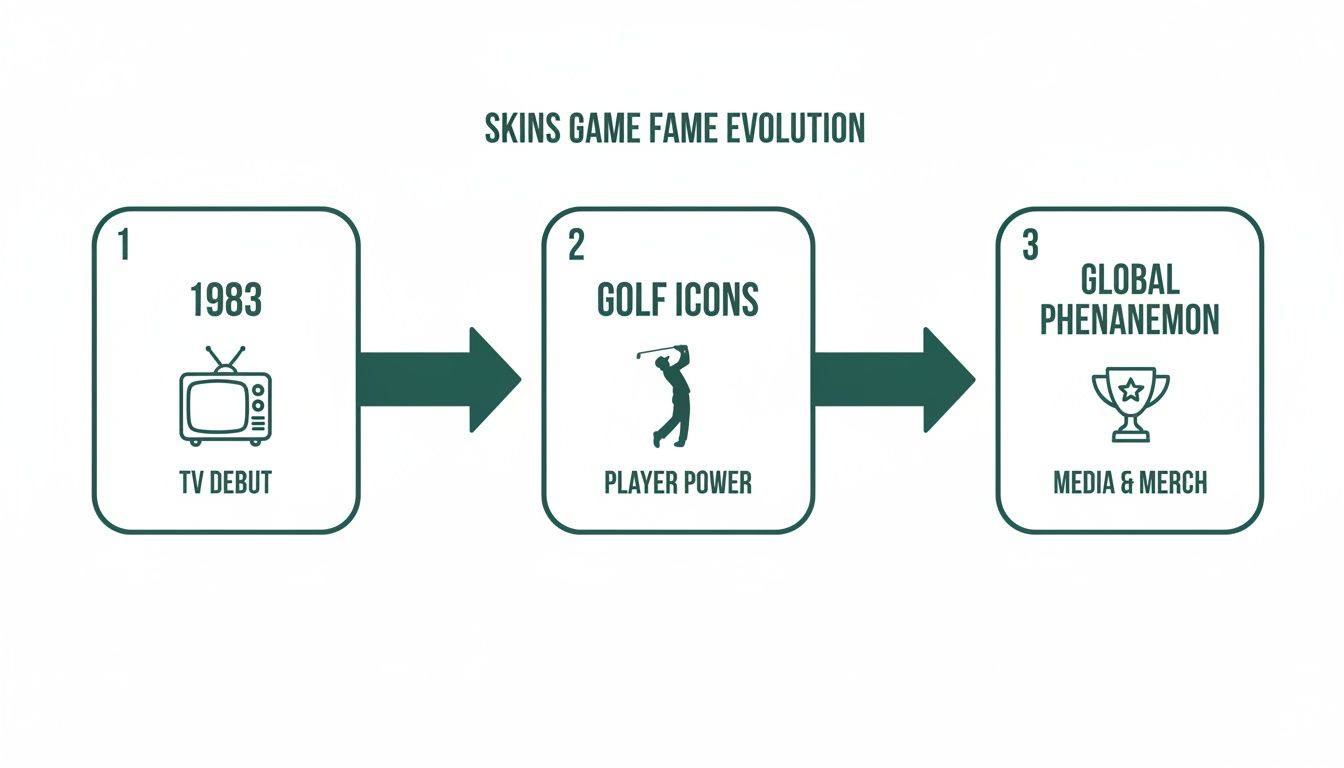
This chart shows how the format exploded from a 1983 TV event with golf legends into the worldwide favorite it is today, all thanks to its thrilling, winner-take-all appeal.
Handling the All-Important Tiebreakers
The single most important rule to agree on before you tee off is how to handle a tie on the final hole. If the 18th is a push and there are still skins left in the pot, things can get messy without a clear plan.
Pro Tip: Always decide on your tiebreaker method before the first ball is in the air. This one simple step prevents any confusion or arguments back in the clubhouse.
You've got two main options, each with its own vibe:
Sudden-Death Playoff: The most dramatic choice. The players who tied on 18 head back to the first tee (or another designated hole). The first person to win a hole outright scoops the entire remaining pot.
Split the Pot: A much simpler and faster solution. The value of all the leftover skins is just divided evenly among the players who tied the last hole.
A playoff delivers a nail-biting finish, but splitting the pot is often the more practical move for a casual round or when you're running out of daylight. The key is that everyone agrees on the method beforehand so the game ends on a high note, no matter who wins.
Creative Variations to Keep Your Skins Game Fresh
While the classic skins game is a blast on its own, adding a few creative twists can keep the competition fresh and make your annual event feel brand new every time. These variations are all about cranking up the strategy, creating those nail-biting moments, and making sure every player is locked in from the first drive to the final putt.
One of the most popular twists is a rule known as Validation or Syndicate. It's simple but brutal. When a player wins a hole, they don't get the skin just yet. They have to "validate" that win by at least tying for the low score on the very next hole. If they can't pull it off, the skin they thought they won goes back into the pot. Talk about pressure. This rule creates huge carryovers and punishes anyone who can't keep their foot on the gas.
Another great option is to set up a team-based skins game. This is perfect for pairs, where the team's best ball score for each hole determines the winner. It adds a whole new layer of camaraderie and strategy, making it a fantastic choice for corporate outings or member-guest tournaments where you want to encourage teamwork. If you need some ideas on how to structure the matchups, check out our guide on how to create a round robin schedule.
Advanced and High-Stakes Rules
For groups that love to sweat, changing up the value of the skins can completely alter the game's dynamic. Instead of every hole being worth the same, you can assign higher values to the tougher holes or, even better, the final stretch of the round.
Progressive Values: You could make the front nine holes worth $5 each, then ramp it up to $10 for holes 10-15, and a whopping $20 for the final three. That guarantees a back nine packed with tension.
Par-3 Jackpots: Designate all par-3s as special "bonus" holes worth three skins instead of one. Suddenly, those short holes become the most important on the course.
No Pars Rule: This one is a favorite for skilled players. In this version, a skin can only be won with a birdie or better. If the lowest score on a hole is just a par, the skin automatically carries over, no matter if it was an outright win or not.
As skins games grew from casual weekend wagers into more organized tournaments, rules evolved to keep things both exciting and manageable. One version flips the accounting: each player essentially brings a skin to every tee box, and the winner of the hole collects one from each of their opponents.
Another high-stakes variant, often called “Back It Up,” lets a player who just won a hole double its value by immediately winning the next one. If they pull it off, a simple $1 + $1 win turns into a $4 payday. But if they fail, they forfeit the skin they just won. Learn more about how the format has evolved by exploring the different types of skins games.
Your Blueprint for Setting Up a Flawless Skins Tournament
Turning the idea of a skins game into an event that runs like clockwork all comes down to the plan. The best events are built on a foundation of smart logistics and clear communication long before anyone steps up to the first tee. Your first job is to lock in the financials.
You'll need to decide on a fair entry fee for everyone and figure out what each skin is worth. For example, if you have 40 players and a $20 entry fee, that gives you an $800 pot to work with. From there, you could set each of the 18 skins at $40 and use the last $80 for a closest-to-the-pin prize.
Establishing the Ground Rules
Once the money is sorted, your next mission is crystal-clear communication. You really can't over-explain the rules, especially if you have players who are new to the format. Ambiguity is the enemy of a fun golf tournament.
The easiest way to handle this is with a simple, one-page rules sheet for every player. This isn't the time for fine print; just hit the key points:
The format (individual or team)
The scoring method (gross or net)
The carryover procedure for tied holes
The final plan for the 18th hole (sudden death playoff or split the pot)
Key Takeaway: A well-defined rules sheet, handed out before play begins, is the single best way to prevent arguments and confusion later on. Clarity is your best friend.
Getting these details buttoned up and into players' hands means everyone starts on the same page. They can focus on golf instead of wondering how things work. For more ideas on event management, check out our complete guide on how to run a golf tournament.
Stop Doing the Math by Hand
In the past, running a skins game meant being chained to a spreadsheet. You’d spend hours punching in scores, manually calculating net totals, tracking carryovers, and trying to keep some kind of leaderboard updated. It's a massive headache that pulls you away from actually running the event.
Thankfully, modern tournament software gets rid of all that tedious work. Imagine a system where players just enter their scores on their phones, and the platform does all the heavy lifting for you.
Live Scoring: Instantly calculates net scores for every player based on their handicap. No more math.
Automatic Carryovers: The system knows when a hole is tied and automatically rolls the pot value to the next hole in real time.
Dynamic Leaderboards: A live leaderboard shows everyone who has won which skins and how much the current pot is worth, keeping the entire field engaged.
This level of automation frees you up to run a professional, seamless event. Instead of being stuck with paperwork, you can actually talk to your players, answer questions, and make sure everyone is having a great time. The right software turns tournament management from a chore into a simple, streamlined process.
Got Questions About Skins? We've Got Answers
The beauty of a skins game is its simplicity, but that doesn't mean questions won't pop up. A few specific scenarios can leave players scratching their heads. Getting on the same page about the common sticking points before you tee off is the best way to keep the round friendly and argument-free.
Here are the quick answers to the most frequently asked questions we hear.
How Do Handicaps Work in a Net Skins Game?
This is where skins becomes a great game for everyone, not just the low-handicappers. In a net game, your course handicap gives you strokes on the toughest holes. Let's say you're a 10-handicap golfer—you'll get one stroke back on each of the 10 hardest-rated holes.
So, if you make a gross 5 on a par-4 that happens to be the 3rd hardest hole, your handicap kicks in. Your net score for that hole becomes a 4. The skin is won by whoever has the lowest net score, which keeps things interesting for golfers of all skill levels.
What Happens If No One Wins a Skin on the 18th Hole?
This is a classic scenario: the pot is huge, everyone ties the last hole, and suddenly no one knows what to do. The answer depends entirely on the rules you set at the beginning.
Pro tip: Decide on the tie-breaker rule before anyone hits their first shot. A simple announcement on the first tee prevents any awkward debates when the pressure is on.
Here are a few popular ways to handle it:
Sudden-Death Playoff: The players who tied head back to the first tee. The first person to win a hole outright takes the entire pot. High drama!
Split the Pot: The remaining cash is divided evenly among the players who tied on the 18th hole. Simple and fair.
Group Split: Everyone in the group splits the pot, regardless of who tied the final hole. A more social, "everyone's a winner" approach.
Can You Play a Skins Game with Teams?
You bet. Team skins is an incredibly fun and social twist, usually played in a better-ball format. In a two-person team game, you simply take the lower score between the two partners on each hole. That becomes the team's official score.
The team with the lowest better-ball score wins the skin. It adds a whole new layer of strategy and camaraderie to the classic skins game.
Running a skins tournament with live scoring, automatic carryovers, and leaderboards that everyone can see has never been easier. Live Tourney handles all the tedious work so you can focus on creating an unforgettable event for your players. See how simple it is to set up your next tournament at https://livetourney.com.





