
Feb 5, 2026
Discover the shamble in golf, a format blending teamwork and individual skill. Our guide covers rules, scoring, and winning strategies for your next event.
If you’ve ever played in a charity or corporate golf outing, you’ve probably run into a scramble. But have you heard of its more interesting cousin, the shamble?
A shamble in golf is a team format that beautifully merges the best parts of a scramble with traditional stroke play. Here’s the gist: everyone on the team tees off, you pick the best drive, and then everyone plays their own ball from that spot all the way to the hole.
It’s that simple. Think of it as giving every player a perfect start on every single hole.
Why the Shamble Format Is Gaining Popularity
The shamble strikes an incredible balance between teamwork and individual skill, which is why it’s become a go-to for member-guests, corporate events, and charity fundraisers. It’s more than just a set of rules; it’s a recipe for a more relaxed and inclusive day on the course.
This hybrid format solves some of the biggest complaints about other team games. In a classic scramble, one great player can carry the whole team, leaving others feeling like they’re just along for the ride. And in a best-ball game, a high-handicapper's wild tee shot can effectively take them out of a hole before it even begins.
The shamble neatly sidesteps both of those problems.
Key Benefits of Playing a Shamble
The format’s rising popularity isn't an accident. It offers some real advantages for both casual and competitive players.
It Speeds Up Play: When you start every hole from the best drive, you eliminate a ton of wasted time looking for lost balls or hitting recovery shots from the trees. This keeps the round moving, which is a massive win for tournament organizers.
It Lowers the Pressure: Bad drive? No problem. Weaker players don't have to stress about a poor tee shot holding the team back. Everyone gets to contribute and enjoy the game without feeling like a liability.
It Keeps the Individual Challenge: Unlike a scramble, you still have to finish the hole with your own ball. This keeps skilled golfers engaged because every approach shot, chip, and putt still counts.
A shamble is the ultimate compromise in team golf. It lets the team capitalize on its best driver while still giving every player the satisfaction of playing their own ball into the green.
Before we dive deeper into rules and strategy, it's helpful to see how the shamble stacks up against other popular formats.
Shamble vs Scramble vs Best Ball at a Glance
This quick table breaks down the key differences at a glance.
Format Feature | Shamble | Scramble | Best Ball (Four-Ball) |
|---|---|---|---|
Tee Shot | Everyone tees off; team selects the best drive. | Everyone tees off; team selects the best drive. | Everyone tees off and plays their own ball. |
Subsequent Shots | Each player plays their own ball from the spot of the best drive. | Team selects the best shot, and everyone plays from that spot. | Each player plays their own ball from where it lies. |
Hole Score | Based on one or two of the team's best individual scores. | One team score is recorded per hole. | The lowest individual score on the hole is the team score. |
Pace of Play | Fast, as poor drives are eliminated. | Fastest, as all players hit from the same best location. | Slower, as all players play their own ball from tee to green. |
Player Pressure | Low on tee shots, moderate on subsequent shots. | Lowest, as bad shots are rarely used. | High, as each player plays their own ball throughout. |
As you can see, each format offers a totally different experience on the course.
Ultimately, the shamble creates a fun dynamic where team strategy and individual performance both matter. It’s a versatile format that almost guarantees a competitive and memorable round for everyone.
And for those looking to master tracking scores in this format, check out our guide on the best golf scorecard practices for any tournament.
Understanding Shamble Rules and Common Variations
The beauty of a shamble is how simple it is. It brilliantly blends a bit of teamwork off the tee with old-school individual play into the green. Once you get the flow, you’ll see why it’s a go-to for so many events.
The standard process for a four-person shamble is the same on every single hole. No complex rules to remember, just a simple routine.
Here’s how it works:
Everyone Tees Off: Just like a normal round, every player in the group hits their tee shot.
Pick the Best Drive: The team heads out to see where the shots landed and chooses the best one. This isn't always about distance; a perfect spot in the middle of the fairway is often way better than a longer drive in the rough.
Play from the Best Spot: Everyone picks up their ball and plays their second shot from the location of that best drive. Usually, players drop within one club-length of the spot, no closer to the hole.
Finish the Hole on Your Own: From here on out, it's all you. Each golfer plays their own ball until they hole out, recording their own individual score for the hole.
This simple, three-step process is what makes a shamble, a shamble.
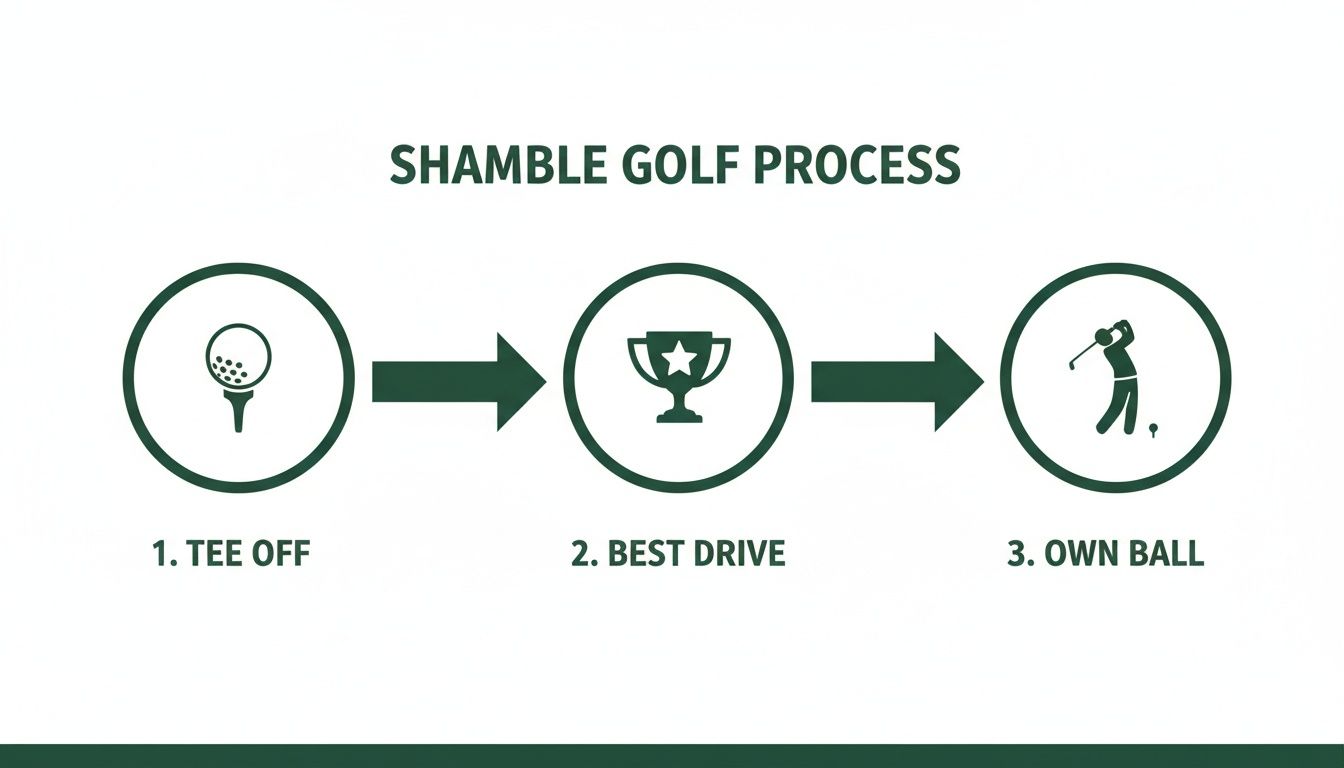
As you can see, the team gets the benefit of a great starting position before everyone transitions back to playing their own game. It’s the perfect mix of collaboration and personal skill.
Exploring Popular Shamble Formats
While the four-person shamble is king for charity events and corporate outings, the format is incredibly flexible. Good tournament organizers know how to tweak it for different group sizes and competitive vibes, keeping the game fresh for almost any occasion.
Two-Person Shamble: A favorite for competitive club leagues and member-guest events. With only two players, the pressure is on. Both players need to deliver a solid drive and a good individual score on every hole.
Three-Person Shamble: Perfect for when you can’t fill out perfect foursomes. The rules don’t change a bit, and it still provides a balanced, fun experience without needing a full team.
Creative Twists: You don't have to use the shamble format on every hole. Some events mix it up, like a "Par 5 Shamble" where teams only use the format on the longest holes and play something else (like best ball) on the par 3s and 4s.
The real magic of any shamble in golf is that it takes the pressure off the tee shot. When everyone starts from a good spot, every player has a real shot at contributing to the team score. That alone makes the round more fun and engaging for golfers of all skill levels.
This adaptability is why the shamble format is a staple for events that need to find that sweet spot between serious competition and a good time. Whether you're running a high-stakes championship or a laid-back company outing, a shamble can be tailored to create the perfect day on the course.
How to Score a Shamble Tournament
This is where the flexibility of a shamble really comes alive. Unlike a scramble with just one team score, a shamble uses individual scores after everyone plays from the best drive. This setup lets organizers decide how many scores to count on each hole, which completely changes team strategy and how competitive the event feels.
Most shambles use one of these common scoring formats:
1 Best Ball of 4: Super forgiving. Only the single lowest score from the four teammates counts as the team score for the hole.
2 Best Balls of 4: This is the sweet spot and the most popular choice for a shamble in golf. The two lowest individual scores are added together for the team's total.
3 Best Balls of 4: A much tougher variation. The top three scores count, so there’s more pressure on every player to post a decent number.
Let's Walk Through a Scoring Example
To see how this works in practice, let's look at a "2 Best Balls of 4" format on a par-4.
Your team hits their drives, you pick the best one, and everyone plays their own ball from there. Here’s how the individual scores shake out:
Player A: Makes a 4 (par)
Player B: Makes a 5 (bogey)
Player C: Makes a 4 (par)
Player D: Makes a 6 (double bogey)
To get the team score, you just find the two lowest individual scores and add them up. Here, that's the two 4s from Player A and Player C. The team score for the hole is 8.
At its core, shamble scoring is simple: use the best drive, then count a set number of individual scores. It keeps the game moving fast while rewarding both a great tee shot and solid individual play.
What About Handicaps?
Handicaps are the key to making a shamble fair and fun for teams with different skill levels. By applying a percentage of each player's handicap, you ensure everyone on the team has a real chance to contribute—not just the scratch golfers.
The shamble format's popularity has exploded, with participation growing by around 35% from 2015 to 2023. To keep things fair, the USGA actually recommends specific handicap allowances, like 65% for four-person teams and 75% for two-person teams. These adjustments create a net score that levels the playing field, so a 10-handicapper can compete right alongside a 25.
This is where modern golf tournament scoring software becomes a lifesaver. Platforms like Live Tourney handle all of this automatically. They apply the correct handicap percentages, calculate net scores on the fly, and display live leaderboards for everyone to see. It takes the manual math—and the mistakes—out of the equation, letting you focus on running a great event.
Developing a Winning Shamble Team Strategy

Winning a shamble isn't just about having the best individual players. It’s about having the smartest team. Every hole kicks off with everyone relying on one tee shot, so your game plan has to be collaborative from the very first swing.
Too many teams fall into the trap of automatically picking the longest drive. But a 250-yard shot sitting pretty in the fairway is almost always better than a 280-yard bomb that ends up in the rough with a tree blocking your path to the green.
The smart move? Designate a "safe" player whose only job is to find the fairway. This gives your big hitter the green light to swing away, knowing there’s already a great backup shot in play.
Mastering Your Approach Shots
Once you’ve picked the best drive, the rest of the hole depends entirely on the scoring format. Let's say you're playing a common "2 Best Balls of 4" game. This is where you can get creative.
If two of your teammates are already in great shape to make par, the other two should get aggressive. Go for that tucked pin. Try the tricky flop shot you’ve been practicing. If it works, you might steal a birdie. If it doesn’t? No big deal—you’ve still got two safe scores in the bag.
A winning shamble in golf requires a fluid strategy. The key is knowing when to play it safe and when to take a calculated risk based on your teammates' positions and the scoring format.
Understanding this dynamic lets your team play with more freedom. It’s how you turn a good round into a winning one.
Building a Balanced Team Roster
Forget stacking your team with four big bombers. The best shamble teams are built like a well-rounded toolkit, with each player bringing a different strength to the course. Over 18 holes, balance almost always beats brute force.
A winning roster usually looks something like this:
The Power Hitter: This player's job is simple: give the team a massive advantage off the tee, especially on long par 4s and par 5s.
The Accuracy Player: The fairway-finder. This golfer is your safety net, consistently putting the team in a perfect position for their approach shots.
The Short-Game Specialist: When someone inevitably misses the green, this is the player who can turn a likely bogey into a clutch par with a great chip or pitch.
The Clutch Putter: Every team needs someone who is automatic from four feet and in. This player is your closer, the one you count on to drain those crucial par and birdie putts when it matters most.
By putting together a team with skills that complement each other, you cover all your bases. You’ll have an answer for any challenge the course throws at you, keeping you in the hunt from the first hole to the last.
How to Organize a Successful Shamble Tournament
Running any golf event is all about the details, but a great shamble tournament really comes down to clear communication and a smart setup. Your job, from the moment players arrive until the last prize is handed out, is to create an experience so smooth that everyone can just focus on having fun.
The first big decision is dialing in the exact format and scoring rules. Are you running a casual "1 Best Ball" charity outing? Or is it a more competitive club championship using "2 Best Balls of 4"? This choice sets the entire tone for the day and tells players how to strategize on the course.
Whatever you decide, make sure that information is everywhere: on the scorecards, on cart signs, and in your pre-round announcements. A player who knows the rules is a happy player, and being clear from the start is the best way to avoid those frustrating scoring debates in the clubhouse later.
Setting Up the Tournament for Success
Once you’ve locked in the rules, it's time to nail down the logistics. A solid pre-tournament checklist is your best friend here, making sure you don't miss a thing long before the first drive is hit.
Your checklist should cover the basics:
Player Registration and Pairings: Get player info and handicaps collected early. You can either create balanced foursomes yourself or let teams sign up together, depending on the vibe of your event.
Course Setup: Chat with the superintendent to get the course in prime condition. Mark your tee boxes clearly and think about adding some on-course contests like "Closest to the Pin" or "Longest Drive" to spice things up.
Scorecard Prep: Design scorecards that are dead simple to read. They should spell out the format (e.g., "2 Best Balls of 4, Net Scoring") and have obvious columns for each player's gross score.
The real magic of a well-run shamble is when the rules feel invisible. When players just get it without having to think too hard, they can relax and enjoy that perfect mix of teamwork and individual play that a shamble in golf delivers.
Getting this groundwork right is crucial, but modern tools can do most of the heavy lifting. This frees you up to actually be a host, engage with your players, and manage the day. For a complete deep-dive on event planning, check out our guide on how to organize a golf tournament.
Using Software to Simplify Shamble Management
Trying to manage scoring and pairings by hand, especially for a bigger field, can turn into a real headache. This is where tournament software like Live Tourney becomes a game-changer, automating pretty much the entire process. These platforms are built to handle the unique quirks of a shamble without breaking a sweat.
Take handicapping, for instance. We know that proper handicapping is critical—about 70% of events apply adjustments to keep things fair. For a head pro, using a system like Live Tourney means you can run a tour-level event without the manual chaos. The software automatically crunches the numbers for scoring, builds tee sheets, and tracks all your side games. This translates to 40% more live entries because players can score right from their phones.
Plus, a 2023 survey found that 58% of operators see shambles as a top revenue driver, pulling in an average of $5,200 per event. A big part of that success comes from the smooth management that software provides.
Instead of chasing down paper scorecards and punching numbers into a spreadsheet, a live scoring system creates an interactive leaderboard that builds excitement all day. Players see exactly where they stand in real-time, and you can finalize the results and payouts the second the last group walks off 18. It’s not just about saving you hours of work; it’s about making the whole event better for everyone involved.
Common Questions About the Golf Shamble Format
Even after you get the basic rules down, a few questions always seem to pop up about the shamble format. Let's run through some of the most common ones so you can feel confident whether you're playing in or running your next event.
What Is the Main Difference Between a Shamble and a Scramble?
This is easily the most common point of confusion, and it all comes down to what happens after the tee shot.
In a scramble, the team picks the best drive, and everyone hits their next shot from that one spot. This continues all the way to the hole—you're always playing from the best ball's location.
In a shamble, only the drive is a team effort. After picking the best tee shot, every player plays their own ball individually from that point until it’s in the cup. This makes the shamble a great hybrid of team and individual play.
Is a Shamble Faster or Slower Than Other Formats?
A shamble usually plays faster than a standard best ball (four-ball) tournament. Since every player starts their approach from a prime spot in the fairway, you waste a lot less time hunting for lost balls or hitting recovery shots out of the trees.
That said, it’s typically a bit slower than a scramble, where only one ball is ever in play after the drive. This puts the shamble in a sweet spot for pace of play—it’s quicker than individual stroke play but not quite as lightning-fast as a scramble.
The shamble format strikes a perfect balance. It’s quick enough for large tournament fields but still preserves the individual challenge that many golfers enjoy, making it a versatile choice for any outing.
Why Is a Shamble Great for Charity or Corporate Events?
The shamble is tailor-made for events with a mix of skill levels, which is exactly what you get at most corporate and charity outings. It’s built to be fun and inclusive for everyone.
For Less Experienced Players: The "best drive" rule is a game-changer. It takes the pressure off hitting a perfect tee shot, letting beginners contribute and play their approach shots from a great lie.
For Skilled Golfers: Better players still get to show off their skills on every shot after the drive. Their individual scores are vital to the team's success, which keeps them locked in and competitive all day.
This balanced setup makes everyone feel like they're part of the team, which is the whole point of a great golf outing. Of course, a smooth event involves more than just the format; practical details like knowing how to maintain golf cart batteries can make a real difference in player comfort and keeping the tournament on schedule.
How Are Handicaps Typically Used in a Shamble?
Handicaps are the key to making a shamble fair. Without them, teams loaded with low-handicap golfers would run away with it every time.
A common approach is to take a percentage of each player's course handicap to create a team handicap. The USGA suggests using 65% of each player's handicap for a four-person team. You add up these adjusted handicaps and subtract the total from the team's gross score to get a final net score. This levels the playing field and gives every team a real shot at winning.
Running a shamble tournament shouldn't be complicated. With Live Tourney, you can automate handicap calculations, pairings, and live scoring in minutes, not hours. Our web-based platform requires no app downloads, making it simple for players and staff to deliver a professional tournament experience.





