
May 28, 2026
scramble handicap calculator, golf tournament handicaps, usga scramble formula, team handicap calculation, golf event management
Learn to accurately use a scramble handicap calculator. Our guide covers USGA formulas for 2, 3, & 4-person teams, with examples to ensure fair tournaments.
If you're running a scramble, you're probably dealing with the same frustration every tournament director hits sooner or later. Players want the event to feel fair, staff wants the setup to be quick, and the scoring table doesn't want to rebuild team handicaps by hand every time a roster changes.
That tension is exactly why a scramble handicap calculator matters. The formulas themselves aren't the hard part. The hard part is applying them correctly, on the right tees, with the right player order, and without introducing quiet math errors that show up later in net scoring.
A lot of scramble complaints start with one bad shortcut. Someone averages Handicap Indexes, uses the wrong tee data, rounds too early, or applies one generic team percentage to every format. The event still runs, but the handicaping isn't doing what it's supposed to do. A good calculator, or better yet, software that handles the workflow for you, fixes that before the first score is posted.
Understanding Core Handicap Concepts First
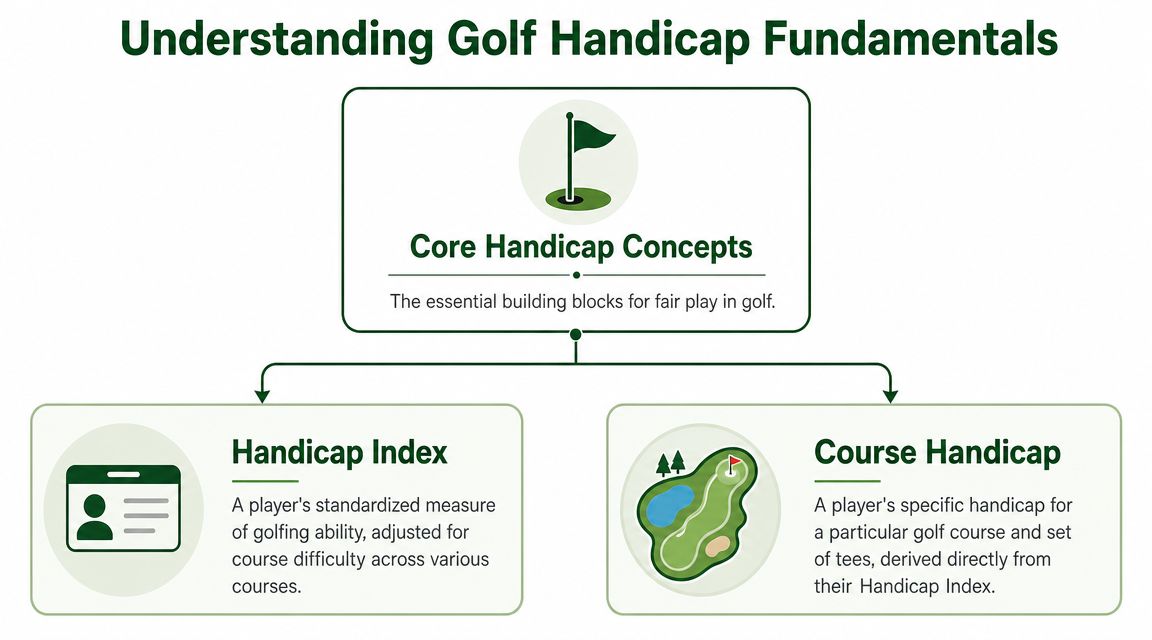
Most scramble handicap problems begin before the scramble formula ever enters the conversation. They start when organizers treat Handicap Index and Course Handicap as if they're the same thing.
They aren't.
A Handicap Index is the player's portable measure of ability. A Course Handicap is the number that applies to a specific course and a specific set of tees. In scramble scoring, that distinction matters because the team allowance should be built from the course-specific number, not from the portable index.
Why averaging indexes doesn't work
A common shortcut is to take four players, average their Handicap Indexes, and call that the team number. It's fast, but it's wrong for a rules-based event.
The reason is simple. Scramble handicapping isn't built as an averaging model. It's built as a course-based, weighted model. Each player first needs to be translated into a course-specific figure, and only then can the team allowance be applied.
The course conversion step exists for a reason. The modern formula used in handicap conversion is Playing Handicap = Exact Handicap × Slope / 113 − CR + Par, as described in PCCaddie's tournament guidance on playing handicap calculation. That means the same player can land on a different usable number depending on the tee and course setup.
Practical rule: If you start with Handicap Index and skip the tee-based conversion, your scramble handicap calculator is already off.
The correct first step
For a fair scramble setup, the workflow starts like this:
Collect each player's Handicap Index
Identify the exact tees being played
Convert each player to a Course Handicap using the tee's Course Rating, Slope Rating, and par
Rank players from lowest handicap to highest
Apply the scramble allowance for that team size
That sequence is what separates a professional event from a casual guess.
What this means in real tournament operations
This isn't just a technicality for association events. It matters in club scrambles, charity outings, and member-guest formats too. If one team is playing from a tee with a meaningful course adjustment and another team handicap was built from raw indexes, the net leaderboard won't reflect the field properly.
The practical takeaway is that a scramble handicap calculator isn't there just to do arithmetic. It's there to enforce the right order of operations. That's the part people miss when they try to build the event in a spreadsheet five minutes before pairings go out.
The Official Scramble Handicap Formulas
Once each player's Course Handicap is in place, the official team allowance becomes straightforward. Many organizers, however, expect one universal percentage and get tripped up. Scramble formats don't use one blanket rule.
The allowance changes by team size. That's important because the format itself changes how much help the team gets from having more players.
The USGA-recommended allowances
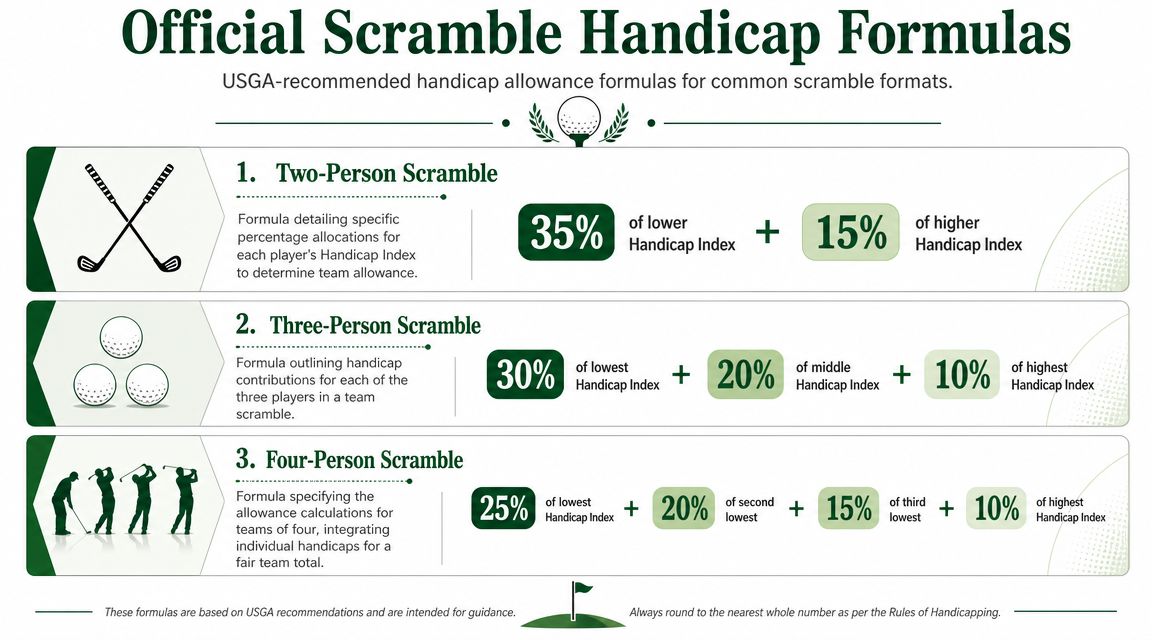
The official workflow is laid out in Appendix C of the USGA handicap allowances guidance. The allowance is applied as the final step after converting each player to a Course Handicap.
Four-player scramble: 25% / 20% / 15% / 10% from the lowest handicap player to the highest
Three-player scramble: 30% / 20% / 10% from the lowest handicap player to the highest
Two-player scramble: 35% / 15% for the low and high player
Those percentages are the part people remember. The part they forget is the ordering. You don't apply them randomly. You rank players from lowest Course Handicap to highest, then apply the allowance shares in that order.
Why the weighting works
A scramble isn't individual stroke play. The team gets multiple attempts at every shot, so the stronger player doesn't need full handicap value to contribute to a fair result. The same is true for the higher-handicap player. Their strokes still matter, but in a scramble they don't carry the same burden they would in solo play.
That's why the formula is weighted instead of averaged. It compresses the team handicap while still recognizing the makeup of the group.
The allowance isn't trying to mirror each player's individual round. It's trying to create a fair team competition.
What operators should use in practice
If you're building event rules today, stick to the published allowance structure unless your committee has a clear reason to adjust it. Consistency matters, especially when players ask how net was produced.
If you need a refresher on the tee-based conversion before applying those percentages, this guide to a USGA course handicap calculator is a useful operational reference.
The big operational lesson is this. A scramble handicap calculator isn't a single formula pasted into a form. It's a rules sequence. Course Handicap first. Team allowance second. Net score after that.
A Worked Example of a 4-Person Scramble
The easiest way to check whether your process is sound is to walk one team all the way through it. Not a vague explanation. An actual team, in order, with each allowance applied to the right player.
For this example, use a four-person team with a realistic spread of abilities. The key is the sequence: convert to Course Handicap first, then rank from lowest to highest, then apply the four-player allowance.
Team setup
Assume the team's Course Handicaps for the tee being played are already established and ranked correctly from lowest to highest.
Player | Handicap Index | Course Handicap | Allowance (%) | Adjusted Value |
|---|---|---|---|---|
Player A | 4.2 | 5 | 25% | 1.25 |
Player B | 9.8 | 11 | 20% | 2.20 |
Player C | 15.3 | 17 | 15% | 2.55 |
Player D | 22.6 | 25 | 10% | 2.50 |
Add the adjusted values and the team playing handicap is 8.50.
How to read the example
This table shows why scramble calculations don't behave like an average. The highest-handicap player may have the largest raw Course Handicap on the team, but their weighted contribution is still limited because the scramble format gives the team multiple chances to produce a good shot.
The low player contributes the largest percentage share, but still not their full number. That's intentional. The formula assumes the best players influence the team result more often, especially off the tee and into greens, so their contribution is weighted differently.
What organizers usually get wrong
The most common mistakes show up right here:
Wrong ranking: applying the largest percentage to the highest handicap instead of the lowest
Wrong input: using Handicap Index instead of Course Handicap
Wrong format: using a four-player allowance for a three-player team with one no-show
Wrong timing: updating pairings but forgetting to rebuild the team handicap
A clean event process fixes all four.
If a player drops out on tournament morning, the team formula changes with the team size. You can't just remove the name and keep the old allowance.
For a broader look at format setup and event structure, this overview of a 4-man scramble is helpful when you're building rules sheets and player instructions.
Why this example matters
When directors say scramble handicaping feels messy, this is usually what they mean. The math itself is manageable for one team. The headache appears when you need to do it across a full field, deal with late substitutions, and make sure every team is being treated the same way.
That's where a dedicated scramble handicap calculator starts earning its place. It standardizes the process so every team is built from the same logic instead of from whoever happened to be standing at the scoring table.
Handling Advanced Scenarios and Edge Cases
Most articles stop at the standard formulas. Real events don't.
The awkward situations are the ones that create disputes. A player has a plus handicap. Two teammates have the same number. A roster includes mixed positive and negative handicaps. Someone rounds each number before the allowance is applied and the final team handicap shifts just enough to matter. Those are tournament desk problems, not theory problems.
Rounding and precision
A precise calculation process needs to preserve precision longer than most manual methods do. According to TrackMan's guidance on team format handicap calculation, each player's Course Handicap should be calculated and rounded to one decimal place before team aggregation, and the final allowance should be applied to the unrounded Course Handicap rather than to prematurely rounded values.
That sounds small. In practice, it isn't. If staff rounds too early, tiny differences accumulate across the field and can affect scoring, flights, and net payouts.
One of the easiest ways to create avoidable scoring noise is to round every step because the spreadsheet is easier to read.
Plus handicaps and mixed-sign teams
Lightweight calculators often struggle in these circumstances. A team with a plus player doesn't fit neatly into a simplistic one-line percentage tool, especially when that team also includes players with positive handicaps.
The right approach is to use a calculator or system that explicitly supports those cases rather than forcing every player into the same assumption. Most generic web calculators are fine for standard teams. They become unreliable when the field gets more varied.
Ties in player ranking
If two players have the same Course Handicap, the practical issue isn't the math itself. It's consistency. Your committee should establish in advance how tied positions are handled in the ranking order for allowance purposes and apply that same rule to every team in the event.
Consistency matters more than improvised fixes at the scoring table. If you decide tied players are treated by listed roster order, do it that way for everyone. If your software uses a fixed internal method, document it in your admin notes and stick with it.
Committee rules still matter
A scramble handicap calculator helps with equity, but it doesn't solve every fairness issue by itself. Committee rules still shape the event.
Consider adding policies like these:
Drive-use requirements: Require each player's drive to be used a minimum number of times when participation balance matters.
Tee assignment clarity: Lock the tees before handicap calculation so staff isn't rebuilding numbers after scorecards are printed.
Roster cutoff rules: Set a deadline for substitutions and explain how a no-show changes the team's allowance formula.
Published scoring policy: State whether net uses the software-calculated team playing handicap exactly as generated.
The strongest tournaments don't rely on percentages alone. They combine accurate handicaping with clear competition rules.
Automating Calculations with Tournament Software
Manual scramble handicaping works for a handful of teams. It starts to fail when the roster changes, players are on different tees, and staff is trying to push out scorecards, cart signs, pairings, and live scoring at the same time.
That's where tournament software changes the job from math management to event management.

What the software should do for you
A professional tool should take a short list of inputs and handle the rest in the correct order. At minimum, that means:
Player data in: names, Handicap Indexes, and tee assignments
Course data applied: Course Rating, Slope Rating, and par for the selected tee
Team logic enforced: ranking low to high and applying the right allowance by team size
Usable output produced: a team playing handicap ready for scorecards and net scoring
That sounds basic, but it's where a lot of event workflows break down. Staff often has the data. What they don't have is a reliable, repeatable system for turning it into clean team handicaps across the whole field.
Why software helps most on the messy stuff
Most public guidance covers standard two-, three-, or four-player teams and leaves the operator to figure out the rest. As noted in this discussion of scramble handicap calculator edge cases, recurring organizer questions tend to center on mixed-team events, plus handicaps, and ties in player ranking. Those aren't fringe issues. They're normal event issues.
This is also where software becomes more valuable than a standalone calculator. A calculator gives you an answer. Tournament software keeps that answer connected to pairings, score entry, and leaderboard output.
What that looks like in practice
In a modern workflow, staff uploads or enters the roster once. The system calculates the team handicap, keeps it attached to the team, and uses that number when gross scores come in and net standings need to update.
One example is Live Tourney's golf tournament scoring software, which is built around event setup, live scoring, and tournament administration rather than just one-off math. That's the practical shift. You're not asking a spreadsheet to impersonate tournament operations. You're using a platform that treats handicaping as one part of the event system.
The real value of software isn't that it can multiply percentages. It's that it keeps the handicap logic consistent when the event gets busy.
Why Accurate Scramble Handicapping Matters
Players will forgive a lot in a scramble. They won't forgive a leaderboard that feels off.
When a team loses net and believes another group got a softer handicap because someone used indexes instead of Course Handicaps, that frustration doesn't stay private. It moves straight to the golf shop, the committee, and next year's registration list.
Fairness is the product
A scramble is supposed to be social, but the competitive side still matters. Good handicaping gives mixed-ability teams a legitimate chance to compete without pretending every roster is equal. It protects the event from the kind of casual shortcuts that make results harder to defend later.
That matters even more in formats where players may not know each other well, like corporate outings and charity events. In those settings, perceived fairness is part of the player experience.
Accuracy also protects staff time
Bad handicap workflows create rework. Staff recalculates team numbers, answers challenges after scoring closes, and explains rules that should have been settled before tee times went out.
Clean calculations do the opposite:
They reduce disputes: the event has a clear and consistent method
They speed up scoring: net results don't need manual cleanup
They improve communication: players understand how their team number was produced
They support professionalism: the operation looks organized because it is organized
The standard players notice
Most golfers won't ask for the full formula. They will notice whether the event feels buttoned up. They notice when scorecards match the format, when net standings update cleanly, and when the staff can explain the handicap method without hesitation.
That's the compelling reason for using a proper scramble handicap calculator and, when the field is large enough, software that applies the logic automatically. The goal isn't to make the event feel more technical. The goal is to make the competition feel credible.
A fair scramble is more fun because players trust it. That's what keeps outings healthy, member events smooth, and repeat participation strong.
If you're tired of rebuilding team handicaps by hand, Live Tourney gives tournament staff a web-based way to manage rosters, scoring, and scramble workflows in one place so the handicap math stays accurate and the event stays organized.





