
Jul 11, 2026
central links golf, golf tournament planning, kansas city golf, golf event management, live tourney
Plan flawless tournaments and outings with our guide to Central Links Golf. Explore course layouts, event capacities, and management tips for the KC area.

You've got dates to lock, a field to manage, sponsors asking for visibility, and players who expect everything to run cleanly from registration through the final payout. That's the situation most tournament directors face when they start planning a Kansas City area event. The hard part usually isn't finding golfers. It's building an operation that feels fair, organized, and professional across every moving part.
That's where Central Links Golf becomes useful in a way many planners miss. It is recognized as a regional golf authority. Fewer use it as an operational framework for better events. If you're running a member championship, charity outing, corporate series, or multi-course amateur competition, the value isn't just the brand. It's the structure behind it, and how that structure can remove friction before your event staff ever sets foot on property.
Your Guide to Planning Events at Central Links Golf
A common planning mistake is treating every course, club, and local golf audience as a separate project. That approach burns time fast. You end up rebuilding registration rules, handicap workflows, eligibility questions, and event communications from scratch.
Central Links Golf gives organizers a more stable base. It isn't a single course operating in isolation. Central Links Golf operates as a unified regional organization in Kansas City, formed through the historical merger of the Kansas Golf Association, the Kansas City Golf Association, and the Kansas Women's Golf Association, creating a single body to link communities across the region through golf through its organizational history. For event planners, that matters because unified governance usually means fewer surprises around standards, competitive expectations, and player familiarity with the system.

Start with the event model
Before you call venues, define which kind of event you're building.
Competitive amateur event: prioritize handicap integrity, tee allocation, and pace-of-play controls.
Corporate outing: prioritize signage flow, sponsor placement, check-in speed, and simple scoring.
Charity fundraiser: prioritize donor experience, on-course contests, and a clean awards cadence.
Multi-day series: prioritize consistency across rounds, rules clarity, and communication discipline.
That sounds obvious, but many event problems come from mixing priorities. A member-style competition run with outing-style shortcuts usually creates disputes. A charity event run like a state qualifier often feels stiff and overbuilt.
Why regional structure helps
In practice, a unified association environment helps in three places.
First, player trust. Golfers are more comfortable when the event feels tied to a recognized regional structure.
Second, administrative consistency. You're not inventing every policy.
Third, scalability. You can build beyond a one-off event and create a repeatable annual format.
Practical rule: If your event could expand next year, build it on systems and standards that already support repeat competition.
If you're still shaping the bones of the event, it helps to work from a planning checklist instead of memory. A solid starting point is this golf tournament planning guide, especially for sequencing deadlines, staffing, and player communications.
Understanding the Central Links Golf Network
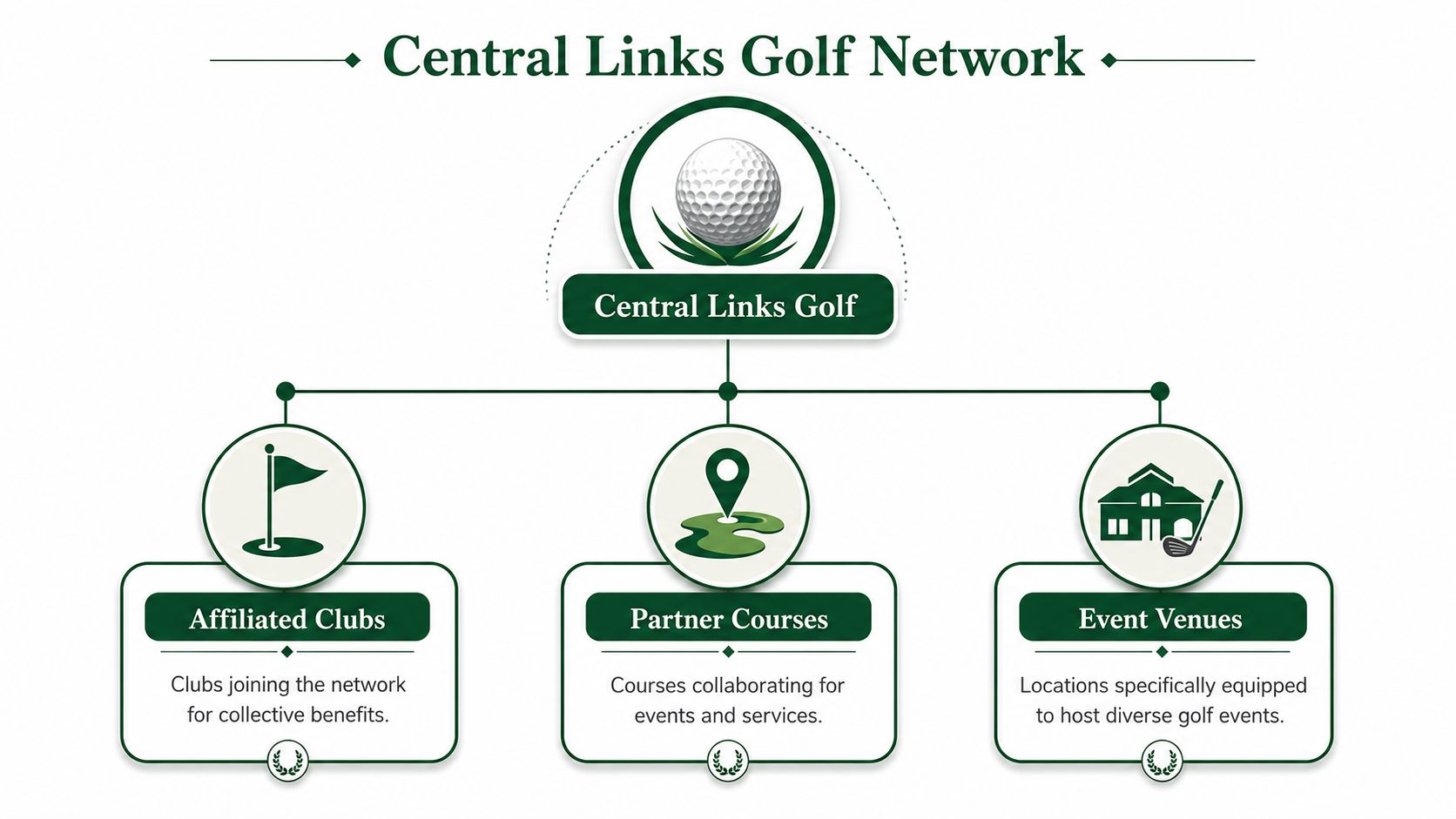
Most organizers hear “Central Links Golf” and think of an association. Operationally, it's more useful to think of it as a network. That network connects clubs, courses, and events under a shared competitive framework rather than leaving each site to operate as its own island.
What the network changes for organizers
The practical benefit is standardization. Central Links Golf provides access to the World Handicap System, and that gives organizers a common language for competition across player types and event formats, as noted on the Central Links Golf site. If you've ever tried to combine players from different clubs without a reliable handicap framework, you know how quickly fairness questions can take over the day.
A networked structure also supports a wider event mix. Central Links Golf documents results for Men's Events, Women's Events, and Junior Events on its historical and competition pages, which signals an established competitive culture across age groups and divisions. That matters when you're deciding whether your event should be open, segmented, invitational, or developmental.
How to think about member clubs and partner venues
Not every course in a regional network plays the same role. As a planner, separate them into three buckets:
Venue role | Best use | What to verify early |
|---|---|---|
Affiliated club | Member-focused competitions and recurring series | Eligibility rules and host support |
Partner course | Public-facing outings or field expansion | Access, traffic flow, and setup flexibility |
Event venue | Flagship championships and sponsor-heavy days | Ceremony space, operations staff, and spectator movement |
That simple filter prevents one of the biggest planning mistakes. A good golf course isn't always a good tournament venue. Some properties handle competition well but struggle with arrival flow, registration space, or post-round gathering. Others are excellent for outings but weak for a serious multi-flight championship.
What works and what doesn't
What works is using the network to reduce variation where variation hurts the event. Registration rules, handicap treatment, division structure, and score submission expectations should feel consistent.
What doesn't work is assuming “regional” means “identical.” Courses still differ. Staff cultures differ. Routing, practice access, food service, and volunteer capacity differ. Strong tournament directors standardize the policy layer and customize the venue layer.
The best events don't erase venue personality. They remove the avoidable confusion around it.
That distinction is why Central Links Golf is useful as a planning backbone. It gives you a shared framework without forcing every event into the same box.
Exploring Key Venues and Signature Holes
Venue selection shouldn't start with prestige alone. It should start with fit. The right course for a charity scramble is often the wrong course for a serious amateur field, and the right test for a strong open division may be a poor choice for mixed-skill participation.
One of the better examples of course character inside the broader Central Links Golf orbit is Sand Creek Station, which Central Links Golf has featured editorially on its blog. For organizers, Sand Creek is a reminder that architecture affects operations. It's not just about aesthetics. It influences pace, scoring spread, setup choices, and how dramatic a leaderboard feels late in the day.
Why architecture matters to event setup
A good tournament venue gives you more than yardage. It gives you decision points. Some courses produce steady, low-volatility scoring. Others create swings that are useful for match play, skins, or spectator interest.
Central Links Golf's course feature notes that Hole 13 is a classic Redan template green complex, with a 45-degree right-to-left oriented approach and a traditional 180–230 yard range, requiring deliberate placement to avoid trouble left, as described in the Central Links Golf blog. That kind of hole matters to organizers because it changes how players of different skill levels experience the same round.
What a Redan means in practice
For a stronger field, a Redan asks for control and angle awareness. Better players may use the slope and accept the architectural challenge. For a mixed field, that same hole can produce a wider spread of outcomes. That isn't bad. It just means you should plan for it.
Use a hole like that to shape event design:
For competitive events: keep hole locations disciplined. Don't compound architectural difficulty with a reckless setup.
For charity or corporate formats: brief players clearly on where the safe miss is.
For live leaderboards: expect scoring variance and build your announcement cadence around meaningful swings.
For pace of play: watch holes that demand recovery shots from difficult collection areas or bunkering.
Matching venue personality to event purpose
A practical venue review should answer four questions:
Does the routing support your format? Shotgun starts, split tees, and crossovers all change the day.
Will the course reward the field you have? Not the field you wish you had.
Can the staff present the course consistently? A hard setup is fine. An uneven one isn't.
Will players remember the round for the right reasons? Strategic challenge is good. Confusion and congestion are not.
Some planners overvalue name recognition. Others overvalue ease. The best choice usually sits in the middle. You want a property with enough character to make the event matter, but not so much operational friction that your staff spends the day solving preventable problems.
Executing Tournaments with Precision
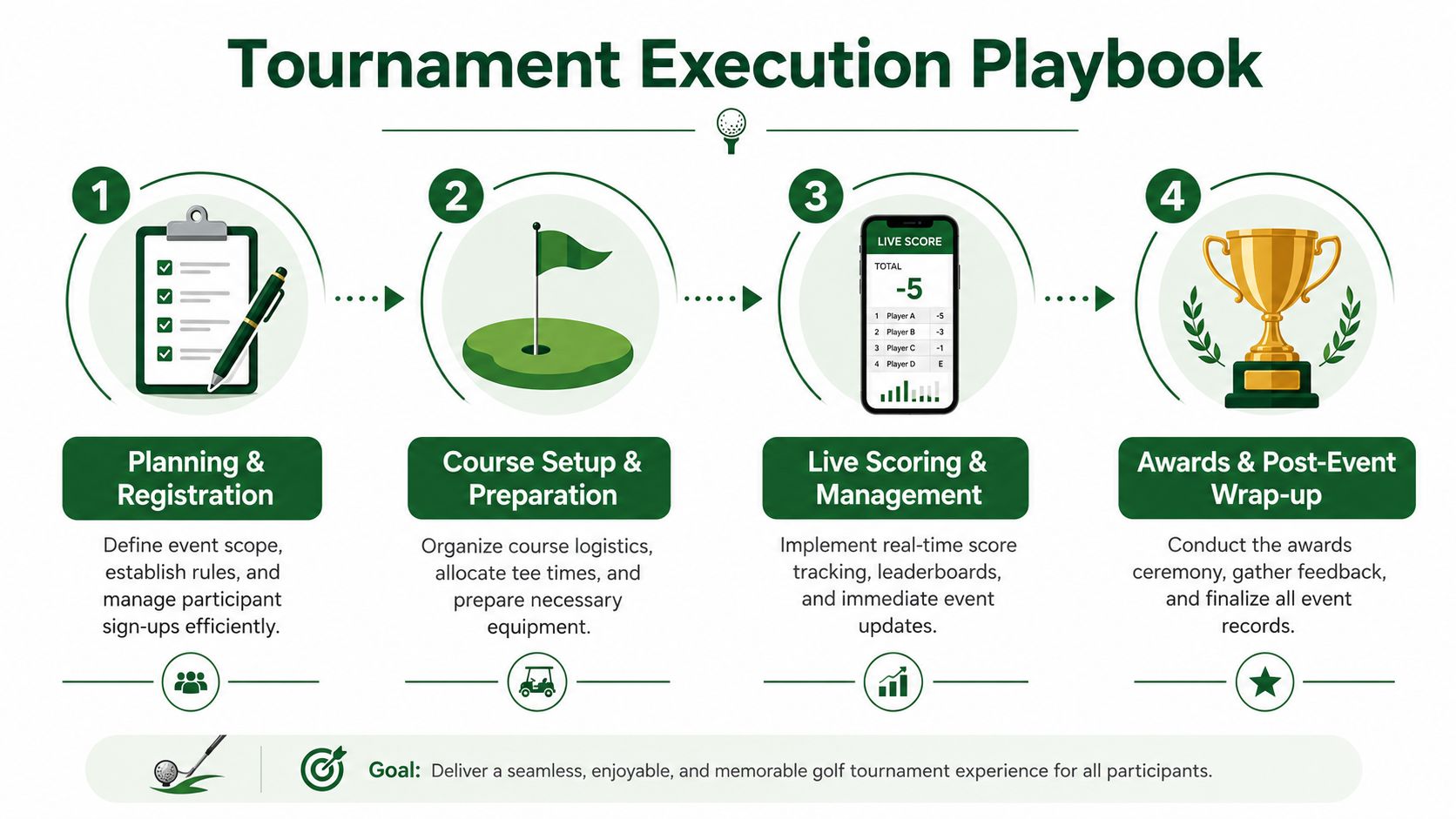
Tournament execution is where good planning usually gets exposed. A clean flyer and a full field don't mean much if players don't understand flights, handicaps, score submission, or playoff procedures. Precision starts before the first tee time.
Central Links Golf uses the official USGA Course Rating System, where Course Rating reflects difficulty for a scratch golfer and Slope Rating measures difficulty for a bogey player, directly affecting normalization inside the World Handicap System, according to the course rating FAQ. For tournament directors, that isn't technical trivia. It's the basis for fair competition when players come from different tees, different clubs, or different playing backgrounds.
Use rating data before you publish pairings
Most handicap disputes don't begin with a complaint. They begin with a setup decision that nobody tested.
Before pairings go out, confirm:
Tee assignment logic: Men's, women's, junior, and mixed divisions should match the competition model.
Net and gross treatment: Decide whether one field can support both cleanly or whether separate competitions are better.
Course setup consistency: If rounds are spread across more than one site or tee, normalize expectations early.
Score posting responsibility: Make it obvious who enters scores, who verifies them, and when they're final.
If you're building your operations sheet, this free template by 1021 Events is a useful companion for timing volunteer briefings, sponsor activations, announcements, and scoring checkpoints. Tournament golf rewards order. Outings do too.
A practical cross-course workflow
The public detail on exactly how Central Links Golf manages cross-course World Handicap System operations is limited. That means event organizers should treat process discipline as their responsibility rather than assuming the system will solve every edge case for them.
Here's the workflow that tends to hold up best in multi-course or rotating-site events:
Lock tee sets early. Don't drift after registration opens unless weather or maintenance forces the change.
Publish competition terms in plain language. Avoid rulebook prose when a direct sentence will do.
Confirm handicap snapshots at a defined deadline. Late movement creates friction.
Train scorers and starters on exceptions. Withdrawals, no-holes, conceded holes in match play, and incomplete cards all need a policy.
Reconcile scores before awards. Never announce official results while staff is still correcting obvious data entry issues.
Field note: Players will accept a difficult result faster than they'll accept an unclear result.
What usually fails on tournament day
The breakdowns are predictable.
One, staff members use different versions of the same rule.
Two, players don't know where to stand, score, or report.
Three, scoring is collected too late to preserve momentum after the round.
A precise event feels calm because the hard decisions were made before check-in opened. Your scoreboard, your printed materials, your starter script, and your awards notes should all say the same thing. If they don't, players find the gap immediately.
Keep the event legible
Execution isn't just correctness. It's clarity.
Use a short player notice for:
Format
Tees
Handicap basis
Tiebreak method
Score submission method
Awards timing
That single page often saves more staff time than any emergency fix later in the day.
Event Logistics Facilities and Amenities
Players judge an event before the first swing. They judge it in the parking lot, at bag drop, at registration, and in the ten minutes when nobody seems sure where the announcements will happen. That's why logistics and amenities deserve the same attention as pairings and rules.
Central Links Golf has the kind of financial stability that signals operational maturity. As a non-profit, it reported $2.2 million in total revenue and $2.2 million in total expenses in 2023, with 87% of resources directed to program services, according to its 2023 Form 990 reporting summary. For event planners, that matters because organizations with real program infrastructure tend to support tournaments with more consistency, better process, and clearer administrative follow-through.
What to inspect during a site visit
Don't stop at the golf holes. Walk the event path.
Arrival flow: Can guests find check-in without staff escorting every third car?
Registration space: Is there room for lines, sponsor tables, and late changes?
Awards setup: Can the property transition from golf to ceremony without chaos?
Food and beverage staging: Are meal service and score reconciliation competing for the same space?
On-course support points: Where do volunteers, contests, hydration, and signage reside?
This is also where planners should think harder about safety. Crowd flow, parking control, vendor access, and emergency pathways often get less attention than they should. A concise outside reference on essential event safety strategies can help sharpen that review before contracts are finalized.
Amenities that actually improve the day
Not every add-on makes the event better. Some just create clutter.
The amenities that usually matter most are:
Clear staging areas for registration, announcements, and awards
Visible directional signage so guests don't keep asking staff where to go
Reliable cart and bag handling when the field is large or sponsor-heavy
Course maps that help golfers and volunteers move with less confusion
A custom visual layout often solves more problems than another email reminder. This guide to a custom golf course map is useful for planners who want cleaner routing for sponsors, contests, hospitality spots, and player wayfinding.
Good logistics are mostly invisible. Bad logistics become the story of the event.
When you evaluate a Central Links Golf venue or affiliated host, ask one simple question. Can this property support the full event experience, not just the round itself? If the answer is yes, operations get easier fast.
Streamline Your Event with Live Scoring
The old scoring model still shows up in too many events. Paper cards move slowly. Staff rekey results under pressure. Players gather around a manually updated board and wait for someone to confirm whether the numbers are final. That process can work, but it rarely feels modern, and it breaks down faster when the field is spread across divisions or venues.
That's why live scoring has become less of a luxury and more of an expectation. For events connected to a structured environment like Central Links Golf, live scoring works best when it supports the tournament framework instead of competing with it.
What modern scoring fixes
Live Tourney was launched in 2022 by a Seattle-based software engineer and golf enthusiast, and it has powered over 10,000 events and scored more than one million holes across the United States and Canada, according to this Live Tourney vendor profile. The practical point for organizers isn't the launch story. It's that app-free access lowers friction for players and guests.
That matters on tournament day because fewer barriers usually mean better score reporting and faster leaderboard movement.
Where it fits in a Central Links Golf event
Use live scoring to make the event easier to follow, not harder to manage.
A smart setup usually includes:
Simple player access so no one has to download anything at check-in
Real-time leaderboard visibility for flights, divisions, or team standings
Cleaner scoring control when staff needs to verify entries quickly
Faster post-round transition into awards and wrap-up
For planners looking at scoring workflows in more detail, this article on golf score tracking is a practical reference for organizing score entry, leaderboard visibility, and staff verification.
The key trade-off is straightforward. Live scoring adds speed and visibility, but only if your event rules, pairings, and player instructions are already clean. Software won't rescue a muddy format. It will, however, make a well-built event feel sharper from the first hole through the final result.
Your Blueprint for a Flawless Golf Event
The strongest way to use Central Links Golf is to stop viewing it as just a regional name and start using it as an operating advantage. Its unified structure helps planners reduce fragmentation. Its competitive framework supports fairer events. Its broader ecosystem makes it easier to build formats that can grow instead of resetting from zero every year.
A flawless event usually comes down to a short list of decisions made well.
The blueprint that holds up
Choose the right event model first. Don't let a charity outing drift into a rules-heavy competition, or a serious amateur event drift into casual outing habits.
Pick venues by fit, not reputation alone. Routing, staging, and player flow matter as much as course quality.
Set handicap and competition policies early. Clarity beats improvisation every time.
Walk the full guest journey. Parking, check-in, announcements, food service, and awards all shape how the day is remembered.
Use technology to sharpen the operation. Live scoring is most effective when the event foundation is already disciplined.
What experienced organizers know
Experienced tournament directors don't chase perfection in the abstract. They remove uncertainty. They make the day easy to understand for players, sponsors, volunteers, and staff. That's what separates a polished event from a stressful one.
Build the rules once. Train the staff once. Communicate it clearly. Then let the golf carry the day.
That's the practical value of Central Links Golf. It gives you a stronger base for event delivery. Pair that with clean logistics and modern scoring, and you don't just run a tournament. You run one that players trust, sponsors respect, and staff can repeat without rebuilding the system from scratch.
If you want a simpler way to run registration, live scoring, leaderboards, and tournament operations, Live Tourney is worth a look. It's built for organizers who want a modern, app-free setup that keeps staff efficient and players engaged from check-in to final results.





