
Jan 17, 2026
Master scoring in golf tournament formats like Stroke Play and Stableford. This guide covers gross vs. net scores and modern workflows for a flawless event.

To really get a handle on modern golf scoring, you have to appreciate just how much the definition of a "good score" has changed. Today's hyper-competitive tournaments, where winners often finish 20 strokes under par, are a completely different world from golf’s early days.
Understanding this shift gives you the context for why precise, real-time scoring has become an absolute must-have for running a successful modern event.
How Golf Scoring Has Evolved Over a Century

Try to imagine a time when winning a major championship meant finishing dozens of strokes over par. That was the reality for the first pros, who were playing with primitive clubs and balls on courses that were a far cry from today’s perfectly manicured layouts. The expectation of what a winning score even looks like has been totally transformed, and that directly impacts how we manage and experience tournaments.
This evolution is really a story told in numbers, revealing a century of progress in every corner of the game. For a tournament director, this isn't just trivia—it frames the modern challenge of setting up a course that's both fair and competitive.
A Tale of Two Champions
You can see the dramatic shift in scoring standards by comparing two U.S. Open champions separated by just over 100 years. It’s a perfect illustration of how far the game has come.
Back in 1906, when the tournament first set an official par, Alex Smith won with a final score of 295. That was a staggering 33 strokes over par. Fast forward to 2011, and Rory McIlroy took home the same trophy with an unbelievable 268—a full 20 strokes under par.
That 53-stroke swing shows just how much better equipment, pristine course conditioning, and modern training methods have changed the game. If you're a history buff, you can dig into more of these incredible stats in the USGA's official records.
Understanding this history helps organizers appreciate why today’s players expect instant, accurate results. The margin for error has shrunk, and the demand for professional-grade scoring has grown exponentially.
This pressure to perform hasn't just stayed at the elite level. It has trickled down to every kind of event, from the Saturday club championship to the annual charity scramble. Players, sponsors, and spectators now expect a seamless, professional experience, which makes an efficient and transparent scoring system an absolute necessity.
Choosing the Right Golf Scoring Format
The scoring format you pick for your tournament does way more than just decide a winner—it sets the entire vibe for the day. Is this a casual, fun-first charity event? Or a serious, down-to-the-wire club championship? The format is the bedrock of the player experience.
Get it right, and everyone from scratch golfers to high-handicappers will have a blast. This one decision shapes the pace of play, the competitive feel, and the overall atmosphere. It's all about matching the game to your event's goals.
Individual Scoring Formats Explained
When the focus is on a single player's performance, two formats reign supreme. And they couldn't be more different in the kind of pressure they create.
Stroke Play is the purest test in golf. Think of it as a marathon where every single shot counts. Each player is in their own battle against the course and the field, and the goal is simple but brutal: post the lowest score possible. This is the format of choice for pro tours and serious championships because it rewards consistency from the first tee to the 18th green. There’s nowhere to hide.
Match Play, on the other hand, is a head-to-head duel. Forget your total score. You're only playing against one other person, one hole at a time. It’s a series of 18 one-hole battles, and you win a hole by scoring lower than your opponent. The player who is "up" by more holes than are left to play wins the match. It’s perfect for creating those dramatic, mano-a-mano showdowns.
Quick Guide to Popular Golf Scoring Formats
For tournament organizers, just knowing the basics isn't enough. You need to know why you'd choose one format over another. This table breaks down the essentials to help you make the right call for your event.
Format | Objective | Best For | Key Feature |
|---|---|---|---|
Stroke Play | Lowest total score over 18 holes. | Serious competitions, club championships. | Every shot counts equally, rewarding consistency. |
Match Play | Win more individual holes than your opponent. | Ryder Cup-style events, knockout brackets. | Creates intense, one-on-one drama on every hole. |
Scramble | Lowest team score per hole, playing from the best shot. | Charity events, corporate outings, casual fun. | Low-pressure and fast-paced; great for all skill levels. |
Best-Ball | Lowest individual score on the team counts for each hole. | Member-guests, team leagues, competitive outings. | Blends individual play with team strategy. |
Stableford | Highest point total, not the lowest score. | Fun leagues, events with varied skill levels. | Encourages aggressive play since a blow-up hole won't kill your round. |
Skins | Win holes outright to collect "skins" (prizes). | Competitive groups, high-stakes matches. | Creates pressure-packed moments as pots carry over. |
Ultimately, your choice boils down to a single question: what kind of experience do you want to create for your players? Once you have that answer, picking the right format becomes a whole lot easier.
Popular Team-Based Formats
When you want to emphasize fun and camaraderie, team formats are the only way to go. They’re a perfect fit for corporate outings, fundraisers, and social leagues where a good time is the main goal.
Here are the heavy hitters:
Scramble: This is the undisputed king of charity tournaments for a reason. Everyone on the team tees off, you pick the best drive, and everyone hits their next shot from that spot. You repeat this until the ball is in the hole. It's fast, it’s low-pressure, and it lets golfers of all abilities feel like they're contributing.
Best-Ball (or Four-Ball): In this format, everyone plays their own ball from tee to green. At the end of the hole, the team simply writes down the best score made by any one player. It's a great blend of personal accountability and team support—you’re on your own, but your partners have your back.
A key part of scoring in a golf tournament is aligning the format with your audience. A Scramble is perfect for a relaxed charity event with novice golfers, while Stroke Play is the only choice for a club championship that needs to identify the single best player.
Unique Scoring Systems for Added Excitement
Want to shake things up? Some scoring systems change how shots are valued, adding a completely different strategic layer to the competition.
The Stableford system flips scoring on its head. Instead of chasing the lowest score, players are trying to rack up the most points. Points are awarded based on your score relative to par (e.g., 1 point for a bogey, 2 for a par, 3 for a birdie). The beauty of Stableford is that one disastrous hole won't sink your entire round. A triple bogey just means zero points, so players are encouraged to go for it.
Another great option for creating buzz is a Skins Game. Here, every hole is worth a "skin," which usually has a cash value. The player with the outright lowest score on a hole wins the skin. If there's a tie, the skin rolls over to the next hole, raising the stakes and creating some seriously tense moments.
Making Sense of Gross Versus Net Scoring
If you've ever run a tournament, you know that handicapping is the soul of fair competition. It’s what lets a weekend warrior tee it up against a scratch golfer and still have a shot at winning. But explaining it can feel like a pop quiz in algebra.
The whole thing boils down to one key difference: the gross score versus the net score.
Think of the gross score as the raw number. It's exactly how many strokes a player took to finish their round, plain and simple. If they shot an 85, their gross score is 85. It’s a pure measure of performance on that specific day, but it definitely doesn't tell the whole story.
The handicap system is what levels the playing field. It applies an adjustment to that raw score, giving you the player's net score.
Calculating the Net Score
A player's handicap isn't just some number pulled out of a hat. It's a calculated average that reflects their potential skill. When you apply that handicap to their gross score, you get the net score—the number that really matters in a handicapped event.
The formula is as straightforward as it gets: Gross Score - Course Handicap = Net Score.
Let's walk through a quick example. Say a player has a Course Handicap of 15. They battle through a tough round and card a gross score of 90.
Gross Score: 90 (the actual strokes they took)
Course Handicap: 15 (their handicap for that specific course)
Net Score: 75 (which is just 90 - 15)
So, for this tournament, that player’s competitive score is a 75. This is what allows them to go head-to-head with a scratch golfer who might shoot a gross 76. Because the scratch player has no handicap, their net score is also 76, and our 15-handicap player wins the day.
Getting these details right on the scorecard is key. For more on that, check out our guide on how to design the best golf scorecard for any event.
Mastering the difference between gross and net scoring is fundamental for any organizer. It's the mechanism that ensures inclusivity, allowing every participant, regardless of skill, a genuine chance to win.
Why This Matters for Your Event
Really getting this distinction helps you choose the right format and set your tournament up for success from the start. You can even run both a gross and a net competition at the same time, awarding prizes for the best raw score and the best handicapped score.
This flowchart can help you decide which direction to go based on your event’s main goal.
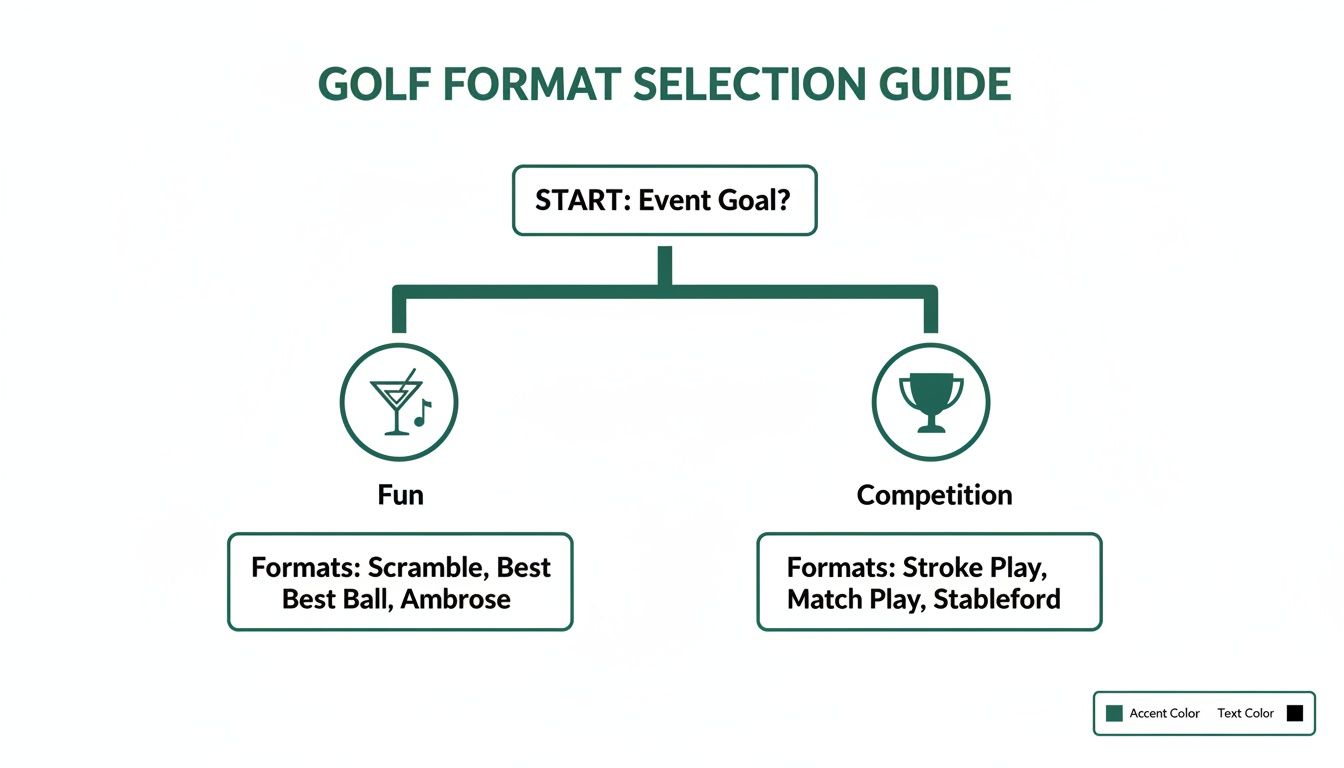
As you can see, formats like scrambles are a perfect fit for fun-focused, casual outings. But if you're running a true competition, something like stroke play with net scoring is where you want to be. Having this clarity from the beginning ensures you create the right vibe for your players.
From Manual Scorecards to Modern Automation
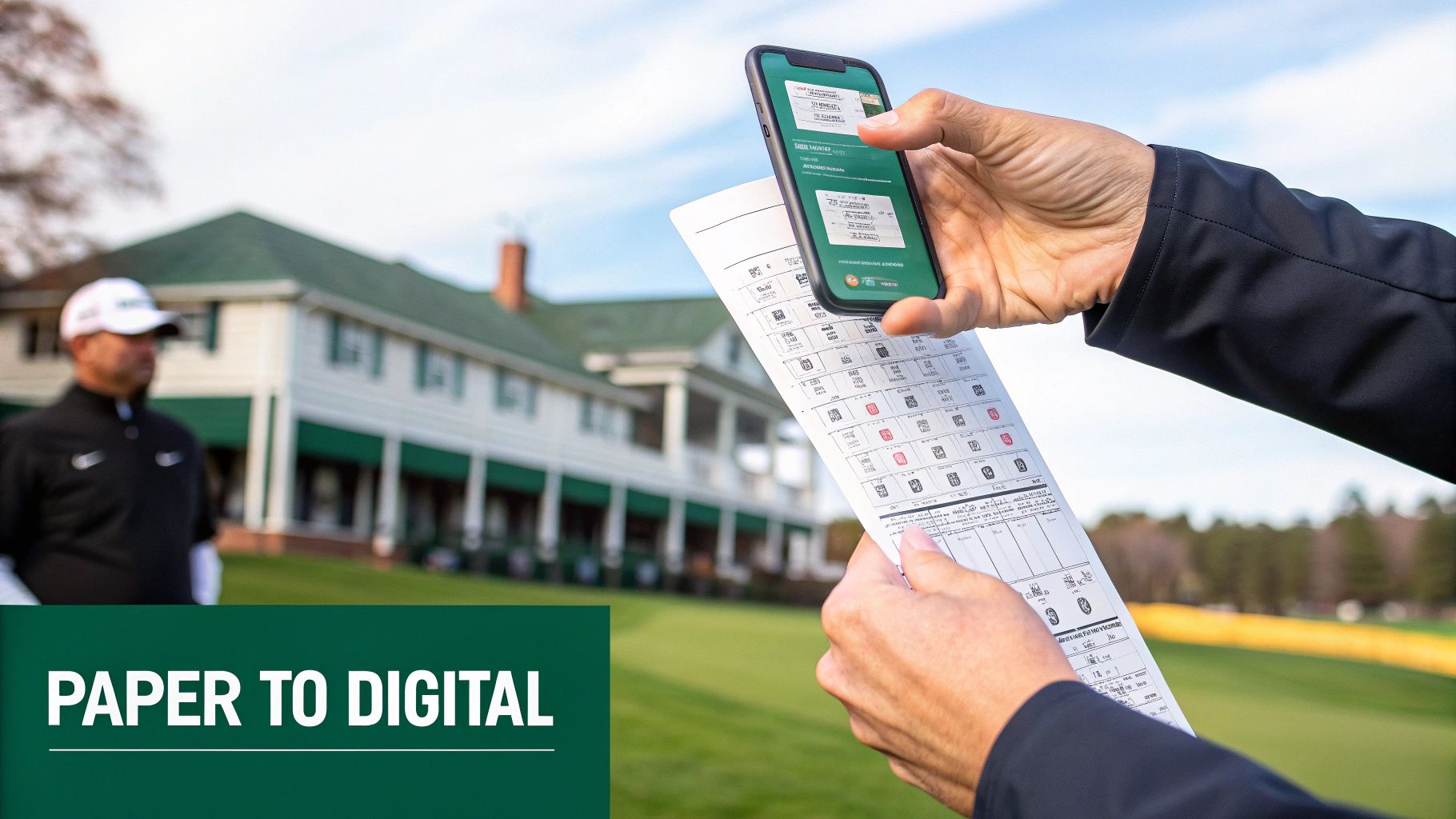
The journey a single score takes from the 18th green to the final leaderboard tells a story about how much tournament operations have changed. For decades, it was a frantic, manual scramble. The process created a ton of stress for staff and a long, boring wait for players.
Thankfully, modern automation has completely changed the game.
To really appreciate how much things have improved, let's look back at the old way. This manual workflow was the standard for years, defined by paper, pens, and a whole lot of patience.
The Traditional Scoring Workflow
The classic approach to scoring in a golf tournament was a high-stakes, multi-step process that always felt like a race against time. The pressure on tournament staff was immense, especially with a clubhouse full of antsy players waiting for results.
Here’s what it usually looked like:
Card Collection: Staff would post up to collect paper scorecards as each group finished their round.
Deciphering Handwriting: The next challenge was just trying to read the scores, which were often hastily scribbled and sometimes completely illegible.
Manual Data Entry: One or two people would then sit at a computer, painstakingly punching in scores from each card into a clunky spreadsheet.
Posting Results: Finally, results were printed out and physically tacked onto a board for everyone to crowd around.
This system was just asking for human error. A misread score, a simple typo during data entry—a single mistake could incorrectly decide a flight winner. That creates an awkward and unprofessional situation that’s nearly impossible to fix after the fact. The whole process was slow, inefficient, and stressful for everyone involved.
The Seamless Modern Approach
Now, contrast that mess with the smooth flow of a modern, automated system. The post-round rush is gone, replaced by instant, accurate results delivered in real-time. It’s a completely different world for organizers and players alike.
Picture a player tapping in their final score on the 18th green. Instead of hiking to a scoring tent, they just enter it on their phone using a simple web link—no app download needed. In that instant, the work is done.
The moment a score is entered on a player's device, it's reflected on live leaderboards for everyone to see, whether they're in the clubhouse, on the course, or following from home.
This isn't just about making things easier; it fundamentally improves the integrity and feel of the event. Automation gets rid of transposition errors, calculation mistakes, and the dreaded illegible scorecard. Your staff is freed up from tedious data entry to focus on what actually matters: interacting with players and making sure they have a great time.
This modern workflow transforms scoring in a golf tournament from a bottleneck into a highlight. By adopting the right golf tournament scoring software, you deliver the immediate, professional experience that today's golfers expect, all while saving your team hours of work.
How Live Scoring Elevates the Tournament Experience
Live scoring is so much more than just a digital replacement for paper and pens. It completely changes the feel of your event. For players, seeing a leaderboard update in real time creates a dynamic, professional atmosphere that you just can't get any other way.
It’s the difference between waiting around for an hour after the round to see how you did, versus knowing exactly where you stand the moment your final putt drops. That real-time feedback keeps everyone—from players to sponsors—locked into the action and adds a layer of excitement that traditional methods miss entirely. For organizers, the benefits are even bigger, turning a logistical nightmare into a smooth, seamless operation.
A Better Experience for Players
The most obvious upgrade live scoring brings is the thrill of the chase. Golfers can track their own position, see what their buddies or rivals are doing, and feel the pressure and excitement of a professional-style event. It keeps them engaged from the first tee to the final green.
Modern platforms like Live Tourney make this ridiculously simple. Players just click a web link to score—no mandatory app downloads, no friction. This simple approach means more people actually use it, creating a better experience for everyone, including the least tech-savvy players in your field.
Live scoring brings the tournament to life. It shifts the focus from a slow, manual post-round process to an interactive, real-time competition that elevates player enjoyment and creates lasting memories.
When you deliver this kind of modern experience, you’re not just running another tournament. You’re creating an event that players will be talking about long after it's over, and one they'll be eager to return to next year.
Smarter Operations for Organizers
For your staff, the impact of live scoring in a golf tournament is a total game-changer. It automates the most tedious and error-prone tasks, freeing up your team to focus on what matters: hospitality and making sure the players have a great time.
Here’s a quick look at how it improves your workflow:
No More Manual Entry: Scores are entered by the players themselves. That means no more hours spent trying to decipher sloppy handwriting or punching numbers into a spreadsheet.
Instant, Accurate Results: All the math for gross, net, and side games is handled automatically. The results are right, every single time.
Faster Tournament Wrap-Ups: With results finalized the moment the last group finishes, you can head straight to the awards ceremony and wrap up the event in record time.
You also get access to detailed analytics. Just look at the pros—modern PGA Tour stats show Scottie Scheffler with a scoring average of 67.99 strokes per round, a level of detail that shows the power of precise data. You can find more incredible performance stats in the PGA Tour's official data hub.
Ultimately, a smooth scoring process reflects well on your entire operation. It shows a level of professionalism and a commitment to giving players the best possible experience, a topic we dive into deeper in our overview of modern golf tournament management software.
Common Questions About Golf Tournament Scoring
No matter how well you plan, a few questions always seem to pop up in the middle of a tournament. Being ready with the right answers is what separates a good event from a great one. Let’s tackle some of the most common scoring questions so you can run your tournament like a seasoned pro.
Think of this as a quick-reference guide to handle those tricky situations. A little prep here goes a long way in making sure every player feels the event is fair, organized, and running without a hitch.
What Is the Best Way to Break a Tie?
Let's be honest, nobody wants to deal with the logistical headache of a sudden-death playoff. The easiest and most accepted way to settle a tie is with a scorecard playoff. It's a simple, pre-determined formula that breaks the tie without anyone having to play another hole.
The USGA-recommended method is the standard you'll see almost everywhere:
Back Nine: First, compare the total scores from holes 10-18.
Last Six: Still tied? Look at the scores from holes 13-18.
Last Three: If it's still a deadlock, check the scores on holes 16-18.
Final Hole: And if you can believe it, if they're still tied, the score on the 18th hole decides the winner.
The best part? Modern tournament software does this for you instantly. No manual counting, no mistakes.
How Do You Handle Multi-Round Tournament Scoring?
For tournaments that span multiple days, the scoring is cumulative. It’s as straightforward as it sounds: you just add up a player's total score from each round to get their final result. This method is all about rewarding consistency.
The same logic applies to net competitions. A player's Course Handicap is applied to their gross score each day to get a daily net score. Then, you just add up those daily net scores. This is where tournament software becomes a lifesaver, as it handles all the math and keeps the leaderboards updated in real-time.
It’s worth remembering that under the Rules of Golf, every player is responsible for their own hole-by-hole scores. If a player signs for a score lower than what they actually shot on any hole, they are immediately disqualified.
What Happens with an Incorrect Scorecard?
This is a classic rules question. What if a player signs for a score that's higher than they actually shot? In that case, the higher score stands. There's no penalty, but they're stuck with that higher number.
This rule really highlights why score verification is so important. Live scoring systems have changed the game here, since scores are entered and confirmed after each hole. Potential mistakes get caught long before anyone puts a pen to a final scorecard.
Can You Use Multiple Scoring Formats in One Event?
Absolutely! In fact, it’s one of the best ways to make an event more fun and engaging for everyone. A lot of tournaments will have a main competition, like a team Scramble, but also run a few side games at the same time. Think individual Gross score, a Skins game, or Closest to the Pin contests.
Good tournament software makes this incredibly simple. You can run multiple competitions simultaneously from a single score entry, and the system automatically calculates the results for every format. No extra work for you, and a lot more fun for the players.
Ready to eliminate scoring errors and run a more professional event? With Live Tourney, you can set up your tournament in minutes and give players the live scoring experience they love—no app download required. Start your free 10-day trial and see how simple tournament management can be.





