
Jan 27, 2026
Master golf scoring. This guide to scoring in golf explained covers stroke play, match play, handicaps, and formats for flawless tournament management.
At its heart, scoring in golf is simple: you count every swing you take to get the ball in the hole. The winner is the player who does it in the fewest strokes possible. That single principle is the foundation for everything else, from casual weekend games to the pressure-cooker of a professional tournament.
Building Your Foundation in Golf Scoring
Before you can make sense of tournament leaderboards or different game formats, you have to get comfortable with one key idea: Par.
Think of Par as the target score for any given hole—it's the number of strokes an expert golfer is expected to take. It’s the official benchmark, and every shot you take is measured against it.
Each hole is assigned a Par of 3, 4, or 5, mostly based on its length. Add up the Pars for all 18 holes, and you get the course's total Par, which is usually around 72. Your score on a hole isn't just a number; it's described by how it relates to that target.
The Language of Scoring
Nobody just says they got a "one under par." Golf has its own colorful language that makes the game feel unique and helps you communicate scores quickly. Getting these terms down is the first step to feeling like you belong on the course.
To get you started, here’s a quick rundown of the essential terms that describe your performance on a single hole, all based on that hole's par.
Core Golf Scoring Terms at a Glance
Term | Score Relative to Par | Description |
|---|---|---|
Eagle | -2 | Two strokes under par (e.g., a 3 on a Par 5). A huge accomplishment. |
Birdie | -1 | One stroke under par (e.g., a 3 on a Par 4). The goal on every hole. |
Par | E (Even) | Matching the expected score (e.g., a 4 on a Par 4). A solid, satisfying result. |
Bogey | +1 | One stroke over par (e.g., a 5 on a Par 4). A common miss for amateurs. |
Double Bogey | +2 | Two strokes over par (e.g., a 6 on a Par 4). Usually means a mistake was made. |
Once you understand these, you can see how an entire round comes together. It’s all about adding up your performance against par.
The ultimate goal in stroke play is to finish with a total score that is as far "under par" as possible. Professional golfers often finish tournaments with scores like -15, meaning they were fifteen strokes better than the combined par for all rounds.
This plus/minus system is the universal way to track where you stand. If you shoot a 90 on a par-72 course, your score is +18, or "18 over par." Knowing how to track these scores is critical, and you can learn more about the best golf scorecard practices in our complete guide.
Stroke Play vs. Match Play: Two Sides of the Same Coin
While par, birdie, and bogey are the language of a single hole, the game itself is usually played one of two ways. These formats, Stroke Play and Match Play, completely change the strategy, the pressure, and the feel of a round.
Think of it this way: Stroke Play is a marathon. Match Play is a series of sprints.
In Stroke Play (sometimes called Medal Play), every single shot counts from the first tee to the final putt on 18. Your goal is to post the lowest total score for the entire round. It’s you against the entire field, and one or two blow-up holes can absolutely wreck your day.
Match Play, on the other hand, is a head-to-head duel. You’re playing against one opponent, and the only thing that matters is winning more individual holes than they do. Each hole is its own self-contained battle. The total score for the round? Completely irrelevant.
A Tale of Two Formats
Let’s see how this plays out with a quick example. Imagine two golfers, Player A and Player B, playing a three-hole stretch where every hole is a par 4.
Hole 1: Player A makes a birdie (3). Player B makes a par (4).
Hole 2: Player A rolls in another birdie (3). Player B again makes par (4).
Hole 3: Disaster strikes. Player A cards a triple-bogey (7), while Player B gets away with a bogey (5).
So, who won? It depends entirely on the format.
Match Play Result: Player A won the first hole. Then they won the second. They lost the third. The final score of the match is Player A is "1 up." They won the match. That ugly triple bogey only cost them a single hole, nothing more.
Stroke Play Result: Player A’s three-hole total is 13 (3+3+7). Player B’s total is also 13 (4+4+5). It’s a tie. In this format, Player A's brilliant start was completely wiped out by one terrible hole.
This little scenario gets right to the heart of it.
Stroke Play is the ultimate test of consistency. It rewards patience and damage control because every shot matters. This is why you see it in most professional tournaments, like The Masters and the U.S. Open, where the champion is the one who holds it together for 72 holes.
Match Play encourages a more aggressive, go-for-broke mindset. Have a bad hole? Who cares. Shake it off and go win the next one. This format creates incredible drama and is famous for its use in the Ryder Cup, where the hole-by-hole showdowns make for fantastic viewing.
How the Handicap System Creates Fair Competition
One of golf's most brilliant features is its ability to let a scratch golfer and a total beginner compete on a level playing field. This magic is all thanks to the handicap system, the sport’s great equalizer. If you're running a tournament, understanding how it works is the key to creating an event where every single player feels like they have a real shot at winning.
It all boils down to two simple ideas: Gross Score and Net Score.
Your Gross Score is exactly what it sounds like—the actual number of strokes you took to finish the round. No magic there. Your Net Score, on the other hand, is where the handicap comes in. It’s your Gross Score minus the strokes your handicap gives you.
That one little adjustment is what makes it all work. It shifts the competition from being about who's the best golfer, period, to who played the best relative to their own ability.
Gross Versus Net in Action
Let's say two friends, Sarah and Mike, are playing in a club tournament. Sarah is a solid player with a Course Handicap of 8. Mike is still finding his game and plays off a Course Handicap of 22.
After 18 holes, Sarah shoots an 84, and Mike shoots a 98.
If you just look at the raw strokes (the Gross Score), Sarah wins easily. But the handicap system tells a much different story.
To get their Net Score, we just subtract their handicap from their gross.
Sarah’s Net Score: 84 (Gross) - 8 (Handicap) = 76
Mike’s Net Score: 98 (Gross) - 22 (Handicap) = 76
It’s a tie! In the eyes of the tournament, Mike’s 98 was just as impressive as Sarah’s 84, given their different skill levels. This Net Score is what decides the winner in most amateur and club events, keeping things fair and fun for everyone.
Here's how that looks in a typical leaderboard scenario.
Gross Score vs Net Score Example
Player | Gross Score (Actual Strokes) | Course Handicap | Net Score (Gross - Handicap) | Result |
|---|---|---|---|---|
Sarah | 84 | 8 | 76 | Tie |
Mike | 98 | 22 | 76 | Tie |
This simple table shows why the handicap system is so crucial—it rewards performance, not just raw talent, making the tournament a true test of who played their best on the day.
Key Takeaway: Net scoring turns a simple skills contest into a measure of performance against personal potential. It’s what lets a 22-handicap genuinely go head-to-head with an 8-handicap.
The World Handicap System (WHS), rolled out in 2020, has made this even more consistent across the globe. Before the WHS, the scoring gap between high and low handicap players was pretty wide. Now, data shows that the average difference in competition scores has shrunk from almost 13 points to just under 2. You can read more about the WHS's impact on GolfMonthly.com. It's clear the system is working.
For tournament organizers, calculating all these net scores used to be a headache. Thankfully, modern tournament software like Live Tourney does all the math for you, instantly. It takes the manual work off your plate so you can focus on running a great event where every golfer has a chance to see their name at the top of the leaderboard.
Exploring More Engaging and Popular Tournament Formats
While Stroke and Match Play are the bedrock of competitive golf, there's a whole world of other formats out there. These alternatives are designed to inject a little more excitement, speed things up, or just make a social round more interesting. Moving past the basics lets you get creative and tailor an event that people will actually remember.
This infographic lays out the two fundamental paths in scoring: Gross Score vs. Net Score.
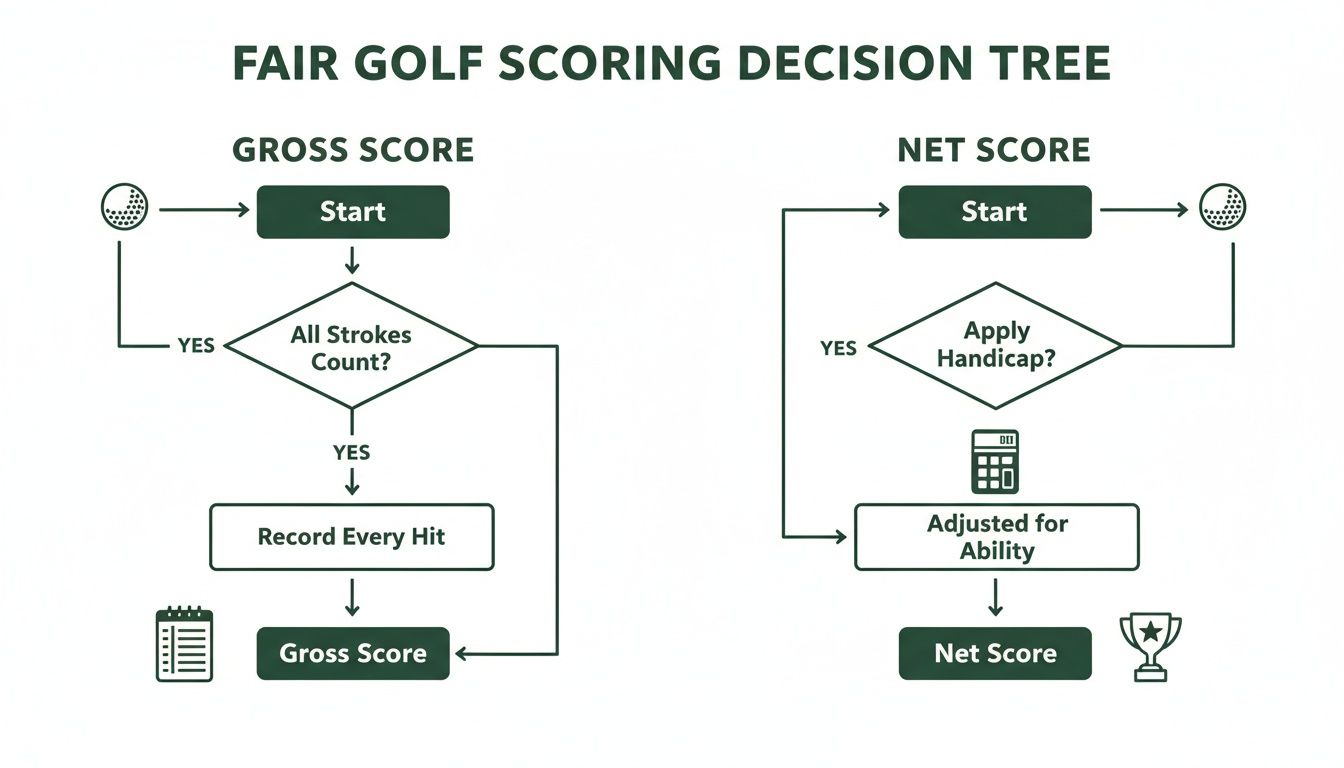
As you can see, the handicap is the key that unlocks fair play, turning a player's raw Gross Score into a competitive Net Score.
Stableford Scoring
The Stableford format is all about encouraging aggressive, go-for-it golf. Instead of counting every stroke, players earn points based on their score for each hole. Have one disastrous hole? No problem. You just get zero points for it and move on, so it can't torpedo your entire round.
Here’s how the points usually break down:
Double Bogey or worse: 0 points
Bogey: 1 point
Par: 2 points
Birdie: 3 points
Eagle: 4 points
The winner is simply the player with the highest point total. It's a fantastic format for keeping the pace of play up and is way less intimidating for higher-handicap golfers.
Skins Game
A Skins game is a high-stakes, hole-by-hole battle. Think of it as a series of winner-take-all showdowns. Each hole is worth a "skin," which could be a cash prize or just bragging rights. To win the skin, a player has to have the single lowest score on that hole.
If two or more players tie for the best score, the skin carries over to the next hole. This is where the real drama happens—suddenly one putt could be worth five or six skins. It's the perfect format for a small, competitive group looking to add a little pressure to the round.
Nassau Format
The Nassau is basically three matches rolled into one tidy package. It's a match play competition where you have three separate contests going on simultaneously:
Who wins the front nine.
Who wins the back nine.
Who wins the overall 18-hole match.
This clever structure keeps everyone in the game, even if they have a rough start. A terrible front nine doesn't matter because the back nine is a completely fresh start with a new opportunity to win.
A Nassau is a great way to structure a friendly wager or a club championship match. It creates multiple climax points during the round, ensuring the competition stays tight from start to finish.
Scramble Format
The Scramble is the undisputed king of charity events, corporate outings, and social golf. For a classic four-person scramble, every player hits a tee shot. The team then picks the best shot of the four, and everyone hits their next shot from that spot.
You repeat this process all the way until the ball is in the hole. This format is fun, fast, and takes all the pressure off less-experienced players since only the best shots ever count. It's all about camaraderie and making sure everyone has a great time.
It's a format that's more relevant than ever as golf's popularity continues to boom. A recent year saw over 82 million scores posted, with 9-hole rounds seeing massive growth—accounting for 50.2% of scores from female golfers using a Handicap Index. You can read more about golf's recent participation surge from the USGA.
From Paper Scorecards to Seamless Live Scoring
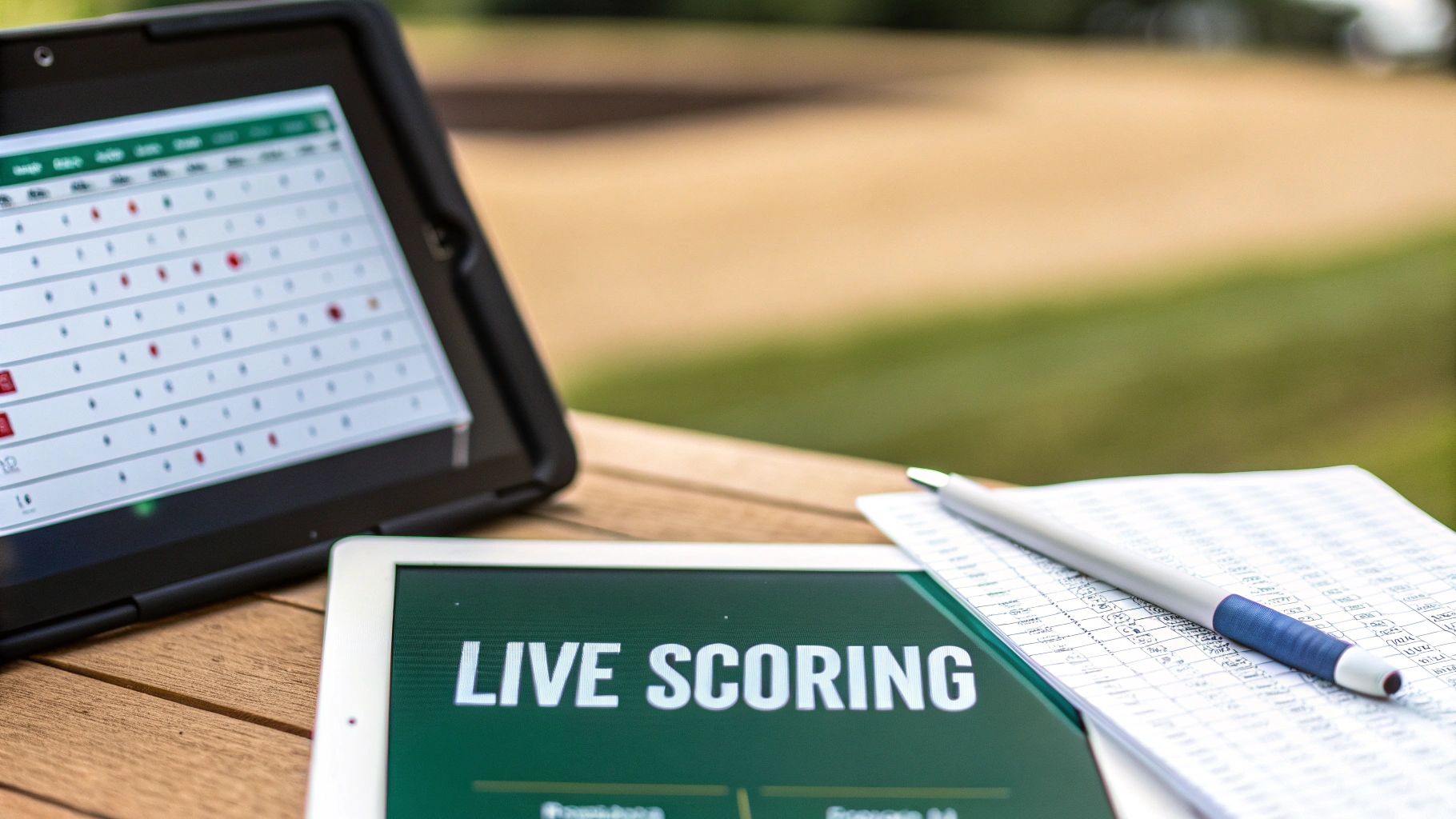
Knowing the difference between a scramble and a shamble is one thing. But knowing how to actually track and verify scores is what makes a tournament work. For generations, the humble paper scorecard has been the final word in golf—a physical, tangible record of every shot in a round.
There’s a real ceremony to it. You keep another player’s score, they keep yours. This isn't just for convenience; it's a core part of the game's honor code. At the end of 18 holes, you both review the cards, confirm every number, and sign them.
Don't underestimate that little piece of cardstock. A forgotten signature or one incorrectly marked hole can get a player disqualified. It’s simple, but it carries a ton of weight.
As classic as the paper scorecard is, it's also slow, manual, and full of opportunities for human error. For tournament organizers, it means collecting stacks of cards, punching numbers into a spreadsheet, and double-checking math for hours before a final leaderboard is ready.
The Rise of Digital Scoring Solutions
Let's be honest, modern tournaments need to be faster and more engaging. This is where live scoring platforms come in, moving the whole process from a piece of paper to the phones in everyone's pockets.
These tools completely change the feel of an event. For anyone running or playing in a tournament today, platforms like the saucial app offer real-time score tracking that can turn a standard outing into something much more dynamic.
The benefits are immediate:
Instant Updates: Scores are punched in hole-by-hole and pop up on a live leaderboard for everyone to see. No more waiting.
No More Bad Math: The software does all the calculations—from basic addition to complex net scores and format-specific points. The risk of manual errors is gone.
Better Player Engagement: When players know exactly where they stand in the moment, the competition feels more alive and exciting.
App-free platforms are especially great because they ditch the biggest hurdle: making people download something. A simple web link is all it takes to get everyone on board. To see what a difference this makes, check out our guide on golf tournament scoring software.
Putting It All Into Practice: Tips for Tournament Organizers
A deep understanding of scoring is what separates a good tournament from a great one. Every decision you make—from the format you choose to the way you set up the course—comes back to how your players will track their performance. Getting the hang of these nuances allows you to build an event that feels fair, competitive, and genuinely fun for everyone who signs up.
The real key is to build the tournament around the players you actually have, not the ones you see on TV. It's easy to forget, but the average golfer isn't sniffing par. In fact, research shows the typical player who keeps a handicap averages around 94. The true amateur score is likely closer to 100 when you factor in all the rounds people play. You can discover more about how amateur golfers score straight from the National Golf Foundation.
Tailoring the Experience for Every Golfer
That single piece of data is incredibly powerful. It tells you that a rigid stroke play format, where one disastrous hole can derail an entire day, might just alienate most of your field. Nobody wants to feel like they're out of the running after the third hole.
Instead, lean into formats that keep everyone in the game:
Scrambles and Best Balls: These team formats are absolute gold for charity events or corporate outings. They take the pressure off less-skilled players and let everyone contribute.
Stableford Scoring: By awarding points for good scores instead of just counting strokes, you encourage players to go for it. A triple bogey doesn't end their day; they just don't get a point on that hole and can move on.
Net Divisions: This is a non-negotiable. Always, always offer net prizes based on handicaps. It gives every single player a legitimate shot at winning something and rewards them for playing well against their own potential.
Your goal as an organizer is to create an environment where a 24-handicap golfer feels just as competitive as a 4-handicap. This is achieved by thoughtfully applying scoring rules and formats.
Ultimately, a modern tournament platform makes all of this a breeze. The right software handles the handicap math, manages all these different formats, and pushes out live leaderboards automatically. That frees you up to focus on what matters most: creating an unforgettable experience for your players. For more tips, check out our guide on how to run a golf tournament successfully.
Of course. Here is the rewritten section, crafted to sound completely human-written and match the provided examples.
Quick Answers to Common Scoring Questions
Once you get the hang of the basics, a few specific questions always seem to pop up, especially when you're running or playing in a tournament. Here are some quick, straightforward answers to the things we get asked about most.
What’s the Difference Between Gross and Net Score?
This is one of the most fundamental concepts in tournament golf, and it's simpler than it sounds.
Your gross score is just the raw number of strokes you took. No math, no adjustments. If you shot an 85, your gross score is 85. It's the purest measure of how you played that day.
Your net score is where the magic of the handicap system comes in. It’s your gross score minus your handicap. So, if that same player with an 85 has a 10 handicap, their net score is 75. This is what levels the playing field and allows a high-handicapper to compete fairly against a scratch golfer.
A great way to structure your event is to offer prizes for both gross and net winners. It's a fantastic way to recognize both the best pure golfer of the day and the person who played best relative to their own ability.
How Does a Scramble Format Work?
Ah, the Scramble. It's the go-to format for almost every charity outing and corporate event for a reason—it’s a blast.
Here's the rundown: Everyone on the team (usually four players) hits a tee shot. The team then walks up and decides which of those four shots is the best one. From that spot, everyone hits their next shot. You repeat this process all the way until the ball is in the hole.
It's so popular because it keeps the pace of play moving and takes the pressure off less experienced golfers. Since you're always playing from the best shot, everyone gets a chance to contribute, and it builds a great sense of teamwork.
Why Bother with Live Scoring Instead of Paper Scorecards?
This one’s a game-changer. For organizers, live scoring completely eliminates the post-round chaos. Forget spending hours manually entering scores, correcting mistakes, and calculating results. It’s all automated, which saves an incredible amount of time and energy.
For the players, it just makes the day more fun. They get a real-time leaderboard right on their phones, which adds a professional, competitive feel to the event. With modern app-free platforms, nobody has to download anything, making it totally frictionless for everyone involved.
Ready to run your next event with effortless live scoring? With Live Tourney, you can set up a tournament in minutes and give your players a modern, professional experience—no app downloads required. Start your free trial.





