
Feb 2, 2026
A complete guide to the Ryder Cup format and scoring. Learn how foursomes, fourball, and singles matches work, how points are awarded, and what it takes to win.
The Ryder Cup format boils down to a three-day, match-play showdown between teams from Europe and the United States. A total of 28 points are on the line.
To win the Ryder Cup, a team has to get to 14.5 points. If things end in a 14-14 tie, the defending champion keeps the trophy. It’s that simple.
Breaking Down the Ryder Cup Structure
The Ryder Cup is one of golf's most electric events, and its unique team-based, match-play structure is the reason why. Forget individual stroke play—this is a different beast entirely.
Over three intense days, 12-player teams from the USA and Europe go head-to-head in a series of matches. The goal isn't just to shoot the lowest score for the day; it's to win more individual holes than your opponent in each specific match. This setup completely changes the dynamic. A single bad hole won’t ruin your round, which encourages aggressive play and opens the door for dramatic comebacks. The pressure on every single shot is immense.
The event unfolds across three distinct formats, each designed to test a different aspect of a player's skill and, most importantly, their teamwork.
The timeline below gives you a quick visual of how the action builds from Friday through Sunday.
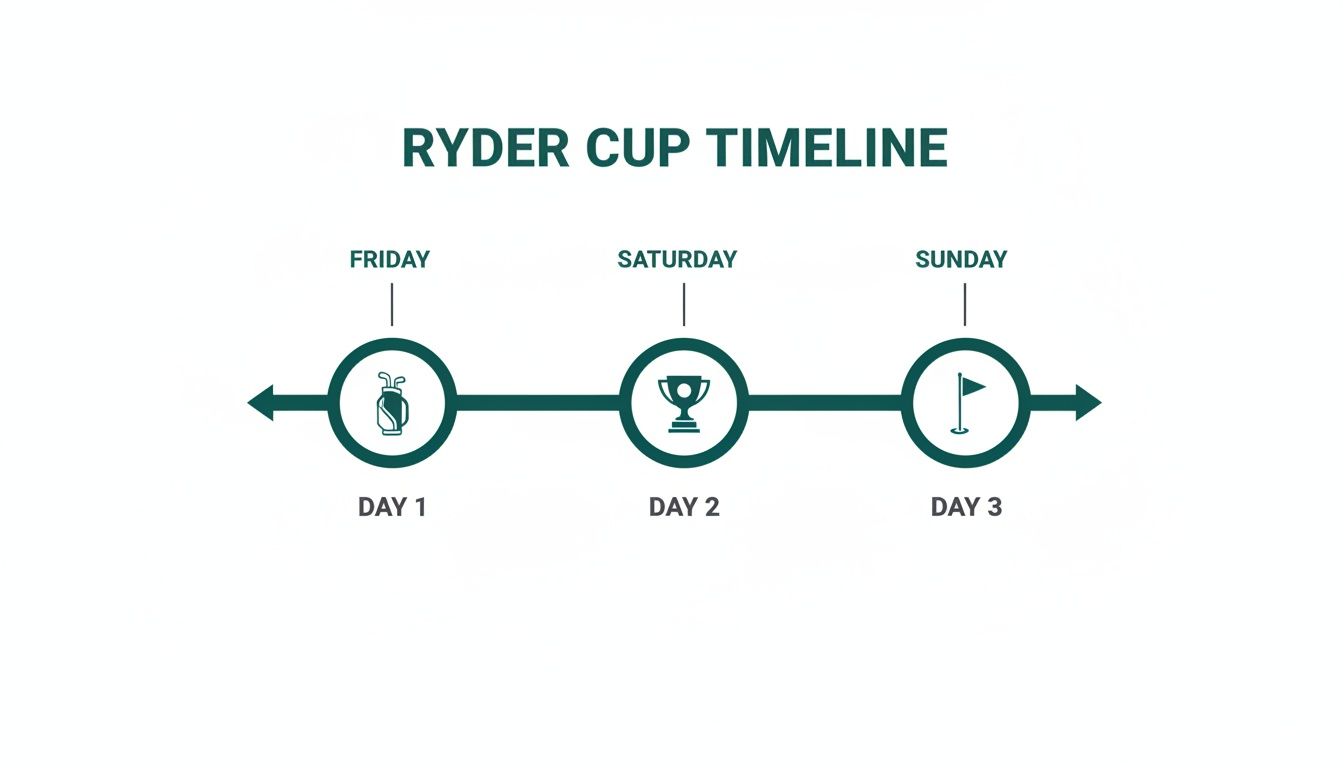
As you can see, the tournament kicks off with team formats before culminating in the do-or-die singles matches on the final day.
To give you a snapshot of the key details, here’s a quick rundown.
Ryder Cup at a Glance
Component | Details |
|---|---|
Duration | 3 Days (Friday, Saturday, Sunday) |
Teams | USA vs. Europe (12 players each) |
Total Matches | 28 |
Total Points | 28 |
Points to Win | 14.5 |
Points to Retain (for holder) | 14 |
This structure ensures every match counts, building the drama right up to the final putt on Sunday.
The Three Core Match Formats
To really get the Ryder Cup, you have to understand the three ways matches are played. Every match, no matter the format, is worth one point for a win. If the match ends in a tie after 18 holes, each team gets a half-point. This is known as a "half."
Here are the formats you'll see:
Foursomes (Alternate Shot): This is a true test of partnership. Two players on a team play just one ball, taking turns hitting each shot. If your partner puts you in a tough spot, you have to figure it out. Strategy is everything.
Fourball (Best Ball): Here, both players on a team play their own ball throughout the hole. The player who cards the lower score on that hole wins it for their team. This format lets players be more aggressive, knowing their partner can back them up.
Singles: Just like it sounds. One player from each team goes head-to-head in a classic match-play duel. With 12 of these matches on Sunday, this is where the Cup is often won or lost.
This blend of formats keeps the competition compelling, mixing team strategy with moments of individual brilliance. If you're interested in applying these same ideas to your own event, our guide on how to organize a golf tournament breaks down how you can set up similar competitive formats.
Exploring the Three Match Play Formats
The legendary drama of the Ryder Cup isn't just about the players—it's baked into its unique format. Instead of standard stroke play, the event is built around a series of intense, head-to-head battles.
To really get what makes the Ryder Cup tick, you have to understand its three distinct match play styles: foursomes, fourball, and singles. Each one tests a different skill set and pushes team chemistry to its absolute limit, turning an individual sport into a collective fight where every hole is a new chance to win or lose.
Foursomes: The Ultimate Test of Partnership
Often called alternate shot, foursomes is a brutal, brilliant format. It’s simple on paper: two players on a team hit the same ball, taking turns with each shot until it’s in the hole. One guy tees off on the odd holes, the other on the evens.
But that simplicity is deceptive. This format demands near-perfect chemistry. If you hit a bad shot, your partner has to clean up the mess, and vice versa. There’s zero room to hide, and the pressure is immense. Trust is everything.
Think of it like a three-legged race in golf. Success depends entirely on moving in sync with your partner. A great drive is only valuable if your teammate can capitalize on it with a solid approach shot.
It’s a rhythm that can throw off even the best players in the world, which is why you often see surprisingly high scores in what is arguably the purest team format in golf.
Fourball: Unleashing Aggressive Play
Fourball, or best ball, flips the script completely. You still have two-player teams, but here, each golfer plays their own ball throughout the hole. When it's all said and done, the team takes the better of their two scores for that hole.
This format is all about encouraging aggressive, go-for-broke golf. One player can aim for the middle of the green to secure a safe par, freeing up their partner to fire right at a tucked pin or try to drive a short par-4. That safety net changes everything.
Strategic Advantage: One player lays up, the other goes for it. This one-two punch is a classic fourball strategy.
Momentum Builder: All it takes is for one player to get hot. A string of birdies from one guy can carry a team and completely flip a match.
This is where you see a ton of birdies and eagles, creating some of the most electric moments in the Ryder Cup.
Singles: The Final Showdown
When Sunday rolls around, it's all about the singles matches. The team dynamic fades into the background for 12 one-on-one showdowns. It’s golf in its purest form: one player against another, with the weight of their team and country on their shoulders.
The pressure is off the charts. More often than not, the entire Ryder Cup comes down to these final matches. Every point is magnified, and the players are constantly watching the live leaderboard, knowing exactly how their individual result impacts the team’s fate.
Today's 28-point structure has become the standard, but it wasn't always this way. The event has come a long way since its 1927 debut as a two-day contest with only 12 total points up for grabs. That evolution has turned it into the three-day spectacle we know and love. This history is why modern tools like Live Tourney are so valuable—they let any organizer easily replicate these classic match play formats for their own events.
How Ryder Cup Points Are Won and Lost
First things first: forget everything you know about traditional stroke play. In the Ryder Cup, your total score over 18 holes doesn’t matter. This is match play, a head-to-head battle where the only goal is to win more individual holes than your opponent.
Think of it like a series of mini-games. Each hole is a self-contained contest. The player or team with the lowest score wins that hole. If you tie, the hole is "halved," and nobody scores. The match score simply tracks who's ahead and by how much.
Understanding Match Play Scoring Terms
As you watch a match unfold, you'll hear a unique language that sounds completely different from a typical PGA Tour broadcast. This is the lingo of match play, and it’s all about tracking the state of the duel.
1 Up: This is simple. It means a player or team has won one more hole than their opponent. If Team USA wins the first hole, they are "1 up."
All Square: This is the term for a tied match. If Team Europe wins the next hole, the match goes back to "all square."
Dormie: You'll hear this one when a match is nearing its end. A match is "dormie" when a team's lead is equal to the number of holes remaining. For example, if a team is "3 up" with only three holes left to play, they are dormie. At that point, they can't lose the match—they can only win or tie it.
This hole-by-hole format creates a constant sense of drama and allows for huge momentum swings. The straightforward, competitive nature of match play is why so many clubs use it for their own events. For a deeper dive into different formats, check out our guide to golf tournament scoring.
How a Match Concludes Early
Because the winner is decided by holes won, not total strokes, matches often end before the 18th green. As soon as one side builds an insurmountable lead, the match is over.
Let's say a team is "4 up" with only three holes left to play (holes 16, 17, and 18). There's no way for their opponent to catch up, so the match ends right there. The final score is recorded as 4&3, meaning a four-hole lead with three holes remaining. A score of 2&1 means the match was won on the 17th hole.
The Magic Number for Overall Victory
Over the three days, a total of 28 matches are played, and each one contributes points to the team's overall score. The breakdown is as clean as it gets.
Here’s a simple table showing how points are awarded for each of the 28 matches:
Match Outcome and Points Awarded
Match Result | Points for Winning Team | Points for Losing Team |
|---|---|---|
Win | 1 point | 0 points |
Tie (Half) | 0.5 points | 0.5 points |
Loss | 0 points | 1 point |
This system keeps the math simple and the stakes high for every single match on the course.
With 28 total points up for grabs, the first team to reach 14.5 points wins the Ryder Cup outright. That half-point is crucial—it makes a tie impossible for the overall score. This "magic number" is what both teams are chasing from the very first tee shot on Friday.
Scoring in the Ryder Cup is pure match play drama, where every hole won moves a team closer to victory. The system's tension-building nature is a key reason Europe has seen a surge in success since the format was solidified in 1979, capturing 12 wins to America's 9 in that period. Discover more insights about the Ryder Cup's history and rules on GolfNow.
But what if the event ends in a 14-14 tie? There's no sudden-death playoff. Instead, the team that won the previous Ryder Cup simply retains the trophy. This adds a fascinating layer of strategy, giving the defending champions a slight edge—they only need to secure 14 points to keep the Cup, while the challengers must earn that extra half-point to win it back.
If you want to truly get the Ryder Cup, you have to speak its language. Match play isn't like the typical stroke-play golf you see every week; it's a head-to-head duel with its own vocabulary for the constant back-and-forth. For anyone running a similar event, knowing these terms is non-negotiable.
The most basic term you'll hear is all square, which is just a fancy way of saying the match is tied. From there, the score is all about who’s ahead. If a team wins the first hole, they go 1 up. If their opponents win the next two, the score flips, and suddenly they're 1 up. This hole-by-hole scoring creates a constant see-saw of momentum.
Critical Match Play Scenarios
As a match gets deeper, a few key situations pop up that every player and organizer needs to have down cold. One of the most common is the concession. A player can "concede" their opponent's next putt—or even an entire hole—meaning it’s counted as holed without them ever hitting the ball. It’s a classic gesture of sportsmanship, usually on very short putts, that helps keep the pace of play moving.
Another term you'll hear constantly in the final stretch is dormie. A team is dormie when their lead is the same as the number of holes left to play. For example, if Team Europe is 3 up with only three holes remaining, the match is dormie. They literally cannot lose. The best their opponent can do is win the last three holes to force a tie.
The strategic chess match of foursomes and fourball is a huge part of why Team Europe has been so dominant in the modern era. Since 1979, they've won an incredible 55% of all sessions and a staggering 63% of foursomes matches. That record isn't an accident; it shows a deep mastery of match play pressure. You can discover more about the Ryder Cup's history to see how team dynamics have shaped this event over the years.
Finally, there’s the order of play. In match play, the player or team "away" (farthest from the hole) always hits next. This isn't just about etiquette; it’s a hard-and-fast rule that adds a real layer of strategy, especially when both teams are sizing each other up around the green.
Running Your Own Ryder Cup Style Tournament
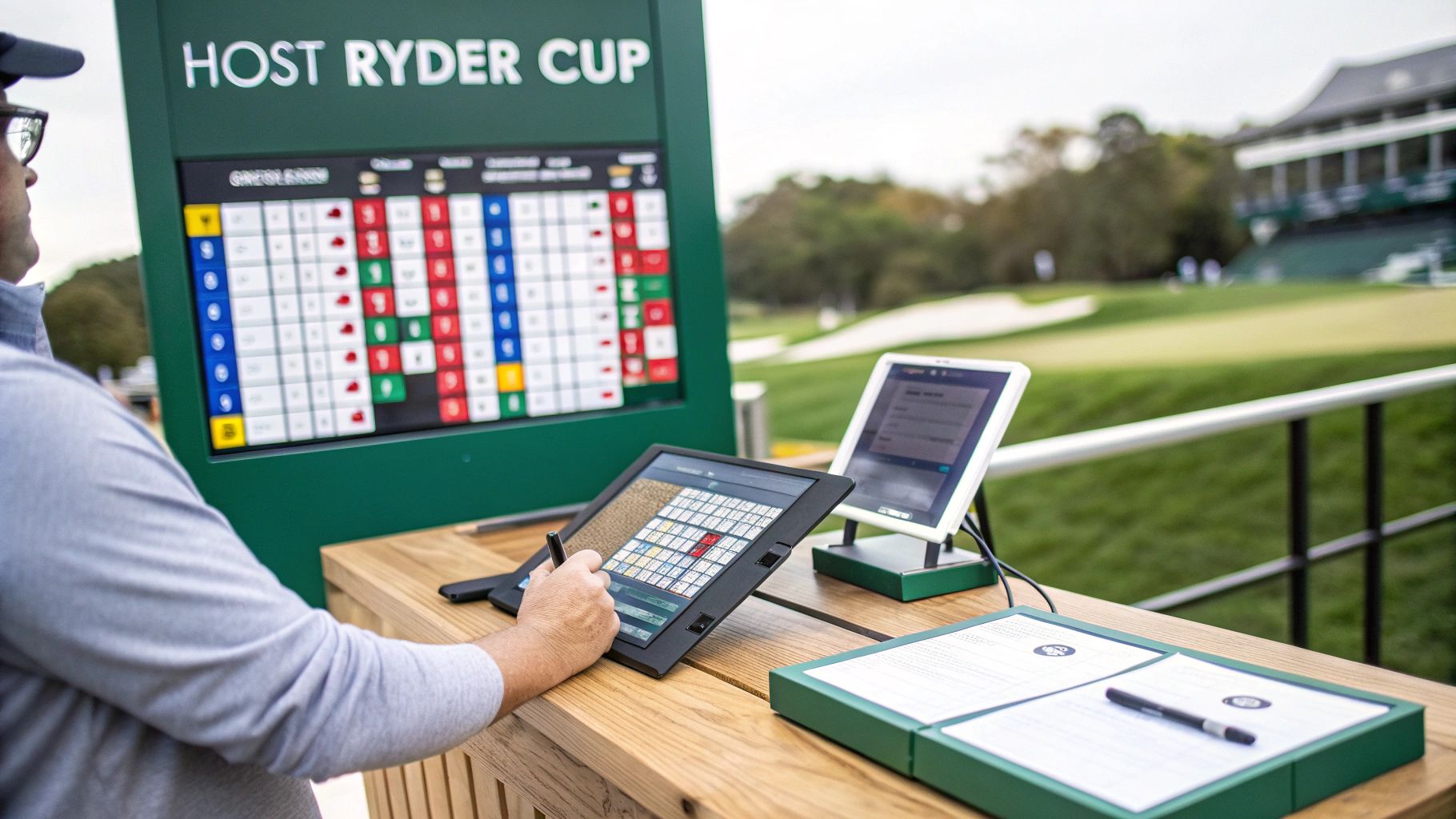
The thrill of Ryder Cup golf isn’t just for the pros. You can bring that same team energy and competitive fire to your club championship, a corporate outing, or even just a weekend golf trip with your buddies. It's all about adapting the structure to fit your group and timeline.
A full three-day, 28-match marathon is a serious commitment, but you can capture the essence in a single afternoon. A great way to do it is by playing one format on the front nine (like fourball) and switching to another on the back (like foursomes). This keeps the day moving and tests every part of a team’s game.
Setting Up Your Event for Success
Getting the teams right is the first big step. A good way to ensure competitive matches is to split players by handicap index into A, B, C, and D flights. Once you have your teams, the real work begins: managing the pairings and scoring across multiple formats.
This is where you want to ditch the spreadsheets. Modern tournament software is a game-changer for events like this. Instead of manually tracking everything, a dedicated platform can automate pairings, calculate points as they happen, and display a live leaderboard that everyone can follow from their phones. That instant feedback makes the whole thing feel bigger and keeps every single player locked in on the team’s score. For corporate events, it can be one of the most fun team-building activities you can organize.
The magic of a Ryder Cup-style event is seeing that leaderboard evolve in real time. Watching your team’s color climb the board after a clutch putt creates a shared excitement you just don't get from a standard stroke play event.
Key Logistical Considerations
To run a smooth tournament, your best bet is to keep things simple and clear. Before anyone hits a tee shot, make sure every player understands the ryder cup format and scoring rules you're using, how points are won, and what happens if a match ends in a tie.
Here are a few tips to make it all run seamlessly:
Simplify the Schedule: For a one-day event, just stick to two formats. A classic combo is nine holes of fourball followed by nine holes of foursomes.
Automate the Admin Work: Use a system that handles registration, pairings, and live scoring. This frees you up to actually manage the event instead of being buried in paperwork. The ability to handle different setups, like round-robin style pairings, is a huge plus. You can learn how to create a round-robin schedule to keep the matchups fresh.
Communicate Clearly: Send out the rules, tee times, and links to the live scoring ahead of time. The more prepared your players are, the smoother the day will go.
By focusing on these core pieces, you can host a memorable, professional-feeling tournament that captures all the unique drama of the Ryder Cup.
Of course. Here is the rewritten section, adopting the expert, human-written style of the provided examples.
Commonly Asked Ryder Cup Format Questions
Even when you have a good handle on the Ryder Cup format, a few specific situations always seem to pop up. Getting these details right is the difference between a smooth, professional event and a chaotic one.
Let’s clear up some of the most common questions that come up during tournament planning.
What Happens if a Ryder Cup Match Is Tied After 18 Holes?
This is a big one. If a match is all square after 18 holes, it’s declared a "half." Each team gets half a point (0.5) for their overall total. Simple as that.
Unlike a knockout tournament, there are no sudden-death playoffs for individual matches. That half-point system is absolutely critical. Those little 0.5 points often decide whether a team reaches the magic number of 14.5 or if the whole event ends in a 14-14 draw, which lets the defending champs keep the Cup.
How Do Captains Decide Who Plays in Each Session?
Each team has 12 players, but only 8 play in each of the four team sessions (foursomes and fourball). The captains have complete control over who plays and who sits.
This is where the real strategy comes in. It’s a mix of art and science, based on things like:
Player Chemistry: Do these guys get along? Do their games complement each other?
Current Form: Who’s hot right now? You ride the hot hand.
Course Fit: Is this a bomber’s paradise or a course that demands precision? The captain has to match the player to the course.
Opponent Matchups: Trying to guess who the other captain will send out and creating pairings that have an edge.
Captains submit their pairings "blind," so they have no idea who they'll be up against until the lists are revealed. For the Sunday singles, each captain just lists their 12 players in order, and the matchups are determined by how the two lists align.
Can You Use a Ryder Cup Format for a One-Day Outing?
Absolutely, and it’s a fantastic way to run a one-day event. While the real thing is a three-day marathon, you can easily capture the spirit in a shorter timeframe. A popular way to do it is to play fourball on the front nine and switch to foursomes on the back nine.
Or, you could just keep it simple and have two big teams play a single format, like a team best ball, for the full 18 holes. Modern tournament software makes this a breeze. You can set up these custom formats and, most importantly, show a live team leaderboard that gets everyone fired up.
The "envelope rule" is a contingency plan for injuries. Before the Sunday singles matches begin, each captain writes the name of one player from their team and places it in a sealed envelope.
So, what’s that for? If a player gets injured and can't play their singles match, the opposing captain opens the envelope. The player whose name is inside is also withdrawn from their match. That specific match is then declared a half, with each team getting 0.5 points. It’s a simple, fair way to ensure an unlucky injury doesn't unfairly cost a team a full point.
Running a Ryder Cup-style event requires precision, from managing pairings to tracking live scores. Live Tourney automates the entire process, allowing you to set up complex formats in minutes and deliver a professional experience your players will love. Learn more and start your free trial today.





