
Feb 3, 2026
Run a better tournament with our complete guide to the quota game in golf. Learn the rules, scoring, and variations to create a fun, competitive event.

Ever heard of a golf game where a bogey can feel like a victory? That’s the magic of the quota game, a points-based format that completely changes how you approach a round and levels the playing field for everyone in your group. Instead of just chasing the lowest score, you’re trying to beat a personal points target—your quota—which is set based on your handicap.
It's a clever system that turns a standard round into a strategic and exciting challenge.
What is the Quota Game?

Think about a typical round of golf. The pressure is almost always on shooting the absolute lowest score. The quota game flips that on its head. It shifts the entire focus from your raw stroke count to how you perform against your own potential. It's a fantastic format for making the game fun and competitive for a mixed bag of players, no matter their skill level.
The concept is beautifully simple. Before you tee off, you get a personal points target you need to hit or beat. This target, your "quota," is tied directly to your handicap, which is the secret sauce that makes the competition fair for everyone involved.
Why a Points System Works So Well
Instead of just adding up your strokes at the end of the day, you’re earning points on every single hole. This small change has a huge impact on how you play the game. A disastrous triple bogey on one hole doesn't torpedo your entire round. You just get zero points and move on, making it much easier to reset mentally.
Here's a look at how points are typically awarded in a quota game.
Standard Quota Game Point System
This table breaks down the most common point values for each score relative to par.
Score Relative to Par | Points Awarded |
|---|---|
Bogey | 1 point |
Par | 2 points |
Birdie | 4 points |
Eagle | 8 points |
As you can see, the scoring system rewards you for good shots while limiting the damage from the bad ones. It creates a more positive vibe on the course, which is why it’s a perfect fit for club events, corporate outings, and those friendly weekend games where fun and competition need to go hand-in-hand.
The quota format didn’t just appear out of nowhere; its roots are tied to the very history of handicapping. It was born from a broader effort to make golf a fairer sport, with pioneers in the early 20th century pushing for systems that could balance the scales. To get a better feel for this, it’s worth checking out the history of golf handicapping from Golf Monthly. This context really explains why formats like the quota game in golf have become such a staple for creating fun, balanced, and memorable competitions.
How to Calculate Player and Team Quotas
Alright, let's get into the nuts and bolts. Calculating a player's quota is the first real step in getting a game set up, and thankfully, the math is simple. This isn't abstract theory—it’s how you set a fair target for every single player before they even step up to the first tee.
The whole thing boils down to a quick formula that turns a player's Course Handicap into a personal points target. This is key because it adjusts the goal not just for the player's skill, but for the specific course they're playing that day.
Calculating an Individual Player's Quota
The standard formula for figuring out an individual's quota is straightforward:
36 - Course Handicap = Player's Quota
So, where does the 36 come from? Think of a scratch golfer—someone with a zero handicap. They're expected to make par on every hole. In this format, a par is worth 2 points. Over 18 holes, that adds up to 36 points. By subtracting a player's handicap from that baseline, you create a fair, personalized target.
Let's look at a few real-world examples:
Low-Handicap Golfer (5 Handicap): 36 - 5 = 31 points. This player has a high bar to clear. They need to score 31 points just to play to their handicap.
Mid-Handicap Golfer (15 Handicap): 36 - 15 = 21 points. Their target is lower, accounting for the strokes they get.
High-Handicap Golfer (25 Handicap): 36 - 25 = 11 points. This golfer's target is much more attainable, which is exactly what levels the playing field.
This simple bit of math is the heart of what makes the quota game in golf so competitive and fun for everyone. It also highlights why having one of the best golf scorecards that's built for tracking points can be a massive help for anyone running an event.
Calculating a Team's Quota
When you move to a team game, the logic is exactly the same—you just scale it up. For a typical four-person team, the formula starts with 144 (which is just 36 x 4 players) and subtracts the combined handicaps of everyone on the team.
Team Quota Formula: 144 - (Sum of Team Handicaps) = Team's Quota
Let’s say you have a team with handicaps of 5, 11, 20, and 28. First, you add them all up, which gives you a total handicap of 64.
Then you just plug it in: 144 - 64 = 80 points. That's the target the team needs to hit.
Trying to do all this by hand for a big tournament can get old fast, not to mention the risk of simple math errors. This is where tournament software really shines, instantly calculating every individual and team quota so you can focus on running the event.
How Quota Scoring Actually Works (Plus a Few Twists)
Okay, so you’ve got your quota. Now for the fun part—actually playing the game. Let's walk through how a typical quota game unfolds on the course and then look at a couple of popular variations that can really spice things up. Seeing it in action is when the strategy clicks.
Picture a golfer named Alex. He’s a 15-handicap, which gives him a quota of 21 points to hit (36 - 15). He steps up to a par-4 and makes a bogey. In stroke play, that's a bit of a letdown. But in a quota game, it earns him 1 valuable point. On the next hole, he rolls in a putt for par, adding 2 more points to his total.
A few holes later, Alex finds his groove and drains a long birdie putt. That’s a huge 4-point boost. By the time he walks off the 18th green, he’s racked up a total of 24 points. To get his final score, we just subtract his quota from his point total: 24 - 21 = +3. Alex finished three points over his target, a fantastic round that will likely put him near the top of the leaderboard.
Chicago Quota: A High-Pressure Twist
One of the most common and intense variations is the Chicago Quota. This version flips the script entirely. Instead of starting at zero and building your way up, every player starts with a negative score based on their handicap. Your job is to dig yourself out of that hole.
The formula is straightforward: Player's Handicap - 39 = Starting Points.
A 5-handicap golfer starts the day at -34 (5 - 39).
A 15-handicap golfer starts at -24 (15 - 39).
A 25-handicap golfer starts at -14 (25 - 39).
The goal is still to finish with the highest score, hopefully clawing your way into positive territory. The points per hole are the same—1 for bogey, 2 for par, 4 for birdie—but that negative starting number adds a serious psychological challenge to the game.
This variation puts the pressure on from the very first tee shot. A few early pars feel like a massive win because you’re actively pulling your score out of the red. Every single point feels that much more important.
Modified Quota Systems for Custom Events
Beyond the standard rules, you can always create a Modified Quota to fit your group’s style. These custom systems let you tweak the point values to reward or penalize certain shots, which is a great way to shape how people play.
Here are a few common modifications:
Penalize Double Bogeys: Awarding -1 point for a double bogey or worse is a great way to discourage "hero" shots and reward consistent, safer play.
Boost Eagles: You can add a high-risk, high-reward element for the big hitters by increasing the points for an eagle to 10 or even 12.
Reward Sand Saves: Some social leagues like to add fun side challenges, like awarding a bonus point for getting up-and-down from a bunker.
These variations make the quota game endlessly flexible. Once you know the alternatives, you can tailor the experience for any group, from a highly competitive club championship to a relaxed corporate outing.
Tips and Strategies for Winning a Quota Tournament
To succeed in a Quota game, you have to completely rethink your approach to the game. It’s not about shooting the lowest score anymore; it’s all about racking up the most points. This one change flips everything on its head, from how you manage the course to how you handle a bad hole.
The first, and most important, strategy is simple damage control. In stroke play, a triple bogey can absolutely wreck your scorecard and your mental game. In Quota, it’s just zero points—the exact same result as a double bogey. This means playing smart and avoiding those catastrophic blow-up holes is the name of the game.
The core mindset for a Quota game is this: a zero is always better than a negative. Taking your medicine, punching out, or playing for a safe bogey is a strategic win. It banks you a point and keeps you moving in the right direction.
Master Conservative and Aggressive Play
Your main goal should be to steadily collect points, hole after hole. Think of bogeys and pars as your foundation. A constant stream of one and two-point holes builds a solid base and keeps you from falling behind your target. These are the points that keep you in the hunt.
But playing it safe will only get you so far. Winning often comes down to cashing in on the big opportunities. Birdies are worth a massive 4 points and eagles are worth 8—these are your game-changers. When you’re in a great spot, like a short iron into a par-5, it’s time to get aggressive. A single birdie is worth four bogeys, so taking a calculated risk on a scoring hole can pay off in a huge way.
Team Strategy for Quota Formats
If you're playing a team Quota event, you can use different playing styles to your advantage. A really effective strategy is to give each player a role:
The Anchor: This player takes the conservative route. Their job is to stay in every hole, steer clear of trouble, and consistently grind out points with pars and bogeys. They provide a steady, reliable score for the team.
The Aggressor: The other player gets the green light to take more risks. They can take aggressive lines off the tee, fire at pins, and hunt for those high-value birdies and eagles. If they make a mistake, the anchor's points are there as a safety net.
This balanced approach ensures your team is always in a position to score, mixing consistency with high-upside potential.
Of course, beyond any specific format strategy, just improving your all-around game is the best way to win. For some practical advice on that, you might find this guide on how to break 90 and 80 helpful.
Running Your Quota Tournament Like a Pro
Pulling off a flawless quota tournament really boils down to two things: smart planning and having the right tools. Your goal is to create an experience that feels professional and fun for every player, all while saving you and your staff from a major administrative headache.
It all starts with clear communication. Put together a simple, easy-to-read rule sheet that lays out the point system and explains how quotas are figured out. A well-designed scorecard is just as important—it needs dedicated spots for strokes, points per hole, and the final tally against each player's quota. These little details go a long way in preventing confusion.
Pairings are another key piece of the puzzle. If it’s just a friendly outing, random pairings are totally fine. But for a more competitive event, you might want to balance the teams by spreading low and high handicaps across the groups. This keeps the playing field level right from the start.
Ditching the Manual Grind with Technology
Let's be honest: manually calculating quotas, tracking points, and updating a physical leaderboard is a massive time-suck, and it’s way too easy to make mistakes. This is where modern tournament software completely changes the game by handling all the heavy lifting for you.
Tools like Live Tourney can manage everything from the initial setup to the final payouts. The software instantly calculates individual and team quotas, generates digital scorecards, and powers app-free live scoring. Players just enter their scores on their phones, and the results pop up immediately on a dynamic, real-time leaderboard.
This simple strategic flowchart is a great visual for players to maximize their points.
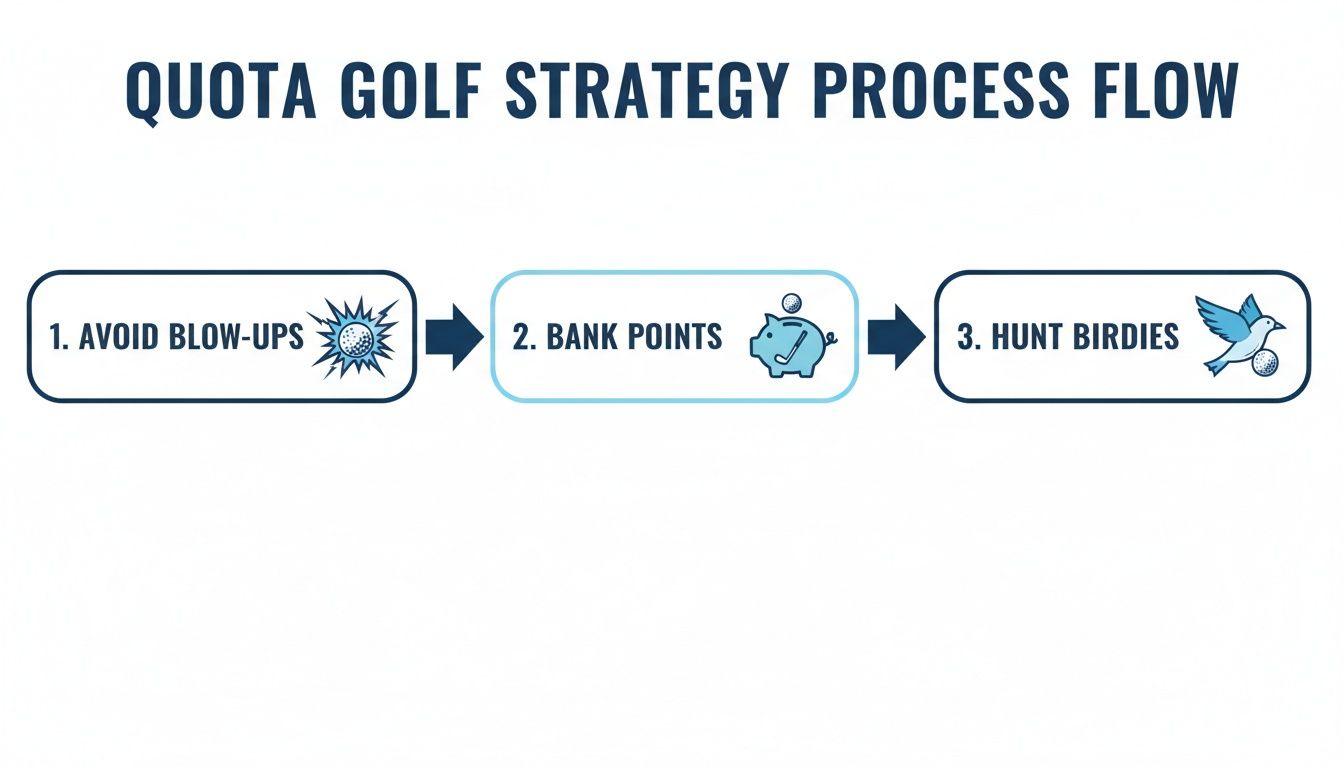
It highlights a balanced approach: play it safe to avoid big numbers, steadily rack up points on the holes you should, and get aggressive when a real scoring opportunity presents itself.
That instant feedback loop is what makes the day so much more engaging. Players can see exactly where they stand at any moment, creating a competitive buzz that spreads across the entire course. The excitement just builds as everyone watches the leaderboard shift with every score that comes in. You can find more practical tips in our complete guide on how to run a golf tournament.
The Real Impact of Live Scoring
Switching from pen and paper to a digital approach makes a huge difference. Here's a look at the time and effort saved when running a quota game.
Manual Setup vs. Live Tourney for Quota Games
Task | Manual Process (Time & Effort) | Live Tourney Process (Time & Effort) |
|---|---|---|
Quota Calculation | Calculate each player's quota by hand using formulas. Prone to errors. (30-60 mins) | Automatically calculates quotas based on handicaps and course data. (Instant) |
Scorecard Creation | Design and print custom scorecards with columns for points. (45-90 mins) | Digital scorecards are generated automatically for every player/group. (Instant) |
Live Scoring | Impossible. Players are in the dark until the end. | Players enter scores on their phones; leaderboards update in real time. (Zero effort) |
Leaderboard Updates | A volunteer manually collects scorecards and updates a physical board. (Ongoing, high effort) | The leaderboard is 100% automated and visible to everyone, everywhere. (Zero effort) |
Final Results | Collect all cards, double-check math, and calculate final standings. (60+ mins) | Final results are ready the second the last score is entered. (Instant) |
The numbers don't lie. In the US, Live Tourney powers over 10,000 events annually. We've seen that quota games drive incredible engagement, boosting live scoring participation by 40% because organizers can lean on real-time tools to make the day more exciting.
For golf course operators, integrating quota into a platform like Live Tourney can cut event setup time by 3x. This is a massive win, helping courses improve player retention at a time when 3.1 million new golfers hit the links in 2023 alone.
By embracing technology, you transform a standard quota game in golf from a manual chore into a polished, professional event. It saves hours of work, eliminates scoring disputes, and delivers the modern, interactive experience that today’s golfers expect.
Ultimately, running a great quota tournament is all about creating a competition that's fair, fun, and runs without a hitch. With some thoughtful planning and the right software, you can deliver an exceptional experience that players will be talking about long after the final putt drops.
Managing Handicaps and Payouts for a Fair Event
Getting handicaps and payouts right are two of the most critical jobs for any tournament organizer. Nail these, and you've got a fair, competitive event that everyone enjoys. Get them wrong, and a great day on the course can turn sour fast.
The biggest hurdle is often figuring out handicaps. Sure, your regular club members probably have an official index, but what about the casual golfers at a charity or corporate outing? You need a flexible system to keep your quota game in golf inclusive for everyone.
Handling Unhandicapped Players
For golfers who don't have an established handicap, you can lean on tried-and-true methods like the Callaway or Peoria systems. These are simple, post-round calculations that use a player's score on a handful of holes to generate a one-day handicap. It's a lifesaver for keeping the competition fair.
It's no surprise that quota games grew in popularity right alongside the modern handicap system. As golf boomed to over 100 million players worldwide, flexible formats were essential. You can see how non-traditional golf is fueling that growth, and it’s why formats like Peoria are so valuable. Plus, using simple tools like Live Tourney’s app-free scoring can lead to 3x faster setups and leaderboards that keep everyone hooked.
Structuring Payouts and Side Games
Once the scores are in, you need a clear payout structure. The most common approach is to reward the top players or teams with the highest scores over their quota—think winners at +8, +5, +3, and so on. Depending on your field size, you can split the prize pool among the top three to five finishers.
A transparent and automated payout process is crucial. It eliminates errors, prevents disputes, and builds trust with your players, making them eager to return for future events.
And don't forget the side games! They add another layer of fun to the day. Contests like skins, closest to the pin, and long drive are perfect additions to the main competition. Modern software can handle all the number-crunching for these games automatically, making it a breeze to manage multiple contests and display winners the moment the last putt drops. For more ideas, check out our guide on different golf tournament scoring formats.
Quota Game FAQs
Even when you've got the rules down, a few questions always seem to pop up on tournament day. Let's walk through some of the common ones so you can run your Quota game with confidence.
What Happens When a Handicap Is Over 36?
This is a classic. What do you do with a player whose Course Handicap is, say, 40? Since the Quota is calculated as 36 minus the handicap, they’d actually start with a negative number.
In this case, a 40-handicap player would have a Quota of -4 (36 - 40). Their goal isn't to get to zero, but simply to score better than -4. If they finish the day with -3 points, they've successfully beaten their quota by one.
How Do You Settle Ties?
It’s bound to happen: two players finish at +5 over their quota. Now what? The best way to handle this is with a standard scorecard playoff, but you absolutely need to decide on the method before the first ball is in the air.
The most common tiebreaker is comparing scores on the back nine. If the players are still tied, you move to the last six holes, then the last three, and finally, hole-by-hole starting from the 18th until you have a winner.
Make sure everyone knows the tiebreaker rules from the start. A quick announcement before the round begins avoids any confusion or arguments later on. It keeps things fair and transparent for everyone.
Does This Format Work Internationally?
Yes, and it's easier than ever thanks to the World Handicap System (WHS). Since the WHS began rolling out in 2020, it has created a much more consistent and fair way to calculate handicaps across the globe.
This unified system means that a format like the Quota game can be played equitably whether you're in the U.S., Europe, or anywhere else. If you're curious about how handicaps are standardized worldwide, the Official World Golf Ranking page is a good place to start.
Ready to run your next quota game without all the manual math and headaches? Live Tourney automates everything from quota calculations to live leaderboards and payouts. Start your free 10-day trial and run a professional, modern golf tournament today.





