
May 24, 2026
quail hollow scorecard, charlotte golf courses, pga tour scorecard, golf tournament setup, wells fargo championship course
Get the complete 2026 Quail Hollow Golf Course scorecard. View hole-by-hole yardage, pars, ratings, and pro tips for running your next tournament.
The Quail Hollow golf course scorecard serves two jobs. Players use it to prepare for a demanding round. Tournament organizers use it to choose tee sets, pace the field, and avoid setup mistakes that punish the wrong skill set.
That distinction matters at Quail Hollow Club in Charlotte. This is a championship venue, and the numbers on the card carry more weight than they do at an ordinary member course. Yardage alone will not tell you enough. You need to know how those yardages affect club selection, handicap allocation, and where the course starts asking for restraint instead of aggression.
That is the point of this guide.
It goes beyond listing holes and pars. The goal is to turn the Quail Hollow scorecard into practical decisions, from reading the card before a competitive round to using the same information for professional event setup, hole strategy, and the closing stretch that can change a leaderboard in a hurry.
Your Guide to the Quail Hollow Scorecard
A player arrives with a yardage book built for member play. The committee posts a longer setup with a different intent, and by the third hole that player is hitting approaches from numbers they never planned for. That happens at Quail Hollow more than people expect, which is why the scorecard matters before the first tee shot is struck.
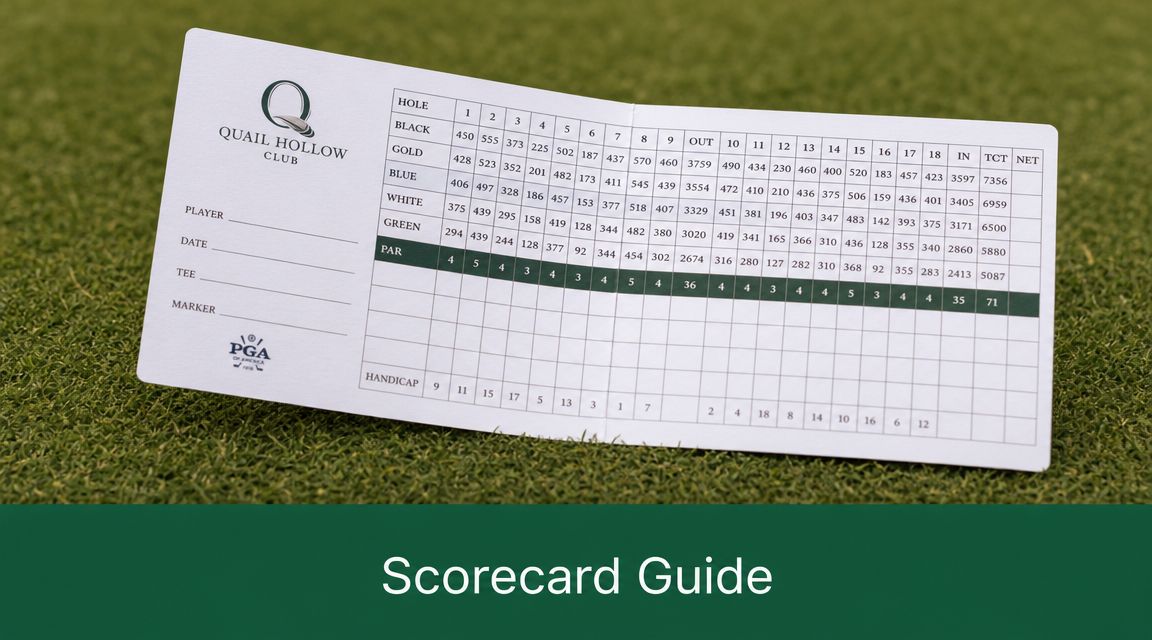
Start with the right property. Golfers usually mean Quail Hollow Club in Charlotte, North Carolina, the private championship venue known for the Green Mile and top-level event setups. There is also a public Quail Hollow Golf Course in McComb, Mississippi. If you are building pairings, printing cards, or setting tees, confirm the venue first and save yourself a preventable mistake.
The practical value of this scorecard is not the yardage line by itself. The useful read is how the card changes under different setups, where the difficult holes are placed in the round, and which tee set suits the field you are running. Players need that to plan tee-ball strategy and realistic approach targets. Organizers need it to avoid a setup that looks fair on paper but produces backups, too many forced layups, or scoring gaps that are wider than intended.
Quail Hollow has that problem more than a typical club because the course can be presented in very different ways. A championship setup asks for one kind of decision-making. A member or event setup can ask for another. If you treat every version of the scorecard as interchangeable, you miss the whole point.
A good working read of the card focuses on three things:
Sequence: where the scoreable holes sit, where momentum can stall, and how the finish affects risk tolerance earlier in the round
Tee use: whether the listed yardage matches the carry distances and pace expectations of your field
Handicap and hole character: which holes create real separation, not just which ones look longest
I have seen strong amateur events go sideways at Quail Hollow because the setup borrowed championship ideas without championship players. The scorecard looked impressive. The round took too long, and the hardest holes stopped rewarding good decisions.
Use the card as a planning tool, not a souvenir. Quail Hollow rewards players who know where to stay patient, and it rewards tournament directors who understand that the same printed numbers can produce very different competitions depending on tee placement, hole locations, and field strength.
Official Quail Hollow Golf Course Scorecard Data
If you need a working reference for the Quail Hollow golf course scorecard, the cleanest place to start is with a simple operations table. One thing to note up front: publicly verified source material confirms the club's standard championship routing as 7,114 yards, par 72, rating 74.9, slope 139 on independent course references, while the PGA Championship setup uses a different championship configuration. The detailed hole-by-hole yardages for every member tee are not fully provided in the verified source set, so the safest way to present this is to separate what's confirmed from what should be verified directly with the club before publishing event materials.
Working scorecard reference table
Hole | Par | Handicap | Championship (Yards) | Tournament (Yards) | Member (Yards) | Forward (Yards) |
|---|---|---|---|---|---|---|
1 | Verify with club | Verify with club | Verify with club | Verify with club | Verify with club | Verify with club |
2 | Verify with club | Verify with club | Verify with club | Verify with club | Verify with club | Verify with club |
3 | Verify with club | Verify with club | Verify with club | Verify with club | Verify with club | Verify with club |
4 | Verify with club | Verify with club | Verify with club | Verify with club | Verify with club | Verify with club |
5 | Verify with club | Verify with club | Verify with club | Verify with club | Verify with club | Verify with club |
6 | Verify with club | Verify with club | Verify with club | Verify with club | Verify with club | Verify with club |
7 | Verify with club | Verify with club | Verify with club | Verify with club | Verify with club | Verify with club |
8 | Verify with club | Verify with club | Verify with club | Verify with club | Verify with club | Verify with club |
9 | Verify with club | Verify with club | Verify with club | Verify with club | Verify with club | Verify with club |
10 | Verify with club | Verify with club | Verify with club | Verify with club | Verify with club | Verify with club |
11 | Verify with club | Verify with club | Verify with club | Verify with club | Verify with club | Verify with club |
12 | Verify with club | Verify with club | Verify with club | Verify with club | Verify with club | Verify with club |
13 | Verify with club | Verify with club | Verify with club | Verify with club | Verify with club | Verify with club |
14 | Verify with club | Verify with club | Verify with club | Verify with club | Verify with club | Verify with club |
15 | Verify with club | Verify with club | Verify with club | Verify with club | Verify with club | Verify with club |
16 | Verify with club | Verify with club | Verify with club | Verify with club | Verify with club | Verify with club |
17 | Verify with club | Verify with club | Verify with club | Verify with club | Verify with club | Verify with club |
18 | Verify with club | Verify with club | Verify with club | Verify with club | Verify with club | Verify with club |
What is verified right now
Independent course references list Quail Hollow Club's standard championship routing at 7,114 yards from the longest tees with a par of 72, a course rating of 74.9, and a slope rating of 139, according to GolfLink's Quail Hollow Club listing.
For elite event play, the setup can stretch materially beyond that. The 2025 PGA Championship official scorecard confirms a 7,626-yard championship configuration, which means the course you watch on a major broadcast may not match the setup your event or member game uses, as shown on the official 2025 PGA Championship scorecard PDF.
How tournament staff should use this
A lot of event mistakes happen because someone copies a card image from a search result and assumes it's complete. That doesn't work at a course like this.
Use this workflow instead:
Confirm the exact tee set your field will play.
Match yardage to rated configuration rather than a generic scorecard photo.
Verify handicap allocation by hole before you publish scorecards or cart sheets.
Separate member play from championship setup in every player communication.
If the routing changes, the scorecard isn't just cosmetically different. It changes pace, club selection, and often how fair the competition feels.
How to Interpret Quail Hollows Course Rating and Slope
You get to Quail Hollow, glance at the card, see a big yardage number, and assume the challenge starts and ends there. It doesn't. Rating and slope are the numbers that tell players what kind of scoring day they are committing to, and they help tournament staff avoid a setup that looks good on paper but plays unfairly in the field.
As noted earlier, Quail Hollow's standard championship setup carries a course rating in the mid-70s and a slope well above average. That combination matters. It tells scratch players they should expect to work for par, and it tells everyone else that misses get more expensive here than they do at a typical daily-fee course.
A course rating estimates what a scratch golfer should shoot under normal conditions from a specific tee. Slope shows how much harder that same setup plays for a bogey golfer relative to a scratch player. If you want the mechanics behind the system, this guide on what a course rating means gives the background.
Here is the practical read.
Scratch and low-handicap players should treat the card as a control document, not an invitation to attack every par 5 and every back pin.
Mid-handicap players need a tee that leaves playable approach clubs into Quail Hollow's longer two-shot holes.
Tournament staff should expect pace problems if too much of the field is hitting long iron or hybrid approaches all day.
I use rating and slope as an early filter for setup decisions because they expose bad tee choices before the first group goes out. If players are forced into repeated carries, long recoveries, and defensive layups on holes that should allow a normal second shot, the setup is off. If the handicap game feels stretched, the rated configuration and the tees in play probably are not aligned.
That is the value of the scorecard here. It is not just a record of yardage. It is a planning tool for scoring expectations, pace, and competitive balance. At Quail Hollow, those details shape the round long before anyone reaches the Green Mile.
Download Your Printable Quail Hollow Scorecard
A printable scorecard still earns its keep. Players like having something they can mark up before the round, and tournament staff need a clean reference at check-in, scoring, and rules review.
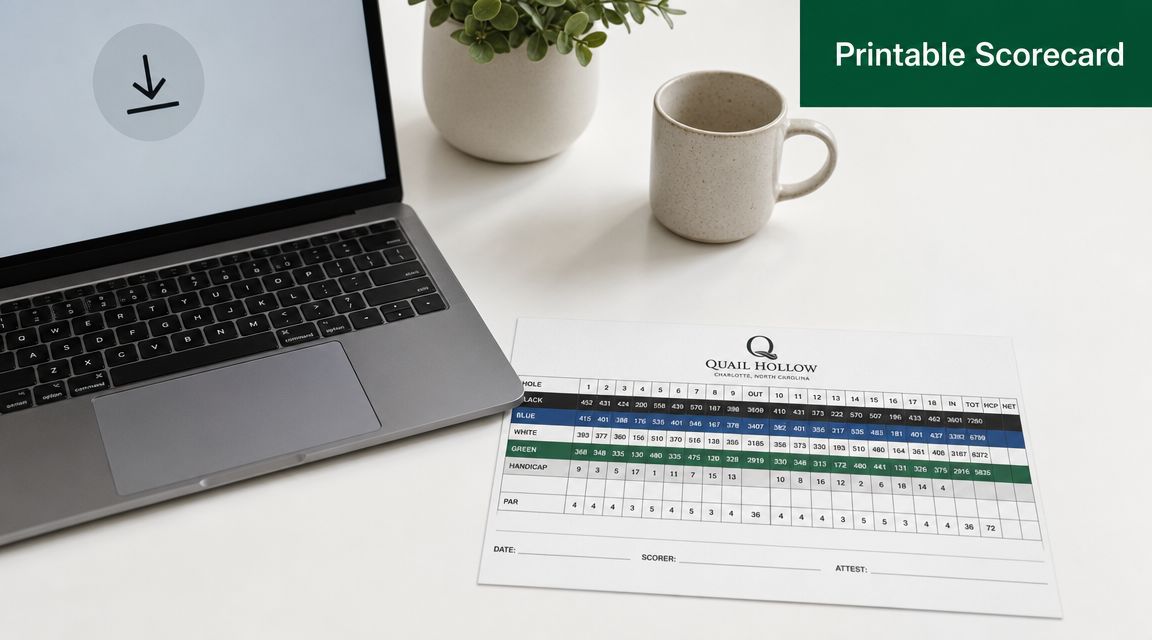
The best printable version isn't a blurry phone screenshot. It's a one-page sheet that shows the tee set you're using, leaves room for hole-by-hole notes, and makes handicap application easy to read at a glance.
For formatting ideas, it helps to compare how other course guides are laid out. This Fullerton golf course scorecard example is a good reminder that readability matters as much as the raw data.
What to include on your print version
Exact tee designation: Don't print a generic “tips” label if the event uses a tournament-specific setup.
Handicap row: Necessary for net games and side competitions.
Space for notes: Quail Hollow is the kind of place where players benefit from writing one target or one miss-side rule per hole.
For a tournament packet, I'd keep one staff copy with setup notes and a separate player copy with only what they need on the course.
Strategy for Key Holes and The Green Mile
You reach 14 in good shape, then the round starts asking better questions. Can the player choose the correct side of the fairway instead of the prettiest line. Can they accept a conservative target when the hole is built to provoke a mistake. That is how the Quail Hollow scorecard becomes useful. It stops being a yardage chart and starts guiding decisions.
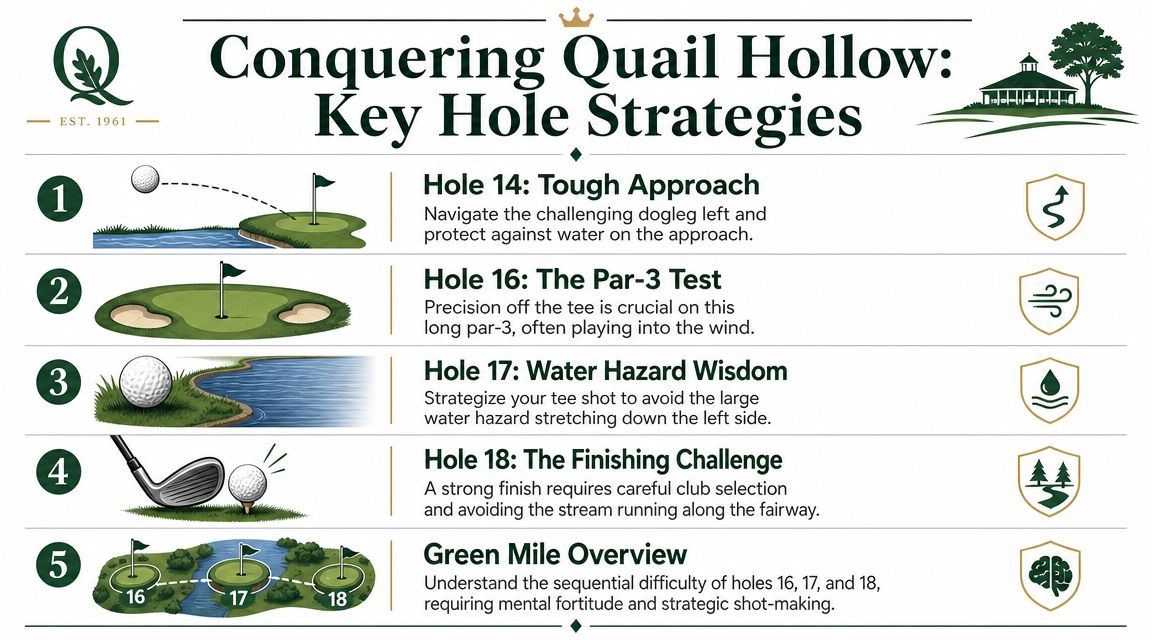
At Quail Hollow, the closing stretch can play very differently depending on the setup used for the day or the championship. Organizers need to account for that before they post tees and hole locations. Players need a plan that survives pressure, not one that only works on a perfect swing.
Hole 14 rewards discipline, not impatience
Hole 14 exposes a common mistake. Players confuse commitment with aggression.
The better play is usually the side of the fairway that opens the approach and gives a full look at the green. If the preferred angle asks for a slightly less aggressive tee ball, take it. A clean number and a clear target on the second shot matter more here than squeezing out a few extra yards.
I tell players to decide their miss before they pull the club. If water stays in the player's eye line through impact, steering shows up fast.
Hole 16 is where the course's true test begins
Hole 16 starts the Green Mile, and the first mistake is usually mental. Players arrive with the hole's reputation already in their head, then force a shot that the setup does not reward.
A better plan is straightforward:
Off the tee: Choose a start line you can repeat under pressure.
On the approach: If the hole location sits near trouble, use the larger safe section of the green.
For tournament staff: In player briefing, make it clear that par often comes from center-green discipline, not from attacking a tucked pin.
On 16, the miss matters more than the ideal shot shape. One poor decision often turns a routine hole into a number that changes a card.
Hole 17 demands full commitment
This hole exposes indecision immediately. The player has to settle on a carry number, select the club that covers it, and accept the target.
The bad pattern is familiar. One player guides the ball because the hazard is in view. Another takes extra club, then loses the discipline to aim at the correct section. Both mistakes come from trying to remove tension instead of managing it.
The sound approach is simpler:
Pick the carry number first.
Aim at the safest playable part of the green.
Take the long putt over the short-sided miss.
For event setup, this is also a hole where hole location can change scoring spread in a hurry. A severe pin pushes players into defensive swings. A fair location still asks for commitment without turning the hole into guesswork.
Hole 18 punishes leakage
The last hole asks for a tee shot with a shape that fits the corridor. Players do not need a hero swing, but they do need to understand which side of the hole keeps the second shot alive.
A ball that leaks into the wrong side brings every problem into play at once. From an operations standpoint, 18 also affects pace late in the day. If the setup invites players to chase too much, the final groups slow down because recovery shots and provisional decisions start piling up.
The Green Mile as an operations issue
Tournament directors should treat 16 through 18 as more than a famous finish. It is a setup and staffing issue.
Use this stretch to tighten three things:
Player messaging: Tell the field where restraint is rewarded.
Scoring expectations: Build gross and net targets with the closing stretch in mind, not just the front side.
Volunteer coverage: Put experienced spotters and scoring help where players face the hardest decisions.
Good players respect the Green Mile. Good tournament staff plan for how it changes behavior before the field even gets there.
Using Scorecard Data for Tournament Setup
Tournament directors don't need more scorecard images. They need accurate setup inputs. That's the primary value of the Quail Hollow golf course scorecard when you're building an event.

Start with the tee decision
At a place like Quail Hollow, the tee choice controls almost everything that follows. It affects pace, net fairness, gross scoring spread, and how enjoyable the round feels to the field.
For a member-guest or invitational, don't choose tees based on status. Choose them based on whether the majority of the field can advance the ball properly and still reach the intended landing zones and approach windows.
A few practical rules help:
Mixed-skill fields: Lean toward a setup that preserves pace and keeps long approaches from dominating every hole.
Better-ball events: You can stretch the course a bit because partners can stabilize bad holes.
Individual net play: Precision matters more. The tees need to align cleanly with the rated setup you'll use for handicaps.
Handicap application has to be exact
Poor setup manifests itself here. If hole handicap rankings are entered incorrectly, net results get distorted fast.
Use the scorecard data to verify:
Setup item | Why it matters |
|---|---|
Hole handicap order | Determines where strokes fall in net play |
Tee-specific yardage | Keeps scorecards and pace notes aligned |
Rated configuration | Supports fair handicap posting and competition setup |
Event-specific routing | Avoids mismatch between printed materials and actual play |
That sounds basic, but it's where a lot of staff hours get wasted. Someone grabs the wrong card, the tee labels don't match, and now pairings sheets, cart signs, and score entry all need to be corrected.
Format changes should affect setup choices
The same scorecard doesn't operate the same way in every format.
In a scramble, players can absorb one weak shot and still advance. In individual stroke play, every miss compounds. In match play, the most difficult holes don't always produce the biggest scoring swings.
That means the scorecard should influence format decisions in different ways:
Scramble: Let the field enjoy the architecture without forcing constant long-iron recovery play.
Net stroke play: Protect fairness first. Accurate handicap allocation matters more than theatrics.
Gross championship division: Preserve challenge, but only if the field is built for it.
Tournament habit: Before publishing pairings, compare the scorecard, the handicap setup, and the player list side by side. Most preventable errors show up right there.
What slows everything down
From the operations side, the weak points are predictable.
Manual entry of hole handicaps into spreadsheets.
Mismatched tee labels across printed materials.
Last-minute changes to divisions after players see the yardage.
Scorecards that list one setup while the starter announces another.
What works is one validated source of course data and one final check before anything goes live. At Quail Hollow, that's not a luxury. It's basic event control.
Modernize Your Event with Live Tourney Software
Manual tournament setup breaks down at the exact points where a demanding scorecard needs precision. Tee assignments get copied wrong. Hole handicaps get entered twice. One version of the scorecard ends up on the check-in table, and another gets used for scoring.
That's why web-based event tools have become the practical choice for modern tournament staff. A platform like Live Tourney removes a lot of the repetitive setup work and gives organizers one place to manage pairings, scorecards, live leaderboards, and player communication.
Where software actually helps
The main benefit isn't hype. It's consistency.
A solid workflow lets staff:
import course and event details once
generate pairings and tee sheets without rebuilding everything by hand
produce scorecards and player materials from the same event setup
handle live scoring without asking players to download an app
For organizers comparing paper-based workflows to a digital system, these examples of digital golf scorecards show why the shift is practical, not cosmetic.
What players notice
Players don't care how many admin tasks happen in the background. They notice whether the event feels organized.
They notice when the scorecard matches the setup. They notice when scoring is simple on the phone they already have in their pocket. They notice when leaderboards update without a pileup around the scoring table.
The best event software makes that feel normal.
What staff notice
Staff notice fewer corrections, fewer duplicate tasks, and fewer late surprises. They spend less time rebuilding exports and more time managing the event itself.
At a course where setup details matter, that's the difference between looking prepared and scrambling after the first group goes out.
Quail Hollow Scorecard Frequently Asked Questions
Is Quail Hollow Club the same as Quail Hollow Golf Course in Mississippi
No. Most searches for the Quail Hollow golf course scorecard refer to Quail Hollow Club in Charlotte, North Carolina, the private championship venue. There is also Quail Hollow Golf Course in McComb, Mississippi, a public Arthur Hills design with a different scorecard, listed by the Mississippi Department of Wildlife, Fisheries, and Parks and also identified by Golfify's facility listing for Quail Hollow Golf Course in McComb.
What is the Green Mile
It's the nickname for Quail Hollow Club's closing stretch. When players mention the Green Mile, they mean holes 16 through 18.
Is Quail Hollow Club private
Yes. Quail Hollow Club in Charlotte is a private club.
Why do different Quail Hollow scorecards show different yardages
Because the setup can change significantly depending on the event and tee configuration. Major championship routing can differ from ordinary member play.
What should a tournament director verify first
The exact tees in use, the rated configuration tied to those tees, and the hole handicap order that will be used for the competition.
If you run golf events and want a cleaner way to manage scorecards, pairings, and live scoring, take a look at Live Tourney. It's a modern web-based platform built for tournaments, leagues, and outings, with app-free scoring that works on any device.





