Dec 19, 2025
Learn how to run golf tournament effectively with budgeting, planning, and day-of tips for a memorable event.

Any great golf tournament comes down to three things: solid planning beforehand, smooth execution on the day of, and smart follow-up after the last putt drops. But the truth is, most of the heavy lifting happens months before anyone even thinks about tee times. This is where you define your goals, get the right people on board, and build a budget that keeps everything on track.
Setting Your Tournament Up for Success
The buzz and excitement of tournament day don't just happen by magic. They're the direct result of careful decisions made long before the first golfer shows up. This early phase is about more than just booking a course—it’s about figuring out the why behind your event and lining up the resources to make it happen.
Without a clear purpose, a good team, and a handle on the finances, even the best ideas can fall flat. This is where you turn a cool concept into a real, actionable plan. It's what separates a chaotic, stressful day from a professional, fun, and profitable one.
Let's walk through the first critical steps that lay the groundwork for a fantastic event.
Define Your Tournament's Core Purpose
Before you even think about a venue or a logo, you need to answer one simple question: Why are we doing this? The answer will drive every single decision you make, from the format you choose to the sponsors you approach. A tournament’s purpose gives it a personality.
So, is your main goal to:
Raise money for a charity? If so, your focus is on maximizing donations and creating an emotional connection to the cause. Every decision should point back to that.
Host a corporate networking event? Here, it’s all about a premium experience. You want to help people connect and make your company look great.
Run a competitive club championship? This is all about the golf. The focus needs to be on fair rules, accurate scoring, and a true test of skill.
Organize a fun, casual outing for friends? Keep it light. Think relaxed formats like a Scramble, good food, and plenty of social time.
Getting this right is non-negotiable. A charity event that feels too stuffy and corporate will miss the mark, just like a competitive tournament that’s too disorganized.
This simple flow shows how these foundational pieces fit together.
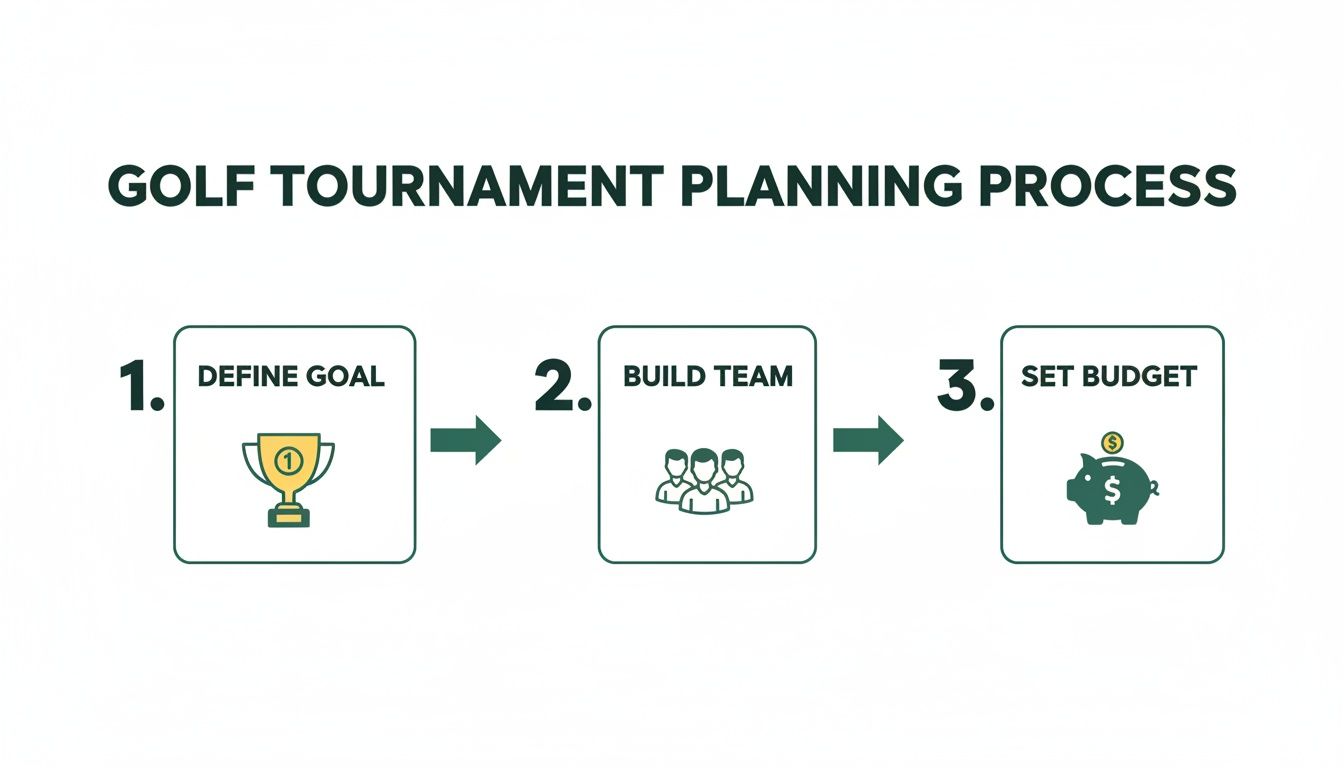
As you can see, it all starts with a clear goal, which then helps you build the right team and a budget to match.
Assemble Your Planning Committee
Trying to run a golf tournament by yourself is a surefire way to burn out. Your best asset is a small, dedicated committee of people you can count on. Give each person a specific role—this avoids confusion and makes sure nothing falls through the cracks. You don’t need a huge team, just the right people doing the right jobs.
Consider creating lead roles for these key areas:
Tournament Chair: The project manager. They keep the train on the tracks and make the final calls.
Sponsorship Coordinator: This person builds the sponsorship packages and goes out to secure partners.
Logistics & Venue Manager: Handles everything with the golf course, from catering to on-site setup.
Marketing & Registration Lead: Gets the word out, manages sign-ups, and handles all player communication.
Volunteer Coordinator: Finds and organizes volunteers for day-of jobs like check-in or watching a hole-in-one contest.
A common mistake is getting too many people involved. A committee that’s too big can get bogged down in debate. A focused team of three to five committed people is almost always more effective than a dozen who are only halfway in.
Create a Realistic Budget and Timeline
Your budget is your financial roadmap. It needs to account for every dollar coming in and going out. Start by listing all your potential costs, from the big ones down to the little things you might forget. For a really deep dive, our complete golf tournament checklist is a great tool for tracking all these moving parts.
Potential Expenses:
Green fees and cart rentals
Food and beverage (breakfast, lunch, dinner)
Prizes and trophies
Player welcome gifts (the "tee gift")
Signage and marketing materials
Event software or payment processing fees
Potential Revenue:
Player registration fees
Sponsorship packages
Mulligans, string, and other on-course fundraisers
Raffles or silent auctions
With your budget in place, build a timeline by working backward from your tournament date. Giving yourself six to nine months is a good rule of thumb. That’s enough time to lock down a great course, land sponsors without rushing, and promote the event to get a full field of players.
Choosing the Right Course and Date
Once you've nailed down your goals, the two biggest decisions you'll make are where and when to host your tournament. These choices will drive your budget, shape the player experience, and ultimately determine how many people show up.
Get these right, and everything else falls into place much more easily.
Choosing a course is about more than just finding the cheapest green fee. You're looking for a partner, not just a patch of grass. The right venue staff can be a lifesaver, while the wrong one can create a dozen headaches you don't need on tournament day.
Finding a Course That Fits Your Event
Let your tournament's purpose guide your search. If you’re running a high-end corporate networking event, you’ll probably be looking at prestigious private clubs. But for a laid-back charity scramble, a well-kept public or municipal course is often the perfect fit.
And don't just think about the 18 holes. The rest of the facility matters just as much.
Clubhouse and Dining: Is there a banquet room that can actually fit everyone for the awards ceremony? Check out their catering menu—does it work with your budget and vibe?
Practice Facilities: A good driving range and putting green are key. It gives players a place to warm up and hang out before the shotgun start.
Staff Support: Find out how involved the course's pro and event staff will be. Their experience can be one of your greatest assets, so make sure they’re willing to help.
Pro Tip: Never book a course based on a phone call. Schedule a site visit and meet the event coordinator in person. You'll get a real feel for the service, and you might spot details—good or bad—that you’d never see on a website.
It’s all about balancing prestige with practicality. A famous course might be a great draw, but it could also eat up your entire budget. Sometimes, a lesser-known local gem offers better value and more personal attention, letting you spend more on prizes, food, and other things that make the day memorable.
Selecting the Perfect Date
Picking a date is basically a game of avoiding conflicts. The last thing you want is to schedule your event on the same day as a major holiday, a popular local festival, or another big golf outing. Check community and school calendars before you lock anything in.
Your timing also has a huge impact on price. Weekday tournaments, especially on a Monday or Tuesday, are often significantly cheaper than a weekend slot. This is a great move for corporate events where people can step away from the office for a day.
Then there’s the weather. Think about your local climate. A 1:00 PM shotgun start in July could be miserable in a hot climate, while an early tee time in October might be too chilly. The shoulder seasons—late spring and early fall—are usually your best bet for pleasant weather.
Even the pros think this way. The PGA Tour strategically spaces out its majors to maximize player participation. We've seen club tournaments scheduled opposite a major championship see a 15% drop in entries. By finding a good spot on the calendar, you could boost your attendance by up to 25%. You can get a feel for the rhythm of the season by checking out the professional golf tour rankings and schedules on cbssports.com.
Key Questions to Ask Potential Courses
Before you start calling around, get a list of questions ready. This helps you compare your options fairly and avoids surprise costs down the road. It also shows the course you're serious and helps you negotiate a better package.
Here’s what you absolutely need to ask:
What’s included in the per-player fee? Does it cover the green fee, cart, range balls, and all taxes or service charges?
Do you require a deposit, and what is the payment schedule? Get the financial terms clear from day one.
What is your cancellation policy? You need to know your options if bad weather hits or something else goes wrong.
Can we place sponsor signs on the course? Some high-end clubs have surprisingly strict rules about this.
What are the food and beverage minimums? This is a classic "hidden cost" that can blow up your budget if you're not prepared.
By doing your homework on the course and date, you’re setting the stage for a smooth, successful tournament that hits all its goals and leaves everyone wanting to come back next year.
Designing a Fun and Engaging Tournament Format
The format you choose for your tournament does more than just dictate how people play—it sets the entire mood for the day. Is this a serious competition for club bragging rights, or a fun, relaxed outing where networking is the real goal?
Picking the right format is all about making sure everyone has a great time, regardless of their handicap. A bad choice can lead to slow play and frustration, but the perfect fit creates a memorable day that has players excited for next year.

Popular Tournament Formats Explained
Let's break down the most common formats. Each one has its own vibe, pace, and is suited for different crowds. Knowing the pros and cons is key to making the right call for your group.
Here's a quick comparison to help you decide.
Popular Golf Tournament Formats Compared
Format | Best For | Pace of Play | Key Feature |
|---|---|---|---|
Scramble | Charity & corporate events, mixed skill levels | Fast | Team plays from the best shot, low pressure. |
Best Ball | Member-guests, competitive but friendly events | Moderate | Each player plays their own ball, team takes the best score per hole. |
Stroke Play | Club championships, serious competitions | Slow | Every stroke counts, true test of individual skill. |
Match Play | Ryder Cup-style events, head-to-head drama | Moderate-Fast | Competing hole-by-hole against a single opponent. |
While each format has its place, one stands out for most non-competitive events.
The Scramble format is your safest and best bet for any event where fun and fundraising are the primary goals. It keeps the day moving, minimizes pressure on new golfers, and encourages a social atmosphere that sponsors and players love.
Establishing Fair Rules and Handicaps
Clear rules are non-negotiable. You need them to prevent confusion and keep the playing field level. Don't just assume everyone knows the specifics of your chosen format.
Communicate the rules clearly on your event website, in pre-tournament emails, and during the opening announcements. Make sure you cover things like mulligan usage, on-course contests, and how to handle rulings.
Handicaps are what make a tournament competitive for everyone. Using a player's official handicap index allows you to calculate a "net score," which adjusts their raw score based on their ability. This gives a high-handicap player a real chance to compete against a scratch golfer. For formats like a Scramble, you can use a percentage of each player's handicap to create a fair team handicap.
Filling Your Field and Managing Entries
Your field size matters. Most courses can comfortably handle between 72-144 golfers. Looking at the pros, you'll see most tour events feature 120 to 156 players. For bigger events, a great tip is to run Monday qualifiers for about 20% of the spots, a tactic the PGA uses. This strategy can boost local engagement by up to 40% and helps guarantee a full, competitive field. You can see how the pros structure their fields by checking out the latest PGA Tour rankings and event details on espn.com.
Of course, you have to get the word out. Start marketing early—at least three to four months out. Create a simple, professional event website with online registration and payment options. Use social media to build excitement and lean on local partners, like the chamber of commerce, to spread the word.
And don't forget your most powerful tool: personal outreach to past players and sponsors. They are your most likely repeat customers. For events with complex matchups, it's also a good idea to explore tools that can help you create a round robin schedule to manage pairings efficiently.
Securing Sponsorships and Managing Finances
A great on-course experience is what players remember, but a smart financial strategy is what makes the event possible in the first place. This is the engine room of your tournament. Without a solid handle on revenue and expenses, even the best-laid plans can turn into a stressful, money-losing headache.
The trick is to treat your tournament like a business. You’re creating a product, and that product needs to deliver real value to both your players and your sponsors. This means building sponsorship packages that actually deliver a return and using modern tools to manage the money, from registration fees to payouts.
Crafting Sponsorship Packages That Sell
Let's move beyond the generic "Bronze, Silver, Gold" packages. Today’s sponsors are savvy—they want to see clear, tangible benefits for their investment. Your job is to show them how they can get meaningful exposure to a captive audience of golfers, which is often their ideal demographic.
Start by brainstorming every single branding opportunity you can think of. Don't just stop at a sign on a tee box.
Title Sponsor: This is your headliner package. It offers exclusive naming rights, like "The Acme Corp Charity Classic." This tier should get maximum logo placement on everything, a speaking slot at the awards dinner, and multiple complimentary foursomes.
Presenting Sponsor: A premium spot just below the title sponsor, often attached to a specific part of the event. Think "Awards Dinner Presented by..." or "Cocktail Hour Presented by...". It’s a great high-visibility option.
Contest Sponsors: Let businesses put their name on the fun stuff. Sponsoring the Longest Drive, Closest to the Pin, or a Hole-in-One contest gives them a dedicated presence on a specific hole where players are already engaged.
Hole Sponsors: The classic entry-level sponsorship. It’s more than just a sign on a tee box—consider adding value by letting them set up a small table or tent to interact with players as they come through.
For charity events, you can also explore different golf tournament fundraiser ideas to boost donations and get sponsors more involved through creative on-course activities.
Pro Tip: Always bundle player entries into your higher-tier packages. A $5,000 sponsorship that includes a $1,200 foursome feels like a much better deal. The sponsor immediately sees a tangible return on their investment.
Streamlining Registration and Payments
Trust me on this one: manual registration with paper forms and checks is a logistical nightmare. It creates a mountain of work for your team and opens the door for all kinds of errors. Bringing this process online is one of the single biggest improvements you can make.
Using dedicated software isn't just a nice-to-have; it's essential for running a smooth event. The right platform automates everything, letting players sign up, pay their fees, and enter their handicap info all in one seamless step. This not only saves you countless hours but also gives your participants a professional, secure experience from the very start. To see what these tools can do, check out this guide on choosing the right golf tournament management software.
Structuring Prizes and Payouts
Let’s be honest—prizes are a huge draw, especially for the more competitive events. A well-structured prize purse doesn't just attract a full field; it keeps everyone engaged until the final putt drops. The key is to find that sweet spot between attractive rewards and your overall budget.
A good rule of thumb is to set aside 15-20% of your total budget for the prize fund. Professional tours often follow a similar model, with the winner typically taking home around 18% of the total purse. For a club-level event with a $10,000 budget, this might mean $2,000 for first place and $1,000 for second. A solid prize structure like this can lead to player retention rates of over 80% for your future tournaments.
Executing a Flawless Tournament Day
After months of planning, the big day is finally here. This is where your careful preparation pays off, transforming all that hard work into a memorable experience for every player, sponsor, and volunteer.
A smooth tournament day isn’t about luck. It's about having a clear, actionable plan for managing every moving part, from the first car pulling into the parking lot to the final round of applause. Your role now shifts from planner to conductor, and this is your playbook for turning a good plan into a great event.
The Morning Rush: Mastering Check-In
The first impression of your tournament happens at the registration table. A chaotic, slow-moving check-in process can sour the mood before anyone even hits the driving range. Your goal is to make it fast, friendly, and efficient.
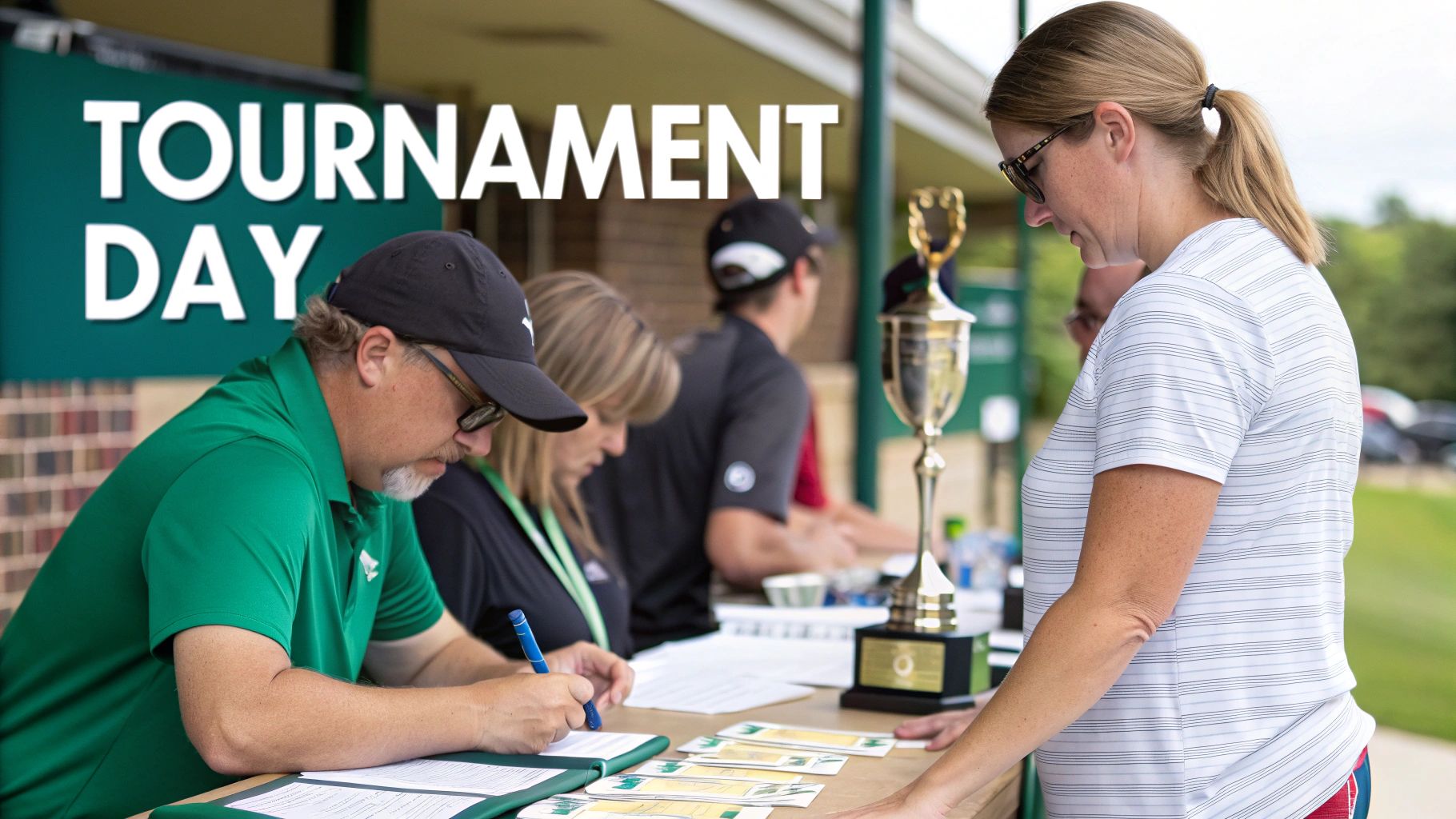
Have at least two volunteers at the registration table—one to greet players and another to handle the check-in itself. It's also a great idea to have your pairings and starting hole assignments printed and displayed nearby. This simple step prevents a flood of the same question and keeps the line moving.
Pro Tip: Create a "problem solver" role for yourself or a lead volunteer. This person doesn't work the table but floats nearby, ready to handle odd issues like a player not on the list or a last-minute payment. This keeps the main line from grinding to a halt.
On-Course Logistics and Signage
Once players leave the clubhouse, the course itself needs to be ready to go. This means having all your signage and contest markers in place well before the first group arrives. A well-marked course ensures everyone knows where they're going and what's happening on each hole.
Clear wayfinding signage is essential. You’ll want to direct players to:
Registration and bag drop locations
Practice areas like the driving range and putting green
Specific contest holes (Longest Drive, Closest to the Pin)
Restrooms and on-course refreshment stations
Volunteers are your eyes and ears out there. Station someone at each contest hole to measure shots and record the leaders. They not only manage the contest but also add to the event's energy and can help keep an eye on the pace of play.
Managing Pace of Play
Nothing kills the vibe of a golf tournament faster than a five-and-a-half-hour round. Slow play is a common complaint, but it's one you can actively manage. The format you chose plays a big role—a Scramble naturally moves faster than Stroke Play—but your on-course management is just as critical.
Ask the course to send a ranger out to monitor the pace, gently encouraging slower groups to pick it up. A good ranger knows how to be friendly yet firm. If you're using live scoring software, you can often spot bottlenecks in real-time as scores stop coming in from a certain part of the course. This lets you proactively address a slow group before they back up the entire field.
Scoring and Awards Ceremony
As the final groups finish up, the focus shifts to scoring and celebrating the winners. Doing this manually is slow and ripe for errors. Using a live scoring system is the modern standard; scores are entered by players on their phones and automatically tabulated, meaning your leaderboard is ready the moment the last putt drops.
Display the live leaderboard on TVs in the clubhouse so players can follow the action as they come in. It really builds excitement for the awards ceremony.
When it's time for the awards, keep it brief and energetic.
Thank Everyone: Kick things off by thanking the players, sponsors, volunteers, and course staff.
Acknowledge Sponsors: Give your title and presenting sponsors a special shout-out.
Announce Winners: Announce the on-course contest winners first, then build up to the overall tournament champions.
Closing Remarks: End on a high note by reiterating the event's purpose, especially if it was a fundraiser.
By nailing these day-of details, you ensure all your planning results in a flawless, professional, and fun event that leaves everyone eager for next year.
Your Top Golf Tournament Planning Questions, Answered
Even with the best plan, questions always come up, especially if this is your first time at the rodeo. We’ve been there. This is our quick-reference guide to the most common hurdles and uncertainties we see organizers face.
Think of it as advice from someone who's seen it all. Here are the straightforward answers to the questions we get asked the most.
How Much Does It Really Cost to Host a Golf Tournament?
This is the big one, and the honest-to-goodness answer is: it depends. A small charity event for a local cause might land somewhere between $5,000 and $15,000. On the flip side, a big corporate tournament with all the bells and whistles—premium gifts, fancy dinner—could easily top $50,000.
No matter the scale, your biggest expenses are almost always the same:
Green fees and cart rentals
Food and beverage packages
Prizes and contest hole giveaways
Signage and marketing materials
Your budget isn't just a document; it's your roadmap. It dictates your entry fees, your sponsorship levels, and ultimately, whether you end up in the red or the black. Don't wing it.
What's the Best Format for a Mix of Golfers?
When you’ve got a field full of scratch golfers and total beginners, there's only one answer: the Scramble. It's the undisputed champion for any event where fun and fundraising trump fierce competition.
It’s popular for a reason.
Everyone on the team tees off.
The team picks the best shot of the bunch.
Everyone plays their next shot from that spot.
This keeps things moving and takes all the pressure off the folks who are just happy to hit the ball straight. It’s social, it’s low-stress, and it guarantees a good time for everyone, which is the whole point of a charity or corporate outing.
I see this mistake all the time: organizers pick a format like Best Ball for a casual crowd. It’s a great competitive format, but for a fun-focused event, it just slows everything down and makes new players feel intimidated. Stick with the Scramble.
When Should I Actually Start Planning This Thing?
The secret to a tournament that doesn't leave you pulling your hair out? Time. Give yourself a runway of at least six to nine months. I know it sounds like a lot, but that head start is the difference between a smooth event and a last-minute scramble.
Starting early lets you lock in the best course on your preferred date before they get snatched up. It also gives your sponsorship team plenty of time to build relationships and secure partners without looking desperate. Most importantly, it gives you a real chance to market the event properly and sell every last spot.
How Do I Get Sponsors Without Begging?
Chasing sponsorships can feel like the toughest part of the job, but it doesn't have to be. The best place to start is right in your own backyard—your personal and professional networks.
Then, build professional sponsorship packages that offer real, tangible value. You’re not just selling a logo on a tee sign; you’re selling access and exposure.
Make it a good deal: Bundle player spots into your top-tier packages.
Think local: Local businesses want to connect with local customers. If your golfers fit their demographic, it's an easy sell.
Lead with the mission: For a charity fundraiser, the "why" is your most powerful tool. Show them the direct impact their money will have.
A slick, professional proposal that shows a clear return for the sponsor is what separates a "maybe" from a signed check.
Running a modern tournament is a whole lot easier with the right tools. Live Tourney simplifies everything from online registration and payments to app-free live scoring that players actually enjoy using. You can elevate your event and save yourself hours of busywork. See how simple it can be at https://livetourney.com.