
Oct 27, 2025
Learn how to create a round robin schedule for any golf league or tournament. This guide covers manual methods, software automation, and tee time pairing.

If you're looking to run a golf league or a multi-round tournament, the round-robin schedule is your best friend. The concept is simple: every player or team plays against every other participant exactly once. It’s the bedrock of fair competition, guaranteeing everyone the same number of matches and avoiding those frustrating early eliminations. The real trick is rotating opponents systematically until every possible matchup has been played.
What Is a Round Robin Schedule and Why Use It for Golf?
At its core, a round-robin schedule is the most equitable way to determine a true champion. Unlike a knockout bracket where one bad day can send a great player packing, this format gives you a complete and balanced slate of matches. It’s perfect for leagues because it rewards consistency over a full season, not just a lucky draw.
This structure is especially well-suited for golf for a few key reasons:
Maximum Player Engagement: Every single golfer is guaranteed to play in every round. This maximizes the value they get from their league fees and keeps them invested all season long.
Ultimate Fairness: It completely removes the luck of the draw. The final standings truly reflect who performed best against the entire field, not just who got an easier path to the top.
Drives Community: By design, players are matched with different opponents each week. This naturally builds camaraderie and helps members get to know one another, which is what a great league is all about.
The Foundation of Fair Play
This method isn’t just for sports—it actually has roots in computer science. The idea of a "round robin" was first cooked up in the 1960s as a fair way for early computers to divvy up processing time among different tasks. That same principle of giving everyone an equal turn has since become a global standard for fairness.
Knowing how to build a round-robin schedule is a game-changer, especially if you want to plan the ultimate golf trip for your buddies and make sure everyone gets a chance to compete against each other in a structured way.
Key Takeaway: The whole point of a round robin is to eliminate randomness. It creates a level playing field where every participant has the exact same opportunity to compete against everyone else.
This structure is the backbone of so many successful leagues. For anyone running a tournament, mastering this scheduling method gives you total control over the player experience. You'll be better equipped to handle common headaches like last-minute dropouts or an odd number of players, ensuring your event runs smoothly from the first tee to the final putt. If you're just starting out, our First Event Guide can walk you through the setup process.
How to Manually Create Pairings with Berger Tables
For smaller golf leagues, putting together your own schedule by hand is a great way to really get a feel for how the pairings work. The classic, most reliable method for this is the Berger Table—sometimes called the circle or polygon method. It’s a simple, visual system that guarantees every player faces every other player exactly once.
The whole thing hinges on one simple idea: you anchor one player and rotate everyone else around them.
Let's walk through it with a quick example. Imagine you're running an 8-player golf league. To complete a full round-robin where everyone plays everyone, you'll need 7 rounds of matches.
Setting Up the Initial Pairings
First, give every player a number, 1 through 8. The trick here is to "anchor" one player in a fixed spot. We'll use Player 8. Think of them as the pivot point that never moves, while everyone else shuffles around.
The other players—1 through 7—are then set up in two columns to create the first round of pairings.
For Round 1, it would look like this:
Player 1 vs. Player 7
Player 2 vs. Player 6
Player 3 vs. Player 5
Player 4 vs. the anchored Player 8
Just like that, you have your first set of fair matchups.
Key Takeaway: The anchor player is the secret sauce here. By keeping one person stationary, you create a simple, predictable pattern that's easy to follow for each round. It’s the best way to avoid accidentally pairing up the same people twice.
Rotating Players for Subsequent Rounds
To build out the schedule for Round 2, you just rotate players 1 through 7 one spot clockwise. Player 8, our anchor, stays put. So, Player 1 moves to where Player 2 was, Player 2 moves to Player 3's old spot, and so on. Player 7, who was at the bottom, circles back up to the top spot that Player 1 just left.
This balanced approach is what makes it all work.
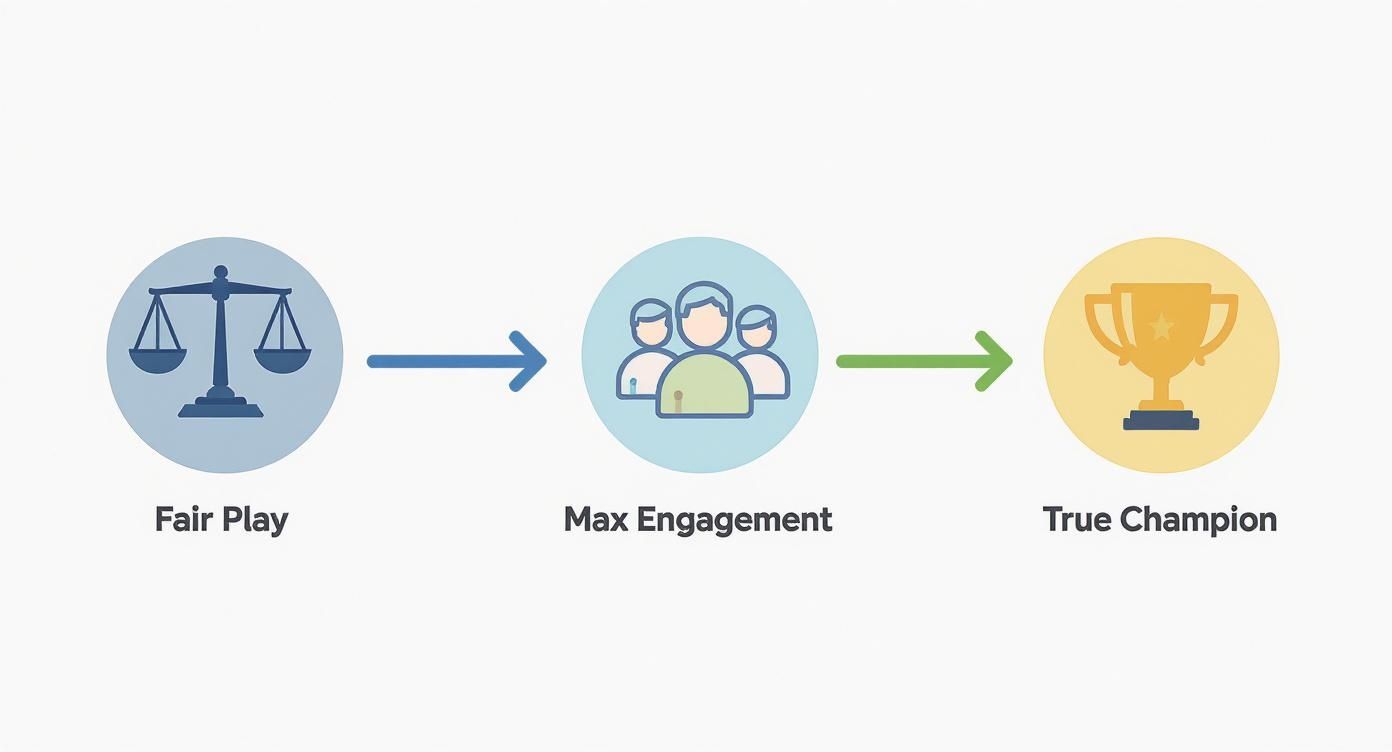
This process ensures everyone gets a new opponent in a fair rotation, which is what you want for finding a true champion. For every new round, you just repeat that same clockwise shift. The pairings change systematically, guaranteeing fresh matchups until the full cycle is complete after seven rounds.
While this is a rock-solid system for smaller groups, it's worth thinking about the pros and cons of using pen-and-paper scheduling methods versus an automated tool, especially as your league starts to grow.
Managing Schedules with an Odd Number of Players
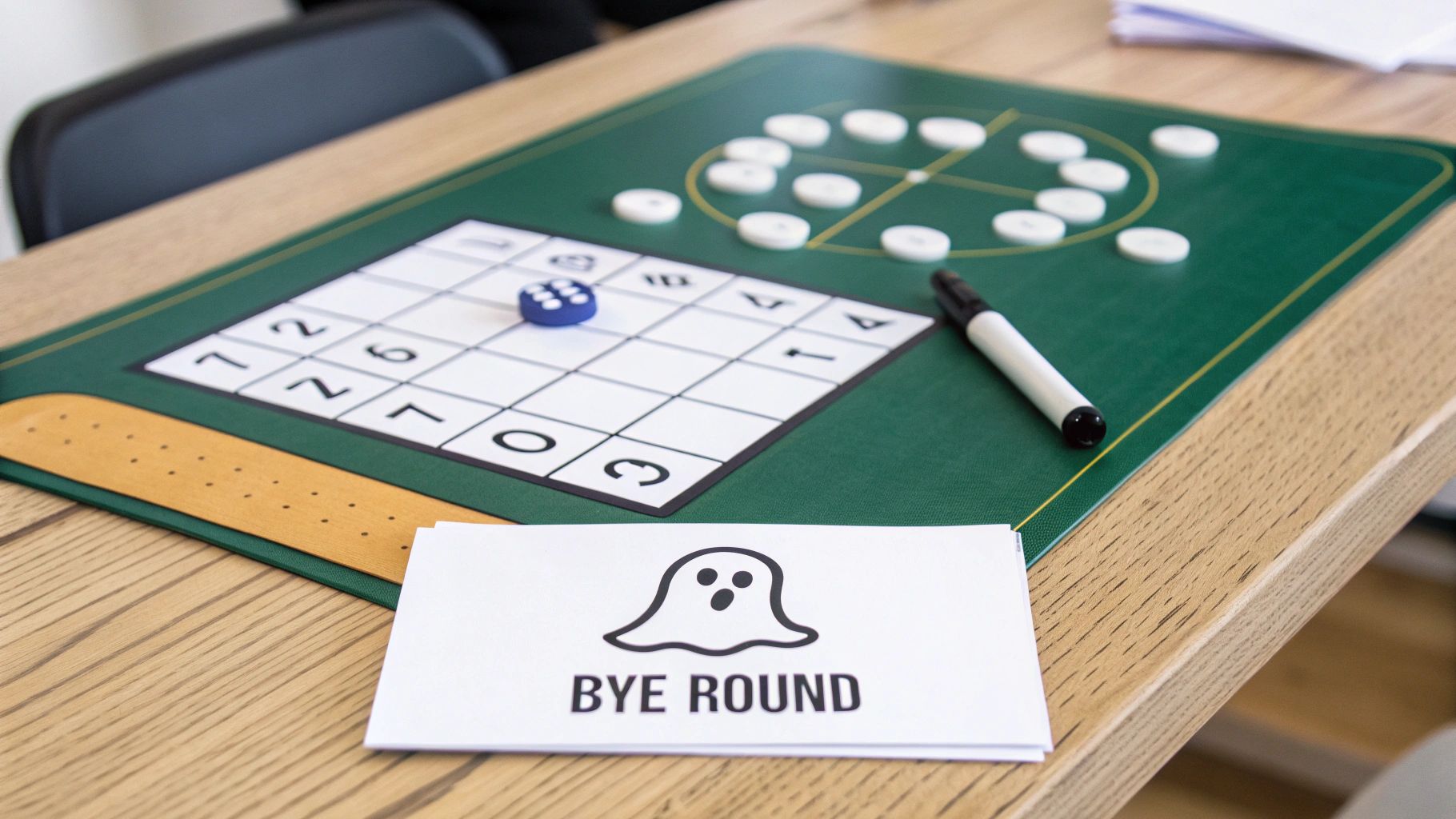
It’s one of the most common snags you’ll hit when building a round-robin schedule: what happens when you have an odd number of players? If you're set up for eight players but only seven sign up, does the whole thing fall apart?
Nope. The fix is actually pretty simple and keeps the entire structure intact. You just introduce a "ghost" player.
This ghost, usually called a bye, is just a placeholder that makes your total number of participants even. It lets you use the exact same rotation method we already covered without changing a thing about the logic. The schedule’s integrity holds up, and the math works perfectly.
The Bye in Action: A 7-Player Example
Let's say you have seven golfers ready to go: Abe, Beth, Carl, Deb, Evan, Fran, and Greg. To even things out, we’ll simply add an eighth participant named "Bye." Now we have eight "players" and can roll out the same 7-round schedule we'd use for a full 8-person league.
The process is identical. We anchor one "player" (in this case, the Bye) and rotate the other seven golfers around it. In any given round, whoever is paired against the Bye just gets that week off. It’s a clean way to ensure everyone gets a rest period while keeping the schedule balanced.
Pro Tip: Don't think of a bye as just a week off—it's a critical part of the scheduling machine. This system guarantees that every actual player still competes against every other actual player exactly once over the course of the season.
How the Bye Rotates Through the Schedule
Let's map this out with our 7-player group. We'll number our real players 1-7 (Abe to Greg) and make the Bye our anchor, Player 8.
Here’s how it looks for the first few rounds:
Round 1: Player 4 (Deb) is paired against the Bye. She gets the week off. The other matchups are 1 vs. 7, 2 vs. 6, and 3 vs. 5.
Round 2: We rotate the circle. Now, Player 5 (Evan) is matched up with the Bye and gets to rest.
Round 3: The rotation continues, and Player 6 (Fran) gets her bye week.
This pattern continues methodically for all seven rounds. By the time the schedule is complete, every single one of the seven golfers will have had exactly one bye week. It’s a fair, predictable system for handling an uneven roster without causing chaos or forcing you to manually rebuild pairings each week. It’s this kind of small adjustment that makes the round-robin format so flexible for real-world leagues where player counts aren't always perfect.
Assigning Pairings to Tee Times and Courses
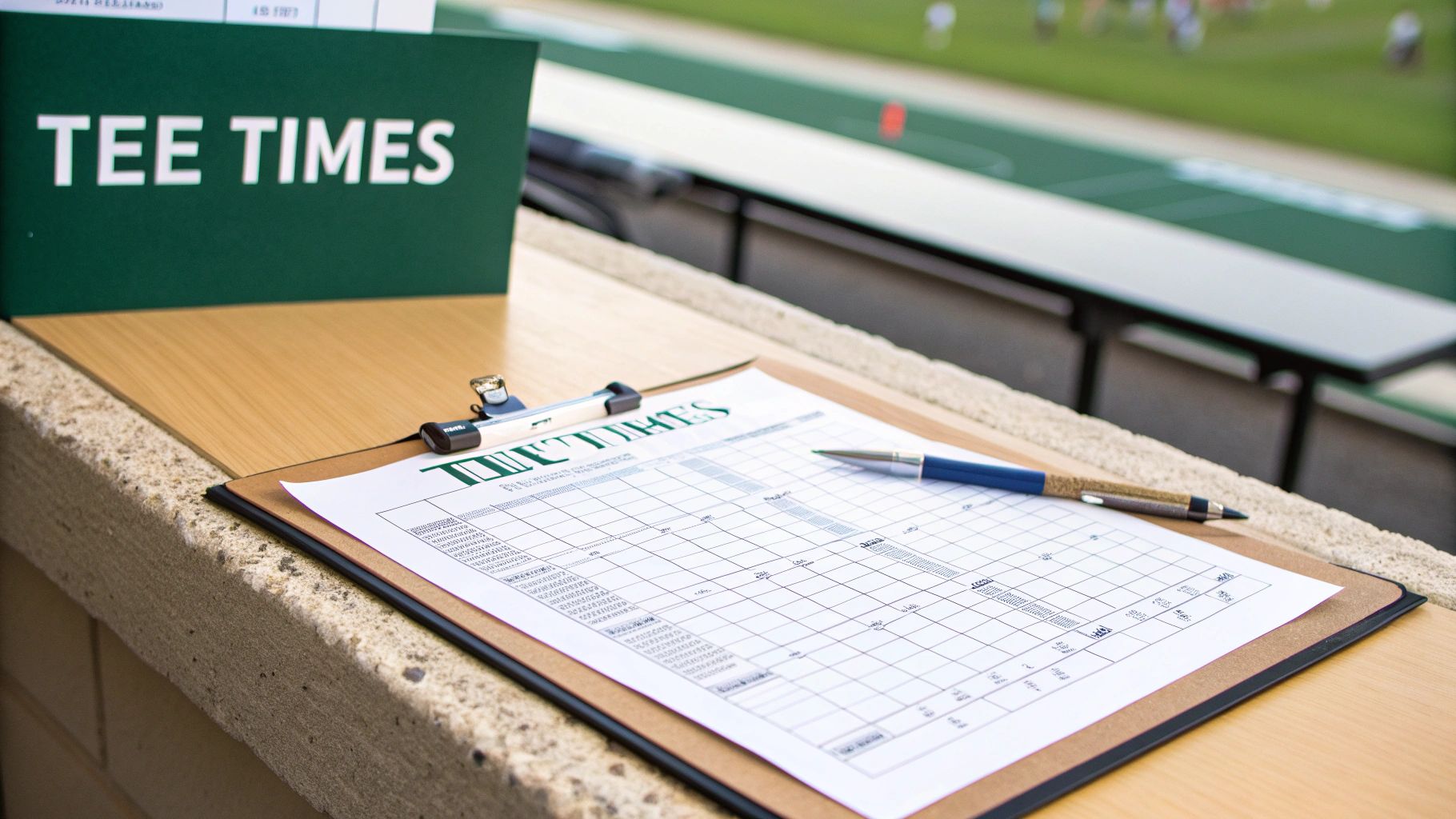
You've done the hard work of generating fair matchups for every round. Now comes the crucial step of turning that list of pairings into a real-world schedule. This is where you map out who plays with whom, what time they tee off, and from which tee box.
This isn't just about filling in a spreadsheet; it's about making sure the logistics live up to the fairness you've already built into the pairings. A well-planned tee sheet makes the day run smoothly and keeps your players happy.
From Pairs to Playable Foursomes
Let's say you're running a 16-player league. The round-robin schedule you created will give you eight separate matches for the week (Player 1 vs. Player 9, Player 2 vs. Player 10, and so on). The simplest way to get them on the course is by combining two of those matches into a single foursome.
It’s pretty straightforward. You could group the first two matches to form your first tee time:
Tee Time 1 (8:00 AM): Player 1, Player 9, Player 2, and Player 10.
Just continue that pattern down the list. The third and fourth matches become the next foursome, the fifth and sixth form another, and you’re done. It keeps things clean and easy to follow.
A Quick Tip for Organization: Always post the full tee sheet well in advance, showing both the foursomes and the individual matches within each group. This lets players find their group and know their opponent before they even get to the course. No confusion, no last-minute questions.
Ensuring Fairness with Tee Time Rotation
One of the most common complaints I hear in season-long leagues is about tee times. Nobody wants to be stuck with the first or last slot every single week. This is an easy problem to solve when you create a round robin schedule—you just have to be intentional about it.
A simple rotation system is all you need. If the group with Players 1-4 got the first tee time in Week 1, they should slide into a middle or late time slot for Week 2.
Here’s a basic rotation strategy you can use over three rounds:
Week 1: The first few pairings on your list get the early times, the middle pairings get the middle slots, and the last pairings get the late ones.
Week 2: The players who teed off late now get the early slots. The "early" group from last week shifts to the middle, and the "middle" group moves to the end of the tee sheet.
Week 3: Rotate again. The group that was in the middle now starts first, and the cycle continues.
This kind of methodical rotation ensures that, over a season, everyone shares the burden of the early morning start. It’s a small detail that makes a huge difference in keeping the league fair and fun for everyone.
Managing Play Across Multiple Courses
If your tournament or league plays across more than one golf course, the same logic applies. The goal is to make sure no one gets stuck playing the same track over and over, especially if one course is seen as more difficult or desirable.
Your master schedule should map out both tee times and course assignments. For a league that alternates between two courses, you can simply have half the field play Course A and the other half play Course B each week, then have them swap for the next round.
By carefully mapping your pairings to tee times and courses, your theoretical schedule finally becomes a living, breathing event. This is the final bridge between planning and playing.
Using Software to Automate Your Round Robin Schedule
https://www.youtube.com/embed/bVSF13sZpNk
While scribbling out pairings on a notepad or wrestling with a spreadsheet is a great way to understand the logic behind a round-robin schedule, it gets old fast. As soon as your league grows or you're managing more than a handful of players, manual methods become a huge time sink and are frustratingly prone to error.
When you're dealing with dozens of players, multiple rounds, and the inevitable last-minute availability changes, automation isn't just a nice-to-have—it's essential for running a smooth, professional event.
This is exactly where golf tournament management software changes the game. Platforms like Live Tourney are built to take the complicated, tedious work of scheduling completely off your plate. You can generate a perfect round-robin schedule in minutes, not hours. Forget about complex formulas and manual rotations; these tools handle it all for you.
The biggest win here is sheer efficiency. You just need to input your player roster, set a few basic parameters, and the software cranks out the entire season's matchups with a couple of clicks. This frees you up to focus on what actually matters—communicating with your players and making sure everyone has a great time on the course.
Getting Started with Automated Scheduling
The setup process is almost always dead simple. You’ll start by creating your event and adding your players, which can usually be done with a quick roster upload from a spreadsheet. From there, you just head over to the scheduling options and select the round-robin format.
This is where the power of automation really becomes clear. You can instantly configure all the details that would be a massive headache to manage by hand:
Number of Rounds: Tell it the exact length of your league or tournament season.
Players per Group: Set up your pairings for match play (twosomes) or combine them into larger foursomes.
Automatic Bye Assignment: The software intelligently handles odd player counts, making sure byes are distributed fairly across the season without you having to lift a finger.
Once you’ve set your preferences, the platform generates a complete, professional schedule. We're talking tee sheets, printable pairings, and even digital scorecards, all ready to go.
Want to see just how easy it is? You can explore a demo of the scheduling tools to get a feel for the workflow yourself.
Beyond Simple Pairings: Powerful Features
Modern scheduling software solves common logistical nightmares before they even happen. For example, if a player has to drop out mid-season, you can simply update the roster, and the system will automatically adjust all future pairings or assign byes to fill that open slot. No need to go back and manually recalculate everything from scratch.
Key Insight: Automation eliminates the single most common source of scheduling errors—human oversight. A single mistake in a manual rotation can throw off an entire season's worth of matchups, a problem that software completely avoids.
The principles behind round-robin automation are used everywhere, not just on the golf course. In the business world, sales teams use it to distribute new leads fairly and quickly. It turns out that when companies respond to an inbound lead within five minutes—a speed often only possible with automated systems—they are 100 times more likely to make meaningful contact with a potential customer.
For tournament organizers looking at different platforms, flexibility is key. If you need a highly customizable database to manage every aspect of your league, you could explore how to boost productivity using Airtable automations. However, for a dedicated golf solution, a specialized tool like Live Tourney offers a much more direct and optimized path to creating the perfect round-robin schedule for your specific needs.
Common Questions About Golf Round Robin Schedules
Once you start mapping out a round-robin schedule, a few "what-if" scenarios almost always pop up. Thinking through these ahead of time means you’ll have a game plan for the most common logistical hurdles you'll face as a league organizer.
Getting these details right is what separates a good tournament from a great one. Let’s tackle some of the questions that come up most often.
What Should I Do If a Player Drops Out Mid-Season?
This is a classic problem, but thankfully, the solution is pretty simple. The cleanest way to handle a dropout is to treat that player's slot as a permanent "bye" for all their remaining matches.
This approach keeps the schedule completely intact for everyone else. Any opponent who was supposed to play the departed golfer simply gets that week off. If you’re lucky enough to find a replacement player, you can just slot them into the empty schedule, and the league continues without a hitch.
Key Takeaway: By turning a dropout's spot into a bye, you preserve the original schedule's integrity. This avoids the massive headache of having to recreate and redistribute pairings for the rest of the season.
Can This Method Be Used for Doubles or Team Play?
Yes, absolutely. The process for creating a round-robin schedule works exactly the same way for team competitions, whether it's two-person teams or larger squads.
Instead of scheduling individuals, you’re just scheduling team names (e.g., Team A, Team B, Team C). If you have an 8-team league, you follow the identical rotation method you would for 8 individual players to generate the team-vs-team matchups for each round.
What Is the Best Way to Score a Round Robin Golf League?
A points-based system is hands-down the most common and effective way to track standings. For match play, a popular format is awarding 2 points for a win, 1 for a draw, and 0 for a loss.
The player or team with the most points at the end of the season wins. Of course, you can also use cumulative formats like total Stableford points or track the stroke play differential over the entire season to determine your champion.
How Do You Ensure Fairness with Different Skill Levels?
While the round-robin format is structurally fair—everyone plays everyone—it doesn't account for skill gaps. This is where a handicapping system becomes essential for keeping things competitive.
Handicaps level the playing field, allowing players of all abilities to compete and have a legitimate shot at winning. It’s a crucial step for making sure matches stay engaging for everyone all season long.
Stop spending hours building schedules by hand. Live Tourney automates the entire process, from creating perfect round-robin pairings to managing live scoring, all in a simple, modern platform. Run your next golf tournament effortlessly and give your players a professional experience.
Explore how Live Tourney can save you time and elevate your events at https://livetourney.com.





