

Dec 30, 2025
A practical guide on how to calculate handicap in golf. Learn the formulas and steps for accurate tournament scoring with the World Handicap System.

To figure out a player's golf handicap, you're essentially finding their Handicap Index. This is done by averaging the best 8 of their last 20 score differentials. That index then gets converted into a Course Handicap based on the specific course's Slope and Course Rating. The whole point is to create a fair, portable measure of a player's potential that works anywhere they play.
Your Guide to Modern Golf Handicapping
If you're a head pro or a tournament organizer, you know that fair competition is everything. Understanding how a golf handicap is calculated is the foundation for any successful event. It’s the magic that lets a scratch player and a weekend warrior compete on even ground, turning a casual round into a real contest.
The modern World Handicap System (WHS) is the universal translator for this, giving us a single, unified method for golfers all over the globe.
This isn’t some new-fangled idea, either. The concept of leveling the playing field is as old as the game itself. The earliest forms of handicapping pop up in the 17th century, where players would simply agree to give a certain number of strokes to weaker opponents. By the 1870s, clubs started making it official, usually by averaging a player's best three scores of the year. It was a step up from the wild west of informal agreements and set the stage for the structured system we have today. You can even dig deeper into the history of tournament handicapping and see how far it's come.
The Core Components of the WHS
To run a smooth tournament, you have to nail the terminology. Getting these basic terms wrong can lead to incorrect stroke allocations and, frankly, a lot of frustrated golfers.
Before we dive into the math, let's get the language right. These are the building blocks of every handicap calculation.
Key Handicap Terminology at a Glance
This quick-reference table breaks down the essential terms you'll encounter when working with the World Handicap System.
Term | Definition | Role in Calculation |
|---|---|---|
Handicap Index | A player's certified measure of potential ability on a course of standard difficulty. It's a decimal number (e.g., 10.4). | The baseline number that travels with a player from course to course. It's the starting point. |
Course Handicap | The actual number of strokes a player receives for a specific round on a specific course and set of tees. | Converts the Handicap Index into playable strokes for the day's round. |
Course Rating | The expected score for a scratch golfer (0 handicap) on a given course. A rating of 71.5 means a scratch player should score around 71-72. | A key variable in the formula that measures the course's baseline difficulty. |
Slope Rating | Measures the relative difficulty of a course for a bogey golfer compared to a scratch golfer. Ranges from 55 to 155. | Adjusts the handicap based on how much harder a course plays for higher-handicap golfers. |
Understanding these terms is non-negotiable for running a fair event. Each one plays a critical role in ensuring the final stroke allowances are accurate and equitable for the entire field.
The key takeaway is simple: A player’s Handicap Index shows their potential, while their Course Handicap shows how that potential translates to the specific challenge of the course they're playing that day.
Of course, doing all this math by hand is quickly becoming a thing of the past. Modern tournament platforms like Live Tourney automate these complex formulas instantly. For head pros, this means you can calculate course handicaps for an entire field in seconds, freeing you up to focus on running a great event.
What Are Course Rating and Slope Rating, Really?
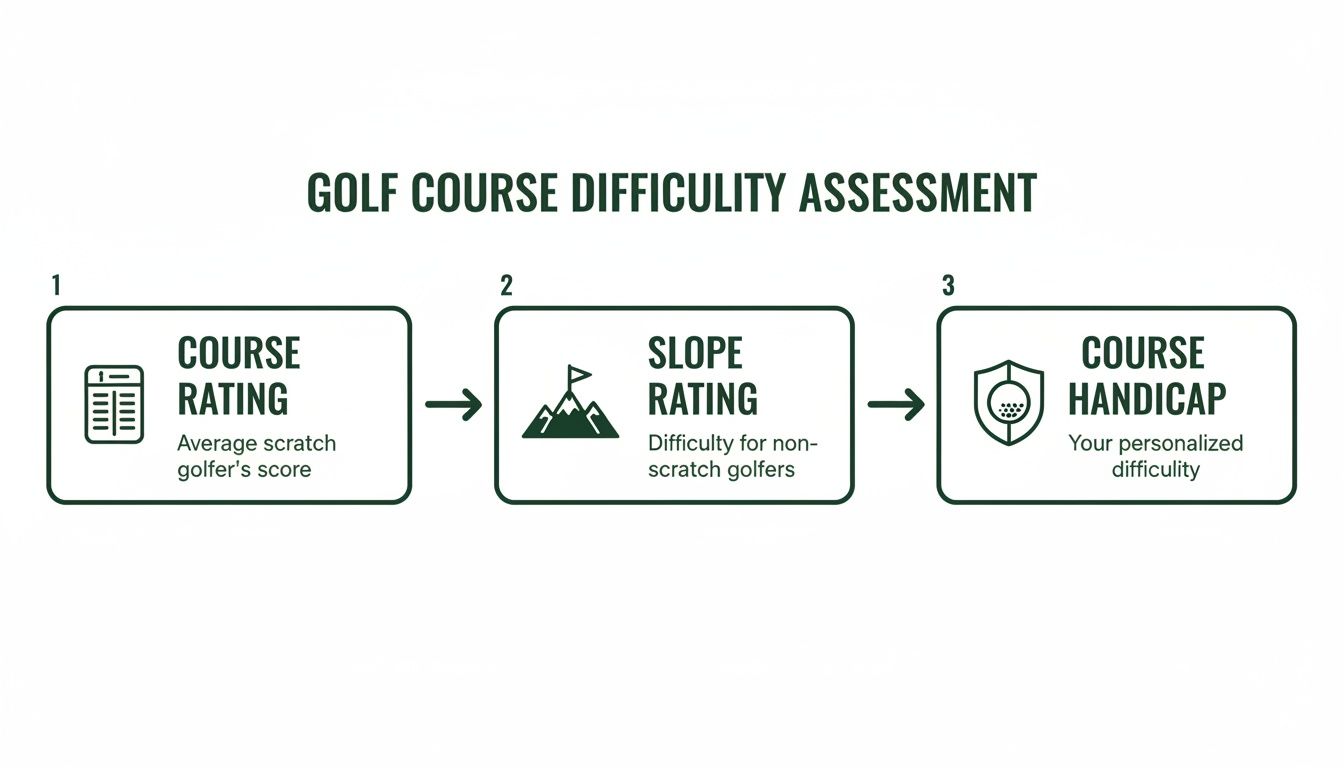
Before you can calculate a handicap, you have to get familiar with two numbers you'll find on every scorecard: the Course Rating and the Slope Rating. These aren't just random stats; they're the engine of the entire World Handicap System. They’re what make your handicap portable and fair, whether you're playing your home course or a bucket-list track on vacation.
Think of them as a team. The Course Rating tells you how hard a course is for a great player, and the Slope Rating adjusts that difficulty for the rest of us. Without both, the whole system would be guesswork.
The Course Rating: A Benchmark for Scratch Golfers
The Course Rating is pretty straightforward. It tells you how difficult a course is for a scratch golfer—someone with a 0 Handicap Index. It’s always a number close to par, like 71.8 or 73.2.
In simple terms, it's the score a scratch player is expected to shoot on a normal day from a specific set of tees. So, if a course has a rating of 72.5, a top-tier amateur is probably going to shoot about half a stroke over par. It's the baseline that every other score gets measured against.
The Slope Rating: How a Course Plays for Everyone Else
This is where the system gets really smart. The Slope Rating measures how much more difficult a course is for a bogey golfer (think a 20 handicap) compared to that scratch player we just talked about. It's a number between 55 (super easy) and 155 (brutally hard), with 113 being the standard for a course of average difficulty.
A high Slope Rating—let's say 140—means there's a huge difference in how a scratch player and a bogey player will handle the course. These are the tracks with forced carries, tight fairways, and lots of trouble that disproportionately punish a mid-handicapper's miss.
On the other hand, a low Slope of 105 means the course is more forgiving. The challenges are more manageable for players of all skill levels, so the scoring gap between a scratch and a bogey golfer won't be as wide.
Your Handicap Index shows your potential, but the Slope Rating is what translates that potential into the right number of strokes for the course you're playing today. It’s what makes the whole system fair.
Before this system was in place, a 10-handicap was a 10-handicap everywhere, which just wasn't fair. A tough course could chew up a mid-handicapper, while an easy one might give them too much of an advantage. The USGA rolled out the Slope System nationwide in 1987 after years of research, finally creating a handicap that could travel. You can dive into the history of the Slope System to see just how big of a deal it was for the game.
How It Works in the Real World
Let's imagine two golfers, both with a 15.0 Handicap Index. They're playing two completely different courses back-to-back.
Course A: A wide-open, friendly municipal course.
Course Rating: 70.0
Slope Rating: 110
Course B: A tight, championship course loaded with hazards.
Course Rating: 73.5
Slope Rating: 142
At Course A, with its low Slope Rating, our golfer would get fewer handicap strokes. The course doesn't punish mistakes as severely, so they don't need as much help to compete.
But at Course B, that sky-high Slope of 142 means they'll get a lot more strokes. The system recognizes that the course is significantly harder for them than for a scratch player, and it adjusts accordingly to level the playing field.
That’s the beauty of it. The ratings work together to make sure that when you calculate a handicap, it’s a fair reflection of the challenge you're facing that day.
Calculating a Player's Handicap Index
This is where the rubber meets the road. Calculating a player's Handicap Index is the core of the World Handicap System (WHS). It’s how raw scores from different courses get boiled down into one simple, portable number that reflects a golfer's potential.
This isn't just about averaging your scores. It’s a smart system designed to give a true picture of your current form while ignoring those inevitable off-days.
The whole thing starts with a crucial metric: the Score Differential. Don't mistake this for your score relative to par. Instead, it’s a standardized number that measures how well you played on a given day, on a specific course, factoring in that course's unique difficulty.
The Score Differential Formula
Every time you turn in an acceptable score, it gets converted into a Score Differential using a universal formula. This is the first real step in figuring out your handicap.
Here’s the formula: (Adjusted Gross Score - Course Rating) x 113 / Slope Rating
Let's walk through a quick example. Imagine you shot an 85 on a course with a Course Rating of 71.5 and a Slope Rating of 128.
First, you subtract the Course Rating from your score: 85 - 71.5 = 13.5
Next, you multiply that by the standard Slope of 113: 13.5 x 113 = 1525.5
Finally, divide by the course's actual Slope Rating: 1525.5 / 128 = 11.9
For that round, your Score Differential is 11.9. That number now represents your performance in a way that can be fairly compared to any other round, on any other course, anywhere in the world.
Picking and Averaging the Best Scores
Your Handicap Index isn't an average of every score you've ever posted. That wouldn’t be a fair reflection of your ability. Instead, the WHS looks at your 20 most recent scores and cherry-picks the 8 lowest Score Differentials from that group.
This method intentionally focuses on your potential, not your average day. It gets that everyone has a round they'd rather forget, so it highlights what you're capable of when you're playing well.
Once those eight best differentials are identified, they're simply averaged together. That final number is your Handicap Index.
For instance, if your best 8 differentials are 10.2, 11.5, 9.8, 12.1, 10.8, 11.1, 10.5, and 11.8, you'd add them up and divide by eight. The average comes out to 10.975, which is rounded to an 11.0 Handicap Index.
The best part is that this is a living number. Every time you post a new score, the oldest of the 20 drops off, and a new calculation is made. Your index always reflects your current game.
To see how this works in practice, let’s look at a sample of 20 scores for a player.
Sample Handicap Index Calculation
This table shows a player's 20 most recent scores and their corresponding Score Differentials. Notice how only the 8 lowest differentials are flagged to be used in the final calculation.
Round | Adjusted Gross Score | Course/Slope Rating | Score Differential | Used in Calculation? |
|---|---|---|---|---|
1 | 90 | 72.0/130 | 15.6 | No |
2 | 88 | 71.5/128 | 14.6 | No |
3 | 85 | 70.0/125 | 13.6 | No |
4 | 84 | 71.2/127 | 11.4 | Yes |
5 | 92 | 73.0/135 | 15.9 | No |
6 | 83 | 70.5/122 | 11.6 | Yes |
7 | 87 | 72.1/131 | 12.8 | No |
8 | 82 | 69.8/120 | 11.5 | Yes |
9 | 91 | 72.5/133 | 15.7 | No |
10 | 86 | 71.0/126 | 13.4 | No |
11 | 84 | 70.8/124 | 11.9 | Yes |
12 | 89 | 72.2/129 | 14.7 | No |
13 | 81 | 69.5/118 | 11.0 | Yes |
14 | 88 | 71.8/128 | 14.3 | No |
15 | 83 | 70.2/123 | 11.7 | Yes |
16 | 90 | 72.8/132 | 14.6 | No |
17 | 85 | 71.4/127 | 12.1 | No |
18 | 82 | 69.9/121 | 11.2 | Yes |
19 | 87 | 71.5/128 | 13.7 | No |
20 | 84 | 70.5/125 | 12.1 | Yes |
Averaging the eight selected differentials (11.4, 11.6, 11.5, 11.9, 11.0, 11.7, 11.2, 12.1) gives us a final Handicap Index of 11.5.
Crucial Adjustments in the Calculation
The WHS has a few built-in safeguards to keep things fair and prevent a couple of bad holes or weird conditions from messing up your index.
One of the most important is Net Double Bogey. This caps your maximum score on any single hole for handicap purposes. Your max is Par + 2 + any handicap strokes you get on that hole. It’s a lifesaver, preventing one disaster hole—that 10 you made on a par 4—from blowing up your score and unfairly inflating your handicap. If you want to dive deeper into scoring, you can check out our complete guide on golf tournament scoring.
Another key adjustment is the Playing Conditions Calculation (PCC). This is an automatic, behind-the-scenes calculation that looks at all the scores posted at a course on a particular day. If scores are way higher or lower than expected—maybe due to gale-force winds or rock-hard greens—the PCC adjusts everyone's Score Differential for that day by -1.0 to +3.0.
This global system, which the USGA and R&A rolled out in January 2020, successfully brought countless different national handicap systems under one roof.
As of May 2025, an incredible 131 countries are on the WHS, meaning over 40 million golfers can use their index anywhere they play. Your 5.4 index from a club in Ohio is now the same as a 5.4 in Scotland, all thanks to these standardized, fair calculations.
From Handicap Index to Course Handicap

Once a player has their Handicap Index, the job isn't quite finished. That index is just a measure of their potential, but it’s not the number they’ll actually use on the course. For any given round, you have to convert that portable index into a Course Handicap—the actual number of strokes they get for that specific set of tees.
This is the final, crucial step. It ensures every player gets the right number of strokes for the unique challenge of the course they're playing that day. This conversion is what makes the whole World Handicap System fair, no matter where you tee it up.
The Course Handicap Formula Explained
Turning a Handicap Index into a Course Handicap isn't just a simple rounding exercise. It involves a specific formula that accounts for the difficulty of the tees being played by using the Slope Rating, Course Rating, and the course's Par.
The most common formula you'll see is: Course Handicap = Handicap Index x (Slope Rating / 113)
The complete World Handicap System formula also includes an adjustment based on the difference between the Course Rating and Par, which fine-tunes the number for net competitions. But for now, let's stick with the core calculation.
Putting the Formula into Action
Imagine a player, Alex, who has a 12.5 Handicap Index. Alex is playing in a tournament and needs to know their Course Handicap for the day. That number will change depending on how tough the course is.
Here’s how Alex's handicap would look at three different courses:
The Easy Municipal Course
Slope Rating: 110 (easier than average)
Calculation: 12.5 x (110 / 113) = 12.16
Result: Alex’s Course Handicap is 12. On a more forgiving course, the system gives fewer strokes because the challenge is lower for everyone.
The Average Private Club
Slope Rating: 125 (a bit tougher than average)
Calculation: 12.5 x (125 / 113) = 13.82
Result: Alex’s Course Handicap rounds up to 14. The increased difficulty means Alex needs more strokes to compete fairly against scratch golfers.
The Tough Championship Layout
Slope Rating: 142 (significantly more difficult)
Calculation: 12.5 x (142 / 113) = 15.70
Result: Alex’s Course Handicap becomes a 16. On a demanding course, the Slope Rating correctly identifies that a mid-handicapper will struggle more than a scratch player and adjusts the strokes accordingly.
This dynamic adjustment is the soul of fair play. It shows that a player's handicap isn't a static number but a fluid value that adapts to the environment—absolutely essential for any competitive event.
For tournament organizers, getting this calculation right is everything. It ensures every player starts on equal footing, which is why accurately tracking scores is so vital. If you're looking for ways to improve this process, exploring options for the best golf scorecard can make a huge difference in both accuracy and the player experience.
This system shows why just guessing a handicap based on recent scores is so unfair. Without factoring in Slope and Course Ratings, you're ignoring the most important context. The WHS formula ensures a player with a 12.5 Index gets the right number of strokes—whether that's 12, 14, or 16—providing an equitable challenge every single time. That precision builds trust and keeps your tournaments competitive and fun for everyone.
Ditch the Calculator: Let Tournament Software Do the Heavy Lifting
Let's be honest, manually calculating handicaps for an entire tournament field is a nightmare. It’s tedious, time-consuming, and worst of all, it’s incredibly easy to make a mistake.
One wrong number plugged into the Slope Rating or a single misplaced decimal can throw off an entire flight. The result? Unfair competition and a clubhouse full of frustrated players. This is exactly why modern tournaments have moved on from spreadsheets and pocket calculators.
Today, specialized software handles these complex calculations for you—instantly and accurately. Platforms like Live Tourney take the entire burden off your shoulders. Instead of grinding through formulas, you and your staff can focus on what really matters: creating a memorable day for your golfers.
From Player List to Course Handicaps in Minutes
The real beauty of using tournament software is the automation. It’s remarkably simple. You can import your player roster directly from a system like GHIN, which already includes each player's official Handicap Index.
From there, the magic happens behind the scenes.
The software automatically cross-references every player's index with the specific course and tee data you've set for the event. It instantly applies the Course Handicap formula to every single participant, generating the correct number of strokes they’ll get from their assigned tees. No more looking up Slope Ratings or doing any math yourself.
This automation is a game-changer:
No More Errors: It completely eliminates the risk of manual calculation mistakes. You can be confident every player has the correct, USGA-compliant Course Handicap.
Save Hours of Work: What used to be a major administrative headache can now be done in minutes. This frees up your team to manage check-in, on-course contests, and other critical tournament tasks.
Guaranteed Fairness: The software uses the official WHS formulas, ensuring every calculation is consistent, fair, and follows the Rules of Handicapping.

A clean, centralized interface becomes your single source of truth for everything from player handicaps and tee times to scoring and results.
It's More Than Just a Calculator—It's an Engagement Tool
Once the handicaps are locked in, the software uses that data to power the features that make a tournament truly fun and engaging. This is where you see the real value. It’s not just about doing math; it’s about creating a dynamic, interactive event.
The real power of automation isn't just in the initial setup. It's in how that accurate handicap data is used in real-time to make the tournament more exciting for every single person on the course.
With accurate Course Handicaps for every player, you can effortlessly run any net game you can think of. Whether it’s a classic net stroke play event, a team best ball, or skins games with handicap strokes, the software handles it all. It automatically applies strokes to the correct holes on each player's digital scorecard.
This flows directly into the live leaderboards. As players enter their scores hole-by-hole on their phones, the system instantly calculates their net position and updates the leaderboard. Golfers can see exactly where they stand at any given moment, adding a professional, tour-like feel to the day. For a closer look at how this works, exploring different golf tournament scoring software options can reveal just how much these tools improve an event.
Ultimately, using software to calculate handicaps is no longer a luxury—it’s the standard for running a professional, fair, and engaging tournament. It transforms a complex task into a seamless process, giving you the confidence that your event is built on a foundation of accuracy and integrity.
Common Questions About Golf Handicaps
Even when you feel like you have a solid handle on the formulas, certain questions about golf handicaps pop up again and again. As a tournament organizer, being able to answer them clearly and confidently is everything. It builds trust and makes sure every player feels like the system is fair.
Let's walk through the most common points of confusion I hear from players.
Do I Really Need 20 Scores to Get a Handicap?
This is probably the biggest misconception out there. While it's true that a fully established Handicap Index uses the best 8 of a player’s most recent 20 scores, you absolutely do not need all 20 to get in the game.
A player can get their initial Handicap Index as soon as they’ve submitted scores for just 54 holes. That can be any mix of 9-hole or 18-hole rounds. The WHS has specific calculations for indexes based on a smaller number of scores, so new players can get out there and compete right away.
What Happens If a Player Doesn't Finish a Hole?
It happens. A player takes too many swipes, gets frustrated, and picks up their ball. Or maybe bad weather rolls in and forces everyone off the course mid-hole. They don't just get a zero.
For handicap purposes, the player records their most likely score. This is a judgment call based on where their ball was and how many strokes it would likely take to finish. A good rule of thumb is to add one stroke if the ball is within 5 feet of the hole, and two to four strokes if it's between 5 feet and 20 yards away.
This simple rule prevents players from picking up to avoid posting a bad number, which helps maintain the integrity of their scoring record.
How Are 9-Hole Scores Used?
A ton of golf is played in 9-hole increments, and the World Handicap System is built for that. When a player posts a 9-hole score, it doesn't just sit in limbo waiting for a partner.
The system automatically combines that 9-hole score with the next 9-hole score they post. Once combined, it becomes a single 18-hole Score Differential, dated with the day the second 9-hole round was played. It's a clean and seamless way to make sure every swing counts.
The key takeaway here is that the WHS is designed to be flexible. It handles incomplete rounds and incorporates 9-hole scores to accurately reflect a player’s ability with whatever scores they have available.
Why Did My Handicap Go Up After a Good Round?
This is easily the most confusing one for golfers. It feels completely backward, but it makes perfect sense once you remember your handicap is based on a rolling 20-score history. Your Handicap Index isn't an average of all your scores; it's a measure of your potential, based on your best 8 recent performances.
Here’s the scenario: You go out and shoot a great round. That new, low Score Differential gets added to your record. But at the same exact time, your oldest score—the 21st one in line—drops off forever.
What if that score dropping off was an even better round from a while back?
New Score Added: A pretty good differential.
Old Score Removed: An excellent differential from months ago.
The Result: The new average of your best eight scores is now slightly higher, and your index ticks up.
It feels wrong, but it’s just the system doing its job—keeping your handicap current and based only on your most recent 20 rounds.
Running a professional-feeling tournament is all about getting the details right. That starts with accurate, automated handicap calculations. Live Tourney takes the manual work and guesswork out of the equation, instantly converting Handicap Indexes to Course Handicaps for your entire field. See how you can elevate your next event by visiting https://livetourney.com.





