
Jan 31, 2026
Learn how to read pin sheets like a pro. This guide decodes the numbers and diagrams to help you choose the right club and improve your course management.

Most golfers see the flag, grab a club, and swing away. It’s a simple approach, but it treats the green as one big, generic target.
The best players, however, know the real secret to precision golf is hidden on that small, often-ignored piece of paper: the pin sheet. It’s not just a list of numbers; it’s a strategic map that turns a wild guess into a confident plan for every approach shot.
Learning how to read pin sheets is a game-changer for your course management. You stop aiming for the "middle of the green" and start targeting the exact location of the hole.
This shift in thinking gives you a huge advantage:
Dial in Exact Yardages: You’ll know the precise distance to the flag—not just a vague number for the front, middle, or back.
Dodge Hidden Trouble: A pin sheet tells you when a hole is tucked behind a bunker or sitting on a treacherous ridge, helping you play smarter, not harder.
Create Better Angles: Knowing where the pin is helps you pick the right side of the fairway off the tee, setting yourself up for a much easier approach.
Select Clubs with Confidence: You can finally choose the right club to fly the ball to the specific yardage you need, avoiding those costly mistakes of being just a little too short or long.
When you ignore the pin sheet, you're pretty much giving away strokes. It’s the difference between hoping your shot is good and knowing you have a solid plan to make it good. This simple tool provides the data you need to turn a decent round into a great one.
Decoding the Language of a Pin Sheet
At first glance, a pin sheet can look pretty cryptic. It's a grid of numbers and diagrams that feels more like a math test than a tool to help your golf game. But once you crack the code, it becomes an indispensable map for every single approach shot you'll face.
Think of it this way: a pin sheet is the difference between guessing and knowing. It’s what turns a vague idea of where the flag is into a precise, actionable number.
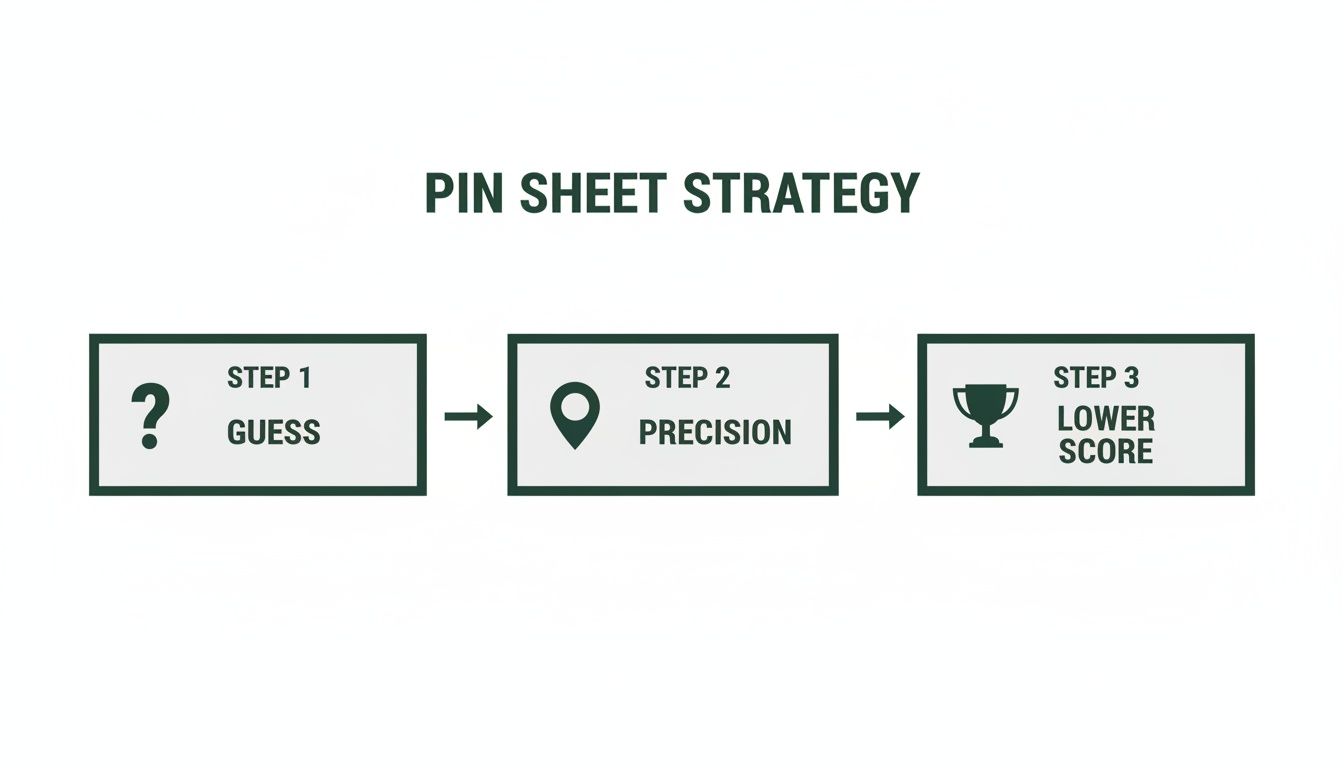
This little piece of paper is a game-changer. It’s a small adjustment to your routine that pays off big time on the scorecard, moving you from hopeful shots to confident, well-executed ones.
Key Numbers and Their Meanings
The heart of any pin sheet is the numbers. This is the raw data you need to figure out your true yardage to the flag, not just the generic number on the sprinkler head.
Hole Number: This one's a gimme, but you'd be surprised how many people look at the wrong hole in the heat of the moment. Always double-check.
Green Depth: Usually found at the top or bottom of the sheet, this tells you the total length of the putting surface. A 34-yard deep green is a massive target compared to a tiny, 22-yard one, and that changes everything.
On & Over Numbers: These are the money numbers. "On" tells you how many yards (or paces) the pin is from the front edge. "Over" tells you how far it is from the left or right edge.
Pro Tip: Don’t just read the numbers; see them in your mind's eye. A pin that’s 6 On is a sucker pin, tucked right behind a bunker. One that's 25 On means you need to take an extra club to get it all the way to the back shelf.
To make this even clearer, here’s a quick breakdown of what you'll typically find and how to use it.
Pin Sheet Element Quick Reference Guide
Element | What It Looks Like | How to Interpret It |
|---|---|---|
Hole Number | A number, 1-18 | Simple. Matches the hole you're playing. |
Green Depth | A number like "GD: 32" | The total front-to-back length of the green. |
"On" Number | A number, typically 3-40 | How many yards from the front edge the pin is located. |
"Over" Number | A number like "L8" or "R5" | How many yards from the left or right edge the pin is. |
Green Diagram | A small shape of the green | Your visual map of tiers, slopes, and bunkers. |
Slope Arrows | Small arrows (→, ↑) | Shows the general direction of the break on the green. |
This table covers the essentials. Mastering these elements is the first step to turning that sheet into a real weapon in your bag.
Understanding Green Diagrams and Symbols
Beyond the raw numbers, most pin sheets give you a little diagram of each green. This is your cheat sheet for navigating the contours of the putting surface before you even get there.
These diagrams often include symbols that tell you about:
Tiers or Ridges: Usually marked with a solid or dotted line. Landing on the wrong tier is a classic three-putt scenario, so pay attention to these.
Slope Direction: You might see arrows or chevrons pointing the way the green breaks. This helps you know where to miss—and more importantly, where not to.
Quadrants: Some sheets divide the green into four sections (front-left, back-right, etc.) to give you a quick reference for the pin's general area.
Pin sheets aren't a new invention, but they've come a long way. The PGA Tour really started standardizing them for big events like the 1987 Ryder Cup, and it made a huge difference. In fact, accurate pin locations helped contribute to a 15% improvement in greens-in-regulation averages for the pros.
Learning to read these details quickly—much like knowing how to keep one of the best golf scorecards—is a small habit that separates the serious golfer from the weekend hacker.
Translating Numbers into Smarter Shot Selection
Knowing what the pin sheet says is one thing. Actually using it to pull the right club is where you start shaving strokes off your score. This is where the data meets the fairway, turning numbers on a piece of paper into a confident swing. The goal is to get past the generic yardage on a sprinkler head and dial in your exact distance to the flag.
The math here is simpler than it looks. You start with the yardage to the center of the green—whether you get that from a GPS watch, a laser rangefinder, or a yardage marker. Then, you just adjust using the "On" number from the pin sheet.
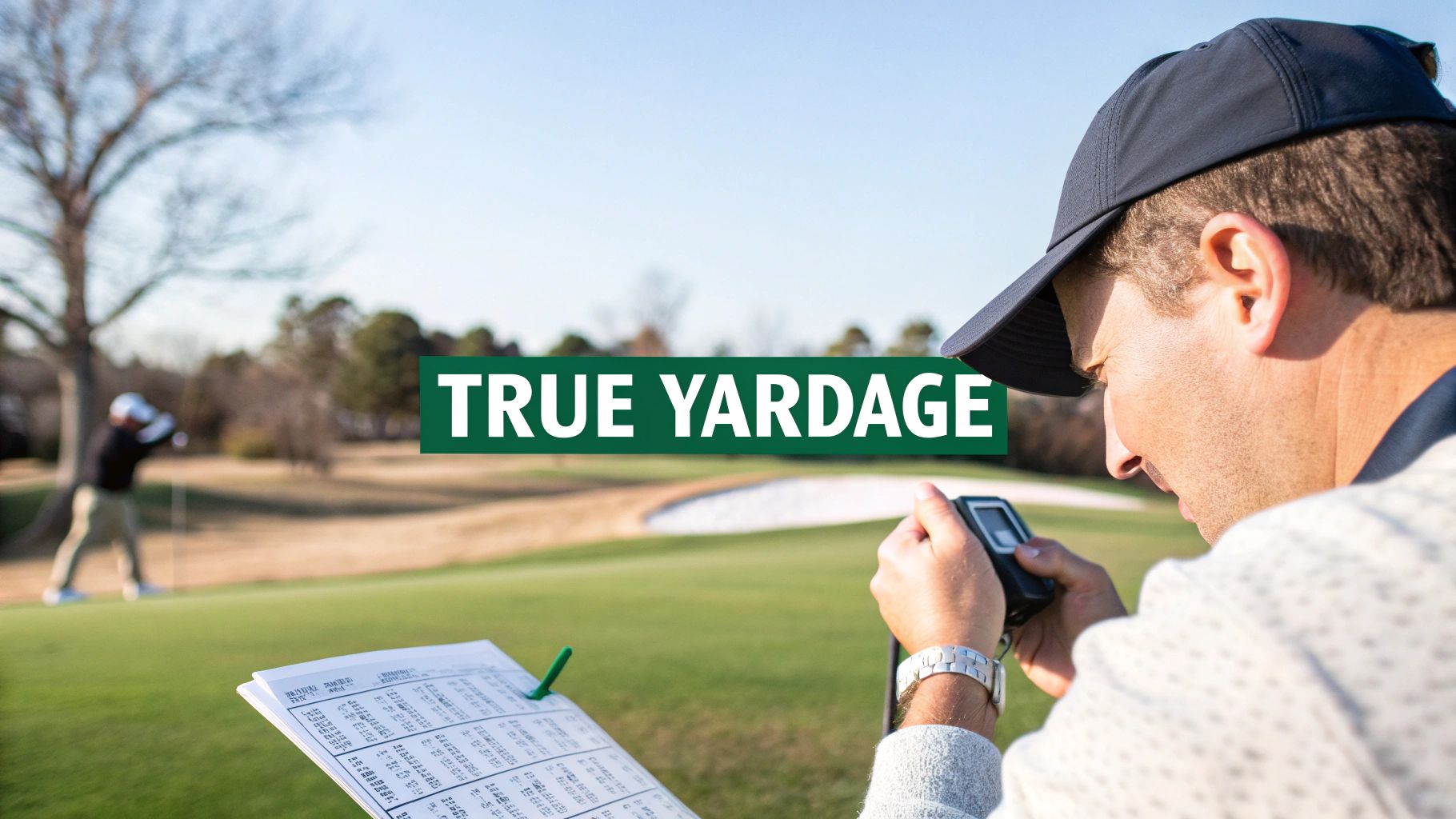
Let’s walk through a real-world example. Imagine you’ve zapped the middle of the green and it’s 150 yards. Your pin sheet says the hole is 6 On. If the green is 32 yards deep, its center is at the 16-yard mark. Since the pin is only 6 yards on, it's actually 10 yards short of the center.
Your true yardage is 140 yards (150 - 10). That’s often a full club difference, and it’s the kind of small adjustment that separates a good shot from a great one.
Practical Scenarios and Club Choice
This is where you can start thinking like a pro, weighing risk and reward with total clarity. Your decisions become strategic, not just reactive.
Front Pin Tucked Behind a Bunker: The sheet says 4 On and 5 Left. Your rangefinder clocks the flag at 135 yards. Do you go right at it? The smarter play is probably to hit the club that carries 142 yards to the big, safe part of the green. You’ll leave yourself a simple putt instead of staring down a tough bunker shot.
Back-Right "Sunday" Pin: The location is 28 On and 6 Right. Your yardage to the center is 160. On a 32-yard green, that means your actual shot is playing closer to 172 yards. Taking that extra club ensures you fly any trouble at the front and, ideally, leave yourself an uphill putt.
A pin sheet doesn't just give you a number; it gives you a target area. A smart golfer knows that "pin high" is great, but being on the correct side of the hole—often dictated by slope and pin location—is what leads to more birdies and tap-in pars.
Adjusting for Left and Right Placements
While the front-to-back number is crucial for club selection, the side-to-side placement tells you where to aim. If a pin is cut 8 Right and there's a deep bunker or water lurking on that side, aiming directly at the flag is a sucker's bet.
Instead, aim for the center of the green. Let your natural shot shape work toward the hole. This simple shift in strategy gives you a massive margin for error, turning a potential double bogey into a stress-free par. Applying this logic over and over is how you really learn to use a pin sheet to your advantage.
Advanced Strategy for Tournament Conditions
A casual Saturday round is one thing. But when a tournament is on the line, you can bet the course superintendent is feeling a little devilish. Suddenly, pins are tucked in spots that demand more than just a good swing—they demand a good plan. This is where your pin sheet transforms from a simple yardage guide into a strategic roadmap for the day.
Serious players know to look for "sucker pins." These are the hole locations that look tempting but are surrounded by danger. A classic example? A front pin sitting just a few paces over a deep bunker or a steep false front. The yardage might scream "perfect 9-iron," but anything less than a perfectly struck shot is an almost guaranteed disaster.
The smart play—the one that wins tournaments—is often to aim for the fat part of the green and completely ignore the flag. It takes discipline, but it’s how you avoid round-killing blow-up holes.
A pin sheet isn't just telling you where to aim your approach shot. It’s giving you a strategic overview for the entire round. Spot the most dangerous pins before you even tee off, and you can build a game plan that favors conservative shots on tough holes and aggressive plays on the easier ones.
Reading the Multi-Day Tournament Flow
In multi-day events, the pin positions almost always tell a story. Tournament directors rarely keep things static; they want to present a different challenge each day. A course that felt gettable on Friday might have its teeth out by Sunday. Recognizing these patterns is a huge advantage.
You'll often see a natural progression:
Day 1: Pins tend to be in more accessible, central locations to let the field settle in.
Day 2: You might see more corner placements or pins on specific tiers, putting a premium on precision.
Final Round: Expect the classic "Sunday pins"—the ones tucked behind bunkers, perched on ridges, or hugging the edge of the green. This is how they separate the contenders from the champion.
Knowing this helps you mentally prepare. If you see a scorecard-wrecker of a pin on Sunday, you know that playing to the center of the green is the winning strategy. Great golf tournament scoring is built on avoiding big numbers, not just on making a pile of birdies.
This level of detail is becoming the standard. A 2023 USGA study highlighted that pin sheets with grid overlays and bunker illustrations boosted player engagement by 28%. More importantly, 85% of golfers said those detailed sheets improved their green-reading accuracy. It's clear that a quality pin sheet isn't just a nice-to-have anymore; it's a critical tool for competitive golf.
Integrating Pin Sheets with Modern Golf Tech
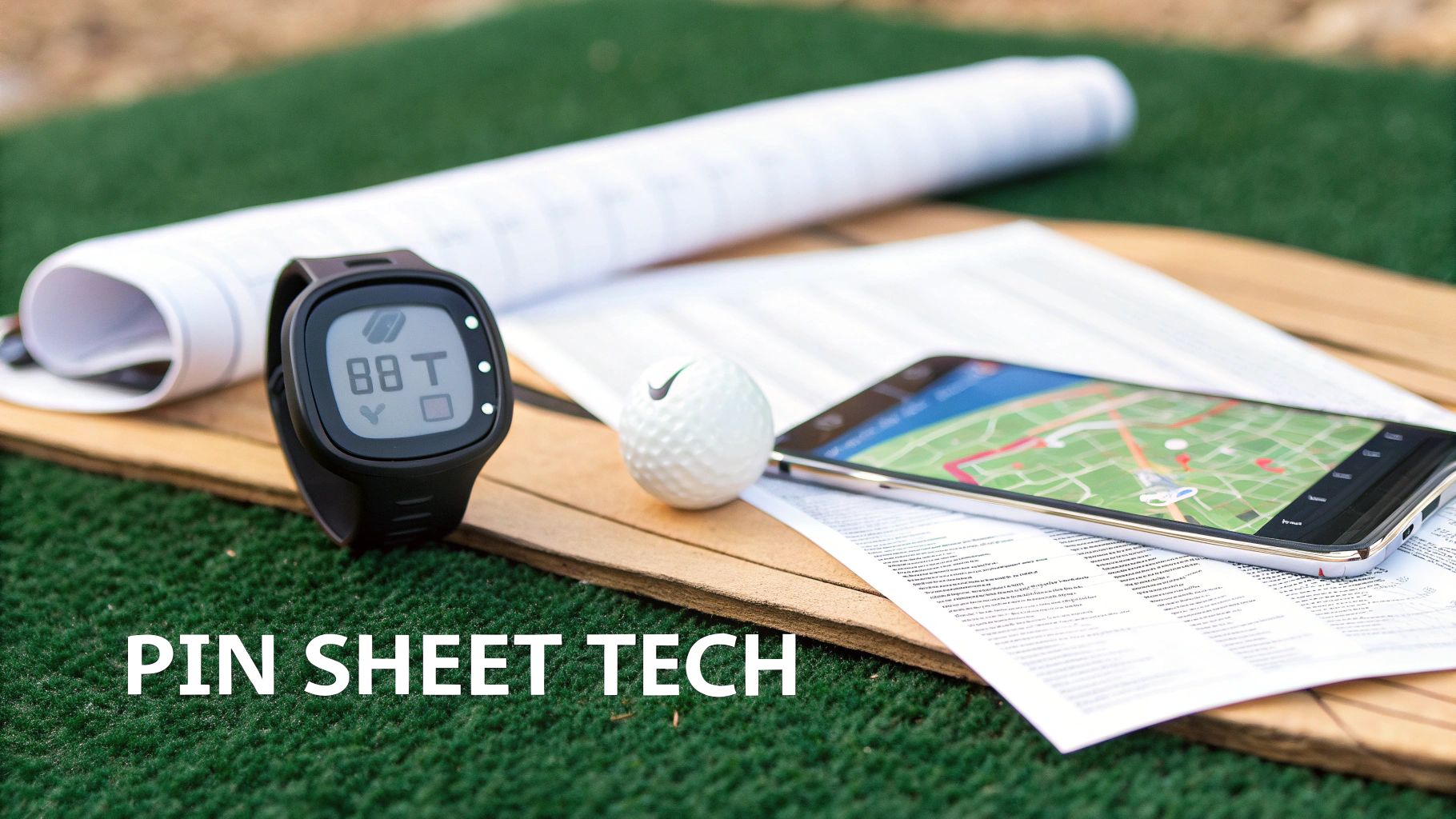
The old-school paper pin sheet is still king, but let's be honest—the tech in your bag can make that information a lot more powerful. Your GPS watch and laser rangefinder are no longer just for guessing yardages; they’re designed to work with the exact data a pin sheet gives you.
Think about it. Instead of just getting a number to the middle of the green, you can get a true "plays like" distance straight to the flag. This is where the magic happens. When you combine your rangefinder's slope-adjusted number with the pin sheet's precise front-edge measurement, you get the most accurate yardage you could possibly ask for.
That fusion of classic course data and modern tech is how you really start dialing in your approach shots. No more guesswork.
A Better Tournament Experience
This isn't just a player-level advantage. For tournament organizers, the benefits are huge.
Digital pin sheets, delivered through an app or a live scoring link, get rid of the paper and give your event a professional, tour-level feel. Suddenly, every participant has all the critical info right on their phone.
Key Takeaway: Combining your pin sheet with your favorite tech is no longer just a pro-level trick. It’s a simple, effective way for any golfer to gain confidence and make smarter club selections based on real, accurate numbers.
This one simple step elevates the entire event. If you want to see how these small details create a memorable day, check out our guide on golf tournament scoring software.
Common Questions About Reading Pin Sheets
Even after you get the hang of reading a pin sheet, a few questions inevitably pop up on the course. I've heard them all. Let's clear up the most common points of confusion so you can trust what you're seeing and swing with confidence.
Yards or Paces?
This is probably the number one question. While you might see old-school pros pacing things off, nearly every modern pin sheet you'll get in a tournament or at a well-run course uses yards. It's the standard. Unless the starter or a rules official specifically tells you otherwise, just assume the numbers are in yards.
Whose Left and Right?
Another classic point of confusion. When the sheet says "R5" for a pin five yards to the right, whose right is it?
It’s always from your perspective as you approach the green from the fairway. Think of it as if you're standing in the middle of the fairway looking at your target. So, "R5" means the pin is five yards to the right of the green's center from your angle of attack.
What If My Sheet Lacks a Diagram?
Sometimes you get a bare-bones pin sheet—just the "On" and "Over" numbers, no picture of the green. This is where your on-course observation becomes absolutely critical. The numbers are still gold, but you have to paint the picture yourself.
When you don't have a map, use your eyes and your rangefinder to fill in the blanks:
Walk up and identify where the major tiers or ridges are.
Get a clear visual on the greenside bunkers and other trouble spots.
Pay attention to the general slope and grain as you approach.
Even without a drawing, the numbers give you the core data you need for club selection. A pin that’s 5 On is always a front pin, no matter what the green looks like. You know instantly you need a club that carries the front edge but doesn't fly all the way to the middle.
Trust the numbers first, but always layer what you see on top of them. The pin sheet gives you the precise data; your eyes provide the context. The key to smart, strategic golf is using both together.
Getting this right prevents simple mistakes and is a cornerstone of solid course management.
Ready to elevate your entire tournament experience? Live Tourney makes running professional, engaging golf events effortless with app-free live scoring, rapid setup, and intuitive management tools. Learn how Live Tourney can transform your next event.





