

Jan 13, 2026
Learn how to obtain a USGA handicap with our complete guide. Find a club, get your GHIN, post scores, and understand how your index is calculated for fair play.

If you've ever wondered how to get a USGA Handicap Index, the process is actually pretty straightforward. You'll need to join a USGA-authorized golf club to get a GHIN number, and then post a minimum of three 18-hole scores (or you can use six 9-hole scores). That's it.
Once you hit that minimum, the World Handicap System (WHS) crunches the numbers and calculates your official index. It updates daily, giving you a real-time reflection of your playing ability and opening the door to fair, competitive golf.
Why Your Official Golf Handicap Matters

A lot of golfers think getting an official handicap is just for serious competitors, but that’s a huge misconception. Your Handicap Index is what levels the playing field, making it possible for players of all skill levels to compete fairly against one another.
It doesn’t matter if you’re in a weekend foursome with buddies or a major club championship. Your index makes sure the game is about how you perform that day, not just who has the most raw talent.
The Foundation of Fair Play
The idea of a handicap isn't new; the USGA formalized its first system way back in 1911. Today's World Handicap System (WHS) is the modern version of that, calculating your index from the best eight score differentials out of your most recent 20 scores.
This system is the engine behind equitable play in tournaments everywhere, including the 10,000+ events and 1M+ holes scored on platforms like Live Tourney, which lets golf course operators verify handicaps in an instant. You can learn more about the history of golf handicapping and how it’s evolved.
Beyond tournaments, a handicap is the best tool for tracking your own progress. It turns a series of random rounds into a measurable journey. Honestly, there's nothing more satisfying than watching your index drop.
A common misconception is that a Handicap Index is your average score. In reality, it represents your potential ability as a golfer, reflecting how well you can play on your better days.
For anyone running a tournament, a field of players with official handicaps is non-negotiable. It makes setting up balanced flights a breeze and, most importantly, protects the integrity of the competition. It's the bedrock of a professional event that every single player can trust.
Finding a Club and Getting Your GHIN Number

The first real step to obtain a USGA handicap is joining an authorized golf club. This might sound a little exclusive, but you have way more options than you probably think. The definition of a "club" has really opened up, making it accessible for any golfer who wants a legit Handicap Index.
This membership is what gets you a personal GHIN (Golfer Handicap and Information Network) number. Just think of your GHIN number as your unique ID in the World Handicap System—it’s how you’ll post scores, watch your progress, and prove your index for any tournament.
Choosing the Right Type of Club
Your choice of club really just depends on how you play the game. You definitely don't need to join a fancy private course to get in on the action.
Here are the main types of USGA-authorized clubs you can join:
Brick-and-Mortar Clubs: This is the traditional route. You can join a private, semi-private, or public course that offers handicap services with their memberships, or through a men's or women's league.
Allied Golf Associations (AGAs): These are your state or regional golf associations (like the NCGA in Northern California or the MGA in Massachusetts). Joining directly through them usually gives you a digital membership that’s perfect for golfers who play all over the place.
eClubs: These are online-only clubs, often run by an AGA. They are a fantastic, low-cost option for golfers who don’t really have a "home course" but want all the benefits of an official handicap.
Let’s say you're running a corporate outing and a few people don't have a handicap. You can just point them to your state’s AGA website, where they can sign up for an eClub in minutes. That simple step gets them a GHIN number and makes them eligible to compete for net prizes.
Getting Your GHIN Number is Simple
Once you've paid the membership dues to your chosen club—whether you do it at a pro shop counter or online—they’ll get you registered with the USGA. Soon after, you'll receive your unique GHIN number, usually in an email. That number is your key to the whole system.
The second you get your GHIN number, you can start posting scores. There’s no need to wait for a physical card or any other confirmation. Just download the official GHIN mobile app, log in, and you're good to go.
Many clubs use modern tools to make this whole process a breeze for their members. For anyone running a league, finding the right golf league management software can completely automate tracking member handicaps and sending out GHIN info, which is a massive time-saver. No matter which route you take, getting your GHIN number is a quick and painless entry into the world of handicapped golf.
How to Post Scores the Right Way
Alright, you've got your GHIN number. Now for the fun part: posting scores.
But for your Handicap Index to actually mean something, you have to post them correctly. Not every swing you take on the course ends up in the calculation. Only "acceptable scores" count, and it's important to know the difference.
An acceptable score has to be played by the Rules of Golf, on a course with a valid USGA Course and Slope Rating. Most importantly, you have to play a minimum number of holes for the score to even be eligible.
What Makes a Score Acceptable
One of the best things about the current system is its flexibility. You don't have to grind out a full 18 holes every single time you want to post a score. This change is a big reason why 9-hole rounds have exploded in popularity.
Here’s what you need to play for a score to count:
For a 9-hole score: You must complete at least 7 holes.
For an 18-hole score: You must complete at least 14 holes.
So what happens if you don't finish? Let's say darkness rolls in after 16 holes. No problem. The system uses par plus any handicap strokes you would have received to generate a score for the holes you missed. This ensures you can still post a valid score for the day.
Understanding Your Adjusted Gross Score
This is where a lot of golfers get tripped up. You don't just punch in the total number from your scorecard. Instead, you post what's called an Adjusted Gross Score, a brilliant concept that stops one or two blow-up holes from ruining your handicap.
The World Handicap System uses a built-in buffer called Net Double Bogey to cap your maximum score on any single hole. It’s calculated like this: Par of the hole + 2 + any handicap strokes you get on that hole.
Say you have a complete meltdown on a par-4 and card a 10. If you don't get a handicap stroke on that hole, your maximum score for handicap purposes is a 6 (Par 4 + Double Bogey 2). It keeps your index a true reflection of your potential, not your worst moments.
For anyone just getting started, learning the format of the best golf scorecard can really help you track both your actual score and your adjusted score as you play.
The Importance of Posting Promptly
As a league administrator, I get asked all the time, "When should I post my score?" The answer couldn't be simpler: do it as soon as your round is over. Post it from the clubhouse bar or the parking lot. Just get it done.
Your Handicap Index updates every single day. Posting immediately ensures your index is accurate for your next round, league night, or tournament. That timeliness is critical.
More golfers than ever are maintaining their handicaps. A record 3.35 million golfers in the U.S. now have an active USGA Handicap Index, submitting over 77 million scores recently. A massive 13.8 million of those were 9-hole scores posted last year—an all-time high. You can dive into more of these stats in the USGA's 2024 Golf Scorecard snapshot. By posting your scores right away, you become a reliable part of this massive, active community.
So, How Is Your Handicap Index Actually Calculated?
Ever wonder how all those scorecards you post get boiled down into one, powerful number? Your Handicap Index isn't just a simple average of your scores; it’s a much smarter calculation designed to reflect your potential playing ability.
The whole point of the system is to measure how you play on your better days, not just your average ones. This is key. It means a few blow-up rounds won't unfairly torpedo your index, giving you a number that truly represents what you're capable of on the course.
It All Comes Down to the Best 8 of 20
The core of the World Handicap System is the "best 8 of 20" rule. It’s a pretty straightforward idea. For every round you play and post, the system calculates something called a Score Differential. Think of this as the official grade for your performance that day, on that specific course.
Once you have at least 20 scores in your record, the system looks at all of them, picks out the 8 lowest (your best rounds), and averages them together. That average becomes your Handicap Index. It’s a rolling average, so as you add new scores, the oldest ones drop off, keeping your index current.
The Magic Is in the Score Differential Formula
This is where the system really shines. The Score Differential formula is what levels the playing field, making sure a 95 on a beast of a course is properly valued against a 90 on an easy muni.
Here’s the formula used for every single round: (Adjusted Gross Score - Course Rating) x (113 / Slope Rating)
Let’s quickly unpack that:
Adjusted Gross Score: This isn't just your total score. It’s your score after applying Net Double Bogey, which basically puts a cap on any disaster holes so they don't wreck your differential.
Course Rating: A number that estimates what a scratch golfer would shoot on that course from your tees.
Slope Rating: This measures the difficulty for a bogey golfer compared to a scratch golfer. The number 113 is the baseline for a course of standard difficulty.
This formula is precisely why your handicap travels so well. It’s not just about what you shot, but how well you played relative to the course's difficulty that day.
Your Handicap Index is a dynamic number that reflects your demonstrated ability. It's not a measure of your average score, but a snapshot of your potential. That's what makes it so powerful.
Built-In Safeguards to Keep Things Fair
To keep everything credible and prevent funky, artificial swings, the system has a couple of built-in protections. A soft cap and a hard cap will kick in if your index starts shooting up too quickly over a short period. These caps slow down and limit any extreme upward movement, ensuring your index remains stable and fair.
For anyone running a tournament, understanding this is huge. It explains why a player's index can change from one day to the next, which is critical when you're setting up flights or running a multi-day event.
Getting a USGA handicap plugs you into a global community—the WHS now covers an estimated 15% of all U.S. golfers. And while a fully mature index uses 20 scores, you can get an official number with just three 18-hole scores (or any combination of 9-hole scores that adds up to 54 holes).
For tournament platforms like Live Tourney, which has helped run over 10,000 events, this system is the backbone for automatically managing handicaps across rosters, payouts, and live leaderboards. You can dive deeper into the growth of the World Handicap System to see just how much it has shaped the modern game.
Using Handicaps for Seamless Tournament Management
For any golf pro or tournament director, a player's Handicap Index isn't just a number—it’s the backbone of a fair, professional, and smoothly run event. Once players understand how to obtain a USGA handicap, the conversation shifts to how organizers can actually use them with integrity and efficiency.
The old days of chasing down players for their index, manually looking up Course Handicaps, and crunching the numbers with a calculator are thankfully behind us. Today, the process should start the moment a player registers. Collecting their GHIN number upfront is the single most important step.
That unique number is the key that unlocks their current, verified Handicap Index directly from the USGA database, ensuring everyone starts on a level playing field.
Automating Handicap Management for Flawless Events
Modern tournament software, like Live Tourney, completely changes the game. All you need to do is upload a simple spreadsheet of your player roster along with their GHIN numbers.
Instantly, the platform connects to the World Handicap System and pulls the most up-to-date Handicap Index for every single participant. This isn't just a time-saver; it’s a guarantee of accuracy. No more dealing with outdated indexes or players "accidentally" reporting the wrong number. The system handles it all, cleanly and correctly.
This simple infographic breaks down how a player's scores get turned into an official Handicap Index.
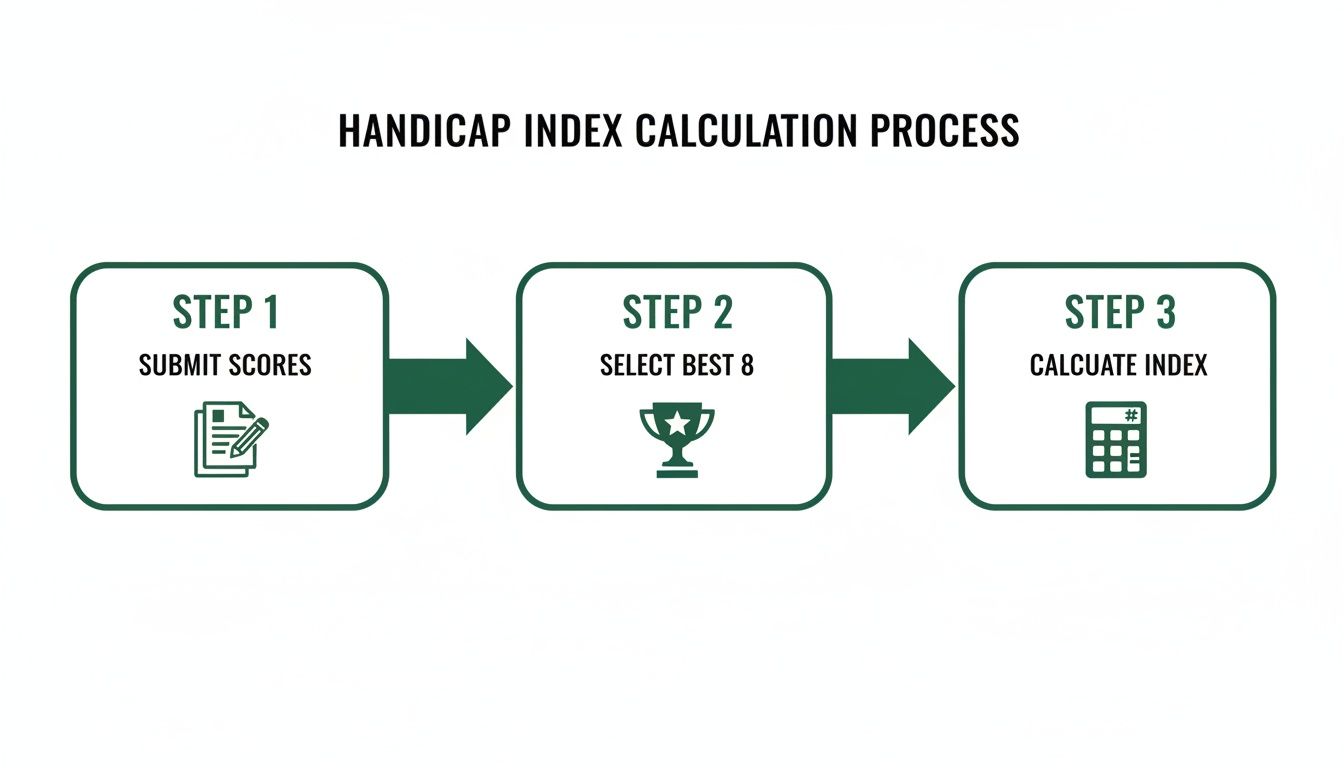
It’s a great visual reminder that an index isn't a simple average—it's a precise calculation that reflects a player's demonstrated potential.
Once the indexes are pulled in, the software automatically does all the heavy lifting based on your event’s specific format and the tees in play.
Course Handicap Calculation: It instantly converts each player's index into a Course Handicap for the specific set of tees they’re playing that day.
Playing Handicap Adjustments: The system applies the correct handicap allowances for any format, whether it's 90% for Four-Ball or a more complex formula for a team Scramble.
Live Net Leaderboards: As scores are entered, a net leaderboard comes to life in real-time, creating a much more engaging experience for players and spectators.
For tournament organizers, this kind of automation is about more than convenience. It's about credibility. When players see a professional, accurate net leaderboard, it builds trust and elevates the entire event.
This seamless process ensures every competition, from a casual club event to a big Ryder Cup-style showdown, is managed with precision. By automating these once-tedious tasks, you eliminate the risk of human error and free up hours of your time. That means you and your staff can focus on what really matters—delivering an unforgettable day for the golfers.
To dig deeper into this, check out our complete guide to golf tournament scoring and see how technology is reshaping event management.
Common Questions About USGA Handicaps
Even after you know the basics, the world of handicapping can feel like it has its own language. It's totally normal to have a few questions. Let's tackle some of the most common ones we hear from golfers and event organizers.
How Many Scores Do I Need to Get a Handicap?
This is easily the most asked question, and the answer is simpler than most people think.
You only need to post a minimum of three 18-hole scores to establish your first official Handicap Index. You can also mix and match 9-hole and 18-hole rounds. As long as they add up to at least 54 holes—for example, six 9-hole scores—you're good to go.
Your new index will be calculated and ready for action the day after you submit that final qualifying score.
Can I Get a Handicap Without a Home Course?
Absolutely. The idea that you need to be a member of a traditional brick-and-mortar golf club is a myth. The system is designed for every type of golfer, including those of us who bounce around different public courses.
You can get an official GHIN number by joining an online "eClub" through your state or regional Allied Golf Association (AGA). These digital clubs are the perfect, low-cost solution for golfers who don't have a single "home" course.
The rise of eClubs has been a game-changer. It gives millions of unaffiliated golfers a way to get an official handicap, ensuring everyone can get in on fair competition, no matter where they play.
Will One Bad Round Ruin My Handicap?
Nope. One blow-up hole or even an entire off-day won't tank your handicap. That's by design. The World Handicap System has built-in protections to stop your index from getting skewed by a few bad rounds.
It works because of two key ideas:
Best 8 of 20: Your Handicap Index is calculated using only the best eight of your last 20 scores. This means your 12 highest scores are automatically tossed out, so the calculation always focuses on your demonstrated potential, not your worst days.
Built-in Caps: The system has a "Soft Cap" and a "Hard Cap." These act as bumpers, preventing your index from shooting up too quickly if you hit a temporary slump. It keeps things stable and credible.
How Can Tournament Organizers Verify Player Handicaps?
For anyone running a tournament, making sure the competition is fair starts with accurate, verified handicaps. Asking players for their index is a recipe for mistakes and, let's be honest, a little sandbagging.
The only real way to do it right is to use a tournament management platform with direct GHIN integration. When players register, just ask for their GHIN number. The software will automatically pull their most up-to-date Handicap Index on the day of the event.
This approach gets rid of manual data entry, prevents players from using old handicaps, and ensures your flights and net scoring are based on current, verified data. It's how you run a legitimate event.
Running a tournament shouldn't feel like a second job. Live Tourney handles the tedious stuff like handicap management, registration, and live scoring, so you can run professional, modern events without the headache. See how it works at livetourney.com.





