
Jan 11, 2026
Learn how to calculate golf handicaps using the World Handicap System. This guide breaks down the formulas, terms, and tools you need for accurate results.

Here's the problem with how most people think about their golf handicap: they assume it's just an average of their scores. While that's a good starting point, the official World Handicap System (WHS) is a lot smarter than that.
Your Handicap Index isn’t about your typical day on the course. It’s a measure of your demonstrated potential—what you're capable of shooting on a good day. It's calculated by taking the average of your best 8 score differentials from your most recent 20 rounds.
Why Modern Golf Handicaps Are More Than Just an Average

This is a critical distinction. By selectively using only your best recent scores, the WHS prevents a few blow-up rounds from unfairly inflating your handicap. The result is a number that reflects your true skill ceiling.
The Evolution to a Global Standard
For years, handicap systems were a mess. A 10-handicap in Scotland wasn't the same as a 10-handicap in the United States, which made it tricky for golfers to compete fairly when they traveled. It was like trying to compare apples and oranges.
The WHS, introduced in 2020, fixed this by creating a single, unified standard. Now, a Handicap Index is calculated the same way everywhere, making it portable and universally understood.
The core idea behind the WHS is simple: create a level playing field so golfers of all abilities can compete fairly, no matter where in the world they tee it up.
Why This Matters for Tournament Organizers
If you run golf tournaments, understanding this foundation is everything. A player's Handicap Index is a data-driven assessment of their potential, not just a casual guess. This builds trust in the system and validates the net scores that automated platforms like Live Tourney produce.
Here’s why the modern system works so well:
Fairness: It accounts for course difficulty. A 90 at a tough track is valued more than a 90 at an easy one.
Consistency: Every golfer's potential is measured with the same formula, worldwide.
Integrity: By focusing on a player's best scores, it accurately reflects their skill and minimizes the impact of a few bad rounds.
The formulas might seem complicated, but their purpose is straightforward: to make the game more enjoyable and competitive for everyone. Modern software handles all the heavy lifting, so you can focus on running a great event.
The Key Data Points Driving Your Handicap
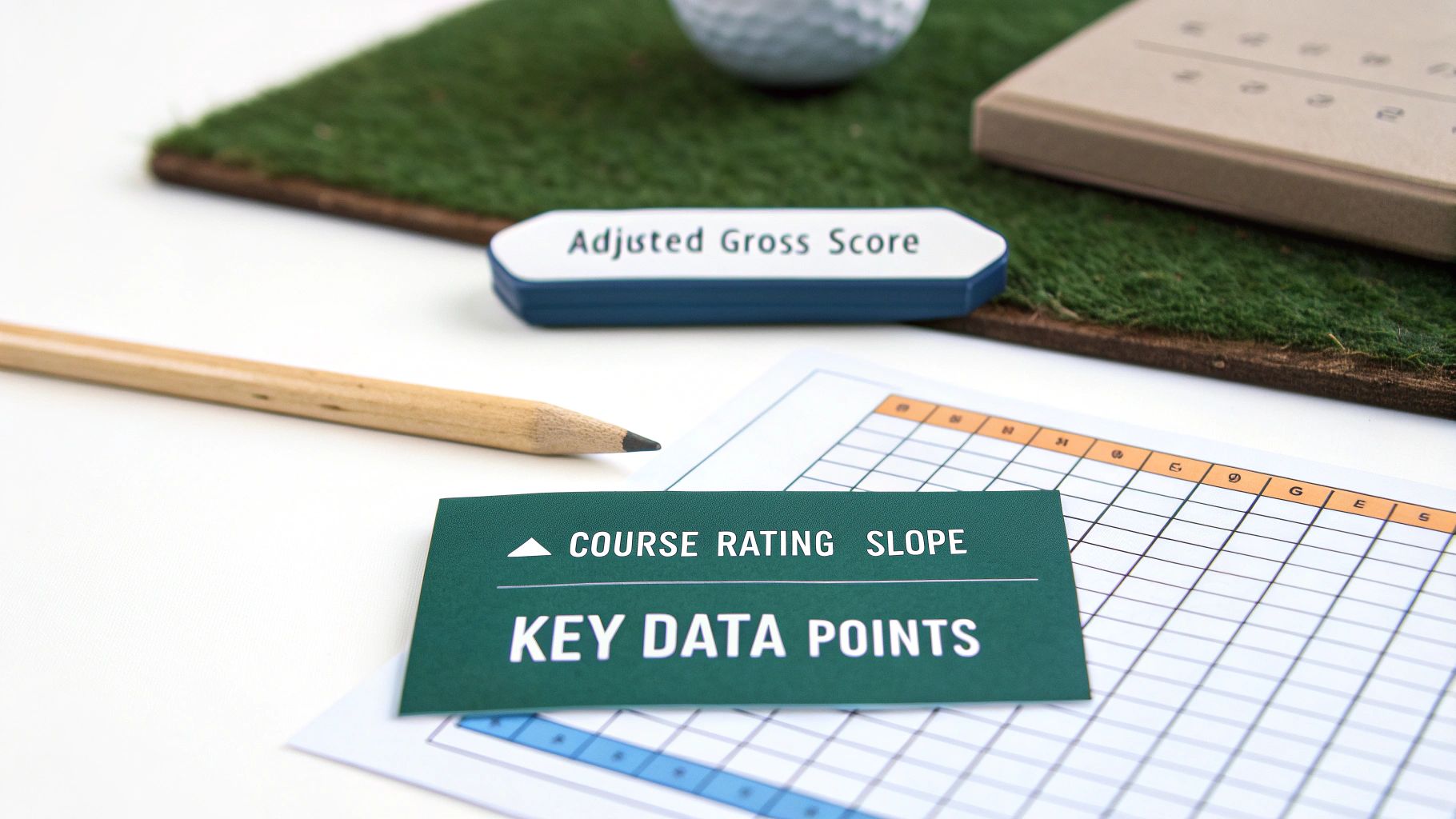
To get an accurate Handicap Index, the World Handicap System (WHS) needs more than just the number you circle on the 18th hole. It’s all about context. For every round you post, the system looks at three core pieces of information.
The most important one is your Adjusted Gross Score. This isn't just your raw score. It’s your score modified for fairness using a procedure called Net Double Bogey, which puts a cap on how badly you can blow up on any single hole.
Let's say you’re a 15-handicap and you're getting a stroke on a tricky par-4. Your maximum score for handicap purposes on that hole is a 7 (par 4 + 2 strokes for double bogey + 1 handicap stroke). Even if you carded a dreaded 9, you’ll post a 7. This keeps one disastrous hole from wrecking your handicap calculation.
Getting these adjustments right is a big deal. You can dive deeper into this by checking out our guide on the best golf scorecard practices.
Understanding Course Difficulty Ratings
Next up, the WHS needs to know how tough the course was playing. This is where two other critical numbers come into play. If you want to understand how handicaps work, you have to get familiar with these.
Course Rating: This tells you what a scratch golfer (a player with a 0 handicap) is expected to shoot on that course from a specific set of tees. A rating of 72.5 means a top-tier player will likely finish just a bit over par.
Slope Rating: This shows the relative difficulty for a bogey golfer (around an 18-handicap) compared to a scratch player. A high slope means the course gets way harder for the average player. The baseline is 113.
Think about it this way. Imagine Course A has a Course Rating of 71.0 and a Slope of 120. Course B is a monster, with a Course Rating of 73.5 and a Slope of 140. Shooting a 90 on Course B is a much stronger performance than shooting a 90 on Course A, and the WHS formula is smart enough to see that.
The real magic of the system is how it standardizes your performance. By weighing your Adjusted Gross Score against the course and slope ratings, it spits out a "Score Differential" that can be compared to any round, on any rated course, anywhere in the world.
This data-driven approach has been refined for over a century. Early methods in the 1900s were pretty simple, often just averaging a player's best three scores over a couple of years—a system that was easy to game. The USGA kept tweaking it, eventually landing on the well-known "best 10 of last 20" formula in 1967.
The modern WHS takes this even further, now using the best 8 of your last 20 differentials. It's a model built on millions of rounds of global scoring data, all in the name of fairness.
Putting the WHS Formula to Work
Okay, so we've covered the key ingredients: your Adjusted Gross Score, the Course Rating, and the Slope Rating. Now let’s see how the World Handicap System (WHS) actually puts them together. It all boils down to a single, powerful calculation for every round you play.
This first step gives you a Score Differential, which is just a standardized number representing your performance on a given day. Think of it as answering the question, "How good was that round, really, once you factor in the course's difficulty?" This number is the foundation for everything that follows.
Calculating the Score Differential for a Single Round
The formula might look a little intense at first glance, but it's actually pretty simple. It's the same calculation that software handles automatically every time you post a score.
Here it is: (113 / Slope Rating) x (Adjusted Gross Score - Course Rating)
Let's walk through a real-world example. Say you just shot an Adjusted Gross Score of 88 on a tough track.
Course Rating: 72.1
Slope Rating: 135
Now, just plug those numbers into the formula: (113 / 135) x (88 - 72.1) 0.837 x 15.9 = 13.3
Your Score Differential for that round is 13.3. This single number lets you compare that 88 on a difficult course to, say, an 84 on an easier one. This kind of leveling is also what makes different golf tournament scoring formats fair and competitive for everyone in the field.
From 20 Rounds to Your Final Handicap Index
A single round is just a snapshot. To get a true picture of your game, the WHS looks at your 20 most recent scores. But it doesn't just average all of them—that would punish you for those inevitable bad days on the course.
Instead, the system picks out your 8 best (lowest) Score Differentials from that list of 20. This is the secret sauce. It’s why your handicap is a reflection of your potential, not just your average day. The system intentionally tosses out your 12 worst recent rounds.
By focusing only on the top 40% of your recent scores, the WHS creates a responsive and accurate measure of your demonstrated skill. It’s designed to reflect what you’re capable of when you play well.
Once those 8 scores are pulled, the last step is as simple as it gets: the system just averages them. The result is your official Handicap Index.
Let's look at how this plays out for a sample golfer with a full 20-round history.
Worked Example Calculating a Handicap Index
The table below shows the 20 most recent score differentials for our golfer. I've highlighted the 8 lowest scores that will actually be used in the calculation.
Round Number | Score Differential | Is Best 8? |
|---|---|---|
1 (Most Recent) | 14.2 | No |
2 | 10.5 | Yes |
3 | 17.8 | No |
4 | 11.2 | Yes |
5 | 19.1 | No |
6 | 13.5 | No |
7 | 9.8 | Yes |
8 | 16.0 | No |
9 | 15.5 | No |
10 | 12.1 | Yes |
11 | 20.4 | No |
12 | 18.2 | No |
13 | 11.8 | Yes |
14 | 10.9 | Yes |
15 | 14.7 | No |
16 | 12.5 | Yes |
17 | 13.9 | No |
18 | 21.0 | No |
19 | 11.5 | Yes |
20 | 16.3 | No |
To get the Handicap Index, we just add up those 8 highlighted numbers and divide by 8.
(10.5 + 11.2 + 9.8 + 12.1 + 11.8 + 10.9 + 12.5 + 11.5) / 8 = 90.3 / 8
The result is 11.2875. The WHS truncates this to one decimal place, so this golfer's official Handicap Index is 11.2.
This entire process—from calculating each differential to averaging the best eight—is precisely what platforms like Live Tourney do instantly for every player in an event.
So, you've got your Handicap Index. Great. It's the number that travels with you, a portable measure of your golfing potential. But here's something a lot of golfers don't realize: you never actually play with your Handicap Index.
Instead, that index gets converted into a Course Handicap. This is the actual number of strokes you'll receive on a specific course, playing from a specific set of tees, on that specific day.
Think of it this way: your Handicap Index is your raw skill level. Your Course Handicap is how that skill gets adjusted for the real-world challenge you're about to face. This simple but brilliant distinction is what makes the World Handicap System (WHS) so effective at leveling the playing field, no matter where you tee it up.
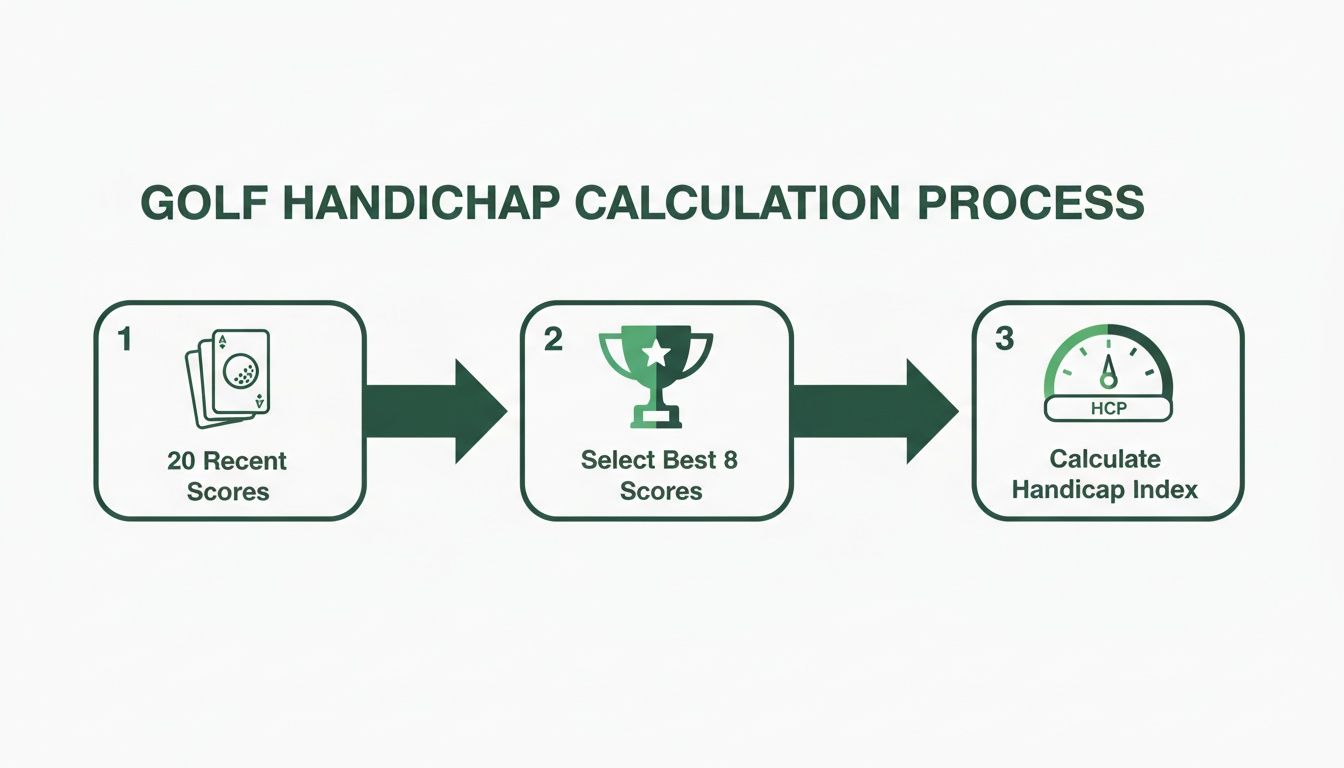
As you can see, the system takes your last 20 scores, finds the best eight, and crunches them into your Handicap Index. Now, let's turn that index into something you can actually use on the course.
The Course Handicap Formula
Figuring out your Course Handicap is just a bit of simple arithmetic. The formula adjusts your index based on the difficulty of the tees you're playing, which is measured by the Slope Rating.
Here's the magic formula:
Course Handicap = (Handicap Index x Slope Rating / 113)
So, what's with the 113? That number represents the Slope Rating of a perfectly average, standard-difficulty golf course. Dividing by 113 is what scales your handicap up for tougher courses (Slope > 113) or down for easier ones (Slope < 113).
Let's walk through a real-world example to see it in action.
A Tale of Two Tees
Imagine a golfer with a 14.5 Handicap Index heading out to play at their home club. They have a choice between two common sets of tees, each offering a totally different experience.
White Tees (More Playable): Slope Rating of 122
Blue Tees (Championship): Slope Rating of 138
First up, let's calculate their Course Handicap from the more forgiving White Tees:
(14.5 x 122 / 113) = 15.65
The system rounds this to the nearest whole number, so from the whites, their Course Handicap is 16. They get 16 strokes. Simple enough.
But what happens when they decide to test their game from the much tougher Blue Tees?
(14.5 x 138 / 113) = 17.71
From the back tees, that number rounds up to 18. Just by moving back a set of tees, they gain two extra strokes to help them handle the more difficult layout.
This is the WHS working exactly as it should. The golfer is rightfully given more strokes on the setup that demands better shots and punishes misses more severely. It’s not about giving anyone an "advantage"—it's about creating a truly fair and equitable game for everyone.
This whole process—finding the Slope Rating, plugging in the numbers, and doing the math—is precisely what tournament software like Live Tourney automates for every single player. It makes sure everyone in an event is competing with the correct, course-adjusted handicap, all without the tournament organizer lifting a finger.
Why Tournament Software is a Game-Changer
After walking through all the manual math, it’s pretty obvious why trying to run a tournament with spreadsheets is just asking for a massive headache. The modern approach is simple: let technology do the heavy lifting. This frees you up to focus on what actually matters—making sure your players have a great time.
Specialized software completely eliminates the tedious data entry and, more importantly, the risk of human error. Instead of you having to track down every player for their Handicap Index, the software pulls it directly from systems like GHIN. Right from the start, you know every number is official and up-to-date.
Get Instant and Accurate Course Handicaps
Once the Handicap Indexes are loaded in, the real magic happens. The software instantly calculates the correct Course Handicap for every single player, adjusted for the specific tee box they’re playing from. No more looking up formulas or fumbling with conversion charts.
This is a lifesaver for any event, whether it's a straightforward net stroke play tournament or a complex, multi-flight scramble. The software guarantees every player gets the right number of strokes for that day and that course—the absolute foundation of a fair event. If you want to dive deeper into how tech can help, check out our guide on golf tournament scoring software.
This level of automation is really only possible because of the World Handicap System (WHS). When it rolled out in 2020, it brought six different global systems under one roof, creating a single, consistent model for over 30 million golfers worldwide. This standardization is what allows platforms like Live Tourney to reliably pull data and apply the correct formulas, no matter where your players are from.
Live Leaderboards with Real-Time Net Scoring
For the players, the most exciting part is easily the live leaderboard. As scores are entered hole-by-hole, the platform automatically applies each player's unique Course Handicap to calculate their net score in real time.
This means everyone—players, organizers, and spectators—can see exactly where they stand at any given moment.
This immediate feedback loop completely changes the dynamic of the event. It’s more engaging, more competitive, and builds a ton of trust in the final results. No more waiting around for an hour after the last putt drops to find out who won.
Of course, even when you have the formulas down, real-world questions always pop up when you're running a tournament. The World Handicap System (WHS) was actually built to handle these odd scenarios, making sure things stay fair even when a player's record isn't a perfect set of 20 scores.
Let's walk through some of the most common questions we see from tournament organizers.
What If a Golfer Doesn't Have 20 Scores?
This is probably the number one question we get. You've got a player who wants to join your event, but they only have a handful of rounds in their scoring history. The good news is you don't have to turn them away or make up a handicap.
The WHS has a built-in, scalable method for this exact situation. It simply uses a smaller number of a player's best scores (their differentials) and, in some cases, applies a small adjustment to keep things from getting skewed.
Here’s a quick look at how it works:
For 3 scores: The system takes their single best Score Differential and subtracts 2.0 strokes.
For 5 scores: It uses just the single lowest differential, but with no adjustment.
For 9 to 11 scores: It will average their best 3 differentials.
This progressive model ensures that as a player logs more rounds, their Handicap Index gets more and more accurate. If you're using tournament software like Live Tourney, this is all handled automatically based on the player's official data. No calculators needed.
How Does WHS Prevent Sandbagging?
Ah, the "sandbagger." Every tournament director's biggest headache. This is when a player intentionally inflates their handicap to get more strokes and a better shot at winning. Thankfully, the WHS has a couple of smart, automated safeguards to protect the field from this kind of manipulation.
First, the system puts both a soft cap and a hard cap on how much a player's handicap can climb over a rolling 12-month period. These caps stop a player’s Index from jumping up dramatically after just a few bad—or intentionally bad—rounds. The absolute maximum it can increase is 5.0 strokes above their lowest point from the past year.
The WHS also has an "exceptional score reduction." If a player posts a score that's way better than their current Handicap Index, the system automatically knocks their Index down. It's a quick correction that ensures their handicap accurately reflects a sudden improvement in their game.
Can I Calculate a Handicap for a 9-Hole Round?
Absolutely. This is a huge deal for weeknight leagues and casual 9-hole events. The WHS is designed to handle 9-hole scores perfectly.
Here's the process: a 9-hole score is essentially put on hold until another 9-hole score is posted. Once a second one comes in, the system combines them to create a single 18-hole Score Differential, which then gets factored into their Handicap Index.
When you're running a 9-hole tournament, the Course Handicap calculation is simply adjusted for those 9 holes. Modern tournament platforms can be set up to manage these events without a hitch, applying the right handicaps without you having to do any manual math.
Trying to manage all these little nuances by hand is a recipe for a long night and a lot of mistakes. But Live Tourney handles it all in the background. From importing official indexes to calculating the correct course handicaps for any format, our platform makes sure every event is fair, accurate, and professional.
Discover how Live Tourney can streamline your next tournament.





