
Jan 4, 2026
Discover how to build a successful golf league program with proven strategies for planning, management, and player engagement that drive revenue and loyalty.

A great golf league isn't just a nice-to-have. It's an engine that drives predictable revenue, builds a real community, and keeps players coming back to your course week after week. It's about moving beyond simply booking tee times and turning your facility into a place where players feel like they belong.
This playbook is your complete guide to planning, launching, and managing a league that meets—and exceeds—what today's players expect.
Why Your Course Needs a Modern Golf League Program
Let's be honest, player expectations have changed. They're not just looking for a place to play anymore. They want an experience—something organized, engaging, and tech-forward that feels professional without losing the fun. This is where a modern league program becomes essential to a successful golf operation.
Think about the all-too-common weeknight league struggling to get by. Registrations are a mess of spreadsheets, pairings are a last-minute scramble, and scoring is a stack of soggy, half-readable paper cards. The result? A headache for your staff and a clunky, disconnected experience for your players.
Now, picture that same league, but transformed. Registration and payments happen online in minutes. Tee sheets and pairings are generated automatically. Players are on the course, entering scores on their phones and watching the leaderboard update in real time. That jump from manual chaos to a smooth, modern operation is what this is all about.
Core Pillars of a Successful League
A league that people love doesn't just happen. It's intentionally built on three core pillars that work together. We're going to walk through how to master each one.
Strategic Planning: This is your foundation. It's about choosing the right formats, creating a balanced schedule, and setting clear rules and pricing that make sense for your players.
Streamlined Execution: This is where good technology saves the day. We're talking about efficiently managing everything from sign-ups and payments to pairings and on-course logistics. It's about ditching the administrative busywork.
Unforgettable Player Engagement: This is the secret sauce that keeps them coming back. Things like dynamic live scoring, fun side games, consistent communication, and building a genuine sense of community around the competition.
A great golf league program is more than just a schedule of events; it's a community-building asset. When players feel connected and the experience is seamless, their loyalty to your course deepens significantly, turning occasional visitors into reliable weekly revenue.
By focusing on these three areas, you'll build a league program that doesn't just fill your tee sheet but becomes a true cornerstone of your course's success and reputation.
Designing Your League's Strategic Blueprint
A great golf league isn’t just thrown together; it's built long before anyone even thinks about teeing off. This is where you lay the groundwork and define the league's entire personality—its competitive fire, its social vibe, and its overall structure. Getting these details right from the start saves you a ton of headaches down the road and creates an experience players actually want.
Your first big decision is the format, and it sets the tone for everything. A hyper-competitive group of low-handicappers will probably want individual stroke play or intense head-to-head match play. But a casual after-work league? They’re going to have a much better time with something like a Two-Person Scramble.
Scrambles are perfect for social leagues because they take the pressure off any one player and speed up the pace of play. This simple choice makes it easier for golfers of all skill levels to join in, knowing they won’t have to carry the team. It all comes down to who you're building the league for.
Matching Formats to Player Goals
Knowing your audience is everything. Are they serious golfers looking for a real test, or are they just coworkers who want a relaxed weekly hang? Your format has to match their goals.
For the Competitors (Match Play/Stroke Play): These formats are all about direct competition. They’re perfect for established groups with low handicaps who want a season-long battle for bragging rights.
For the Social Crowd (Scramble): This is your go-to for corporate leagues, beginner groups, or anyone where fun is the top priority. It’s inclusive and keeps things light.
For the Balanced Field (Best Ball/Four-Ball): A great middle ground. This format mixes individual play with a team dynamic, blending personal accountability with partner support.
A well-chosen format does more than just dictate scoring; it shapes the entire social dynamic of your league. Aligning the format with player expectations is the single most important step in building a program that retains its members season after season.
Structuring Your Schedule and Rules
Once you've locked in the format, it's time to build a schedule that makes sense. A consistent weekly time slot—say, every Tuesday at 5:00 PM for 12 weeks—gives players the predictability they need to commit.
For formats like match play, you'll need a round-robin schedule to make sure everyone plays each other fairly. If that sounds like a logistical nightmare, don't worry. You can use an online tool to create a round robin schedule and save yourself hours of manual work.
Next, get your rules down on paper. Clear, simple rules prevent arguments later. Make sure you cover the big stuff: handicap calculations, sub policies, and what happens when it rains. Put these rules right on the registration page so everyone knows what they’re signing up for.
Organized golf is blowing up. In 2023, on-course participation in R&A markets hit 42.7 million players—a 44% jump since 2016. A big part of that growth comes from structured events like leagues, which are bringing tons of players to the course. With registered club members up 10% since 2020, a well-run league is perfectly positioned to capture this energy. You can dig into these trends in this detailed report from Perfect Putt.
Setting Up Pricing and Payouts
Be transparent with your pricing. Break down the costs so players see exactly where their money is going—greens fees, cart fees, prize fund contributions, and any food and drink specials. No one likes surprises when it comes to money.
Your payout system should also match the league's vibe. For a serious league, a bigger prize pool for the top finishers makes sense. For a social league, spread the love. Smaller prizes for weekly winners, skins, or closest-to-the-pin contests keep way more players engaged all season long. Using a platform like Live Tourney can handle these calculations for you, making sure the payouts are spot-on every single week.
Streamlining Operations From Signup To Tee Off
A golf league that feels polished and easy for players is always the result of smooth, organized operations behind the scenes. This is where you move from a good idea to a well-oiled machine, managing everything from a player's initial signup to the moment they step onto the first tee. The real goal is to make all the admin work completely invisible to your league members.
It all starts with registration. A complicated, multi-step signup that involves printing forms or making phone calls is the fastest way to lose players before they even commit. A simple, mobile-friendly online registration page isn't just a nice-to-have anymore; it's a must. It should take a player just a few minutes on their phone to sign up, pick a division, and pay their league dues.
That convenience has a direct impact on your numbers. When the process is easy, more people actually finish it. A high number of abandoned registrations usually points to a clunky system, not a lack of interest.
Mastering Roster and Pairings Management
Once players are signed up, managing the roster is the next big hurdle. Last-minute changes are a guarantee in any league—someone gets sick, a meeting runs late, or a new player wants to join mid-season. The difference between a well-run league and a chaotic one is how you handle those adjustments on the fly.
The first step? Ditch the spreadsheet. A central, digital roster lets you:
Handle Substitutions Instantly: Quickly swap an absent player with someone from a pre-loaded sub list.
Add New Players Seamlessly: Onboard new members without having to manually update five different documents.
Accommodate Player Requests: Easily pair friends or group players by skill level using simple drag-and-drop tools.
This leads right into what is often the biggest time-sink for any league manager: creating weekly pairings and tee sheets. Manually building foursomes, balancing handicaps, and assigning tee times can burn hours every single week. Automating this is a total game-changer. Modern software can generate balanced pairings based on your chosen format in seconds.
Shifting from manual spreadsheets to an integrated platform isn't just about saving time—it's about eliminating errors and making the entire experience better for your players. When pairings are fair, tee times are communicated clearly, and last-minute changes are handled without a hitch, players notice.
From Digital Dashboard To On-Course Materials
An efficient operational hub does more than just manage players and pairings. With all your league data in one place, you can generate professional, customized on-course materials with just a few clicks. It’s this kind of polish that makes your golf league feel like a premium experience.
Imagine printing perfectly formatted materials directly from your league dashboard:
Official Scorecards: Pre-filled with player names, handicaps, and tee info.
Custom Cart Signs: Featuring player or team names for easy navigation.
Personalized Bag Tags: A small but professional detail that players appreciate.
Locker Room Tee Sheets: Clear, easy-to-read printouts for players to check their assignments.
These small touches add up to create a cohesive and impressive event. Instead of fighting with mail merges and formatting issues, you can focus on what matters—engaging with your players. Exploring a dedicated golf league management software is the best way to see how these tasks can be simplified.
The difference between wrestling with manual tools and using an automated platform is night and day. Let's break it down.
Manual League Management vs Automated with Live Tourney
We see it all the time: league managers spending hours on tasks that software could do in minutes. Here’s a realistic look at the time commitment.
Task | Manual Method (Spreadsheets & Email) | Automated Method (Live Tourney) |
|---|---|---|
Player Registration | 3–5 hours manually entering data from forms or emails into a spreadsheet. | 15 minutes to set up a public registration page. Players sign themselves up. |
Weekly Pairings | 1–2 hours per week of manually creating foursomes and balancing handicaps. | Under 5 minutes to auto-generate pairings based on your preset rules. |
Communicating Tee Times | 30-60 minutes per week sending mass emails and answering individual questions. | Automatic. Players get notifications and can view tee sheets online anytime. |
Scorecard & Cart Signs | 1-2 hours per week using mail merge templates and wrestling with printer settings. | Under 10 minutes to print all on-course materials directly from the dashboard. |
Managing Substitutions | 15-30 minutes per request, finding a sub and manually updating pairings/sheets. | Under 2 minutes. Swap players with a click and all materials update automatically. |
Ultimately, this level of organization doesn't just save your staff countless hours. It directly improves the player experience, making them feel like they're part of a well-run, professional event every single week. It’s this operational excellence that turns a good league into a great one.
Elevating the On-Course Player Experience
A successful golf league is about more than just organized tee times. It’s about creating an exciting, memorable atmosphere that players genuinely want to be a part of. The real magic happens during the round itself, transforming a standard weekly game into a dynamic event.
This is where you can truly stand out. Modern players, even in a casual league, are used to immediate feedback and a professional feel. The days of waiting until everyone is back in the clubhouse to tally up soggy, handwritten scorecards are long gone. Adding a real-time element is the single best way to boost energy and engagement from the first tee to the final putt.
The Game-Changing Power of Live Scoring
Live scoring is the heart of a modern on-course experience. The moment players can enter scores on their phones, you instantly create the feel of a "real" tournament. It’s a simple feature that generates a buzz that paper scorecards never could.
When players can see a live leaderboard update after every few holes, their entire mindset shifts. A casual round suddenly has stakes. They know exactly where they stand, who they need to catch, and how their buddies are playing in the group ahead. This creates friendly rivalries and conversation that lasts the entire round and long after.
The moment players see their names move up or down a live leaderboard, the round becomes more than just a game—it becomes an event. This immediate feedback loop is addictive and a huge driver of player retention.
The best part? It doesn't need to be complicated. App-free solutions that work through a simple web link remove any tech barriers. Usually, just one person in each group enters scores for the foursome, making it accessible even for players who aren't tech-savvy. You can see how modern golf tournament scoring software achieves this without requiring any annoying downloads.
This simple journey—from signing up to enjoying the live, on-course experience—is what it's all about.
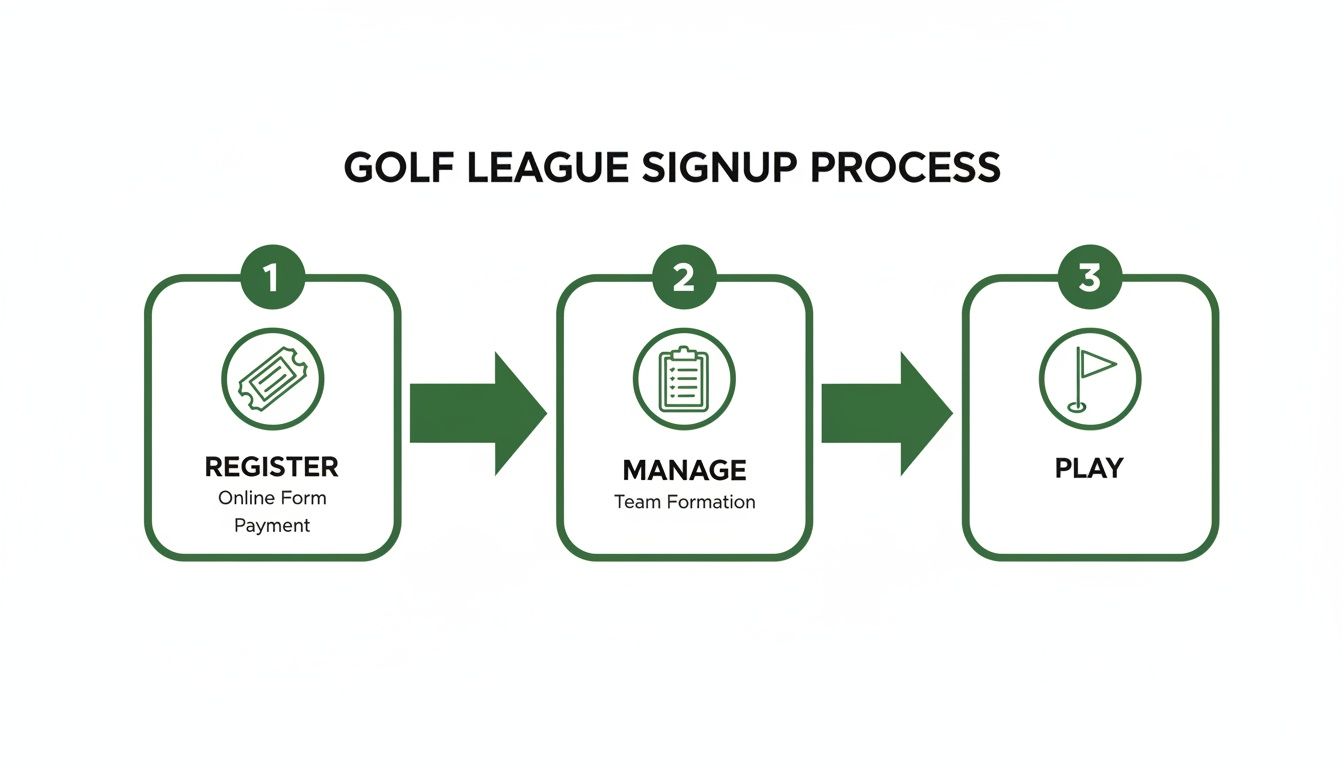
A streamlined digital platform connects registration directly to the on-course action, making the experience seamless for everyone involved.
Integrating Fun Side Games Seamlessly
Side games like Skins, Closest to the Pin (CTP), and Longest Drive are staples of any good golf league. They give everyone a chance to win something each week, even if they aren't torching the course. The problem is, managing them manually is a massive headache.
Tracking buy-ins, marking CTPs on a piece of paper, and calculating skin payouts by hand is tedious and full of potential mistakes. Integrating these games directly into your league's digital platform automates the whole thing.
Skins: The system automatically tracks hole-by-hole scores, identifies the outright winner on each hole, and calculates the payout instantly.
Closest to the Pin: Set up designated CTP holes right in the platform. Players can enter their distance on their digital scorecard, which populates a live CTP leaderboard for everyone to follow.
Longest Drive: Just like CTPs, a designated hole can track the longest drive of the day, adding another fun layer of competition.
This kind of automation doesn't just save you time—it makes the experience better for the players. They see who won what right away, which keeps them more invested in the league.
Keeping Players Connected with Real-Time Communication
Good communication is the glue that holds a great league together, especially during the round. A centralized platform allows you to send out important updates quickly and efficiently.
Imagine a storm is rolling in. Instead of scrambling to call or text dozens of players, you can send a single push notification or email to everyone with clear instructions. That level of professional communication builds trust and shows players that your league is well-managed.
After the round, you can use the same tools to announce the weekly winners, share updated season standings, and preview the next event. This consistent contact keeps the league top-of-mind and builds a strong sense of community that extends well beyond the 18th green.
Post-Round Strategies for Long-Term Success
The final putt has dropped, but your job isn’t over. In fact, what you do right after the round—and in the days that follow—is what separates a decent league from one that players can’t wait to come back to. This is where you build momentum and keep everyone invested for the long haul.
The most critical first step? Getting the results out. Fast. Players are buzzing to see who won, how the side games paid out, and where they stand in the season-long race. If you make them wait, that excitement fizzles out.
This is where a good system is a game-changer. Imagine being able to send out a summary email celebrating the winners and linking to the final leaderboards just minutes after the last group finishes. That kind of speed makes your league feel professional and dialed-in.
Leveraging Data for Continuous Improvement
Every week, your league is generating a goldmine of data. Don't let it sit there. If you look beyond just the scores, you can spot trends that will help you make your league better and better.
Start by digging into a few key metrics:
Participation Trends: Notice a dip in attendance on certain weeks? Or maybe a drop-off late in the season? That’s a sign you might need to tweak the schedule or throw in a fun mid-season event to shake things up.
Pace of Play: Modern scoring systems can track how long each group takes. If you see consistent logjams on certain holes, you can bring it up with the course or address it with the players.
Side Game Popularity: Are skins always popular but other games fall flat? That tells you exactly what your players want, so you can stop offering games nobody plays and double down on the ones they love.
This approach isn’t about guesswork. It’s about using real information to make smart, small adjustments that add up to a much better experience for everyone.
Gathering and Acting on Player Feedback
Data tells you what is happening, but direct feedback from your players tells you why. You need a simple way to ask for it. It doesn't have to be complicated—in fact, simpler is usually better.
The best league managers I know are fantastic listeners. They actively ask for feedback—the good and the bad—and then, most importantly, they show the players they’ve been heard by taking action. That simple loop of listening and responding builds incredible loyalty.
Try sending out a quick two-question survey mid-season and at the end of the year. Just ask: "What did you enjoy most?" and "What's one thing you'd change?" The answers will give you a perfect roadmap for next season.
To keep players coming back, you need to go beyond the course and build a real community. This is where you can lean on strategies for increasing customer engagement to keep the conversation going year-round. And when you do make a change based on feedback, shout it from the rooftops. Send an email that says, "You asked for more variety, so next season we're adding a two-week match play tournament!" It shows you’re not just listening—you're delivering.
Planning and Marketing for Next Season
The absolute best time to start hyping up next season is while the current one is still fresh in everyone's minds. Ride that wave of good energy.
Grab testimonials from happy players. Shine a spotlight on your season-long champions in your emails and on your website. Use the feedback you’ve gathered to announce smart improvements for next year. Maybe that means adding a senior division or a more casual, non-competitive flight. Announcing those kinds of upgrades early can trigger a flood of early-bird sign-ups.
By constantly refining your league based on what you learn, you create something that doesn't just survive—it gets better every single year.
Your Top Golf League Program Questions Answered
Even the best-laid plans run into real-world questions. Once your league is up and running, you'll inevitably face a few tricky situations. Here are the most common ones we see and how to handle them like a pro.
What Is the Best Format for a Casual Social Golf League Program?
For any league where fun and socializing are the main goals, you can't go wrong with a Two-Person Scramble or Best Ball (Four-Ball). Hands down, these are the best options.
Why? Because team-based formats take the pressure off any one player. That’s the secret to attracting and keeping players of all skill levels. A beginner or a high-handicapper feels a lot more comfortable when they know their partner's shot is there to back them up. This simple choice gets more people to sign up and, more importantly, to keep showing up.
A scramble, in particular, is great for speeding up play and creating a relaxed, fun vibe on the course. It’s less about your personal score and all about teamwork.
The format you choose sets the entire tone for your league. For social leagues, pick a format that kills individual pressure and cranks up the team fun. It's the fastest way to build a welcoming atmosphere that players want to be a part of.
Modern tools make setting this up a breeze. With a platform like Live Tourney, you can configure a scramble or best ball format in a few clicks. It automatically crunches the handicap numbers and throws the team scores onto a live leaderboard, which just adds to the fun.
How Can I Handle Substitutions and No-Shows Without Creating Chaos?
Let's be real: last-minute dropouts are going to happen. The difference between a minor hiccup and a full-blown nightmare is having a plan. The key is twofold: establish a clear sub policy from day one and use a single system to manage the changes. Trying to track everything through a messy web of emails, texts, and voicemails is a guaranteed headache.
This is where moving the whole process online pays off big time. You can let players manage their own attendance or give an admin the power to drag and drop a new player into the roster.
Think about it: a player gets sick an hour before their tee time. Instead of frantically re-doing pairings by hand, you just open your league dashboard, pull from a pre-loaded sub list, and swap them out. The system instantly recalculates handicaps for the new pairing and updates every digital tee sheet and scorecard. Smooth, simple, and no chaos.
What Is the Most Effective Way to Communicate with All My League Players?
Good, consistent communication is everything. But group texts get noisy fast, and social media posts get buried. The cleanest, most professional way to handle it is with a communication tool that’s built right into your league management software.
This lets you send the right message to the right people. You can easily create different email lists for specific groups, like:
All League Members: Perfect for big news like registration opening or the end-of-season party.
Weekly Participants: Send out pairings, tee times, and rules for that week’s event.
Team Captains: For any specific instructions or tasks they need to handle.
Using a platform with built-in email means you can use templates for recurring messages. With merge tags, you can even auto-populate each player's name or tee time, which adds a professional touch and makes sure everyone gets the right info.
Is Setting Up Live Scoring Difficult for Players Who Aren’t Tech Savvy?
This is a huge, and very valid, concern. The short answer is no—if you pick the right system. The single biggest mistake you can make is forcing players to download an app. That's an immediate turn-off for less tech-savvy folks and a surefire way to get low adoption.
The gold standard here is an app-free, web-based solution. Players just click a link you send them, and a scoring portal opens right in their phone's browser. No downloads, no logins, no forgotten passwords.
The best ones are designed to look and feel just like a paper scorecard, so it’s immediately familiar. And since only one person per group needs to enter the scores for everyone, it’s even easier. Players see the live leaderboard updating in real-time, and that immediate feedback gets them hooked. In our experience, these app-free systems see over 40% more participation than their app-based counterparts, simply because they remove all the friction.
Ready to run a professional, engaging golf league without all the headaches? Live Tourney gives you all the tools you need in one simple, web-based platform. From easy registration and automated pairings to app-free live scoring, we help you create an experience your players will talk about all year.





