Jun 27, 2026
georgia state golf association, gsga, georgia golf tournaments, junior golf georgia, golf handicap georgia
Explore the Georgia State Golf Association. Our 2026 guide covers membership benefits, tournament schedules, handicap services, and junior golf programs.

You've cleaned up the swing faults. The card is starting to show more 70s than 80s. Your Saturday group is still fun, but it isn't scratching the itch anymore. At some point, most improving golfers in Georgia ask the same question: where do I go if I want my golf to count?
For serious amateur golf in this state, the answer usually runs through the Georgia State Golf Association. It's where handicap administration, competitive access, junior pathways, and statewide golf structure come together. If you want to post a real score, enter a real event, or understand how competitive golf works in Georgia, this is the organization you need to know.
The catch is that most writeups stop at the brochure version. They list benefits, mention championships, and leave out the practical part. Golfers need to know how to get in. Parents need to know where junior golf leads. Club managers need to know what running these events takes on the ground. That's the part that matters when you're the one entering, staffing, scoring, or explaining rules at the scoring table.
Your Guide to Competitive Golf in Georgia
A lot of golfers reach the same fork in the road. Casual play got them started, but it won't test the parts of the game that matter under pressure. You need a handicap that travels, tournaments with structure, and a field that doesn't give away anything.
That's where the Georgia State Golf Association fits. For players in Georgia, it's the practical entry point into organized amateur golf. It gives golfers a framework for posting scores, entering competitions, and playing under a consistent rules environment instead of whatever the group decided on the first tee.
What most players are actually looking for
Usually it comes down to three things:
A real handicap: You need an official Handicap Index if you want fair net competition and clean eligibility for many events.
A better test: State and club events expose weak spots fast. Decision-making, pace, recovery play, and mental routine all show up.
A golf community beyond your home game: Competitive golf gets easier when you know how entries, pairings, and tournament expectations work.
That's why the Georgia State Golf Association matters. It isn't just for elite players trying to win a title. It also serves the golfer who wants to stop guessing where they stand.
Competitive golf changes how you practice. Once you know the score counts and the rules will be enforced, your range session gets a lot more honest.
The first move that usually makes sense
If you're new to organized golf in Georgia, start simple.
Join through a participating club or membership channel.
Establish and maintain your handicap record.
Play smaller events before targeting major championships.
Learn the rules frequently encountered under pressure, especially relief, drops, and penalty situations.
That progression works because it builds tournament comfort before stakes get high. Most golfers don't need more swing thoughts. They need more reps in a real competitive setting.
The Heart of Georgia Golf Mission History and Role
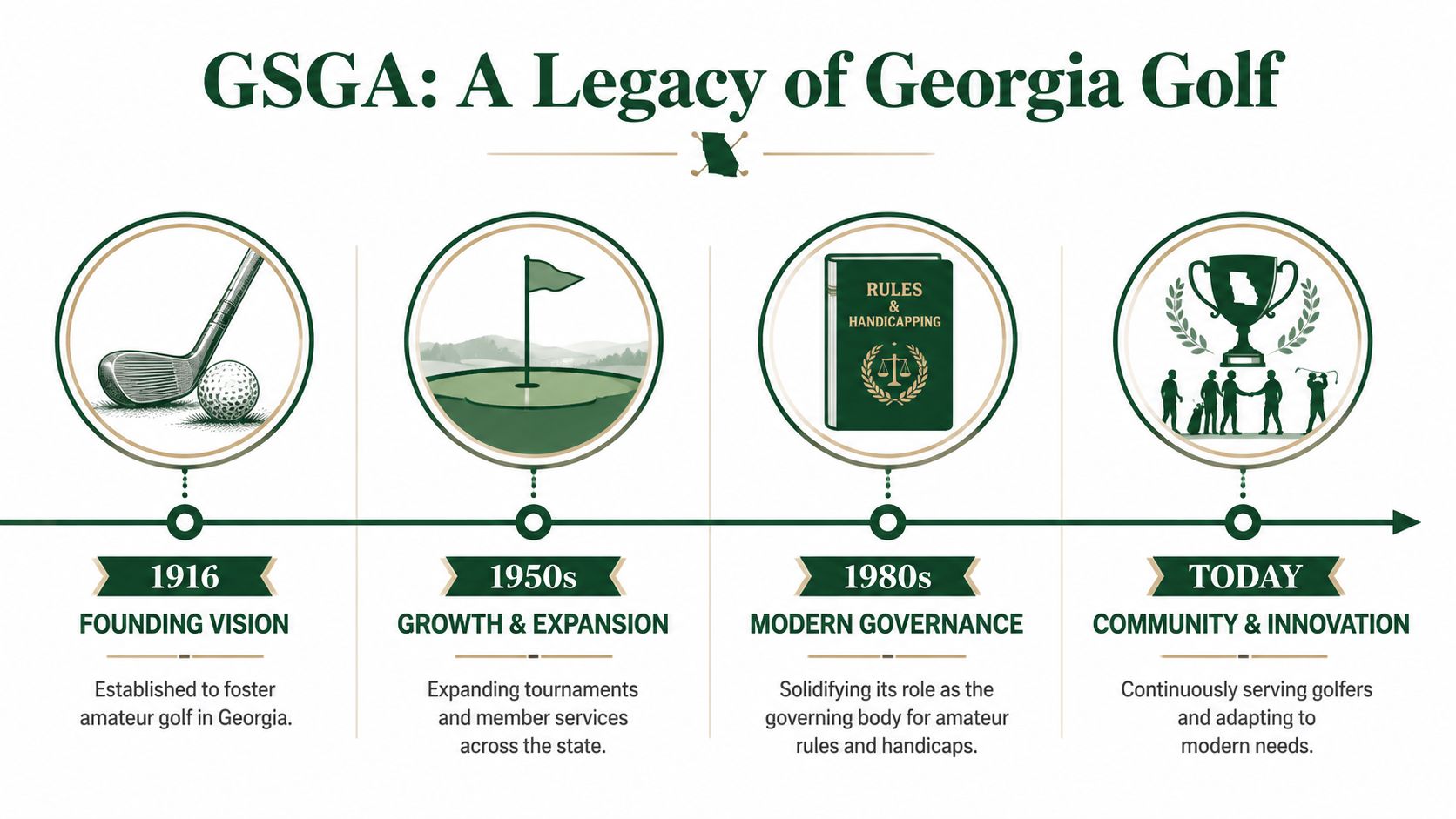
The Georgia State Golf Association has real weight because it sits at the center of Georgia's amateur golf structure, not on the edges of it. It was founded in 1916, and its inaugural event, the Georgia Amateur Championship, was won by 14-year-old Bobby Jones. It operates as a non-profit Allied Golf Association to the USGA, serves nearly 350 member clubs, and governs the game throughout the state, according to the GSGA historical overview.
Why that history still matters
Plenty of golf organizations have a long story. Not all of them have a governing role that still affects what players and clubs do today.
The Bobby Jones connection matters because it places the Georgia Amateur at the start of the state's competitive identity. But the more important point for current players is institutional continuity. When an association has been operating since 1916, it becomes the place where rules administration, event standards, and golf access get organized instead of improvised.
That affects more than championship golf. It shapes how member clubs think about handicaps, competition calendars, and player development.
What the GSGA actually does in practice
From a tournament director's perspective, the value isn't abstract. The association creates a common competitive language across Georgia. That means golfers, head professionals, and staff aren't reinventing procedures from one event to the next.
A few practical implications:
Rules consistency: Clubs and players work from a shared rules framework instead of local guesswork.
Event legitimacy: Competitive results carry more meaning when eligibility and administration follow a recognized standard.
Statewide connectivity: Golfers can move between clubs and events without learning a totally different system each time.
Operational reality: A governing body is most useful when nobody notices it. If pairings, eligibility, handicaps, and rulings all feel predictable, the system is doing its job.
The trade-off clubs and players should understand
Association governance adds structure, and structure always adds some friction. Entry standards, policy requirements, and formal rules enforcement can feel heavier than a member game or a casual invitational.
That's not a flaw. It's the cost of fairness.
For golfers, that means fewer shortcuts. For clubs, it means tighter administration. For both, it means competitive golf in Georgia has a real backbone. That's why the Georgia State Golf Association still matters almost a century after Bobby Jones started the story.
Unlocking Your Golf Potential with GSGA Membership
Most golfers don't join the Georgia State Golf Association because they want another logo on a card. They join because they want their golf organized in a way that opens doors. The practical value starts with handicap service, but it doesn't end there.

The handicap is the foundation
If you're going to compete, your first tool is an official USGA Handicap Index. Without it, you're limited. Net events become messy, pairings get harder to manage fairly, and many tournament opportunities narrow quickly.
If you need the nuts and bolts, this guide on how to obtain a USGA handicap walks through the basics clearly. The larger point is simpler: a handicap gives your scores context. It lets you compare rounds across courses and conditions in a way that casual scorekeeping never can.
For improving players, that matters because it changes how you judge progress. Instead of saying, “I think I'm playing better,” you've got a trackable record.
Membership pays off when you use it
A lot of golfers underuse their membership. They post scores, maybe glance at event listings, and stop there. The better approach is to treat membership as an operating pass into the Georgia golf ecosystem.
What tends to be most useful:
Tournament access: If you want to compete, eligibility is the point. Membership puts you on the board.
Course connection: Organized golf often gives players opportunities to experience clubs and formats they wouldn't otherwise touch.
Credibility for your game: When you carry a maintained handicap and play posted events, people know what your number means.
What works and what doesn't
I've seen the same pattern for years. Golfers who get the most from membership do a few simple things well.
Approach | What happens |
|---|---|
Post scores consistently | Your index reflects your actual game, not the version you remember |
Enter manageable events first | You learn pace, procedure, and nerves without forcing a leap |
Read entry details carefully | You avoid preventable mistakes with eligibility and format |
Ignore the admin side | You end up confused about deadlines, policies, or what event fits you |
The handicap isn't there to flatter you. It's there to expose your scoring pattern honestly enough that competition can be fair.
The real investment
The value of GSGA membership isn't only in benefits listed on a page. It's in what membership lets you build: a competitive schedule, a credible scoring record, and better decisions about where your game belongs.
That's why serious golfers in Georgia usually end up here sooner or later. If you want your golf to travel beyond your weekend group, membership is the practical first step.
The Competitive Edge Navigating the GSGA Tournament Calendar
The GSGA calendar makes more sense once you stop looking at it as one giant list. It's really a ladder. Some events test pure individual performance. Some lean into partner formats and club representation. Others give juniors a competitive runway with rules and expectations that mirror higher-level golf.

If you're trying to sort out where you fit, think less about prestige first and more about fit first. The strongest tournament schedules are built around formats that match your current game, not your ego. For a broad look at event types and competitive options around the state, this guide to golf tournaments in Georgia is a useful companion.
The anchor event every Georgia player knows
The Georgia Amateur Championship is the historic centerpiece. It dates to 1916 and has been held annually since its inception, with Bobby Jones winning the first title at age 14, according to the Georgia Amateur Championship history.
That history matters because it sets the tone for what state-level amateur golf in Georgia is supposed to be. It isn't casual. It isn't loosely run. It's the kind of event where details that seem minor in a member game start costing strokes.
For players eyeing that level, the lesson is straightforward. Learn tournament golf in pieces before you try to learn it all in one week.
Team events bring a different pressure
Individual events expose your own game. Team events expose your habits.
That's why member-guest and partner formats are so useful. They test communication, match awareness, and whether a player can stay disciplined when someone else's score is in play too. Some golfers who look average in individual stroke play become very effective partners because they understand momentum and risk better than the field.
From an organizer's angle, team events also require cleaner administration. Handicaps, side games, pairing logic, and live scoring all get trickier once two-person strategy enters the picture.
Rules are not a side issue
As a USGA Allied Golf Association, the GSGA enforces the 2023 USGA Rules of Golf across all competitions. That includes specific regulations such as prohibiting caddies for players in 18-hole Junior Tour divisions to encourage self-reliance and strategic thinking, according to the GSGA history and governance page.
That's a bigger deal than many players realize. Rules consistency changes behavior.
Relief decisions matter more: You can't rely on group consensus when a ruling gets technical.
Preparation has to be sharper: Competitive players need to know procedures, not just etiquette.
Junior development gets stronger: Removing caddies from certain divisions puts decision-making back in the player's hands.
A tournament field gets better when players know they have to solve the course themselves.
How to choose the right starting point
If you're entering the GSGA world for the first time, use a simple filter:
Pick a format you already understand. Stroke play is demanding enough without learning a new game inside it.
Choose an event where the field won't rush your development. You want pressure, not panic.
Study the entry information like a rules sheet. Most avoidable tournament mistakes happen before the opening tee shot.
Treat your first event as reconnaissance. Learn check-in flow, warm-up timing, pace, and scoring procedure.
Players who do that tend to stick with tournament golf. Players who jump in blind often decide competition “isn't for them” when the actual problem was poor preparation.
Developing the Next Generation of Georgia Golfers
Junior golf in Georgia works best when families understand that development isn't only about playing more tournaments. It's about moving through the right competitive environments in the right order. The Georgia State Golf Association has become a major part of that pipeline.
The scale alone matters. The GSGA manages one of the country's largest junior golf programs, serving over 2,500 junior members annually across more than 150 affiliated clubs, highlighted by a GSGA Junior Tour with over a dozen regional championships, according to this overview of the GSGA junior program footprint.
What parents should look for first
A good junior program doesn't just create players who can stripe it on the range. It creates golfers who can show up prepared, keep pace, handle a bad hole, and finish a round without emotional collapse.
That's why the Junior Tour matters. It gives young players a structure that teaches more than ball-striking.
Competitive exposure: Juniors learn what a real starting time, score submission, and rules environment feels like.
Course management: Tournament golf forces choices that a casual round lets kids avoid.
Independence: Players start owning decisions instead of outsourcing them to parents or coaches.
The right path isn't always the fastest one
Some families rush into bigger events too early. Usually that backfires. A junior who's overwhelmed by pace, procedure, and pressure doesn't learn much except how uncomfortable tournament golf can feel.
A steadier progression works better:
Stage | What the player should be learning |
|---|---|
Early competitive rounds | Basic etiquette, pace, scorekeeping, emotional control |
Regional junior events | Travel routine, consistency, post-round reflection |
Higher-stakes championships | Strategy under pressure, resilience, self-management |
For parents: Judge a junior event by what your child learns there, not just by where they finish.
Why the structure matters long term
Georgia produces strong junior golfers because the environment isn't random. There's a visible bridge from beginner competition to more serious tournament golf. That helps juniors, but it also helps parents make better decisions about scheduling, coaching, and expectations.
The strongest young players usually aren't the ones who play the most golf. They're the ones who play golf with a purpose. They learn how to prepare, how to recover, and how to think. If a junior golfer in Georgia wants a credible pathway into organized competition, the GSGA is one of the clearest places to find it.
Modernizing Your Events A Guide for Tournament Organizers
Ask any head professional or tournament director what burns time during event week, and the answer usually isn't pairings alone. It's the stack of small failures that pile up around old systems. Manual score entry. Late player changes. Clumsy leaderboard updates. Staff answering the same scoring questions over and over because the workflow never got simpler.
That's the hidden side of association golf. The standards are higher, but many clubs still try to run modern tournaments with dated tools.

Where older workflows break down
While GSGA membership offers benefits, clubs often struggle with legacy tournament software. Modern platforms can cut event setup time by 3x and increase live scoring participation by 40%, addressing operational inefficiencies that older systems create, according to the GSGA membership benefits discussion.
Those gains matter because tournament operations are usually understaffed, not overstaffed. If setup takes too long, your team cuts corners elsewhere. If scoring is awkward, players stop using it. If reporting is messy, the golf shop eats the cleanup after the awards are done.
The practical weak spots are predictable:
Registration friction: Bad forms create bad data, and bad data wrecks pairings.
Scoring bottlenecks: One person at a table shouldn't be the whole results engine.
Player experience gaps: Golfers expect live information now. Static sheets feel old immediately.
What better event operations look like
A modern setup should reduce staff touchpoints, not multiply them. It should also work for charity outings, member events, junior competitions, and association-style formats without forcing a completely different process every time.
If you're reviewing systems, look for software that handles registration, live scoring, pairings, and reporting in one flow. Live Tourney's golf tournament management software is one example of that model. It uses app-free live scoring and web-based event management, which is especially useful when you've got mixed player groups and don't want download friction on the first tee.
For organizers building fundraising outings alongside competitive events, this guide on how to plan a successful charity golf event is also worth keeping nearby. Charity formats bring their own wrinkles, especially around sponsor exposure, check-in flow, and non-golfer-friendly registration.
If your scoring platform needs a staff tutorial every time, it's not saving staff time.
The real trade-off
Modernizing doesn't mean chasing flashy features. It means choosing fewer failure points on tournament day. The best systems make the event easier for the shop, easier for volunteers, and easier for players who only want one thing from the technology: for it to stay out of the way.
Your GSGA Questions Answered
How do I get my first GSGA handicap
Join through a participating club or approved membership channel, then start posting eligible scores consistently. The key is consistency. A handicap only helps if the record reflects your real golf, not selected highlights.
What's the easiest way to enter a GSGA tournament
Start with an event that fits your current game and read the eligibility notes before you click enter. Most first-time mistakes aren't about golf. They're about entering the wrong format, missing a requirement, or not understanding the event conditions.
I'm a parent. What should my junior do first
Choose age-appropriate competition and focus on learning tournament habits before chasing results. Juniors need to know pace, procedure, and self-management. A clean round with smart decisions usually tells you more than a finish position.
What's the difference between the GSGA and the Georgia PGA section
The short version is this: the GSGA sits on the amateur and statewide governance side of the game, while PGA section activity centers on golf professionals and professional development. If you're an amateur player, parent, or club looking at statewide competitive structure, the GSGA is usually the relevant lane.
What should club managers pay attention to first
Don't just look at membership benefits on paper. Look at operations. The biggest event-day problems usually come from outdated scoring workflows, weak registration processes, and too much manual cleanup after the round. Better systems don't replace good tournament staff, but they do remove avoidable friction.
If you run tournaments, leagues, junior events, or member outings in Georgia, Live Tourney is worth a look. It gives clubs and organizers a web-based way to handle setup, scoring, and live leaderboards without adding app friction for players, which makes day-of operations a lot cleaner.