
Jan 8, 2026
Discover the best four player golf games for your next event. Learn the rules, strategies, and scoring for Scramble, Four-Ball, and other popular formats.

If you've ever played in a charity or corporate golf event, chances are it was a four-player game like a Scramble or Best Ball. There’s a simple reason for that: these formats are fun, fast, and inclusive. They're the go-to choice for tournament organizers everywhere because they bring people together, no matter their skill level.
Why Four Player Games Are the Heart of Modern Golf Events

Ever wonder why that annual charity tournament is almost always a four-person scramble? It's no accident. For event organizers, these games are a secret weapon for pulling off a successful, memorable day on the course. They neatly solve the logistical headaches that come with managing a big group of golfers with wildly different abilities.
The biggest win is social engagement. Unlike a traditional stroke play tournament where everyone’s head is down, grinding over their own score, team formats are all about high-fives, friendly banter, and celebrating a great shot together. This is exactly the kind of atmosphere you want for a corporate outing where networking is key, or for a fundraiser that’s meant to be lighthearted and fun.
The Practical Advantages for Organizers and Players
Beyond just being a good time, four-player games have some serious practical benefits. Pace of play—a constant headache for course operators—gets a massive boost. In a scramble, for example, the team plays from the best shot every time, which naturally speeds things up. This lets organizers pack the course and get everyone finished in a reasonable amount of time.
This isn't just a hunch; it's how modern golf events run. The vast majority of organized tournaments are built around four-player formats because they move faster and are way easier to handicap. A scramble is the perfect vehicle for a charity or corporate event to fill a 120–144 player shotgun start, which maximizes the day's revenue.
To give you a clearer picture, here’s a quick rundown of the most common formats you'll encounter.
Quick Guide to Popular Four Player Formats
This table breaks down the basics of each game, helping you decide which one is the right fit for your group or event.
Format Name | Core Concept | Best For | Pace of Play |
|---|---|---|---|
Scramble | All four players tee off, select the best shot, and everyone plays their next shot from that spot. | Charity events, corporate outings, mixed-skill groups. | Fast |
Best Ball (Four-Ball) | Each player plays their own ball. The team's score on each hole is the lowest score among the four players. | Member-guest tournaments, competitive but social rounds. | Moderate |
Shamble | All four players tee off, select the best drive, and then each player plays their own ball from that spot for the rest of the hole. | A good mix of Scramble and Best Ball; balances team play with individual scoring. | Moderate |
Foursomes (Alternate Shot) | Two players form a team and alternate hitting the same ball. One player tees off on odd holes, the other on even holes. | Competitive club events, requires strategy and strong teamwork. | Fast |
Each of these formats brings a different dynamic to the course, but they all share the goal of making golf a team sport.
The real magic of these formats is their ability to level the playing field. A novice golfer who might feel intimidated in a traditional game can hit one great drive or sink a crucial putt that helps their team, making them feel like a valuable contributor.
This inclusive vibe is a huge part of what makes an event successful. When every single player, from the scratch golfer to the 25-handicap, leaves feeling like they had a great time and chipped in, you've nailed it.
If you're thinking about planning an event, our guide on how to organize a golf tournament dives deeper into these core principles. Ultimately, these games do more than just get people on the course—they turn a simple round of golf into a shared experience.
Mastering the Most Popular Four Player Formats
Knowing the basics of four-player golf games is a solid start, but true mastery comes from digging into the subtle strategies that turn a good round into a great one. Whether you’re organizing a high-stakes member-guest or a relaxed charity outing, picking the right format and knowing how to attack it is crucial.
Let's break down the most popular formats, getting into the rules, scoring quirks, and tactical advice that actually make a difference on the course. Each game offers a unique mix of teamwork and individual pressure, and knowing which levers to pull can give your team a serious edge.
The Scramble: The Ultimate Team Game
The Scramble is the undisputed champ of charity and corporate events, and for good reason. It’s simple, it's fast, and it’s incredibly inclusive. In a Scramble, all four players tee off, the team picks the best shot, and everyone plays their next stroke from that exact spot. You just repeat that process until the ball is in the hole.
The beauty of the Scramble is that it lets everyone contribute. A less experienced player might hit one perfect drive or sink a crucial 20-foot putt, making them the hero of the hole.
Strategic Tip for Scrambles: Let your best putter go last. Once you’re on the green, have the other three players take a run at the putt first. This gives your most reliable putter three different reads on the line and speed, which dramatically boosts the chances of making a key birdie or eagle.
The core strategy in a Scramble is risk management and optimization. You want your long hitters to swing freely on their drives, knowing the team has safer shots to fall back on. Once you're on the green, it’s all about giving your best putter the most information possible.
Four-Ball (Best Ball): Balancing Individual Play and Team Support
Four-Ball, which most people just call Best Ball, is a fixture in more competitive events like member-guest tournaments. In this format, all four players play their own ball from tee to green. On each hole, the team's score is the single lowest score made by any of the four players.
This format creates a fascinating dynamic. You’re playing your own ball, but your partner’s performance completely changes your strategy. If one player is sitting pretty in the fairway, their partner can take a much more aggressive line, knowing a safe score is already in play. It’s this blend of individual accountability and teamwork that makes it a favorite among skilled golfers.
Foursomes (Alternate Shot): The True Test of Partnership
You'll see this one in high-profile events like the Ryder Cup. Foursomes, or Alternate Shot, is one of the most demanding formats out there. Two-person teams play with only one ball, taking turns hitting shots until the hole is finished. One player tees off on the odd-numbered holes, and the other handles the evens.
Pairing is everything in Foursomes. You need to match players whose skills complement each other. For example, pairing a long, straight driver with a player who has a deadly short game is a classic winning formula. Communication and trust are non-negotiable—one bad shot can leave your partner in a brutal spot.
The Shamble: A Hybrid Approach
The Shamble hits that perfect middle ground between the all-in-on-one-shot Scramble and the individual play of Best Ball. Just like a Scramble, all four players tee off and the team chooses the best drive. But from that point on, each player plays their own ball into the hole.
This format is fantastic because it takes the pressure off the tee shot—often the most nerve-wracking shot for amateurs—while still keeping a big chunk of individual play. Scoring can vary in a Shamble, but it usually involves taking the one or two best scores from the four players on each hole.
Common Shamble Scoring Variations:
One Best Ball: The team's score is simply the single lowest score among the four players.
Two Best Balls: The two lowest scores are combined for the team score on that hole.
One Best Ball Gross, One Best Ball Net: A more complex version where you take one low gross score and one low net score.
Choosing the right format really depends on your group's skill level and the vibe you want for your event. Each of these four-player games brings a completely different flavor to the course, guaranteeing a memorable day for everyone involved.
Pairing and Handicapping for a Fair and Fun Tournament
Once you’ve picked the perfect format, the next step is what really makes or breaks a great tournament: creating balanced teams. Let's be honest, nobody enjoys a runaway victory. Proper pairing and handicapping are the secret sauce that gives every group a real shot at winning, keeping the energy high and the day fun for everyone.
If you don't have a system, you'll inevitably end up with a few super-teams dominating the leaderboard, which just kills the vibe for the rest of the field. The goal is to create a level playing field where teamwork, strategy, and a little luck can carry any group to the top. This isn't about complex math; it's about being smart when building your foursomes.
The A-B-C-D System for Balanced Teams
One of the best and most common methods for building fair teams, especially for a scramble, is the A-B-C-D player system. This simple approach stops you from accidentally stacking all the low-handicap players on one team. It's a logical process that works wonders for competitive balance.
Here’s how you do it:
Rank Your Players: First, get all the player handicaps and sort the entire field from lowest (your best players) to highest.
Create Four Tiers: Now, divide that list into four equal groups. The top 25% are your 'A' players, the next 25% are the 'B's, the third group are the 'C's, and the final 25% are your 'D' players.
Build the Teams: Form each foursome by picking one player from each tier. Simple as that. Every team will have an A, B, C, and D player.
This method naturally spreads the skill across the entire tournament. Each group gets a mix of strong players and higher handicappers, which leads to a much tighter, more exciting competition from the first tee to the last putt.
A well-paired tournament just feels fair. When players see a tee sheet with a balanced distribution of skill, you get instant buy-in. It makes the event more engaging before a single ball is even hit.
Calculating Team Handicaps Correctly
Once the teams are set, applying a team handicap is the final touch to level the playing field. For scrambles, you don't just add up everyone's handicap. Instead, you use a weighted formula that gives a little more influence to the better players on the team.
A popular and USGA-recommended formula for a four-person scramble looks like this:
25% of the A player's course handicap
20% of the B player's course handicap
15% of the C player's course handicap
10% of the D player's course handicap
Let’s run through a quick example. Say you have a team with handicaps of 5 (A), 12 (B), 20 (C), and 28 (D). Their team handicap would be (0.25 x 5) + (0.20 x 12) + (0.15 x 20) + (0.10 x 28) = 9.45. You'd subtract that number from their gross score to get their net score.
Using proven formulas like this is critical for getting accurate and fair results. It's a huge piece of the puzzle, and you can dive deeper in our complete guide to golf tournament scoring.
How to Set Up Your Tournament in Minutes
Getting your four-player tournament from an idea to a fully organized event shouldn't be a headache. The days of fighting with spreadsheets and manually creating pairings are over. Modern tournament software, like Live Tourney, is built to do the heavy lifting, so you can go from a simple player list to a ready-to-go tournament faster than you think.
With the right tool, you just upload your player roster, pick your format—say, a four-person scramble—and let the software handle the tedious stuff. It automatically creates balanced pairings using methods like A-B-C-D, builds a professional tee sheet, and even generates custom cart signs and scorecards.
From Roster to Ready-to-Play
Once your players are in the system, you can start layering in the fun stuff. This is where you can instantly add popular side games that really dial up the excitement for everyone.
You can add games like:
Skins Game: Set up a gross or net skins game where every hole is up for grabs.
Closest to the Pin: Designate a few par-3s and let the software track the winners automatically.
Longest Drive: Pick a wide-open fairway and reward the biggest hitter in the field.
This diagram breaks down the simple flow for creating balanced teams, which is a core function the software automates.
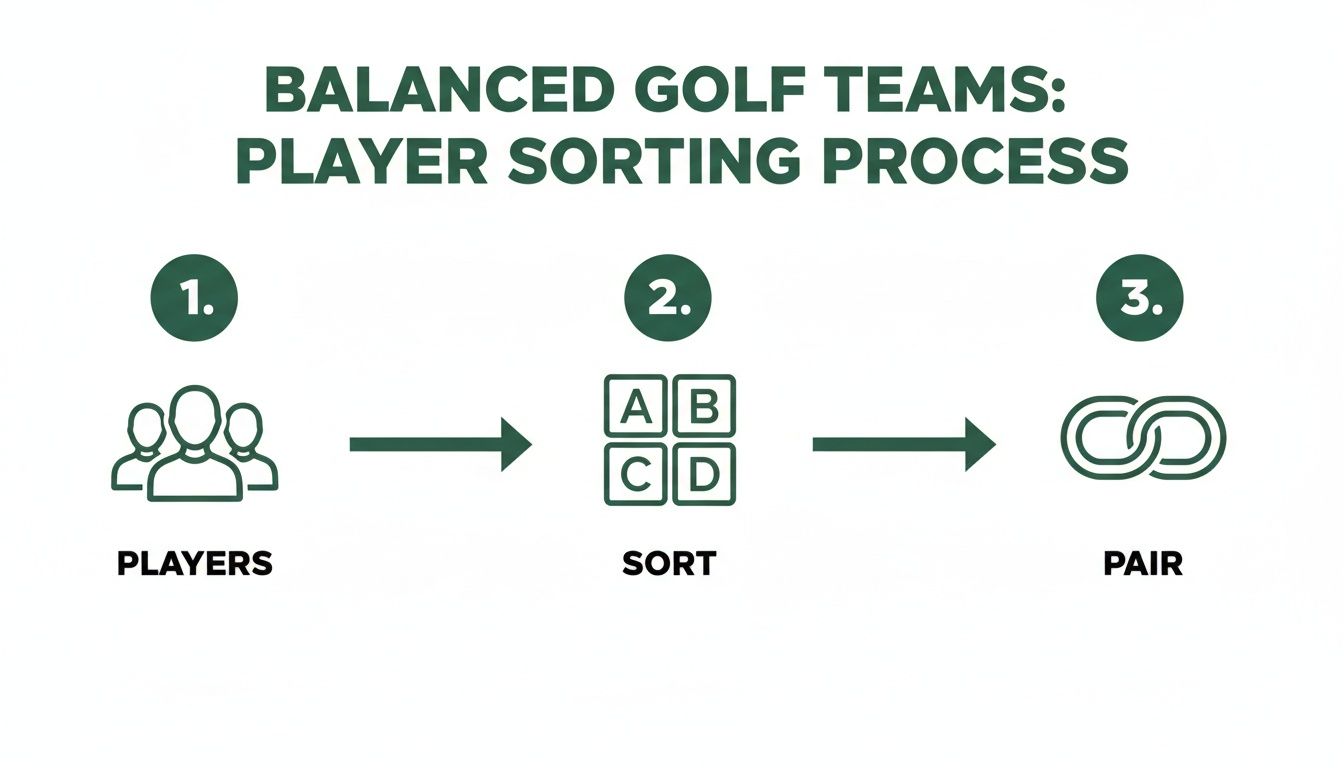
It’s a straightforward process: the system takes your player list, sorts everyone by skill level, and then intelligently groups them to keep the competition fair and fun.
This kind of automation is becoming a necessity as more courses schedule more events. A single 20-team, four-player league can generate 1,600 individual player-rounds over a 20-week season. Trying to manage that many pairings, scores, and payouts by hand is just not practical. The R&A's research on global golf participation highlights just how much the game is growing.
The real win here is the time you get back and the professional touch it adds to your event. What used to take hours of manual work—creating pairings, designing cart signs, printing scorecards—is now done in minutes. That frees you up to focus on what matters: the player experience.
Everything in One Place
Good software acts as a command center for your entire event, and you can run it from any device. It pulls all the key tournament setup options into one clean interface, making it easy to manage everything without getting lost in menus.
From a single dashboard, you can jump between managing players, adjusting pairings, setting up scoring, and getting your printable materials ready to go.
Ultimately, a streamlined process like this empowers anyone—from a PGA pro running a club championship to a first-time volunteer organizing a charity scramble—to host an event that feels polished and professional. When you take away the administrative burden, you can put your energy where it belongs: creating a memorable day on the course for every single player.
Boosting Player Engagement with Live Scoring
The final putt drops, players shake hands, and the anticipation builds. But what happens next can make or break the post-round experience. Instead of a chaotic scramble to collect and tally paper scorecards, imagine an electric atmosphere buzzing in real-time. This is the power of live scoring in four-player golf games—it transforms a good event into a genuinely memorable one.

When players can see a dynamic leaderboard on their phones, the whole experience changes. A simple, app-free approach is key; players just need a link to enter scores for their group. This one small touch adds a professional feel and keeps every team engaged, whether they're leading the pack or trying to grind out a few spots on the back nine.
Creating a Clubhouse Buzz
The real magic happens as the last groups walk off the 18th green. With a live leaderboard displayed on a clubhouse TV, you create a natural gathering point. Players grab a drink, find their team's name, and watch the results pour in hole-by-hole.
This shared experience creates a palpable excitement that paper scorecards just can't match. The post-round hang becomes part of the event itself, not just a holding pattern before the awards. You can check out some of the best modern options in our guide to golf tournament scoring software.
Live scoring does more than just display numbers; it tells the story of your tournament as it unfolds. That suspense and immediate feedback are what players remember and talk about long after the day is over.
This immediate access to results also eliminates the dreaded "scoring tent" bottleneck. Forget about deciphering bad handwriting or manually punching in dozens of scores under pressure. The final results are calculated instantly and accurately.
Seamless and Accurate Awards
When it’s time to announce the winners, the whole process becomes smooth and error-free. The live leaderboard serves as the final, verified standings for your main tournament and any side games you’re running.
Gross and Net Winners: Automatically calculated and displayed. No more hand-figuring handicaps.
Skins Game: Instantly identifies which teams won which holes, and for how much.
Closest to the Pin: Leaders are updated in real-time as players enter their measurements right on the course.
By embracing live scoring, you not only make the event more fun for players, but you also eliminate a ton of administrative headaches for yourself. The awards ceremony becomes a seamless celebration, capping off a professionally run event that leaves every participant impressed.
Your Top Four-Player Golf Game Questions, Answered
If you’re running a golf tournament, whether you're a seasoned pro or a first-timer, a few key questions always seem to pop up. Planning these events can bring up some tricky situations, but with a little foresight, you can have the answers ready before anyone even has to ask.
We hear the same questions all the time. Think of this as your go-to guide for sorting out the small details that make a huge difference on tournament day.
What's the Best Format for a Corporate or Charity Event?
Nine times out of ten, a four-person Scramble is the perfect choice. It's the most welcoming format for beginners, keeps the pace of play moving, and lets golfers of every skill level feel like they're contributing.
This setup keeps the focus squarely on teamwork and fun, which is exactly the atmosphere you want for a corporate or charity outing. It ensures everyone—from scratch golfers to complete novices—has a great time.
How Do You Handle Handicaps in a Scramble?
This is a big one. Simply adding up all four handicaps gives a huge advantage to teams stacked with low-handicap players. A much fairer way is to use a percentage of each player's handicap.
A popular and balanced formula looks like this:
35% of the A-player's handicap
25% of the B-player's
15% of the C-player's
10% of the D-player's
Just add those adjusted numbers together to get the final team handicap. You'll subtract that from their gross score to get their net.
What's the Main Difference Between a Scramble and a Shamble?
It’s easy to get these two mixed up, but the distinction is actually pretty simple. Both formats kick off the same way: everyone on the team tees off, and the group chooses the best drive to play from.
The real difference is what happens next. In a Scramble, the whole team plays their second shot from that best-drive spot. But in a Shamble, each player hits their own ball from that spot all the way to the hole, mixing team play with an individual challenge.
How Can I Make Sure the Pace of Play Stays on Track?
Besides picking a faster format like a Scramble, your best tool is communication. Let everyone know the pace-of-play expectations before they even tee off. A quick reminder about "ready golf" doesn't hurt, either.
For bigger events, having a few marshals on the course can help keep groups moving. Even better, using live scoring software lets you see exactly where the bottlenecks are forming in real-time. You can then send a gentle nudge to any slow groups before they back up the entire field.
Ready to run a flawless golf event with less stress and more engagement? Live Tourney makes setup, scoring, and management effortless. Start your 10-day free trial and see how simple your next tournament can be.





