Apr 1, 2026
Access the definitive Cypress Point scorecard. Get a hole-by-hole guide, printable downloads, and strategic insights for this legendary course.
Before you even think about stepping onto the first tee at Cypress Point, you need to understand the numbers. They tell a story. The scorecard isn't just a piece of paper; it’s the blueprint for one of the most revered and challenging rounds of golf you'll ever play.
From the tips, we're talking about a par-72 layout that stretches to 6,524 yards. But that yardage is deceptive. The real teeth are in the course rating of 73.1 and a slope of 141. Those figures should get your attention—they signal a course that demands precision and punishes mistakes, especially for bogey golfers.
Quick Reference Cypress Point Scorecard

Let's break down the core stats. Whether you're planning a trip or setting up a tournament, knowing the difference between the tee sets is the first step. These numbers dictate strategy, handicap assignments, and ultimately, how the course plays on any given day.
For tournament organizers, that high slope rating is a critical piece of information. It highlights just how much tougher Cypress Point plays for the average amateur compared to a scratch player, which is vital when you're assigning strokes for a net event using a platform like Live Tourney.
Cypress Point Club Scorecard At-a-Glance
Here’s a quick summary of the ratings for the two primary tees. It’s the kind of at-a-glance data you’ll want to have handy.
Tee | Yardage | Par | Slope | Rating |
|---|---|---|---|---|
Championship | 6,524 | 72 | 141 | 73.1 |
Regular | 6,249 | 72 | 139 | 72.1 |
Even from the Regular tees, the course maintains a stout 139 slope and 72.1 rating, losing less than 300 yards. This isn't a course where moving up a tee box suddenly makes it easy. Now, with these numbers in mind, we can dig into the hole-by-hole strategy.
Downloadable Hole by Hole Cypress Point Scorecard
The course and slope rating give you the big picture, but the real test is in the details of each hole. To truly get a feel for the strategic genius Dr. Alister MacKenzie built into the Monterey Peninsula, you need to see the course hole by hole.
This isn't just for trivia's sake; it's a practical tool. Knowing the exact yardages and understanding the Stroke Index for each hole is fundamental to building a solid game plan. It’s how you start making smart decisions long before you ever step on the first tee.
Official Cypress Point Club Hole-by-Hole Scorecard Data
Here’s the complete breakdown for all 18 holes. Pay close attention to the unique flow, like the back-to-back par 5s on the front nine (5th and 6th) and the legendary consecutive par 3s on the back (15th and 16th). These are the kinds of details that make Cypress Point one of a kind.
Hole | Championship Yardage | Regular Yardage | Par | Stroke Index |
|---|---|---|---|---|
1 | 421 | 417 | 4 | 7 |
2 | 549 | 524 | 5 | 1 |
3 | 173 | 170 | 3 | 15 |
4 | 373 | 363 | 4 | 11 |
5 | 496 | 472 | 5 | 9 |
6 | 521 | 498 | 5 | 5 |
7 | 166 | 139 | 3 | 17 |
8 | 358 | 344 | 4 | 13 |
9 | 291 | 280 | 4 | 18 |
OUT | 3,348 | 3,207 | 37 | |
10 | 475 | 455 | 5 | 10 |
11 | 422 | 412 | 4 | 4 |
12 | 398 | 390 | 4 | 8 |
13 | 400 | 385 | 4 | 6 |
14 | 393 | 380 | 4 | 12 |
15 | 139 | 130 | 3 | 16 |
16 | 233 | 222 | 3 | 2 |
17 | 378 | 370 | 4 | 14 |
18 | 342 | 338 | 4 | 18 |
IN | 3,180 | 3,082 | 35 | |
TOTAL | 6,528 | 6,289 | 72 |
This table gives you the raw data needed for everything from club selection to importing the course into tournament software like Live Tourney.
Printable Cypress Point Scorecard PDF
We've taken this data and formatted it into a clean, easy-to-read printable scorecard. It's a high-quality PDF that's perfect for a few different things:
Tournament Setup: Organizers can have it on hand for quick reference when setting up an event.
Game Prep: Golfers can print it out, study the layout, and jot down notes before a round.
A Cool Keepsake: Let's be honest, it's a great memento for any fan of golf's most iconic courses.
The design is simple and functional—no clutter, just the critical info you need. It’s perfect for a quick look on the course or for your planning sessions.
Grab a copy for your digital files or to print out.
Download Your Free Printable Cypress Point Scorecard PDF Here
Decoding The Course Rating And Slope
When you glance at a Cypress Point scorecard, two numbers immediately jump out and tell you everything you need to know about the challenge ahead: the Course Rating and the Slope Rating. These aren't just arbitrary figures; they're the universal language of golf difficulty, and understanding them is the first step to truly respecting this course.
Let's start with the Course Rating. Think of this as the course's difficulty for a scratch golfer (someone with a 0 handicap). At Cypress, the championship tees have a rating of 73.1. In simple terms, this means a scratch player is expected to shoot about one over par, or a 73, on any given day. It’s a direct assessment of how the course plays for the very best.
Now for the Slope Rating. This number tells a different story. It measures the relative difficulty for a bogey golfer (around a 20 handicap) compared to that scratch player. Cypress Point’s massive slope of 141 is exceptionally high, which confirms what many already know: this track is significantly tougher for higher-handicap players. A high slope means a bogey golfer’s score will climb much faster here than on a course with an average slope of 113.
What The Numbers Mean For Your Game
So why do these ratings matter? They directly impact your Course Handicap, which is what adjusts your personal Handicap Index to the specific difficulty of the course you're playing that day. For anyone running a tournament, these numbers are the foundation for fair play, leveling the field for players of all skill levels. They are the backbone of the entire handicap system.
This image breaks down the key data points on the Cypress Point scorecard, from the total yardage to the par and hole count.
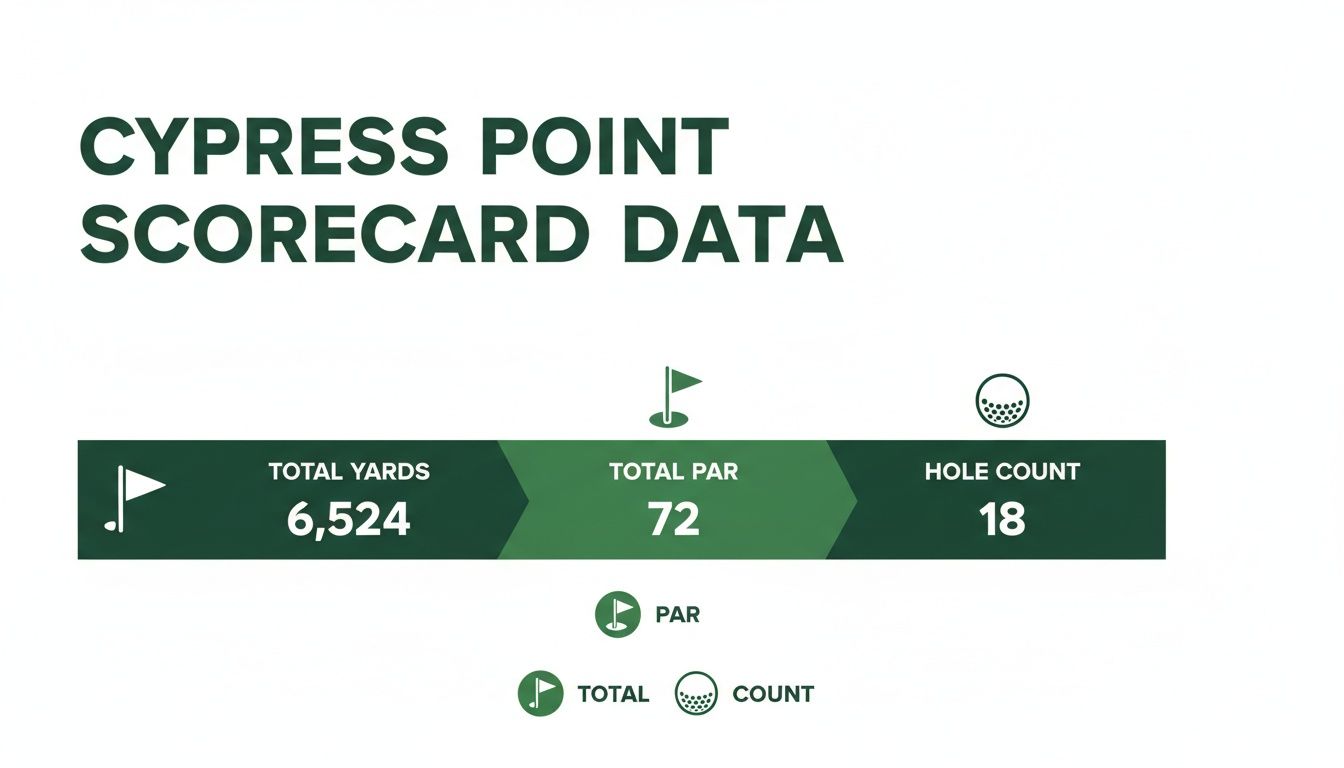
You can see how all these stats come together to build the course's formidable reputation.
The official scorecard lays out a par 72 course that stretches to 6,552 yards, with the front nine playing as a beastly par 37. If you really want to get into the weeds on how these ratings are calculated and what they mean, we have a complete breakdown in our guide on what course rating means in golf.
Strategic Guide To Playing Every Hole

The scorecard gives you the numbers, but playing Cypress Point well is about strategy and feel. Think of the course in three acts: the forest, the dunes, and the iconic ocean finish. This guide is your cheat sheet for navigating each part, turning raw data into a real game plan.
We’ll break down how to approach each phase, drawing on decades of local knowledge and an understanding of Alister MacKenzie's genius design.
Navigating The Forest And Dunes
Your round starts in the Del Monte Forest for holes one through seven. This is not the time for hero golf. It’s all about precision.
Holes 1-4: Start smart. These opening holes reward control off the tee. The goal is to give yourself a clean look at the green. The par-5 2nd hole is the #1 handicap for a good reason; at 549 yards, trying to get home in two is a fool's errand for most. Play it as a three-shot hole and you might just walk away with a par.
Holes 5-6: Here’s your first real scoring chance with back-to-back par 5s. The 496-yard 5th and 521-yard 6th are gettable, but stray shots find trouble fast. A smart layup is always a better play than a risky shot into the trees.
Holes 7-9: The course opens up as you move into the dunes. The character changes completely. The short par-4 9th is a classic risk-reward hole. Big hitters might be tempted to go for the green, but anything less than perfect is getting swallowed by sand. It's a tempting dare right before you make the turn.
Once you hit the 7th hole, MacKenzie's bunkering becomes the star of the show. The dunes demand creativity and shot-shaping, a completely different test than the forest.
Conquering The Iconic Ocean Holes
When you step onto the 13th tee, the round changes. The course turns toward the Pacific, and you’ve arrived at the stretch of golf that makes Cypress Point legendary. From here on out, wind is your primary opponent.
The walk from the 14th green to the 15th tee is pure theatre. The roar of the ocean takes over, and you see the dramatic meeting of land and sea. It’s arguably the greatest finishing stretch in all of golf.
This is where courage and caution have to work together. Knowing your carry distances is one thing, but accounting for the wind and ocean spray is another. This is where a caddie earns their keep. A scorecard won't tell you about the day's conditions, but detailed notes and experience will. If you want to get better at that, you can learn more about how to read pin sheets in our guide.
Hole 15 (139 yards, Par 3): Don't let the short yardage fool you. This little shot is all carry over a small inlet to a green surrounded by six bunkers and the Pacific. It requires one pure, committed swing.
Hole 16 (233 yards, Par 3): The moment everyone waits for. It's a 233-yard carry over the ocean. This is one of the ultimate tests in golf. There's a layup area to the left, but making par from there is no picnic.
Hole 17 (378 yards, Par 4): A stunning par 4 that hugs the cliff's edge. The iconic cypress trees guard the fairway, forcing you to choose a line and commit to it. It’s as beautiful as it is treacherous.
A Deep Dive Into The Legendary 16th Hole

You can't really talk about the Cypress Point scorecard without zeroing in on its most famous hole: the legendary 16th. It’s so much more than a par 3. It's the moment in the round that defines your day and, for many, stands as the most dramatic one-shotter in all of golf. Standing on that tee is an experience in itself, presenting a choice that can make or break your entire score.
The card lists it as a 233-yard par 3 from the tips, but that number barely scratches the surface. The shot is a full carry over the churning Pacific Ocean to a green perched on a distant, rocky point. It’s the ultimate gut check.
The Hero Shot Vs. The Safe Play
The beauty of the 16th is the clear choice it forces on you. Do you go for it all, or do you play the percentage shot? Alister MacKenzie’s genius is on full display here, as he gives you a bailout but makes sure it’s no simple alternative.
The Hero Shot: This is the one you dream about. It requires a perfectly flushed long iron, hybrid, or even a fairway wood to carry the ocean. With the coastal winds always a factor, just picking the right club is half the battle. Pull it off, and you've got a story for life.
The Safe Play: To the left, a small patch of fairway offers a landing area. While it saves you from a watery grave, it leaves a tough pitch to a green that's difficult to hold from that angle. Making par from the bailout area is far from a given.
The hole’s very existence as a par 3 is thanks to the course’s visionary, Marion Hollins. Back in 1928, she famously stepped up and hit a drive across the chasm, proving to a skeptical MacKenzie that the green was reachable and forever sealing its iconic status.
This single hole on the Cypress Point scorecard is a masterclass in risk-reward design. Its history is filled with memorable moments, from Bing Crosby’s hole-in-one in 1947 to Ed 'Porky' Oliver's infamous 16. You can read more about the astounding facts and statistics about Cypress Point here.
Using The Scorecard To Run Your Tournament
Any good tournament director knows that a successful event starts long before the first tee shot. When you're at a place like Cypress Point, that scorecard in your hand is more than just a place to pencil in 4s and 5s—it’s your blueprint for a fair and competitive day.
The first call you’ll need to make is tee selection. Let's be honest, this course is a beast from any box. The scorecard tells the story: a 141 slope from the Championship tees and 139 from the Regulars. For a field with a wide spread of handicaps, the best play is often a mixed-tee setup. You can put your low-handicap sticks on the Championship tees and let the rest of the field play the Regulars. This keeps the course tough but playable for everyone.
Assigning Handicaps For Common Formats
Once your tees are sorted, it's time to handle handicaps. The Stroke Index on the card is your guide here, telling you where strokes should fall. How you apply them, though, depends entirely on your format.
Here are a couple of the most common setups:
Scramble: For a classic four-person scramble, a popular handicap formula is to take a percentage of each player's Course Handicap. We typically see 25% of the A-player's, 20% of the B's, 15% of the C's, and 10% of the D-player's handicap. This keeps one low-handicap player from carrying the whole team.
Best Ball (Four-Ball): In a two-person best ball match, things are simpler. The player with the lowest handicap plays straight up (off scratch), and the other three players get strokes based on the difference between their handicap and the scratch player's. For a team stroke play event, most organizers give players 85-90% of their Course Handicap. It encourages more birdies and keeps the round exciting.
When you use the data on the scorecard this way, you’re turning numbers into a smooth, well-run tournament. It's this kind of prep work that makes the day better for every single player.
How To Digitize The Scorecard For Live Scoring
Want to run live scoring for your event at Cypress Point? It all starts with getting the course details out of that paper scorecard and into your tournament software. This is the simple, one-time setup that unlocks everything from live leaderboards to a faster, smoother tournament day for everyone involved.
The first step is building the course profile inside the platform. You’ll just need to enter the hole-by-hole information directly from the scorecard.
Par: Add the par for all 18 holes (like the famous Par 3 on Hole 16).
Yardage: Input the yardages for the tee boxes you're using, whether it's the Championship tees or the Regular set.
Stroke Index (Handicap): Make sure to enter the handicap number for each hole. This is critical for making sure strokes are allocated correctly for net competitions.
Once you save this information, the system takes care of the rest. It can instantly generate digital scorecards, printable tee sheets, and custom cart signs, all based on the data you just entered. Best of all, it's a "set it and forget it" process that ensures your calculations are perfect for every event you host at the course.
Automating Communications and Reports
Getting your scorecard into a digital format does more than just simplify scoring; it gives you a powerful set of data you can use long after the final putt drops. If you want to automate follow-up emails or create personalized reports, you can explore tools like the best mail merge for Google Sheet to connect with your players. Imagine sending every participant an email with their final results and a thank you note, all with a single click.
This kind of setup not only makes the event feel more professional for players but also cuts down on the administrative headaches for your staff. To see what else is possible, take a look at our guide on picking the right golf tournament scoring app.
Frequently Asked Questions About The Cypress Point Scorecard
Whether you're prepping for a round, running a tournament, or just love legendary course design, the Cypress Point scorecard often brings up a few questions. We get it. Here are the straight-up answers to the most common things we hear.
What Makes The Cypress Point Scorecard So Challenging?
The numbers on the card tell part of the story. A course rating of 73.1 and a slope of 141 are no joke—they immediately signal that you're in for a serious test of golf.
But it’s more than just numbers. The real challenge comes from the combination of relentlessly long par 4s, strategic par 5s that demand a solid plan, and the ever-present coastal winds that can turn a good shot into a bad one in a heartbeat. Throw in iconic, heroic shots like the 233-yard carry on the par-3 16th, and you understand why posting a good score here feels like a major accomplishment.
Can I Get A Printable Copy Of The Cypress Point Scorecard?
Absolutely. We've included a link in this guide to a custom-designed, high-quality printable PDF of the Cypress Point scorecard. It's perfect for mapping out your strategy before a round, setting up a tournament, or even just framing as a keepsake.
How Is The Stroke Index Determined For Each Hole?
The Stroke Index, or handicap rating, is simply a ranking of the holes from hardest (#1) to easiest (#18). This is what's used to dish out strokes in match play.
At Cypress Point, the #1 index hole is the beastly 549-yard par-5 2nd. This means it's the hole where a higher handicap player is statistically most likely to need an extra stroke to even the playing field against a scratch golfer.
How Can I Use This Scorecard In Tournament Software?
This is where the magic happens for tournament organizers. You can take the hole-by-hole par, yardage, and stroke index data from the scorecard and plug it directly into a modern platform.
Once the course is built in the system, the software takes over. It automatically generates digital scorecards, creates tee sheets, and powers a live leaderboard for your event. It's a huge time-saver.
Running a tournament like a pro means using the right tools. With Live Tourney, you can build out your entire event in just a few minutes. It handles everything from registration and pairings to live scoring and final payouts, giving players an experience they'll actually enjoy. Find out how Live Tourney can make your next golf event run a whole lot smoother.