
Feb 1, 2026
Learn how to create round robin schedule for golf events, with pairings, bye management, and automation tips for a flawless tournament.

To run a fair golf tournament, you need a schedule where everyone plays everyone else. It's the only way to truly find out who the best player is. The simplest way to do this is with a round robin format using a fixed-and-rotate system. This approach guarantees every player gets the same number of matches against a variety of opponents, making it the gold standard for competitive golf.
Why Round Robin Is the Gold Standard for Fair Play

When you're running a golf league or a multi-day tournament, the schedule is everything. A round robin format is your best bet because it gets rid of the random luck that can ruin a single-elimination bracket. No one gets an easy path to the finals; they have to earn it.
This is about more than just fairness, though. It’s about keeping people engaged. When players know they have a full slate of matches, every round matters. It keeps the energy high from the first tee shot to the final putt and makes for a much more memorable event.
Key Benefits for Your Golf Event
A round robin schedule brings a few huge advantages to the table that really improve the experience for your players:
Guaranteed Play: Nobody goes home after one bad round. Every player gets a full schedule of matches, which means they get more value and playing time for their entry fee.
A True Champion: The winner is decided after facing every other competitor. There's no doubt left about who was the most consistent player throughout the event.
Builds Community: More matches mean more interactions between players. This is perfect for building camaraderie in a club or league setting.
If you want to see how this plays out in a broader context, looking at systems for managing various sports leagues can give you some great practical insights into making these formats work.
The whole point of a round robin is to take luck out of the equation. A balanced schedule means the final standings reflect skill and consistency, not just a favorable draw.
Of course, you can always map out a round robin schedule by hand with a spreadsheet. But let's be honest—it’s a tedious process and it's easy to make mistakes. This is where modern tools like Live Tourney come in. The software handles all the heavy lifting, instantly creating balanced pairings, managing byes for odd numbers, and publishing a live schedule for everyone to see.
Let's walk through both the manual and automated methods. By the end, you'll know exactly which approach is right for your next event.
Manual vs Automated Round Robin Scheduling
Deciding how to create your schedule often comes down to a trade-off between time, accuracy, and player experience. Here’s a quick comparison of doing it by hand versus using a dedicated platform like Live Tourney.
Feature | Manual Method (Spreadsheets) | Automated with Live Tourney |
|---|---|---|
Speed & Efficiency | Slow and time-consuming, requires careful manual input. | Instantaneous, generates a balanced schedule in seconds. |
Accuracy | High risk of human error, leading to unbalanced matchups or mistakes. | 100% accurate and algorithmically balanced to ensure fairness. |
Bye Management | Complicated to track and ensure fairness for odd player counts. | Automatically handles byes and distributes them evenly. |
Live Updates | Impossible. Any changes require manual updates and redistribution. | Real-time updates for pairings, scores, and standings. |
Player Access | Requires printing or emailing static files. | Players can access a live, interactive schedule from any device. |
Customization | Limited to your spreadsheet skills. | Easily handles seeding, flights, and custom format rules. |
While the manual method is free, the time you save and the professional experience you provide with an automated system are often well worth it. You get to focus on running a great event instead of getting bogged down in administrative tasks.
You can't just jump into creating round robin pairings without a little groundwork first. A bit of prep work now saves you from a world of logistical pain later. It’s the difference between a tournament that runs like clockwork and one that feels like a scramble from the first tee.
The first, and most critical, task is to lock in your player roster. This isn't just about getting a list of names; it's the foundation for your entire event. Setting a hard registration deadline is non-negotiable. This gives you a final, definite player count to work with, which means you can plan everything—pairings, tee times, and course logistics—without any last-minute chaos.
Getting the Right Player Details
Once you know who’s playing, you need to collect a few key details from each participant. This information is what allows you to create matchups that are both balanced and fair.
Here’s what you absolutely need:
Official Handicap Index: This is a must-have for seeding players and creating flights. It's the key to ensuring competitive balance.
Contact Information: Grab an email and phone number for everyone. You'll need it for sending out schedules, updates, and other important communications.
Team or Grouping Requests: If it's a team event, make sure you know who's playing with whom before the day of the tournament.
Nailing these details is a huge part of learning how to run a golf tournament that feels professional and buttoned-up.
What to Do With an Odd Number of Players
One of the most common snags organizers hit is ending up with an odd number of players or teams. Don't sweat it. This is where the ‘bye’ comes in. A bye is just a scheduled rest round for one player or team, and it slots perfectly into the schedule.
Let's say you have 13 players. You simply create the schedule as if you have 14. That 14th "player" is the bye. Each round, one golfer will be paired against this phantom opponent and will just sit that round out. This keeps the schedule perfectly balanced for everyone else.
A bye isn't a problem to solve; it's a feature of a well-designed schedule. It guarantees every player still gets to face every real opponent exactly once.
By planning for the bye from the start, you integrate it seamlessly. It’s a proactive move that ensures fairness and keeps the tournament moving along without any awkward gaps or last-minute patches.
Creating Pairings Manually with the Circle Method
If you really want to get under the hood of what makes a fair tournament tick, learning to create a round robin schedule by hand is a fantastic skill. The classic "circle method" is a simple, visual way to build a perfectly balanced schedule with nothing more than a pen and paper. Honestly, it’s a great way to grasp the logic before you ever touch a piece of software.
The core idea is surprisingly simple. You arrange your players in a circle (or two columns) and then rotate them one position after each round. But there's a catch: to make it work, one player has to stay put. This "anchor" is the key that prevents you from just repeating the same matchups over and over.
The Anchor and Rotate Technique for Even Numbers
Let's say you have six golfers: Player 1, Player 2, Player 3, Player 4, Player 5, and Player 6.
Fix Player 1: First, write down the number '1' and decide this player isn't going anywhere. They are your anchor.
Arrange the Rest: Line up the other five players in order around Player 1.
Rotate Clockwise: For each new round, Player 1 stays put while everyone else moves one spot clockwise.
This diagram shows how the pairings change over five rounds for six teams. The beauty of this method is that it guarantees everyone plays each other exactly once.
As you can see, Player 1 cycles through opponents from 6 down to 2, while all the other pairings shift systematically. It's a visual approach that makes it easy to track and double-check that you haven't repeated any matchups.
This manual method has been the backbone of competitive scheduling for generations. Round robin formats have powered golf's professional circuits for decades, and these same principles influence modern tools like Live Tourney. The LPGA Tour, for example, famously rebuilt its schedule from just 14 events in 2010 to 33 by 2014 by strategically organizing its tour stops—a macro version of round robin planning. You can find more about how the pros structure their seasons on Wikipedia.
Handling Odd Numbers with a Ghost Player
So what happens when you have an odd number of players, like seven? The circle method still works perfectly; you just need to add a "ghost" player to make the total even. This ghost is your bye.
You'd set up the schedule for eight players, with Player 8 being the bye. Then you follow the exact same anchor-and-rotate process. Each round, whoever gets paired against the ghost player simply has that round off.
The "ghost player" isn't just a workaround; it's the mathematical solution that keeps the rotation perfect. It guarantees every real player gets an equal number of matches and one scheduled rest.
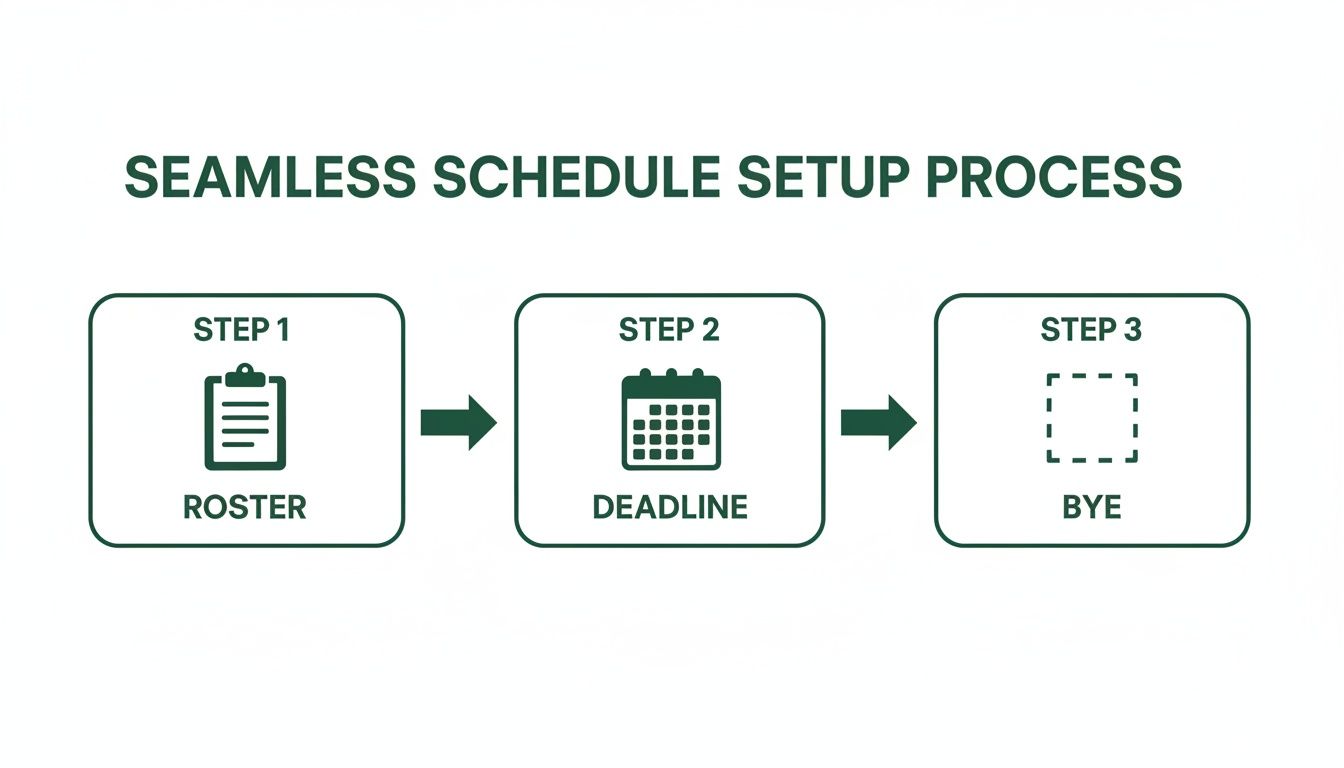
This infographic breaks down the essential steps you need to take before you even start scheduling, including how to account for a bye.
Visualizing this flow—from finalizing your roster to integrating byes—helps ensure you don’t miss a foundational step before pairing everyone up.
While building a schedule by hand is empowering, it's also prone to human error, especially as your group gets larger. One small mistake can throw off the entire tournament's balance, which is why so many organizers eventually turn to automated solutions to save time and guarantee fairness.
Advanced Strategies for Competitive Balance
Once you've got the hang of building a basic round robin schedule, it's time to start refining it. A simple schedule makes sure everyone plays everyone else, but a strategically planned one makes the whole tournament more competitive and feel way more professional. This is where you move past just making pairs and get into the details that really elevate the experience for your players.
One of the best ways to do this is with seeding. This just means you rank your players by skill or handicap before you create the pairings. The whole point is to keep your best players from knocking each other out in the early rounds, which can kill the excitement later on. By seeding the field, you get a much more balanced spread of talent throughout the schedule.
Establishing Clear Tie-Breaking Rules
So, what happens when two players end the tournament with the exact same record? It's going to happen. And if you haven't decided on clear tie-breaking rules beforehand, you're just asking for confusion and arguments.
It's critical to figure this out and tell everyone before the first ball is in the air. Some of the most common methods include:
Head-to-Head Results: This is the easiest and usually the fairest. The winner of the match between the two tied players gets the higher rank. Simple.
Scorecard Playoffs: If they didn't play each other or the head-to-head is a wash, a scorecard playoff is a classic solution. You typically compare scores on the back nine, then the last six holes, then the last three, and finally the 18th hole until you have a winner.
Points Differential: For team events, using the total points or holes won over the entire tournament can be a great secondary tie-breaker.
Trying to figure out a tie-breaker after a tie has already happened completely undermines the event's integrity. Announce the rules in advance—it’s a small step that shows you're a pro and prevents disputes down the road.
Making Schedules Accessible and Shareable
The last piece of the puzzle is just good communication. A perfectly balanced schedule doesn't do anyone any good if players have no idea when or where they're supposed to be.
This is where a little bit of automation can be a game-changer. Sure, you can email out a static PDF or a spreadsheet, but platforms like Live Tourney give you a dynamic link that players can pull up right on their phones. It allows for real-time updates and guarantees everyone is looking at the most current info on matchups, tee times, and course assignments.
The efficiency you gain here isn't just a nice-to-have; it's what the pros do. The PGA Tour market, which is built on highly organized tournament schedules, ballooned to $2.5 billion in 2024 and is expected to hit $3.8 billion by 2030. That growth shows just how much value there is in organized, accessible scheduling. If you're curious, you can explore more on these market trends to see the scale of professional tour management.
Automating Your Schedule with Golf Software

While the manual circle method is a great way to wrap your head around how fair pairings work, it has its limits. A tiny mistake can throw entire rounds out of balance, and trying to scale it for a big league quickly becomes a logistical nightmare.
This is exactly why so many tournament organizers turn to technology to create a round robin schedule in minutes, not hours.
Using golf software like Live Tourney eliminates the risk of human error and frees you up to focus on what actually matters—the player experience. Instead of spending an afternoon wrestling with a spreadsheet, you can generate a complete, perfectly balanced schedule with just a few clicks. It's a straightforward process that saves a massive amount of admin time.
The Power of Instant Generation
The real magic of automation is getting speed without sacrificing quality. Once your player roster is set, the software does all the heavy lifting.
Upload Your Roster: Just import a list of your players or teams.
Select Your Format: Choose the round robin option in the tournament setup.
Generate the Schedule: The system’s algorithm instantly maps out every pairing for every round.
What used to be a tedious, error-prone chore is done in less time than it takes to make a pot of coffee. For busy course operators and league managers, that efficiency is a game-changer. The best part? You can trust the schedule is fair, balanced, and ready to go.
The real value here isn't just saving time; it's about delivering a professional, seamless experience for your players. An error-free, instantly accessible schedule sets the tone for a well-run event from the very beginning.
This shift mirrors what we're seeing on the professional tours. The DP World Tour, for instance, restructured its final events into a nine-week "Back 9" series in 2024. This round robin-style scheduling drew over 400,000 fans—a 7% attendance bump from the previous year. For organizers using platforms like Live Tourney, which powers over 10,000 events, adopting these automated setups can bring that same professional buzz to your club. You can read more about the DP World Tour's success on Golf Business News.
Beyond Pairings: Essential Software Features
Modern golf league management software does a whole lot more than just create pairings. It becomes the central hub for your entire event, handling all the small details that make a huge difference.
A great example is automatic bye assignment. If you have an odd number of teams, the software intelligently assigns the bye in each round, making sure it’s distributed fairly. No more manually tracking who’s had a week off.
You can also generate professional materials that seriously elevate your tournament’s presentation. Think printable tee sheets, official scorecards, and even customized cart signs and bag tags. It’s a simple way to make your event feel more polished and organized, leaving a lasting impression on every player.
Answering Your Round Robin FAQs
Even the best-laid plans can hit a snag. When you're in the weeds of organizing a tournament, questions always come up, from last-minute dropouts to figuring out if the format even fits your event's timeline. We get these questions all the time, so we've put together some quick answers to the most common ones.
Think of this as your go-to guide for handling those little curveballs that tournament day loves to throw at you.
How Do I Handle Player Dropouts Mid Tournament?
It's one of the most frustrating things that can happen: a player has to withdraw after the tournament has already started. This can really throw a wrench into a schedule you've painstakingly built by hand.
If you're using a manual schedule, the simplest fix is to treat all of that player's remaining games as forfeits. Their scheduled opponents just get an automatic win for that round. It’s not a perfect solution, but it keeps the tournament moving for everyone else without forcing you to scrap the whole schedule and start over.
This is where modern software makes a huge difference. With a platform like Live Tourney, you can just mark the player as "withdrawn." The system takes care of the rest, awarding default points or handling the scoring implications automatically without disrupting the flow for any of the other players. It keeps the tournament's integrity intact with almost no administrative headache.
Can a Round Robin Format Work for a One Day Event?
Absolutely. A round robin isn't just for multi-week leagues. It's actually a fantastic format for single-day events, especially if you have a smaller field of players. The trick is to adjust the length of the matches.
Instead of playing full 18-hole matches, you run a condensed schedule. For example, you could have a group of eight teams play a series of quick, 9-hole matches throughout the day. This keeps everyone engaged and playing from morning to afternoon, which is great for camaraderie and maximizing time on the course.
This kind of fast-paced format is perfect for corporate outings or club championships where the social aspect is just as important as the final score. It turns a standard golf day into a much more interactive and competitive event.
The key to pulling this off is tight time management. You have to be crystal clear with players about the flow of the day, tee times, and pacing to keep everything on track. If you want to dive deeper into logistics, you can read our guide on improving your golf tournament scoring process.
What Is the Difference Between Single and Double Round Robin?
The difference here is pretty straightforward and just comes down to how many times opponents play each other.
Single Round Robin: This is the format we've mostly been talking about. Every player or team competes against every other competitor exactly once. It's the most common and efficient way to structure most tournaments and leagues.
Double Round Robin: In this setup, every participant plays every other opponent twice. You see this more in longer league seasons where you want to add more matches to the schedule, creating a home-and-away dynamic.
For golf, a double round robin could mean two clubs playing each other at both of their home courses. It effectively doubles the season's length and gives you a lot more data to determine a true champion. For most events, though, a single round robin hits that sweet spot between fair competition and a manageable schedule.
Ready to stop wrestling with spreadsheets and start running flawless tournaments? Live Tourney automates your entire scheduling process in minutes, from generating balanced round robin pairings to publishing live, interactive leaderboards. Save time, eliminate errors, and give your players an unforgettable experience.





