Jun 22, 2026
8 team bracket, single elimination, consolation bracket, tournament bracket, event management
Learn to create and run an 8 team single elimination bracket with consolation. Our guide covers seeding, diagrams, scheduling, and tips for a flawless event.

You're usually in the same spot when this format comes up. You have 8 teams, a limited window, and a group of players who want a real tournament experience, not a one-and-done morning. A straight knockout is clean, but it can feel harsh when half the field is finished after its first match.
That's why an 8 team single elimination bracket with consolation works so well. You still get the urgency of knockout play, but you also keep teams engaged after an early loss. For schools, clubs, charity events, and member tournaments, that balance matters more than most first-time organizers expect.
The bracket itself isn't the hard part. The hard part is choosing the right consolation path, seeding it in a way people accept, and updating results fast enough that nobody is left asking where they play next. When those pieces are handled well, the day feels organized. When they aren't, even a small event gets messy fast.
Why Your Tournament Needs a Solid Bracket Structure
A solid bracket does two jobs at once. It decides a champion clearly, and it gives your staff a repeatable system for moving teams through the day without arguments, delays, or improvised fixes.
With eight teams, that pressure shows up immediately. Players want competitive matches. Coaches and captains want a format that feels fair. Staff want a schedule they can run. Spectators want to understand what they're watching. If your bracket format is vague, every one of those groups starts asking questions at the same time.
The real decision is not bracket or no bracket
The main consideration is whether your event values speed only or speed plus participation. A pure knockout is compact and simple. A knockout with consolation asks for a little more planning, but it solves one of the biggest event-day frustrations: teams traveling in, checking in, warming up, and then being done after a single result.
Practical rule: If your event wants both a true champion and a better experience for the full field, build the consolation path before registration closes, not after the first complaints.
A good structure also protects your staff. When people know where winners advance and where losers drop, the desk doesn't become a debate table. That matters even more if you're running multiple playing areas or relying on volunteers to report scores.
What works in practice
The strongest setups usually share a few habits:
They define the purpose early. Is consolation there to award specific placement, to give teams more games, or both?
They keep the path visible. Teams should be able to look at one board or one screen and know their next step.
They avoid mid-event format changes. Nothing creates more confusion than adjusting placement rules after matches have started.
An 8 team single elimination bracket with consolation isn't just a diagram. It's your operating plan for the whole event. If the structure is right, scheduling gets easier, score reporting gets cleaner, and the tournament feels more professional from the first whistle to the last final.
Setting Up the Core Single Elimination Bracket
Before you add any consolation game, build the main bracket correctly. The standard 8-team single elimination bracket has four quarterfinals, two semifinals, and one championship match, for exactly 7 games total according to Carrom's 8-team bracket breakdown.
That structure is the foundation. If the main side is sloppy, the consolation side becomes chaos.

Choose a seeding method that fits the event
Seeding should match the event's purpose, not your personal preference.
For a casual club day, a random draw is often enough. It's easy to explain, and nobody expects deep competitive calibration. Put the draw in public, do it once, and don't tinker with it afterward.
For a more competitive event, use ranked seeding based on whatever your group already trusts. That could be league finish, season points, coach input, handicap category, or prior results. The important part is consistency. If you seed, seed the whole field. Don't seed the top few teams and guess the rest.
A standard seeded layout is straightforward:
Seed line | Matchup |
|---|---|
Top quarter | 1 vs 8 |
Second quarter | 4 vs 5 |
Third quarter | 3 vs 6 |
Bottom quarter | 2 vs 7 |
This keeps the strongest seeds apart until later rounds, assuming they win. If you want a practical walkthrough for drawing and formatting the bracket itself, this guide on how to create a tournament bracket is a useful reference.
Build for clarity, not just fairness
A technically correct bracket can still confuse people if the labels are poor. Name the rounds clearly. Label the quarterfinals, semifinals, and final in a way your staff can call out without hesitation.
I like simple game labels that match the bracket flow:
Games 1 to 4 for the quarterfinals
Games 5 and 6 for the semifinals
Game 7 for the championship
The bracket should answer two questions instantly: who plays now, and where does the winner go next?
That sounds obvious, but first-time staff often overcomplicate the board with team notes, seed notes, and side comments. Keep those elsewhere. The main bracket should stay readable from a distance.
Common setup mistakes
The mistakes are usually small, but they ripple through the day.
Mixing seeding logic. If one side of the bracket is seeded and the other was drawn casually, someone will spot it.
Publishing before checking names. A misspelled team name seems minor until it creates score-entry confusion later.
Forgetting the loser pathway. Even if you haven't posted the consolation side yet, your staff needs to know where quarterfinal losers will be routed.
A clean main bracket gives you stability. Once that's locked, the consolation side becomes a controlled extension of the event instead of a patch job.
Integrating a Consolation Bracket for More Play
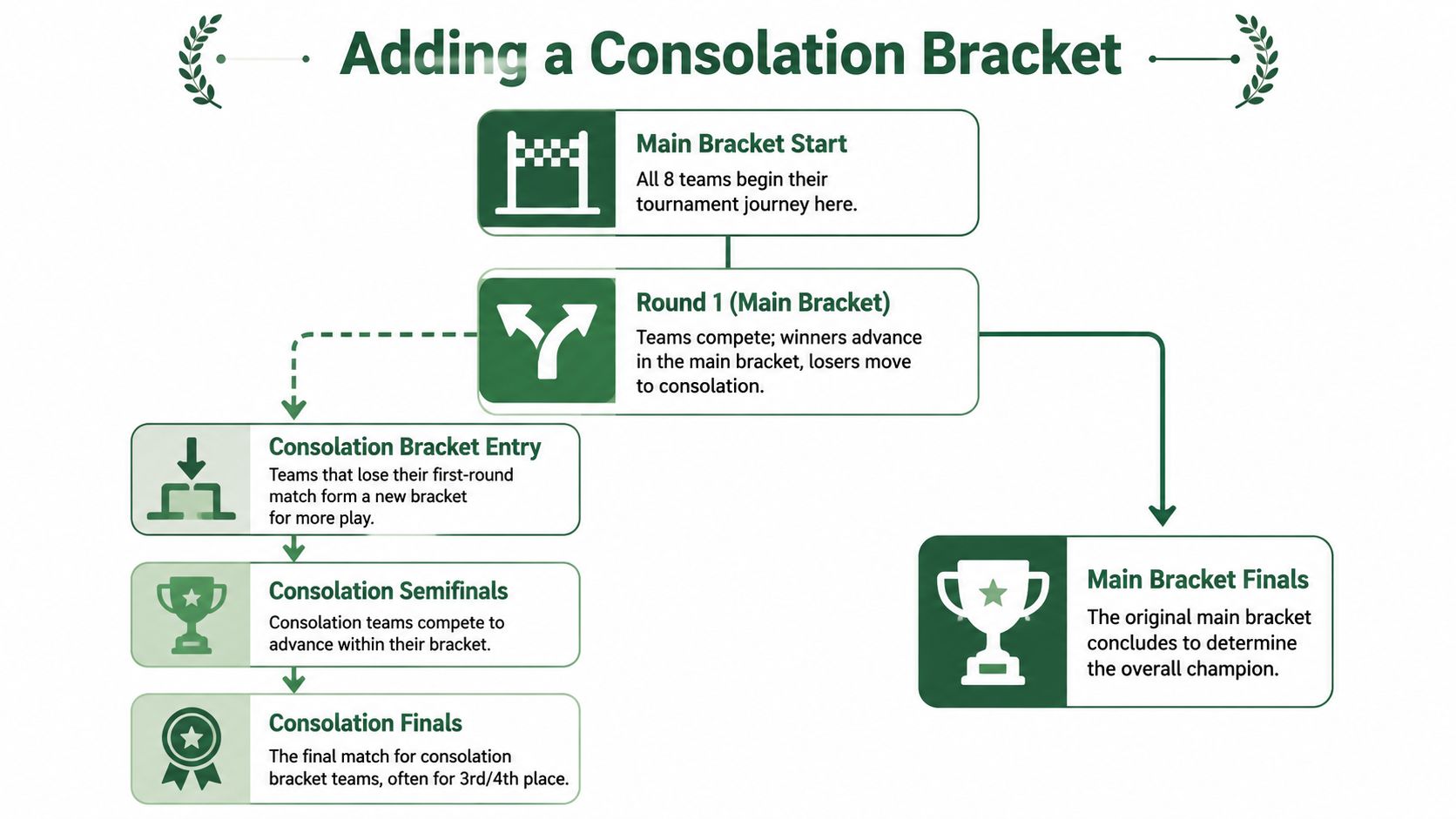
The tournament begins to feel thoughtful, rather than merely efficient. The moment you add consolation, you're telling teams that one bad draw or one rough first game won't end their day.
A published 8-team consolation format can push the event beyond the basic knockout structure. One documented template includes a Game 10 for 7th place, which shows the format can add at least 3 extra games beyond the standard setup, and another version routes quarterfinal and semifinal losers into the consolation side for placement play, as shown by PrintYourBrackets' 8-team consolation examples.
Two consolation models that actually work
Most organizers are deciding between two practical versions.
Quarterfinal losers enter a separate consolation bracket
This is the fuller version. The four teams that lose in the quarterfinals move into their own bracket and continue playing for a consolation title or a placement outcome.
This format works well when:
Travel time is significant and teams expect more than one match
Entry fees or member expectations are higher
You want the lower half of the field to stay engaged
It creates more movement and more value, but it also gives your staff more to track.
Semifinal losers play a third-place game
This is the lighter version. You keep the main bracket simple, and the two teams that lose in the semifinals meet in a placement match.
This works when your schedule is tighter or when you want a clear podium-style finish without adding a full secondary bracket. It doesn't solve the one-and-done issue for quarterfinal losers, but it does create a cleaner final ranking near the top.
How to choose the right version
Choose based on your event's actual goal, not what looks more impressive on paper.
Event priority | Better fit |
|---|---|
More guaranteed play for early losers | Quarterfinal-loser consolation |
Simpler operations | Third-place match only |
Fuller placements | Expanded consolation path |
Limited time or staff | Smaller consolation setup |
If your staff is inexperienced, a smaller consolation format often runs better than a larger one managed poorly.
That trade-off matters. A tournament that promises extra placement games but updates them late will frustrate teams more than a modest format that runs cleanly.
What players notice most
Players usually don't study bracket theory. They notice whether the format respects their time. If they lose early and immediately know their next match, the event feels organized. If they lose and then wait around while staff figure out the bracket, morale drops fast.
That's why an 8 team single elimination bracket with consolation works best when the consolation side is planned at the same time as the championship side. Don't bolt it on after the draw. Assign the loser routes, decide what places you're awarding, and write those rules on the event sheet before the first game starts.
Scheduling Matches and Defining Scoring Rules
A bracket on paper becomes real when every match has a place, a time, and a reporting process. That's the difference between a smooth event and a crowded desk with three coaches asking the same question.
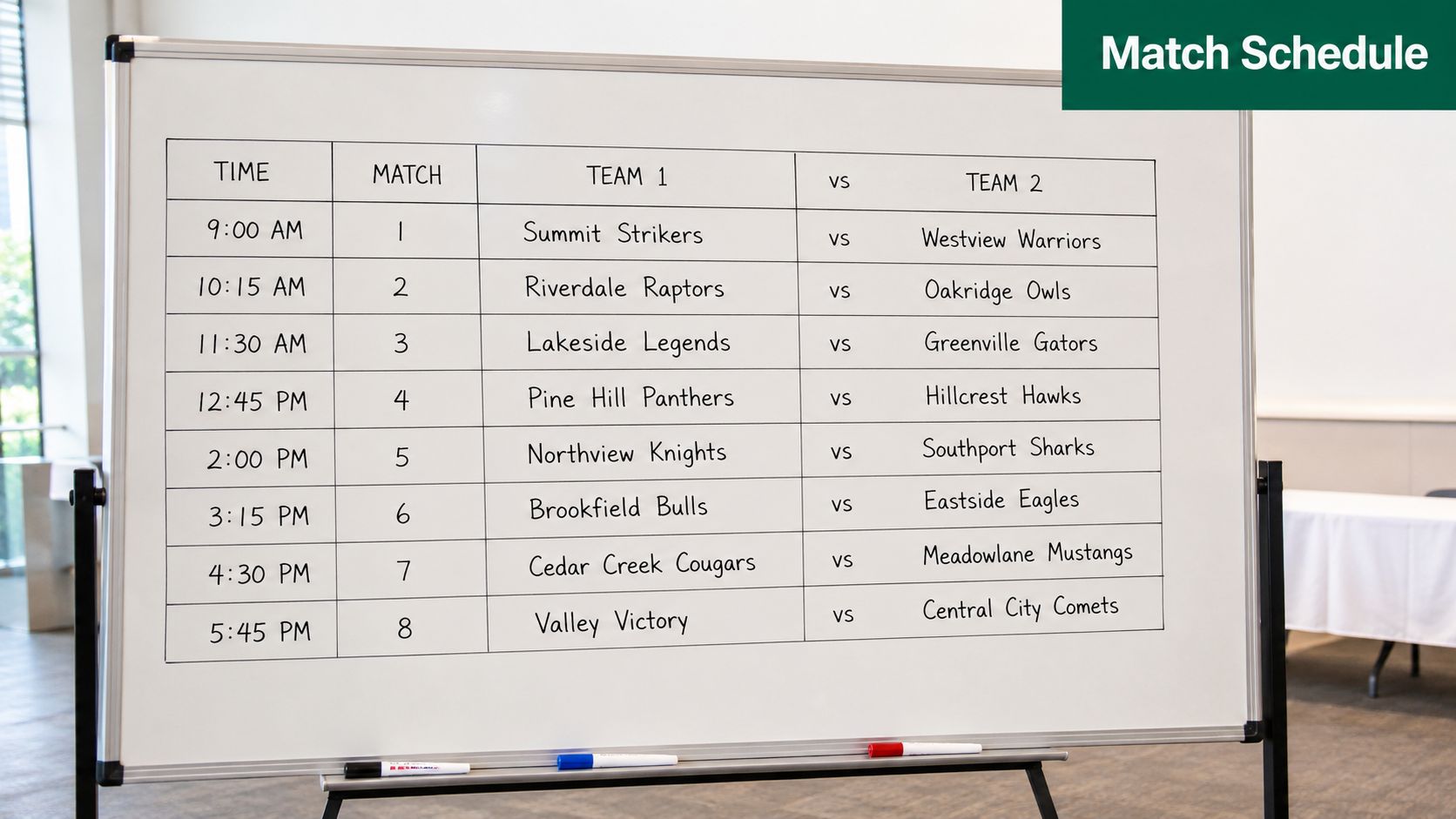
Number every match before game day
Even if the bracket software displays rounds automatically, your staff should still work from a master match list. Give every game a clear identifier and use that same identifier on the schedule, the score sheet, and the public bracket.
That matters even more once consolation is involved. “Loser of Game 2 vs Loser of Game 4” is much safer than “the two teams from the middle side of the bracket.”
A simple schedule usually includes:
Match number
Teams or placeholder positions
Playing area
Start time or rolling order
Score reporting location
For clubs that need help coordinating multiple fields, courts, or member groups, the Vanta Sports platform for clubs is worth reviewing for scheduling ideas and workflow examples.
Lock the rules before the first result comes in
You don't want staff inventing procedures mid-event. Publish the scoring method, tie process, and reporting chain in advance. If your event uses sport-specific scoring or live updates, keep one version of the rules at the desk and one visible to teams.
For golf-specific event staff, this resource on scoring in golf tournament formats is a practical reference for standardizing how scores are entered and checked.
Write your scoring rule so a volunteer can apply it correctly without asking for interpretation.
That's the test. If the rule needs a committee to explain it, it's too loose for event day.
Practical Tips for Flawless Tournament Execution
Most bracket problems don't come from the format. They come from late score entry, bad loser routing, and staff assuming everyone understands the board.
An 8-team consolation setup has one specific risk that catches new organizers: if you're using consolation games to determine places from 3rd through 8th, quarterfinal losers and sometimes semifinal losers must be routed into the correct placement matches, or the bracket can't distinguish the final standings properly, as noted in this consolation bracket integrity reference.

The failure points to watch
The first one is delayed reporting. A team finishes, leaves the area, and nobody enters the result right away. That one delay can hold up both the main bracket and consolation path.
The second is unclear ownership. If everyone thinks someone else is updating the bracket, nobody is doing it. Assign one person to receive official results and one person to update the board or platform. In a small event, that may be the same person. In a busier one, separate the roles.
Habits that prevent most confusion
Print a backup bracket. Even if you're digital-first, keep a paper copy at the desk.
Use one reporting point. Don't let teams report scores to whichever volunteer is nearby.
Update immediately. Don't batch results unless the event is paused.
Pre-write consolation placeholders. Staff should already know where each loser goes.
A bracket stays trustworthy only if it's updated while the result is still fresh and everyone involved is still standing there.
That sounds strict, but it saves a lot of rework.
When a digital tool helps
Manual boards work. They just demand discipline. Once you start juggling live scoring, rolling start times, and placement routing, software becomes less about convenience and more about error reduction.
One option is Live Tourney's guide to running a golf tournament, along with the platform itself for organizers who want digital score capture, live updates, and centralized event management. That kind of setup is especially useful when staff need one current version of the bracket instead of multiple handwritten copies drifting out of sync.
What doesn't work is half-committing. If you're using a digital system, use it as the official board. If you're using paper, make paper official. Split systems create conflicting information, and conflicting information is how teams end up in the wrong game.
From Bracket Plan to Memorable Event
A well-run 8 team single elimination bracket with consolation does more than crown a winner. It gives every team a clearer day, more confidence in the process, and a better sense that the event was worth showing up for.
The practical formula is simple. Seed in a way your field accepts. Decide whether your consolation format is about extra play, placement, or both. Label every match clearly. Define scoring and reporting before the first game. Then update results fast enough that no one has to guess what happens next.
That's what separates a bracket that merely exists from one that runs the event.
If you get those decisions right, the tournament feels calm even when the matches are intense. Staff know where teams go. Players know what they're playing for. Spectators can follow the progression without needing constant explanation. That's the mark of a good tournament director, whether the bracket lives on a whiteboard, in a spreadsheet, or on a live platform.
If you want a simpler way to manage brackets, live scoring, and event-day updates, take a look at Live Tourney. It gives tournament staff a central place to organize play, record results, and keep participants looking at the same current information.