
Feb 6, 2026
Discover how to run a successful 4 man scramble with our expert guide. Learn rules, fair handicapping, and tips for an unforgettable golf tournament.
If you're running a golf event, the format you choose is probably the single most important decision you'll make. And when it comes to delivering a fun, engaging, and successful day, the 4-man scramble is in a class of its own.
A scramble isn't just another way to play golf; it's a proven formula. It’s a team-based format where four players work together. Everyone hits a tee shot, the team picks the best one, and all four players hit their next shot from that spot. You repeat this all the way to the hole.
This simple setup is perfect for charity events, corporate outings, and member-guest tournaments because it dials down the individual pressure and turns up the fun for players of all abilities.
Why the 4-Man Scramble Is the Ultimate Tournament Format

The scramble format masterfully blends friendly competition with social interaction, making it the go-to choice for a huge range of events. It completely levels the playing field. A novice golfer might sink the winning putt, while a seasoned player’s booming drive sets the whole team up for an easy birdie.
This dynamic gets rid of the intimidation that comes with individual stroke play, which means more people feel comfortable signing up. The result? A bigger field, higher engagement, and a much more energetic atmosphere on the course. For a wider look at event planning, you might find our complete guide on how to run a golf tournament helpful.
For a quick overview, here's a look at what makes the 4-man scramble so effective.
| 4 Man Scramble At a Glance |
| :--- | :--- |
| Characteristic | Description & Benefit | | Team-Oriented | All four players contribute to a single score. This builds camaraderie and makes the game more social and less stressful for individuals. | | Inclusive for All Skills | A beginner's lucky putt is just as valuable as a pro's long drive. Everyone can contribute, which encourages more people to participate. | | Faster Pace of Play | Teams play from the best shot, which generally speeds up the round compared to individual formats. This is a huge plus for keeping the day on schedule. | | Low-Pressure Environment | No one has to worry about a bad shot ruining their score. The shared responsibility makes for a more relaxed and enjoyable day. | | High Engagement | The team dynamic keeps players invested in every shot. It’s more exciting and interactive, which leads to a better overall experience. |
This format is all about creating a positive, shared experience that brings people back year after year.
The Foundation of Fun and Inclusivity
The real appeal of the scramble is its team-first nature. Every shot is a group effort, which builds friendships and takes the heat off any one player. It's this inclusive vibe that has cemented its status as the top choice for organizers who want to maximize participation and fun.
This isn't a new trend, either. The 4-man scramble has been the powerhouse format for fundraisers and corporate events for decades because it guarantees a good time. Back in the 1980s, scrambles already made up over 60% of all organized golf events in the U.S. That dominance continues today for one simple reason: it works.
The magic of the scramble is that it turns a challenging individual sport into an accessible team game. It ensures that every participant, from a scratch golfer to a first-timer, feels like they are part of the action and contributing to the team's score.
That collaborative spirit doesn't just make the day more memorable; it directly helps your event's bottom line. Happy players are far more likely to jump into side games, buy merchandise, and—most importantly—sign up for your tournament again next year. By choosing a scramble, you’re not just putting on a round of golf. You're building a community.
Mastering Scramble Rules and Engaging Variations

The beauty of the 4‑man scramble is its simplicity, but don't let that fool you. The bedrock of a smooth, fair event is a clear set of rules. Getting everyone on the same page before the shotgun start is the single best thing you can do to avoid headaches and confusion out on the course.
At its core, the game is beautifully straightforward. Each of the four players hits a tee shot. The team walks up, collectively decides which drive is in the best spot, and all four players hit their next shot from there. Lather, rinse, repeat, all the way until the ball is in the cup.
But the devil is in the details, like how players place their ball. The standard is to allow placement within one club-length of the chosen shot, no closer to the hole. You also need to decide if that placement can improve the lie—for example, can a team move their ball from the rough into the fairway? Whatever you choose, just be consistent.
Core Rules for Your Scramble
To make sure every team is playing the same game, your pre-tournament briefing and rules sheet need to cover these fundamentals. No ambiguity.
Tee Shots: It sounds obvious, but state it clearly: all four team members hit a tee shot on every hole.
Shot Selection: The team captain usually makes the final call, but it’s a group decision.
Playing the Next Shot: Once the best ball is chosen, all players take their next shot from that spot.
Putting: The same logic applies on the green. Pick the best ball's position, and everyone putts from there. The first putt that drops is the score for the hole, and the team moves on.
Nailing down these fundamentals prevents those awkward mid-round rules debates and, just as importantly, keeps the pace of play moving. Set the expectations early so your players can just relax and have a good time.
A common strategic twist we love is the minimum drive requirement. This rule forces the team to use a set number of each player's tee shots (say, two per player). It’s a great way to stop teams from just leaning on their "A" player's monster drives and makes sure everyone truly contributes to the score.
Injecting Excitement with Scramble Variations
While the standard format is a proven winner, throwing in a variation can make your event memorable and add a fresh layer of strategy. A well-chosen twist can really cater to the vibe of your group, whether they're ultra-competitive or just out for a fun day.
One of the most popular tweaks is the Texas Scramble. It’s essentially the standard format but with that minimum drive requirement we just talked about. It's a fantastic way to ensure all four players are strategically involved from tee to green.
Another great option is the Shamble (sometimes called a "Bramble"). Here, all four players tee off and the team selects the best drive. But from that point on, each player plays their own ball into the hole. You then take the best one or two scores from the team for that hole. This format lets skilled players flex their muscles a bit more while still giving the team the huge advantage of a great tee shot. It's an excellent choice for a more competitive field.
Finally, don't forget the classic add-ons for extra fun and fundraising:
Mulligans: Selling do-over shots is a timeless and easy way to raise a little extra cash.
String: Let teams buy a length of string (maybe 10 feet) to physically move their ball out of a tough spot or to sink a putt that's "close enough." The catch? Once a length of string is used, it must be cut off and discarded. It adds a whole new layer of strategy.
Smart Handicapping Keeps the Competition Fair
Nothing kills the vibe of a 4-man scramble faster than a lopsided leaderboard. When a few stacked teams run away with it, the whole event can feel pointless for everyone else. This is exactly where simple, smart handicapping becomes your best friend. It’s the key to a fun tournament where every team feels like they have a legitimate shot.
You don’t need to be a math genius. The goal is just to level the playing field enough to keep things interesting. By far, the most common and effective way to do this is by creating a team handicap based on a percentage of each player's individual handicap. This simple step prevents a team of four scratch golfers from completely dominating a field of more casual players.
A great way to get started is by breaking players into tiers before you even touch a calculator.
The A-B-C-D Player System
This method is pretty much the gold standard for balancing teams in a scramble. It's straightforward: you just rank each player on a team from best to worst, assigning them a letter—A, B, C, or D—based on their handicap or even just their average score.
Player A: The team's best golfer (lowest handicap).
Player B: The second-best.
Player C: The third-best.
Player D: The team's highest-handicap golfer.
Once you’ve got everyone sorted, you can plug their handicaps into a weighted formula. This makes sure the final team handicap actually reflects the group's collective skill, rather than being skewed by one really good player. For a closer look at the mechanics of different formats, check out our guide on golf tournament scoring methods.
A popular and highly effective formula is this one:
Team Handicap = (25% of Player A's Handicap) + (20% of Player B's) + (15% of Player C's) + (10% of Player D's)
A Real-World Handicap Example
Let's put that formula to work with a real team. Imagine you have a foursome with these handicaps:
Player A: 5
Player B: 12
Player C: 18
Player D: 24
Using the formula, their team handicap shakes out like this: (0.25 x 5) + (0.20 x 12) + (0.15 x 18) + (0.10 x 24) = 1.25 + 2.4 + 2.7 + 2.4 = 8.75.
You'd round that up, giving the team 9 strokes off their final gross score. That small calculation is a game-changer. It creates just enough of a buffer for higher-handicap teams to go toe-to-toe with the sharks.
Without it, the advantage for skilled teams can be huge. Some experts even warn that an unhandicapped scramble can give A-player-heavy teams a 12-stroke edge right out of the gate. That's why using a tiered system is so critical for fairness. To get more ideas, check out these scramble handicapping strategies to make sure your event is competitive. This little bit of prep work is what keeps the suspense alive until the very last putt drops.
Strategic Pairings and Seamless Tournament Starts
How you group your players and kick off the event really sets the tone for the entire day. Get these details right, and you’ll run a smooth, professional tournament that people remember. These aren't just minor logistical choices—they directly impact the flow of play, the competitive balance, and the overall vibe of the day.
One of your first big decisions for a 4-man scramble is how you’ll form the teams. The simplest path is to let players sign up as a pre-made foursome. This guarantees they get to play with friends or colleagues, which is a huge draw for corporate outings and charity fundraisers. The downside? You can easily end up with a few stacked teams of low-handicap players who run away with the whole thing, which can be a bit deflating for everyone else.
Crafting Balanced Teams
The alternative is to build the pairings yourself. This is where the A-B-C-D player system we talked about in the handicapping section really pays off. By hand-picking teams with a good mix of skill levels, you can engineer a much more balanced and competitive tournament from the start.
Sure, this route requires a little more legwork upfront. You'll need to collect handicaps or at least average scores from every player when they register. But the result is well worth the effort. A balanced field keeps the leaderboard tight and makes more teams feel like they actually have a shot at winning as they head into the back nine.
Pro Tip: Try a hybrid approach. Let teams register together, but tell them you reserve the right to swap one or two players to even things out. This keeps the social aspect intact while preventing a total blowout.
Choosing Your Tournament Start
Your other major logistical hurdle is the start format. Deciding between a shotgun start and traditional tee times has big implications for your schedule, budget, and the overall player experience.
Start Method | Best For | Considerations |
|---|---|---|
Shotgun Start | Large fields, social events, post-round banquets | Higher cost (often requires buying out the entire course), more complex logistics to get everyone into position. |
Tee Times | Smaller groups, budget-conscious events, courses with public play | Players finish at different times, making a single awards ceremony tricky. Can feel less like a unified event. |
A shotgun start, where every team tees off at the same time on a different hole, is the go-to for a 4-man scramble. It’s perfect because everyone finishes around the same time, which flows perfectly into a post-round lunch, awards ceremony, or networking session. If you have more than 80 players, this is almost always the way to go.
On the other hand, tee times are a great fit for smaller, more casual outings where a staggered finish isn't a deal-breaker.
Boosting Engagement with On-Course Contests
A great 4-man scramble is more than just the final score. Let's be honest, the most memorable events are packed with smaller moments of excitement, friendly rivalries, and extra chances to win something cool. On-course contests and side games are your secret weapon for turning a standard round of golf into a dynamic, can't-miss experience.
These mini-competitions keep the energy high and give every single player—regardless of their team's score—a reason to stay locked in on every hole. Beyond just the fun, these contests can seriously boost participation. Plus, selecting effective promotional products as prizes can leave a lasting impression that brings golfers back year after year. The key is to pick the right contests and place them strategically around the course.
Staple Contests Every Scramble Needs
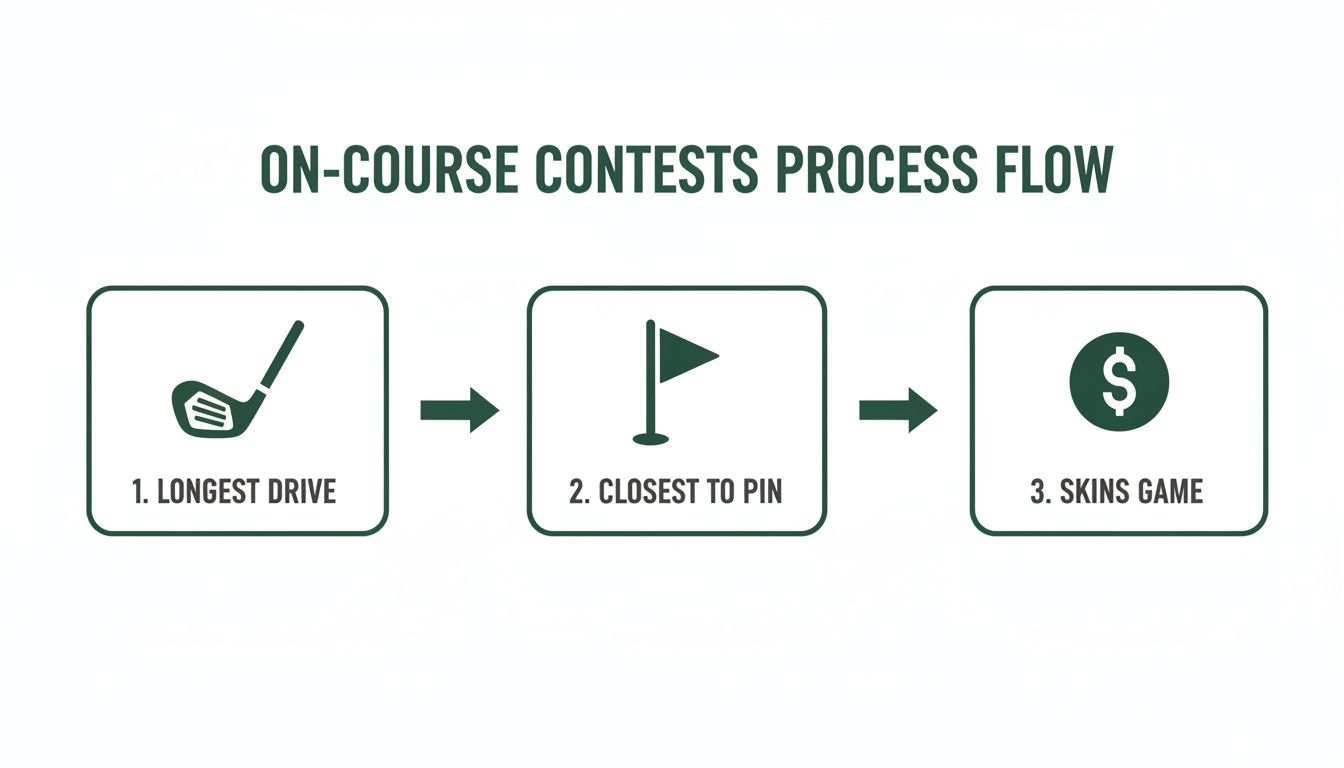
You don't need to reinvent the wheel here. Three classic contests form the foundation of a great tournament experience, and they work for a reason.
Longest Drive: This one is a pure crowd-pleaser that rewards raw power. Make sure you place this on a long, wide-open par 5. You want players to feel like they can swing for the fences without much risk. A new driver or a high-end gift certificate is always a killer prize here.
Closest to the Pin: A true test of precision. This is perfect for a scenic par 3. Just be sure the hole you choose has a green that can actually hold a good approach shot. Nothing's worse than a green that repels every ball. A quality rangefinder or a set of premium wedges makes for an excellent reward.
Skins Game: This adds a fantastic layer of hole-by-hole competition. Teams "buy in" before the round, and the team with the lowest outright score on a hole wins a "skin" (a share of the pot). If two or more teams tie, the skin carries over to the next hole, building suspense and making that next birdie putt feel a whole lot bigger.
The impact of well-run side games on participation and fundraising can be massive. Just look at the 2023 Shelby Rotary Club's outing: 244 players across 61 teams helped generate payouts topping $20,000 in prizes and side games. That’s a testament to how these little additions can elevate an event. You can dig into their successful 4-person scramble results to see the real power of engagement.
Think beyond just rewarding first, second, and third place. A robust payout structure that includes contest winners, the "Most Honest" team (last place), and maybe even a random drawing keeps way more players invested in the post-round awards ceremony.
Structuring Your Payouts for Maximum Fun
How you structure your prizes is just as important as the contests themselves. A deep prize pool that rewards more than just the top three teams keeps the excitement going long after the final putt drops.
This is a great chance to get creative. Consider adding fun prize categories for things like "Best Team Name" or "Best Dressed Foursome" to add a social, lighthearted element to the awards.
Whatever you decide, just be transparent. Clearly outline the entire prize distribution on your rules sheet and in your pre-tournament announcements. Whether you're offering cash, pro shop credit, or sponsored gifts, make sure the rewards feel substantial enough to generate buzz and keep that friendly competition fired up all day long.
Automating Your Scramble with Live Tourney
Let's be honest. Nobody enjoys fumbling with printed tee sheets, manually entering scores, or posting a paper leaderboard that’s outdated the second it goes up. Those days are over.
Modern tournament software like Live Tourney is built to take all that administrative grunt work off your plate for a 4 man scramble. Think about it: uploading your entire player list and having pairings, cart signs, and tee sheets generated in minutes, not hours. It completely frees you up to focus on what matters—making sure your players have a great time.
This isn't just about convenience; it fundamentally changes how you run your event. For a platform like Live Tourney, which has powered over 10,000 events, the simple scramble format is a perfect fit. We've seen it cut setup time by 3x and spike live scoring adoption by 40%. For a busy head pro, that’s a massive win.
Seamless Setup and Live Scoring
Getting an event off the ground is surprisingly simple. Once your tournament is created, you just upload a spreadsheet with your player names. From there, the system takes over.
You can drag and drop players onto teams or let the software automatically create balanced foursomes based on handicaps. In a few clicks, it generates all your print materials—from scorecards to bag tags—with a clean, professional look.
But the real magic kicks in on tournament day with app-free live scoring. Players just open a link on their phones and enter their scores as they go.
This immediate feedback completely changes the atmosphere. Teams can see exactly where they stand against the field in real-time, turning a standard round into a much more dynamic and competitive experience.
On-course contests become effortless, too. You can designate prize holes for games like Longest Drive and Closest to the Pin, and the software tracks the winners right on the leaderboard. No more forgotten proxy markers or manual tracking. It’s all integrated, ensuring your entire event runs smoothly and professionally from start to finish.
For a deeper look at what to look for in a platform, check out our guide on choosing the right golf tournament management software.
Got Questions About Your 4-Man Scramble?
Even if you’ve run dozens of events, the 4-man scramble always seems to bring up a few tricky questions. Getting the details right is what separates a good event from a great one, and this format’s popularity means players have certain expectations.
So, let's tackle a couple of the most common things that come up during planning.
What’s a Good Winning Score to Expect?
This is the big one. While it always depends on your course's difficulty, a competitive scramble will usually see winning teams finish somewhere between 12 to 18 under par. They get hot, they make putts, and the score drops fast.
For a more casual charity outing where you have a wider mix of skill levels, a winning score closer to 8 under is a more realistic target.
How Long Should the Round Take?
Pace of play is always a concern. The good news is that scrambles are naturally faster than a standard round. You can pretty safely plan for a round to take between 4 and 4.5 hours. Using a shotgun start is a huge help here, as it gets everyone on the course and moving at the same time.
A Quick Tip for Better Strategy
Want to add a little more strategy and make sure everyone on the team is contributing?
Require each team to use a minimum number of tee shots from every player—say, two per person. This simple rule is fantastic because it prevents teams from just leaning on their A-player for every drive. Suddenly, that 15-handicap's tee shot on a tight par-4 becomes incredibly valuable, and it adds a whole new layer of decision-making to the day.
The scramble's genius lies in its adaptability. There’s no pressure on any single shot, which is why the format fosters participant enjoyment rates as high as 95%.
It's this flexibility that makes the scramble such a powerhouse format. In major markets, they account for 35% of all club tournaments. And when you dial in the handicaps correctly, the competition gets tight—winning margins often average just 2-3 strokes. You can dig into more scramble tournament data here.
Ready to run your scramble without the administrative headaches? Live Tourney offers app-free live scoring and automated setup to make your event a breeze. Start your free trial today.





