Jun 25, 2026
two man scramble rules, golf tournament formats, scramble rules, golf tournament setup, live scoring
Understand the two man scramble rules for scoring, handicaps, and play. This guide gives tournament organizers practical tips for a smooth, fair event.

The usual moment of panic hits the night before the event. Pairings are set, scorecards are almost ready, and then the questions start. How many drives does each player need to use? Are mulligans allowed? Which handicap formula are you using? What happens if two teams tie?
That's where most two man scramble events either feel polished or start to wobble.
A two man scramble is popular for a reason. It keeps weaker players involved, gives stronger players room to be aggressive, and moves faster than formats that demand every player finish every shot alone. It works for club events, charity outings, and corporate days because it feels social without becoming chaotic.
The catch is that fun only lasts when the rules are clear. If the staff explains one thing, the scorecard says another, and teams hear a third version at the first tee, you'll spend the day settling arguments instead of running the tournament. Good organizers avoid that by making the format simple on paper, practical on the course, and easy to score at the end.
Setting the Stage for a Perfect Scramble
The strongest two man scramble events don't begin on the first tee. They begin in the planning window when the organizer decides what kind of day this is supposed to be.
A member event usually wants competitive integrity. A charity outing often wants a looser tone, but still needs guardrails. A corporate scramble has the widest range of ability, which means confusion spreads fast if the rules sheet leaves anything open to interpretation. The format may be familiar, but the execution changes depending on the field.
I've seen the same pattern over and over. Organizers assume players already know the format, so they keep the printed rules short. Then the starter gets cornered with five versions of the same question. Can the ball be moved in the rough? Who putts first? Does every player need a drive counted? The shorter rules sheet ends up creating a longer day.
What players actually want
Most players don't need a lecture on golf terminology. They want three things:
A fair game: They need to know the better team won because it played better, not because it found a loophole.
A clean pace: They don't want endless rulings on simple situations.
A smooth finish: They want to know how scores, handicaps, and ties are handled before prizes are announced.
A scramble feels casual to players, but it should never feel casual to the person running it.
That's why the best approach is to treat the rules as an operating system. Every local rule, scoring choice, and scorecard note should help staff answer questions quickly and help players make decisions without guessing. If the format is built right, the day feels relaxed because the logistics are not.
Where most trouble starts
Problems usually come from one of these sources:
Unclear local rules
Handicap confusion
No method for tracking required drives
No published tie-break procedure
When those four pieces are nailed down before carts leave the staging area, the tournament already feels more professional.
How a Two Man Scramble Works from Tee to Green
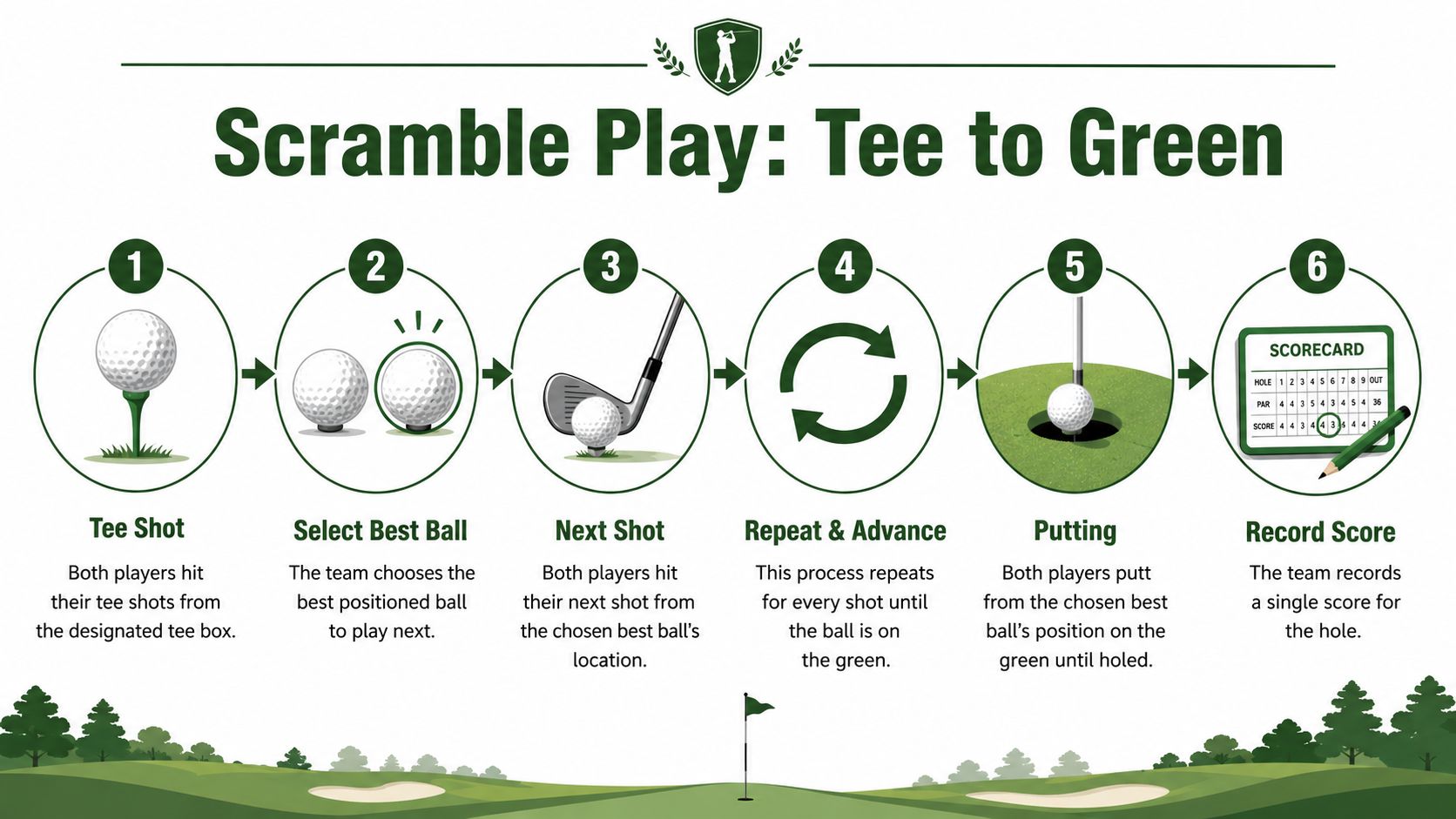
A two man scramble is a team-based best-shot round. Both players hit every stage of the hole, but the team only counts one ball position each time.
That sounds simple, and it is, once people see the sequence clearly.
If you want a separate overview of scramble formats beyond this specific version, this guide to golf tournament scramble formats is a useful companion.
The basic sequence on a hole
A clean way to explain it to first-time players is to walk them through one hole.
Both players tee off from the assigned tee markers.
The team chooses the better drive based on lie, angle, distance, and next-shot difficulty.
Both players play the next shot from that chosen spot.
The team chooses the better result again.
That process repeats until the ball is on the green and then into the hole.
The team records one score for the hole.
The key thing players need to understand is that they are not alternating shots and they are not playing their own ball through the hole. They are building one score together from the best available result at each stage.
How the rhythm actually works
On a par 4, one player might hit a safe tee shot into the fairway while the other hits a longer drive but leaves a poor angle behind a tree. The team usually takes the fairway ball. Both players then hit approach shots from that location.
If one approach finishes on the front fringe and the other lands twelve feet under the hole, the team chooses the putt from twelve feet. Both players then putt from there. If the first player misses just low, the second player now has a better read. If the second player makes it, the team is done.
That's why the format works so well. Every shot gives the team two chances, but only one outcome matters.
Why organizers should teach the logic, not just the rule
A quick starter script helps more than a thick handout. Tell players this:
Pick the ball that gives your team the best next shot, not just the one that traveled farthest.
That one sentence prevents a lot of bad decisions and even more disputes. Newer teams often choose the longest ball automatically, even when the shorter ball has the cleaner lie or a much better angle. Once players understand that the scramble is about position, not just raw distance, the round runs smoother and scoring makes more sense.
Essential Rules and Common Variations
Most disagreements in a two man scramble don't come from the basic format. They come from the local details. If you're running the event, these are the rules that need to be printed, announced, and enforced the same way by everyone on staff.

Ball placement after the chosen shot
Once the team selects a ball, both players need a clear procedure for where they may place their own ball. If you don't define this, players will create their own version in the fairway, rough, and bunkers.
A practical rules sheet should address:
Marking the chosen spot: Use a tee or ball marker before the original ball is lifted.
No closer to the hole: That should always be stated plainly.
Same type of lie: If the chosen ball is in the rough, both players play from the rough. If it's in a bunker, both play from the bunker.
On the green: State your putting placement rule clearly so nobody improves a line by accident.
Order of play matters more than people think
There's no need to overcomplicate this, but the team should understand why order matters. The more reliable player doesn't always need to go first.
A common practical pattern is:
Off the tee: Let the steadier player hit first if the hole demands a ball in play.
Approach shots: Let the safer shot go first so the second player can attack.
Putts: Let the player with the weaker read go first when the first attempt can provide information.
That isn't a rulebook issue. It's a tournament-flow issue. Teams that understand this tend to play faster and ask fewer on-course questions.
The drive requirement that protects the format
This is one local rule I strongly recommend spelling out in bold.
Practical rule: A critical technical rule to ensure fairness is the mandatory requirement that each player must have their drive selected a minimum number of times (e.g., four times per 18 holes). Without this, teams could simply use the stronger player's drive on every hole, undermining the team aspect of the event. This standard is discussed in this minimum drive requirement reference.
If you don't track this, some teams will accidentally ignore it and others will push the edge. Either way, the event gets messy. The simplest fix is to add a small drive-used box on the scorecard and require players to mark whose drive was chosen on each hole.
Mulligans, string, and other add-ons
These extras can fit a charity event, but they rarely belong in a serious competitive scramble unless the entire field expects them. They raise money and add energy, but they also create more rulings.
Use them only if you define them in writing:
Mulligans: State when they may be used and whether they apply to putts.
String: Explain exactly how a team uses it and what happens after the cut portion is spent.
Gimmes: If allowed, define the distance standard clearly before the round.
What doesn't work is a casual verbal explanation at registration. If one team hears “inside the leather” and another hears “inside the grip,” you've created an avoidable scoring problem.
The more charitable the atmosphere, the more precise the printed rules need to be.
Calculating Handicaps and Scoring Explained
Handicap policy is where scramble events usually get exposed. A team can accept a tough break on a bounce or a lip-out. They do not accept a scoring method that feels unclear, inconsistent, or improvised at the table after the round.
The practical fix is simple. Pick one formula, define it in writing, load it into your scoring setup before the event, and use the same method for every team. If you want a quick way to test pairings and team allowances before publishing the rules, this scramble handicap calculator guide is a useful starting point.
The two most common methods
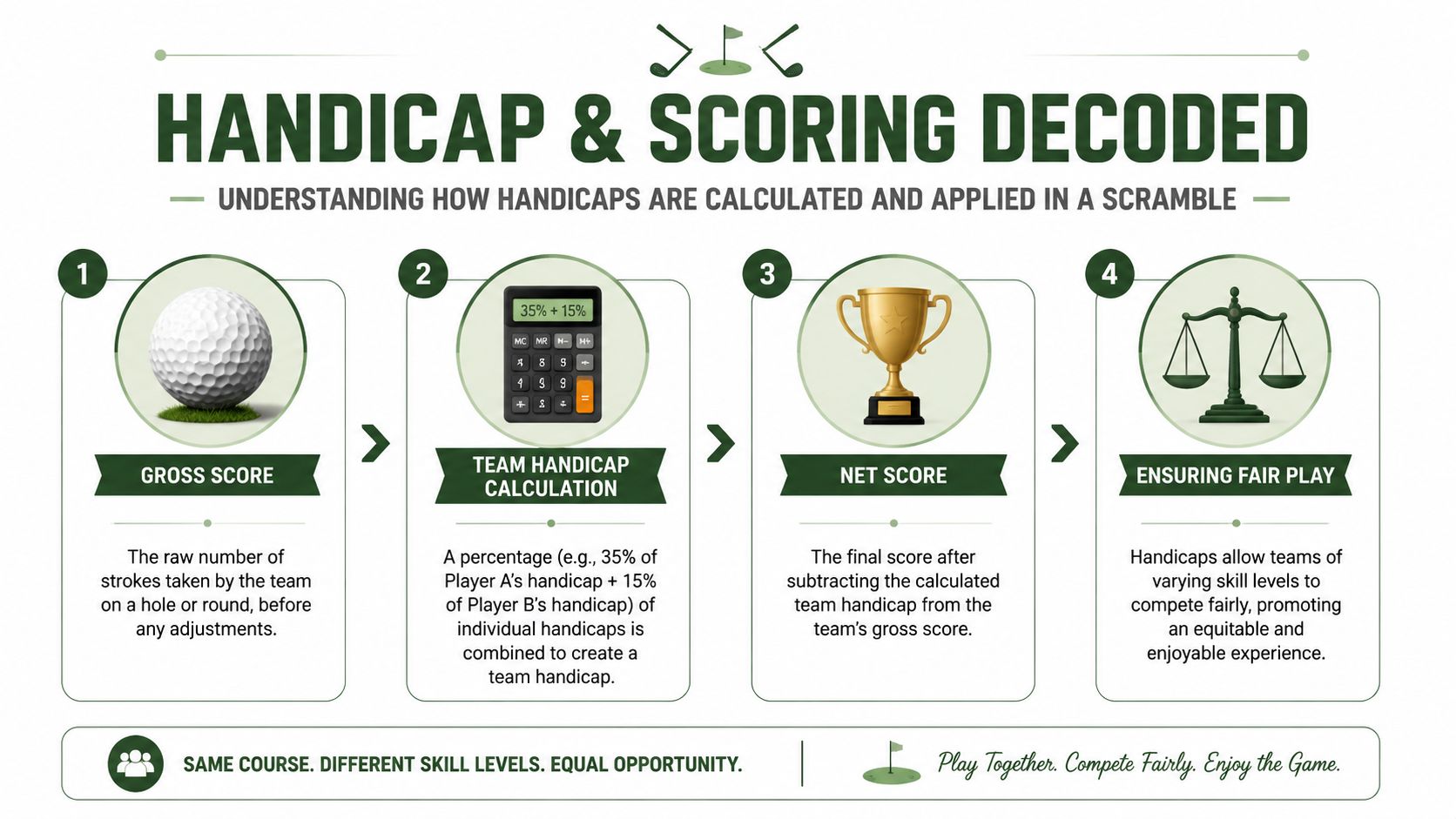
For a two-player scramble, the USGA recommendation is 35% of the lower course handicap plus 15% of the higher course handicap, as outlined in the USGA scramble handicap guidance.
Many local events use a simpler house rule: take the two handicaps, average them, then apply 75% to that result. It is easy to explain and easy to calculate on paper, which is why charity and member events often prefer it. The trade-off is accuracy. Simpler administration can come at the cost of a result that fits the team format less well.
Why the formulas give different answers
A two-man scramble is not a normal stroke-play pairing. The lower-handicap player usually drives more of the team's strategy, and that influence shows up all round. The weighted USGA method reflects that reality better than a straight average.
The average-based method still has value. I use that type of simplified allowance only when the event priority is speed at check-in, fewer scoring questions, and a field that cares more about pace and prizes than handicap precision.
That is the core organizer decision. Fairness at the margins, or easier administration.
Method | How it works | Best use case |
|---|---|---|
USGA weighted method | 35% of lower course handicap + 15% of higher course handicap | Competitive events where net results need a stronger fairness standard |
Local average method | Add both handicaps, divide by two, then apply 75% | Casual events that want faster setup and simpler explanation |
A worked example
Suppose Player A has a 12 course handicap and Player B has an 18 course handicap.
Using the USGA weighted method, the team allowance is (12 × 0.35) + (18 × 0.15). That produces 4.2 + 2.7 = 6.9, usually rounded under the committee's stated procedure. If your event rounds to the nearest whole number, that team plays off 7.
That number applies to the team's total, not to individual holes unless your event software is set up for hole-by-hole net displays. On the card and leaderboard, the team still posts one gross score per hole. The handicap adjustment is then applied to produce the net result.
What to publish before the first tee time
Organizers get fewer scoring disputes when the rules sheet answers the operational questions, not just the math.
Use course handicap, not handicap index. If you do not state that clearly, players will bring different numbers to registration.
Set a handicap deadline. My preference is the day before pairings are finalized, so no one is updating numbers at the scoring table.
State whether prizes are gross, net, or both. Players behave differently when they know which board matters.
State your rounding rule. Round to nearest whole number, round down, or let the software handle it. Just do not leave it unstated.
Enter the formula into your scoring system before the event opens. That prevents hand-edited results and saves time when teams finish in bunches.
A good handicap policy does more than produce a number. It prevents the two problems that slow down every scramble finish: teams asking how their net score was built, and staff trying to recreate the math after the cards come in.
Real-World Examples and Tie-Breaking
Rules stick when players can see them in action. A simple hole example usually answers more questions than a page of definitions.
Take a team on a par 5. Player one hits a safe drive into the right side of the fairway. Player two hits a longer drive but pulls it into light rough with a blocked angle. The team chooses the fairway ball because the next shot is cleaner.
From there, both players hit their second shot. One lays up to a comfortable wedge distance. The other tries to reach farther but leaves a poor lie. The team takes the layup. Both then hit wedges from that spot. One finishes outside birdie range, the other gives the team a realistic chance. They choose the closer ball, both putt, and one holes out. The team records a single score for the hole.
What the score actually represents
The recorded number is the team's gross score on that hole. It doesn't matter which player contributed each selected shot. The card only cares about how many strokes the team needed from tee to hole using its chosen ball each time.
That's where organizers need consistency. Players should never be left wondering whether they're writing down a team score, an individual score, or some hybrid. In a scramble, it's always one team score per hole.
If your scoring table has to explain what number belongs on the card, the rules sheet wasn't finished.
Handling the full-round result
At the end of the round, the team totals its gross score across all holes. If the event uses a handicap allowance, the committee subtracts the team handicap to produce the net score. That final net number decides placement in a net competition.
For ties, the cleanest option is a scorecard playoff. Put the method in writing before the round starts. A standard committee procedure is to compare the back-nine score first, then the last six holes, then the last three, and finally the closing hole if needed. What matters most isn't which version you choose. It's that every team knows the method before prizes are awarded.
A tie-break policy works best when it appears in three places:
On the printed rules sheet
At the scoring table
In the starter announcement
That small bit of repetition prevents one of the most common end-of-day arguments.
Setup Tips for Tournament Organizers
A two man scramble usually goes off the rails before the first group tees off. The warning signs are easy to spot. Players reach the table asking how many drives each partner must use, volunteers give different answers about preferred lies, and the scoring team is still editing cards while carts are pulling away.
That kind of day is preventable.

Build the rules sheet like an operator
A good rules sheet does one job. It lets staff answer routine questions by pointing to the page instead of debating intent in the cart barn.
Keep it short, but cover the items that create disputes:
Format summary: Both players hit, one ball is selected, both play from that spot until the hole is finished.
Ball placement rule: State the allowed placement in the fairway, rough, bunker, and on the green.
Drive-use requirement: Print the minimum and tell teams how to mark it during the round.
Scoring method: Say whether prizes are based on gross, net, or both.
Tie-break method: List the exact scorecard playoff procedure you will use.
Add-ons: Mulligans, string, and gimmes only belong on the sheet if the terms are specific enough to enforce.
If the committee plans to rule on something, print it.
Control the first-tee briefing
Starter announcements work best when they focus on the few things teams are likely to forget under pressure. Long speeches get ignored. A clear 60-second briefing gets repeated inside every group.
I usually want the starter to cover five items, in this order:
The handicap method being used that day
The drive-count requirement and where to record it
The local ball-placement rule
The on-course contact for rulings
The score submission process after the round
That script helps staff as much as players. Once volunteers all use the same wording, fewer groups try to negotiate their own version of the format.
Use one system for setup, scoring, and paperwork
Scrambles create administrative work in clusters. Pairings, cart signs, scorecards, handicap allowances, live scoring, and payout verification all touch the same event. If those pieces live in separate spreadsheets and pro shop notes, mistakes show up fast.
The recurring problem is consistency. Organizers choose one handicap allowance, one drive-use rule, and one scoring workflow, but the field only experiences those choices through scorecards, announcements, and leaderboard updates. If any of those pieces disagree, the rules sheet stops mattering.
That is why clubs often pair tournament-specific tools with broader golf club event management software that fits their day-to-day operation.
For a practical overview of the full setup process, this golf tournament planning guide for organizers is a useful reference.
Where software actually saves time
The value is not flashy. It shows up in the places where tournament staff usually gets buried late in the day:
Handicap setup: Apply the event formula the same way for every team.
Score intake: Cut down on unreadable cards, missing totals, and delays at the table.
Printed materials: Generate scorecards, cart signs, and player sheets from one source.
Leaderboard control: Post results faster without re-entering the same information twice.
The best scramble operations still rely on judgment. Software just removes the repetitive work so staff can handle rulings, pace issues, and player service instead of chasing paperwork.
Conclusion Running a Fair and Fun Scramble
A good two man scramble feels easy to the players because the organizer handled the hard parts early.
The essentials are straightforward. Use clear rules. Define how the format works on every shot. Publish the drive-use requirement. Choose one handicap method and stick to it. Put the tie-break procedure in writing before anyone asks about it at the awards table.
That combination does more than prevent disputes. It protects the reason people like this format in the first place. A two man scramble should be competitive without feeling tense, social without becoming sloppy, and simple to play without being vague to administer.
The best events aren't the ones with the longest rule sheets. They're the ones where staff, volunteers, and players all work from the same playbook. When that happens, the round moves better, scoring is cleaner, and the finish feels earned.
Modern tools help, but the primary win is operational clarity. Get that right, and your scramble will feel fair, fun, and professionally run from the first tee to the final score posting.
If you want a simpler way to run pairings, live scoring, scorecards, and scramble setup without making players download an app, Live Tourney is built for exactly that job. It helps organizers cut down on manual work, keep the leaderboard moving, and deliver a cleaner tournament experience for staff and players alike.