
Jun 14, 2026
texas amateur golf, tga championships, amateur golf tournaments, golf tournament management, texas golf association
The complete guide to Texas amateur golf. Learn about the Texas Amateur Championship, how to qualify, event schedules, and resources for players and organizers.
If you're a player in Texas, you've probably had the same moment everyone has at some point. You pull up a state association page, start scanning qualifiers, exemptions, age divisions, registration windows, and host sites, and suddenly the whole thing feels bigger than your golf game. If you're a head pro or tournament director, the feeling is similar. Members want answers, good players want a path, and every event has to look organized from the first email to the final scorecard.
That's what makes Texas amateur golf so interesting. It's not just broad. It's layered. There's history, real prestige, a clear competitive ladder, and a modern expectation that events will run cleanly and look professional. Players want to know where they fit. Organizers need to know how to deliver an experience that matches the standard.
An Introduction to the Texas Amateur Golf Scene
Texas amateur golf works because it combines tradition with volume. You have established championships, regional competition, club-level feeder events, and a state structure that gives players a real route from local golf into serious competition. For a new head pro, the mistake is treating it like a loose collection of events. It isn't. It's a system, and once you see the system, the calendar starts to make sense.
For players, that system matters because it tells you where to start. For clubs, it matters because your members don't just want access to events. They want guidance, recommendations, and a smoother path into competitive golf.

A lot of players first enter the scene through local and metro competition, then branch outward into bigger state opportunities. If you're helping golfers in North Texas find their footing, a practical starting point is this guide to golf tournaments in Dallas, which gives useful context for how local competition often feeds broader ambition.
What makes Texas different
Texas has range. One player may be chasing top-level amateur championships. Another may be trying to prove he belongs in qualifiers first. A club may have juniors rising into elite events, mid-ams balancing work and tournament golf, and seniors who still want a serious championship schedule. The job isn't to treat all those golfers the same. The job is to place them correctly.
That's where the Texas Golf Association sits at the center. It provides structure, scheduling, championship pathways, and the kind of consistency that keeps the competitive side of the game credible.
Practical rule: The faster you identify a player's actual lane, junior, amateur, mid-am, senior, or qualifier-first, the better decisions you'll make about schedule, prep, and expectations.
What players and clubs usually get wrong
Most confusion comes from skipping the basics. Players chase marquee events before they understand eligibility. Clubs promote events without explaining what level of readiness is really required. That creates frustration on both sides.
A better approach is simpler:
Start with fit: Match the golfer to the right level of event, not the most famous event.
Build from logistics: Registration, travel, practice rounds, and rules matter as much as swing work.
Treat every event like a test of habits: The player who handles details well usually competes better when pressure rises.
Texas amateur golf rewards preparation. That applies to the player trying to qualify and the club trying to support him.
The Texas Amateur Championship Explained
The Texas Amateur Championship is the event that gives the rest of the calendar its shape. If you want to understand why Texas amateur golf carries weight, start here. The championship has been held at some of the state's most important venues for more than a century, and Houston Country Club alone hosted it seven times, in 1906, 1912, 1915, 1921, 1949, 1956, and 2006, a span of 100 years that shows how well-established the event is in Texas golf culture, as noted in this Texas Amateur preview and fact sheet from AmateurGolf.com.
Prestige in amateur golf isn't created by marketing language. It comes from continuity, host sites, and the level of player who wants the title badly enough to build a season around it. The Texas Amateur checks all three boxes.
Why the championship matters
For players, this isn't just another start on the schedule. It's a benchmark. A strong showing says something about your game, your preparation, and your ability to handle a full championship environment. For clubs, a member competing here reflects well on your player development and your competitive culture.
The event also has staying power. The Texas Golf Association's championship archive exists because the title means something over time, not just in one summer.
Format changes how you prepare
This championship is a 72-hole stroke-play test. That one fact should shape every prep decision a player makes. You are not preparing for one hot round. You are preparing to stay organized, patient, and competitive over multiple days.
That changes the standard operating plan:
Build for endurance, not adrenaline. Players who rely on short bursts of momentum usually leak shots late.
Expect changing conditions. Morning and afternoon rounds can ask different questions.
Keep paperwork and logistics clean. Multi-day tournaments punish disorganization faster than casual competition does.
A prestigious championship usually feels demanding before the first tee shot. That's normal. It means the event is asking for complete preparation, not just talent.
The type of player it attracts
The field tends to draw golfers who already know how to compete, not just how to shoot numbers in casual rounds. They understand pace, procedure, and how to recover after a bad stretch. Newcomers often underestimate that part. They think the challenge is ball-striking. Ball-striking matters, but championship golf also tests discipline.
A head pro advising a member should frame it candidly. Entering the Texas Amateur conversation means stepping into a setting where routine, course management, and composure matter every day. That's why the title carries so much respect.
Exploring Other Major Amateur Competitions
The Texas Amateur may be the headline event, but most golfers build their competitive identity elsewhere first. That's a good thing. Strong amateur systems need layers. They need age-based championships, regional pathways, and qualifiers that let players find the right level before they move up.
A lot of clubs could offer more help than they currently do. A member doesn't always need a grand target. Sometimes he needs the next sensible target.
How to think about the calendar
Instead of viewing Texas amateur golf as one giant list, break it into three buckets:
State championships: These are the events with the most visibility and the highest prestige for their category.
Regional events: These help players prove they can travel, adapt, and compete away from their home club.
Qualifiers and open tests: These sort out readiness very quickly.
One useful reality check comes from open competition. The Texas State Open began in 1960, was first won by amateur Homero Blancas, and no amateur has won it since, which underscores how difficult it is for amateurs to beat professionals and why amateur-only championships remain so important, as noted on the 117th Texas Amateur page from the Texas Golf Association.
That matters because it tells players not to confuse ambition with sequencing. There's value in playing events designed for your stage of development.
Key Texas amateur golf events overview
Event Name | Primary Audience | Common Format |
|---|---|---|
Texas Amateur Championship | Elite amateur players in Texas | Stroke play |
Texas Mid-Amateur | Adult amateurs in the mid-am category | Championship stroke play or match play depending on event structure |
Texas Senior Amateur | Senior amateurs | Championship stroke play |
Regional amateur championships | Players building state-level resumes | Competitive individual formats |
USGA qualifiers in Texas | Players pursuing national pathways | Qualifying rounds |
What works for players and clubs
The best scheduling plans are selective. Players who enter too much golf often show up flat when the important weeks arrive. Clubs that support members well usually help them narrow the field.
A practical screen looks like this:
Choose one anchor championship: Pick the event that defines the season.
Add one or two proving grounds: Regional events or qualifiers tell you whether the game is trending the right way.
Leave room for recovery and practice: Tournament golf exposes weaknesses, but only if you have time to address them.
Where organizers fit in
If you run events at the club level, remember that your competition often feeds this larger ecosystem. A well-run member qualifier or championship teaches habits that transfer. Clear notices, accurate pairings, pace expectations, and prompt scoring aren't cosmetic details. They prepare players for the standard they'll meet outside your gates.
How to Qualify and Register for Events
Most entry problems in Texas amateur golf aren't caused by golf swings. They're caused by missed details. A player assumes he's eligible. A deadline gets overlooked. A handicap requirement gets checked too late. A qualifier is needed, but travel planning starts after the field is set.
That's why experienced tournament people push administration early. If you want the player calm by tournament week, the work has to start well before tournament week.
The basic entry sequence
The first thing I'd tell any player or assistant pro is to treat registration like part of preparation, not a separate chore. The golfer who handles paperwork late usually handles practice late too.
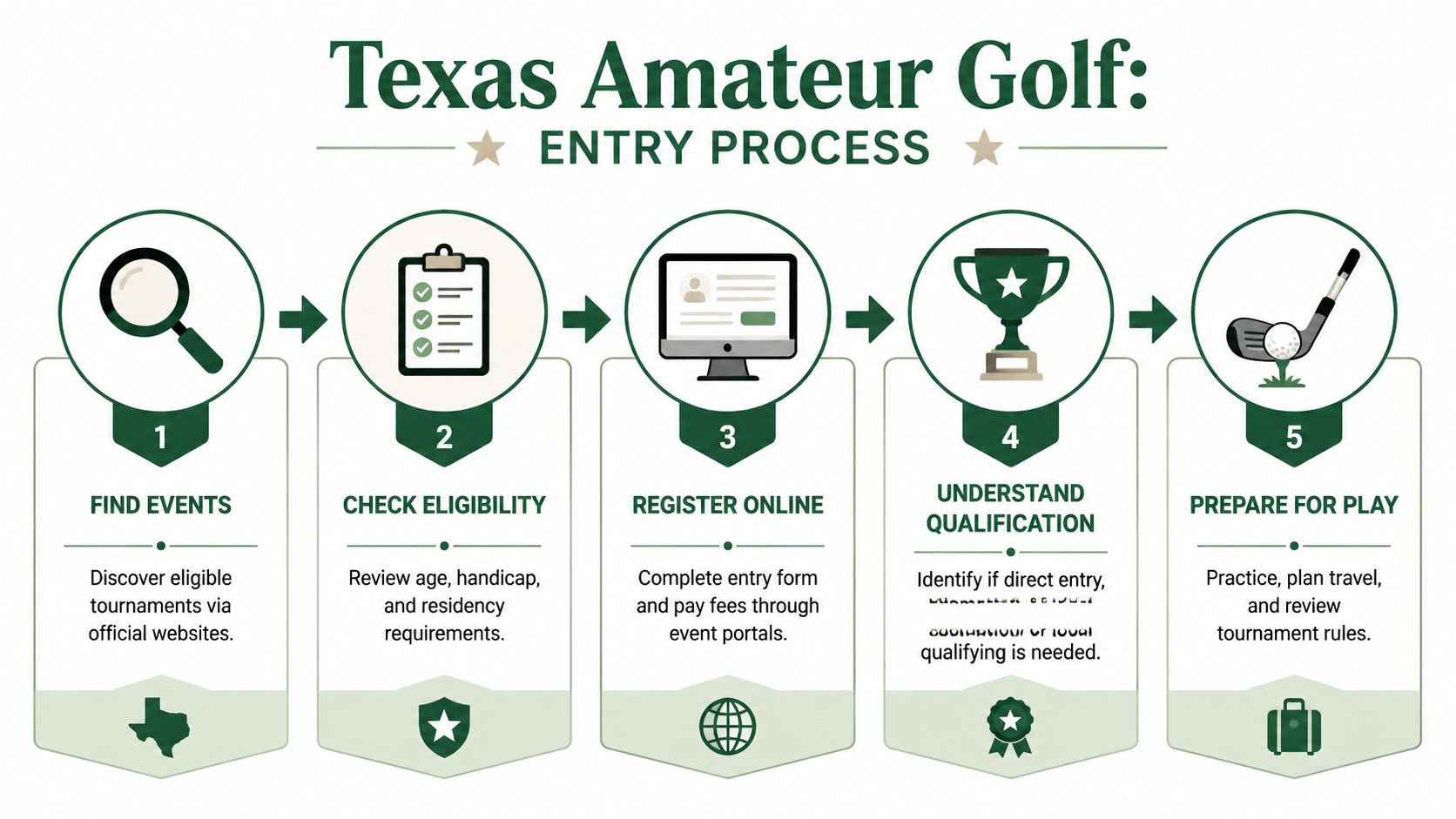
A clean process usually looks like this:
Find the right event first. Don't start with prestige. Start with fit, location, timing, and realistic competitiveness.
Check every eligibility line item. Residency, age division, amateur status, and handicap all matter.
Confirm your handicap record is current. If a player is fuzzy on that process, this guide on how to obtain a USGA handicap is useful background before entry windows open.
Determine whether you're exempt or qualifying. Never assume direct entry.
Register immediately once you're ready. Waiting rarely creates an advantage.
What players should verify before clicking enter
A lot of avoidable mistakes happen because players read only the headline details. Tournament pages usually tell you much more than date and site. They also tell you what kind of player the field is built for.
Before registering, verify:
Eligibility fit: Make sure the player belongs in that division and meets the event's stated requirements.
Qualification path: Some players get in directly. Others need a qualifier. Those are very different planning tracks.
Operational details: Read policies on practice rounds, caddies, walking, transportation, and score posting.
Withdrawal rules: Emergencies happen. Know the procedure before you need it.
Don't enter first and figure it out later. Read the event information like it's part of the scorecard.
Advice for head pros helping members
When members ask, “Can I play in this?” the right answer usually isn't yes or no. It's a short checklist. Ask whether they're eligible, whether they're prepared for a qualifier, whether they can manage travel, and whether their current game supports the attempt.
That conversation saves time and protects credibility. Members trust pros who give honest guidance, even when the answer is “not yet” or “let's target a different event first.”
What good event pages have in common
If you organize events, borrow from the strongest association pages. They make the next action obvious. They explain formats clearly. They lay out exemptions, qualifying routes, and timing in one place. New players don't need more text. They need fewer blind spots.
Preparing to Compete in Texas Tournaments
Once a player gets into the field, preparation stops being theoretical. It gets practical fast. What yardages matter off the tee. Which misses are playable. How the greens release in the afternoon. What to eat between rounds. Where not to short-side yourself. That's tournament golf.
A lot of amateurs prepare backwards. They spend too much time searching for a swing feeling and not enough time building a competition plan. In Texas events, that's a mistake. The margins are too thin.
The proof is simple. The 115th Texas Amateur was a 72-hole stroke-play event, and Reese Roberts won with 269 total, just two strokes clear of the field, according to AmateurGolf.com's recap of the championship at Trinity Forest. In that kind of environment, one loose decision matters.
Preparation that actually travels
The players who hold up over multiple days usually have a repeatable prep routine. Not a glamorous one. A repeatable one.
Focus on these pieces:
Course scouting: Learn where the course asks for restraint. Every venue has holes that tempt players into needless aggression.
Yardage discipline: Tournament misses often come from guessing, not swinging.
Green mapping in simple terms: Know where uphill putts are and where the bad leave lives.
Equipment check: Ball, glove, shoes, weather gear, snacks, and backup basics need to be settled early.
Texas-specific adjustments
Texas golf can ask for versatility. Turf conditions, wind exposure, firmness, and rollout can differ a lot from one region or club to another. Players who only prepare for “their” style of golf often look uncomfortable once conditions shift.
That means practice should include more than stripe-it sessions on the range. Hit flighted shots. Rehearse uncomfortable tee balls. Spend time from tight areas around greens. If the player travels poorly, the issue usually shows up in trajectory control and short-game adaptability first.
The player who knows where to miss often beats the player who only knows how to attack.
Mental prep is part of the score
Newer competitors often lose ground because they think mental game work means motivational talk. It usually means better pacing. Better reset routines. Better acceptance after a bad bounce or one bad hole.
I'd rather have a player with a clear post-bogey routine than a player with one extra “feels good” swing thought. Championship golf isn't won by avoiding stress. It's won by handling stress without speeding up.
A usable competitive routine includes:
A plan for the opening stretch
A consistent between-shot process
A reset after mistakes
A simple end-of-round review
If you're a head pro, that's where your advice can matter most. Not in giving more swing mechanics. In helping the player show up organized enough to let his game surface.
Modernizing the Tournament Experience
Tournament standards have changed. Players still care about the golf first, but they also expect events to communicate well, score cleanly, and feel current. Parents, members, and friends want to follow along without waiting for a final email recap. Staff want fewer clipboards, fewer scoring bottlenecks, and less cleanup after play.
That shift is visible in Texas amateur golf. In 2025, 116 Texas golfers earned USGA exemptions through TGA qualifiers, and the association has also been livestreaming championships, a sign that real-time engagement and digital access now matter to the amateur game, as highlighted in this Texas Golf Association Instagram post.
Why digital operations matter on tournament day

For organizers, the biggest gain isn't novelty. It's control. Real-time scoring reduces the lag between what's happening on the course and what the committee, players, and spectators can see. That improves decision-making late in the round, especially when the leaderboard is tight.
It also changes how polished the event feels. Pairings, updates, score visibility, and player communication all reflect on the club. If those pieces feel clunky, the event feels clunky.
What works and what doesn't
What works:
App-free scoring access: The fewer steps players need to take, the more likely they are to use the system correctly.
Centralized event setup: Registration, pairings, communications, and scoring should live in one operational flow when possible.
Clear spectator visibility: Family and members follow events more closely when leaderboards are easy to access.
What doesn't work:
Overbuilt systems for simple events: If staff need too much training, the tool is wrong for the event.
Manual score relays all day: That creates delays and invites errors.
Technology without a staff plan: Digital tools still need a scoring policy, a rules contact, and a clear check-in process.
For clubs looking at workflow options, tournament hosting guidance is useful because it frames event operations from setup through scoring and communications. One platform in this category is Live Tourney, which is a web-based tool for registration, pairings, and live scoring without requiring players to download an app.
The player side of modernization
Players notice modern operations in small ways. They know when registration is confusing. They know when scoring updates are slow. They know when it's hard for family to track results. The smoothest events remove friction.
That same thinking applies to practice and preparation at home. Golfers who want more structured short-game work sometimes use dedicated backyard practice surfaces, and a resource on artificial putting greens can help players think through what makes a home setup functional instead of decorative.
Better tournament operations don't replace good competition. They make good competition easier to see, easier to follow, and easier to manage.
Essential Resources for Players and Organizers
The players and clubs that succeed in Texas amateur golf usually rely on a short list of dependable resources. They don't chase scattered information. They know where official schedules live, where rules are posted, how handicaps are maintained, and how event administration gets handled.
That discipline matters because tournament golf punishes confusion. If the player has the wrong details, he starts behind. If the organizer has the wrong process, the whole field feels it.
The core resource stack
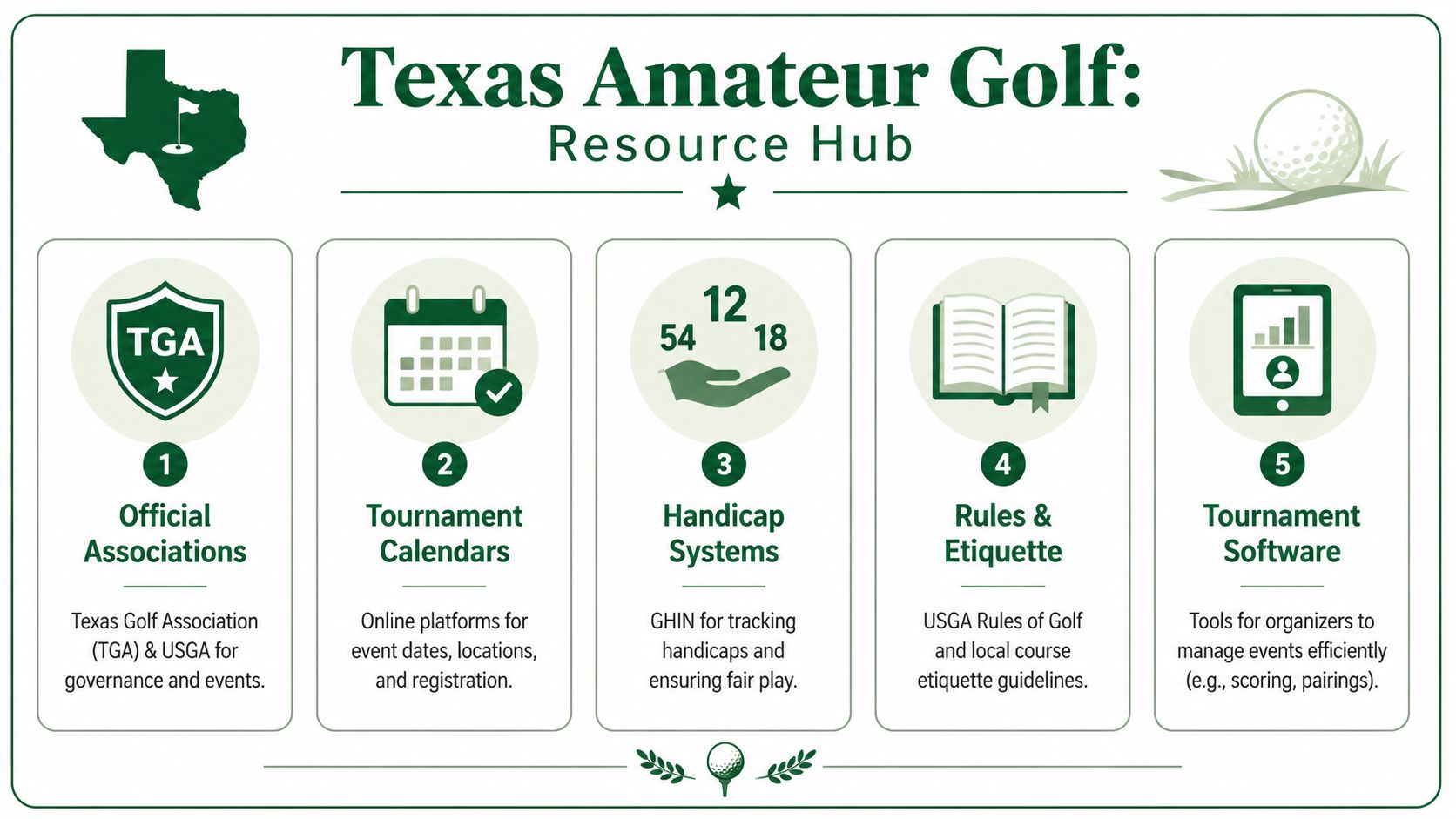
For most players and organizers, the working stack is straightforward:
Official association sites: Use the Texas Golf Association and the USGA for championship information, governance, and official rules materials.
Handicap systems: Keep handicap records current and verified through the standard channels your club already uses.
Tournament calendars: Watch official posting pages and club communications instead of relying on hearsay.
Rules references: Have current Rules of Golf materials available before the event, not only after a ruling comes up.
Tournament management tools: Use software that supports pairings, score collection, and player communication in a clean workflow.
A simple operating model for clubs
If you're a new head pro, keep your support model tight. You don't need to become the state association. You need to become the reliable first stop for your members.
Use this structure:
Need | Best club response |
|---|---|
A player wants to compete | Direct him to the correct division and event level |
A member asks about eligibility | Verify basics before encouraging entry |
A golfer is in the field | Help him build a course-prep and logistics checklist |
The club is hosting | Standardize pairings, notices, scoring, and printed materials |
The real takeaway
Texas amateur golf rewards people who are organized. That applies to the player trying to qualify, the parent helping with travel, the assistant pro answering member questions, and the tournament staff building pairings before sunrise.
The strongest clubs do one thing very well. They reduce friction. They give players clear answers, honest expectations, and event experiences that feel deliberate from start to finish.
Run every event so that a first-time competitor can follow it without guessing. That's the standard players remember.
If you run tournaments, leagues, club championships, or qualifiers and want a cleaner operational setup, Live Tourney is worth a look. It gives organizers a web-based way to handle registration, pairings, communications, and live scoring in one place, which fits the practical demands of modern Texas amateur golf without adding more complexity for staff or players.





