May 30, 2026
old corkscrew scorecard, old corkscrew golf course, florida golf courses, jack nicklaus design, golf tournament setup
Get the Old Corkscrew Golf Course scorecard. View tee yardages, ratings, pars, handicaps. Download printable PDFs & CSV data for your next tournament.
You're probably looking at the Old Corkscrew golf course scorecard for one reason. You need to make a decision before anyone hits a shot.
Maybe it's a charity outing and you're trying to avoid a five-hour survival test. Maybe it's a member event, and you need tee assignments that feel fair without stripping the course of what makes it difficult. Or maybe you're a serious player who pulled up the card, saw the back-tee numbers, and immediately understood that this place won't let you fake your way around.
That's the right reaction. Old Corkscrew is the kind of course where the scorecard matters before the round starts. The yardages tell part of the story. The ratings and slope tell another part. The gap between those two is where most event planning mistakes happen.
Introducing the Old Corkscrew Scorecard
The first thing that jumps off the page is intimidation. That's not just because the course is long. It's because the card signals a layout built to test decision-making, patience, and tee selection discipline.
Old Corkscrew carries the kind of pedigree that gets tournament staff to pay attention. The Jack Nicklaus-designed course opened in 2007 on a 275-acre site in Lee County, south of Fort Myers, and Nicklaus Design later described it as one of southwest Florida's most demanding courses, as noted by 18Birdies' Old Corkscrew course listing.
For an event organizer, that one historical detail matters more than it may seem. A modern course with a demanding reputation usually means the scorecard was built with multiple use cases in mind. Daily-fee play, competitive rounds, and organized events all need different setups. If you treat the card like a static image, you miss the operating logic behind it.
Why organizers should care about the card
A scorecard does three jobs at once:
It sets expectations: Players decide whether the day feels playable or punishing before they leave the first tee.
It shapes pace: Poor tee selection creates backups faster than almost anything else.
It affects scoring integrity: The right setup makes results feel earned. The wrong setup makes them feel random.
Practical rule: At a course with a strong design identity, don't start with “How far should we play it?” Start with “Who is this event for?”
That's how I'd approach Old Corkscrew every time. The right read of this card isn't “hard course.” It's “hard in different ways depending on who you put where.”
Course Overview and Key Metrics
Tournament setup at Old Corkscrew usually goes wrong before anyone reaches the first tee. The common mistake is treating total yardage as the full story. At this property, rating and slope matter just as much because they affect who can score, who can keep pace, and who starts making doubles after one poor miss.
The operating numbers are straightforward. Old Corkscrew is an 18-hole, par-72 course with year-round play, and its published tee yardages run from 7,393 yards at the Black tees down to 5,161 yards at the Red tees, as noted earlier.
The tee structure at a glance
Tee set | Yardage |
|---|---|
Black | 7,393 |
Gold | 6,617 |
Blue | 6,262 |
White | 5,728 |
Red | 5,161 |
For organizers, that spread is the first useful planning signal. A card with more than 2,200 yards between the longest and shortest listed setups gives you real flexibility for shotgun events, mixed divisions, charity fields, and senior play. It also gives you more ways to create problems if you choose tees by ego instead of scoring profile.
The back tee markers carry a 77.6 course rating and 153 slope. Those are tournament numbers, not decoration. A rating in that range means strong players still have to earn par. A slope of 153 tells you the course gets disproportionately harder for the bogey golfer, which is exactly the group that drives pace issues in many public events.
That trade-off should shape setup decisions early.
If the field includes high-handicap players, occasional golfers, or corporate guests, the Black tees usually create the wrong kind of difficulty. You do not get better competition from that choice. You get longer approach shots, more penalty strokes, and backup on forced-carry holes. For many events, Gold and Blue are the working tee sets because they preserve the course's character without stretching the round past a reasonable pace target.
White and Red matter for more than accommodation. They are useful tools for keeping a mixed field engaged and keeping score distribution within a range that software can handle cleanly for net and gross leaderboards. That becomes practical when you are building tee assignments, importing divisions, or testing projected pace in tournament platforms. The scorecard is not just a reference image here. It is the framework for tee-sheet logic, scoring balance, and printable player materials.
A good Old Corkscrew setup starts with one question. Which tee set gives your weakest intended player a fair chance to advance the ball without turning every long hole into a penalty exercise? Once that answer is clear, the rest of the event build gets easier.
Complete Old Corkscrew Scorecard Data Table
This is the point where many organizers want the full hole-by-hole matrix. In a perfect world, you'd have every yardage by hole, every par, and every handicap line item ready for import and print.
The problem is simple. The verified source material available here confirms the course-level tee yardages and overall framework, but it does not provide a complete verified hole-by-hole data set for all 18 holes and all five tees. Because accuracy matters more than filling cells, the right move is to keep the reference table structurally complete while limiting hard numbers to what's verified.
Course-level scorecard reference
Metric | Verified data |
|---|---|
Holes | 18 |
Availability | Year-round |
Par | 72 |
Black tees | 7,393 yards |
Gold tees | 6,617 yards |
Blue tees | 6,262 yards |
White tees | 5,728 yards |
Red tees | 5,161 yards |
Hole-by-hole planning table
Use the following table as your working layout for tournament setup, scorecard build, or software import review. Fill the per-hole values from the club's official scorecard or your confirmed event packet before publishing to players.
Hole | Black (Yards) | Gold (Yards) | Blue (Yards) | White (Yards) | Red (Yards) | Par | Handicap |
|---|---|---|---|---|---|---|---|
1 | Verify with club | Verify with club | Verify with club | Verify with club | Verify with club | Verify with club | Verify with club |
2 | Verify with club | Verify with club | Verify with club | Verify with club | Verify with club | Verify with club | Verify with club |
3 | Verify with club | Verify with club | Verify with club | Verify with club | Verify with club | Verify with club | Verify with club |
4 | Verify with club | Verify with club | Verify with club | Verify with club | Verify with club | Verify with club | Verify with club |
5 | Verify with club | Verify with club | Verify with club | Verify with club | Verify with club | Verify with club | Verify with club |
6 | Verify with club | Verify with club | Verify with club | Verify with club | Verify with club | Verify with club | Verify with club |
7 | Verify with club | Verify with club | Verify with club | Verify with club | Verify with club | Verify with club | Verify with club |
8 | Verify with club | Verify with club | Verify with club | Verify with club | Verify with club | Verify with club | Verify with club |
9 | Verify with club | Verify with club | Verify with club | Verify with club | Verify with club | Verify with club | Verify with club |
10 | Verify with club | Verify with club | Verify with club | Verify with club | Verify with club | Verify with club | Verify with club |
11 | Verify with club | Verify with club | Verify with club | Verify with club | Verify with club | Verify with club | Verify with club |
12 | Verify with club | Verify with club | Verify with club | Verify with club | Verify with club | Verify with club | Verify with club |
13 | Verify with club | Verify with club | Verify with club | Verify with club | Verify with club | Verify with club | Verify with club |
14 | Verify with club | Verify with club | Verify with club | Verify with club | Verify with club | Verify with club | Verify with club |
15 | Verify with club | Verify with club | Verify with club | Verify with club | Verify with club | Verify with club | Verify with club |
16 | Verify with club | Verify with club | Verify with club | Verify with club | Verify with club | Verify with club | Verify with club |
17 | Verify with club | Verify with club | Verify with club | Verify with club | Verify with club | Verify with club | Verify with club |
18 | Verify with club | Verify with club | Verify with club | Verify with club | Verify with club | Verify with club | Verify with club |
How to use this without creating errors
If you're building event materials, don't let anyone manually type hole data from a blurry image at the last minute. That's how card mismatches happen.
Use this workflow instead:
Confirm the official card version with the golf shop.
Lock tee assignments before creating printed materials.
Check front-nine and back-nine totals against the verified overall tee yardages.
Review handicap hole order separately from yardage entry.
That process is less exciting than strategy talk, but it saves more headaches.
Printable Scorecard and Downloadable Data
Searching for the Old Corkscrew golf course scorecard implies a need for a printable, shareable, or importable document, not commentary.
That's fair. A usable scorecard asset beats a screenshot every time, especially when staff members are building cart signs, pairings sheets, or score-entry templates under a deadline.

What to download and when
A good event file stack usually includes three versions of the same information.
PDF scorecard: Best for printing in the shop, handing to volunteers, or attaching to an event packet.
PNG image file: Better for mobile viewing, sponsor decks, and quick player communications.
CSV data file: Best for software import and any workflow that needs structured hole and tee information.
If you're assembling templates, this guide to golf scorecard formats is useful because it helps you separate player-facing design from data-entry structure. Those are not the same job.
Why structured data matters more than a pretty image
A printed card is fine for a casual round. It's not enough for event operations.
A tournament setup needs consistent field names, hole order, tee naming, and scoring logic. A CSV file solves the practical problems that PDF and PNG files can't:
Fewer transcription mistakes
Cleaner imports into tournament platforms
Easier version control when tee assignments change
Faster review by staff before the event opens
If the scorecard lives only as an image, someone on your team will eventually retype it by hand. That's the process to avoid.
Even when an event is small, structured data keeps everyone aligned. You can print from it, build digital score-entry from it, and audit it later if a hole setup question comes up.
Hole by Hole Strategy Guide and Notes
The most useful way to read the Old Corkscrew golf course scorecard is to treat it as a warning label. The numbers tell you length, but they also hint at where the course extracts mistakes.
Third-party scorecard context points out a significant gap in most coverage. It rarely translates raw yardage into practical decisions about tee appropriateness for a corporate outing, or how wind, forced carries, and penalty areas change scoring expectations, as discussed on the SkyGolf Old Corkscrew scorecard page.

What the scorecard doesn't spell out
At a wooded, nature-preserve-style Jack Nicklaus layout, players shouldn't assume every yard plays at face value. Long holes can become much longer if the landing zone narrows where the average player drives it. Mid-length holes can feel severe if the second shot asks for a carry, a shaped approach, or a conservative miss pattern.
That's why hole strategy at Old Corkscrew starts with restraint.
Off the tee: Favor the side that leaves the clearest next shot, not just the shortest route.
Into greens: Misses need to be intentional. Short-side recoveries are where rounds drift.
On risk-reward holes: Event players often force hero shots because the yardage looks manageable.
Three practical scoring patterns to expect
The card usually affects players in three common ways.
Long par 4 pressure
A strong yardage on the card often creates a false sense that the only answer is power. On this type of course, that's often wrong. The better play is a tee ball that stays in position, even if it leaves a longer approach.
Players who miss the fairway at a demanding venue don't just lose distance. They lose angle, spin control, and confidence on the next shot.
Forced-carry hesitation
Outings reveal skill. Better players see the line and commit. Casual players start steering the club.
For organizers, that's a tee-selection issue first and a player issue second. If your field includes many golfers who don't carry the ball consistently, the challenge becomes emotional before it becomes technical.
Penalty-area compounding
One ball in trouble is manageable. The second mistake on the same hole is what wrecks a scorecard.
A difficult course doesn't beat players with one bad shot. It beats them when a bad shot triggers a rushed decision.
For teams building hole notes or player guides, a hole-by-hole planning template is helpful because it forces you to document where the smart miss is, where the card is deceptive, and which holes need pace-of-play warnings.
Tournament Setup Guide for Old Corkscrew
The most common failure point at Old Corkscrew shows up before the first group tees off. A tournament committee prints cards, assigns a back tee for prestige, and discovers by hole 4 that the field is waiting on every shot into the par 4s. Pace slips, carts stack up, and the scoring spread comes from penalty strokes instead of skill.
That is a setup error, not a player problem.
Tee recommendations by event type
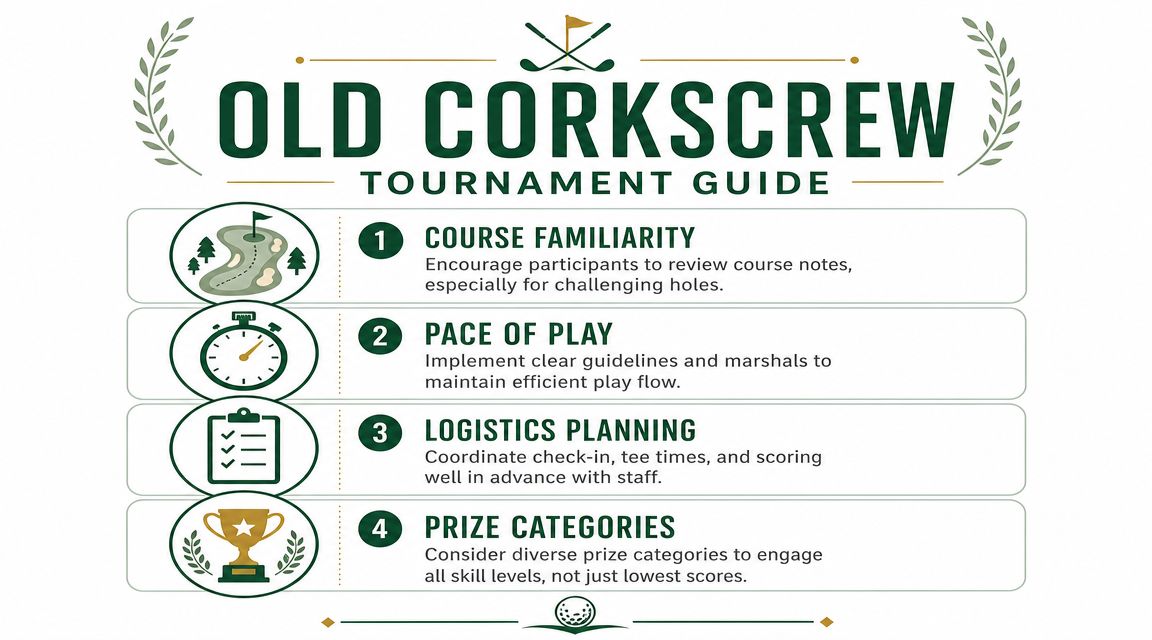
At Old Corkscrew, tee selection drives pace, scoring distribution, and how cleanly your digital setup matches the round you are trying to run. Organizers should choose tees based on expected carry distance, format, and how much pressure the field can handle on approach shots.
Charity scramble or corporate outing: Start with White and Red. That setup keeps the architecture in play without turning the day into ball searches and pickup scores.
Member-guest or mixed-skill competition: Blue usually gives the best balance. Better players still need to plan their way around the course, while the rest of the field can finish holes at a reasonable pace.
Low-handicap or championship field: Gold is a legitimate tournament test. Black fits only a field that can carry forced lines and hold longer approaches consistently.
I see organizers miss this by setting tees for image instead of field behavior. Old Corkscrew exposes that mistake fast.
A good rule is simple. If your shortest realistic hitters cannot advance the ball to the main landing areas, move the field up and protect pace before you protect ego.
Setup choices that improve operations
Good tournament setup at this course means placing challenge where it separates scores cleanly. It should not create backups, rulings, or confusion for volunteers.
Use these adjustments:
Place contest holes on holes with space. Long drive should sit on a hole where players can swing freely and spotters can see the full landing area.
Choose visible par 3s for closest-to-the-pin. Staff can confirm measurements faster, and players know whether an aggressive line is worth it.
Write local rules in plain language. Penalty areas, drop options, and pace expectations should fit on one sheet without interpretation.
Give starters short operational notes. One sentence per trouble hole is enough. Mention the forced carry, the conservative line, or the likely bottleneck.
Registration also matters more here than at an easier resort course. If scorecards, cart signs, and digital pairings do not match, groups lose confidence before the opening tee shot.
Software and data workflow
Tournament staff should build the scoring setup from the same course data used for tee assignments and printed materials. That cuts down on the two errors that waste the most time on event day. Wrong hole data and mismatched tees.
A practical workflow looks like this:
Task | Better approach | What to avoid |
|---|---|---|
Tee assignment | Finalize by player type and format before pairings close | Changing tees after scorecards are printed |
Hole data entry | Import the course once into your tournament system | Re-entering pars, handicaps, and yardages in multiple places |
Player scoring | Use one shared scoring method for the whole field | Mixing paper cards, text updates, and manual recap |
Staff review | Audit printed and digital setups side by side | Assuming the scorecard image matches the software build |
For mixed fields, Old Corkscrew slope rating explained in plain language helps committees decide whether one-tee, split-tee, or flighted tee assignments will produce fair net results.
If your event includes a pre-tournament clinic, sponsor activation, or indoor rules briefing, golf simulator options for Wisconsin homes can also give you a useful reference point for practicing carry-distance decisions and target lines before players see the course in person.
Understanding Old Corkscrew's Difficulty
Old Corkscrew is difficult for a reason that experienced players recognize quickly. It doesn't ask only for length. It asks for disciplined positioning and an honest understanding of your carry numbers.
That distinction matters. Plenty of courses can be stretched. Fewer courses keep demanding good decisions after you move up a tee.
Why the architecture feels demanding
The course's wooded, preserve-style setting shapes how the round unfolds. Sightlines matter. So does commitment. A player who drives it far but out of position often faces the same practical problem as a shorter player who missed in the wrong place.
That's why this kind of layout tends to expose second-shot weakness. You don't just need to advance the ball. You need to leave an angle that lets you hit and hold the green without flirting with the wrong side.
For golfers trying to rehearse that kind of decision-making off the course, it can help to study golf simulator options for Wisconsin homes because simulator practice is one of the cleaner ways to work on target discipline, carry distances, and club selection under repeating conditions.
Why slope matters so much here
The most useful framework for players and organizers is slope, especially when evaluating how a mixed field will handle the course. If you need a plain-language refresher, this slope rating definition is the right concept to review before you assign tees.
At a venue where the longer setup carries a very high slope, the challenge doesn't scale evenly. Better players may still find ways to recover. Higher-handicap players often can't. That creates bigger score swings, slower play, and more mental mistakes.
What works and what doesn't
What works at Old Corkscrew:
Conservative targets with committed swings
Tee boxes matched to the field
Accepting bogey as a good result on difficult holes
Planning for misses before swinging
What doesn't:
Chasing back tees for ego
Treating every reachable line as the correct line
Running a casual outing with competitive-course assumptions
Ignoring how penalty trouble compounds
A good score here usually comes from fewer bad decisions, not a pile of heroic shots.
That is the course's identity. It rewards players and organizers who respect the card early.
Frequently Asked Questions About Old Corkscrew
Is Old Corkscrew a full-length course?
Yes. The verified course framework identifies Old Corkscrew as 18 holes and par 72, with multiple tee options for different playing levels.
Is the course suitable for all skill levels?
It can be, but only if the tees match the field. The course gives organizers room to scale the challenge with tee options ranging from 7,393 yards down to 5,161 yards in the verified scorecard framework covered earlier.
What's the biggest mistake organizers make here?
Using the scorecard as a distance chart instead of a setup tool. At Old Corkscrew, the right tee assignment has a direct effect on player enjoyment, pace, and scoring spread.
Should stronger players automatically play the back tees?
Not automatically. Back-tee use should depend on the event format, the strength of the field, and the kind of day you want to create. A competitive championship setup is different from a member event or sponsored outing.
Is a printed scorecard enough for a tournament?
Not usually. A printed card is useful for players, but tournament staff also need clean digital data for scoring, pairings, and verification.
What should players expect from the course style?
They should expect a demanding, strategic round where positioning matters. The course has a reputation for requiring more than simple power, which is why the scorecard becomes more meaningful once you read it in context.
If you're organizing an event and want the scorecard, pairings, and live scoring process to stay aligned from the start, Live Tourney is worth a look. It gives tournament staff a practical way to manage setup, scoring, and player-facing details without juggling disconnected tools.