Sep 21, 2026
max golf handicap, golf handicap rules, World Handicap System, handicap index cap, golf tournament eligibility
Learn what the max golf handicap is under the World Handicap System, how caps work, and what it means for tournaments, formats, and player eligibility.

You're staring at an entry sheet for next weekend's event. Most of the field looks familiar. Then one name stops you. The player carries a 48 Handicap Index. Someone on the committee says that can't be right. Someone else says the max golf handicap is higher now. A third person asks whether letting that player in will blow up the net competition.
That's the moment where a lot of captains and first-time tournament directors get tangled up. They mix up the handicap system's ceiling with the event's own entry rules.
The short answer is simple. The max golf handicap under the World Handicap System is one number for everybody. The harder question, and the one that matters when you run events, is whether your competition should use that full number or set a lower limit.
What the Max Golf Handicap Actually Means for Players and Organizers
You have a player on the entry sheet with a Handicap Index in the high 40s. One committee member says, “The system allows it.” Another says, “Our net event will get messy if we accept it.” Both comments can be true at the same time.
That is the key idea.
A maximum golf handicap answers one question inside the handicap system. Tournament policy answers a different question inside your event. If you blend those together, you end up arguing about fairness without first agreeing on what the number controls.
Under the World Handicap System, 54.0 is the highest Handicap Index a golfer can hold. That ceiling applies to all golfers. It sets the outer edge of the handicap record itself. It does not automatically set your tournament's entry standard.
A good way to explain it to a committee is to compare it to a road with a posted weight limit and a bridge with a lower local limit. The national rule tells you what is legal in general use. The local structure still gets its own restriction based on the job it has to do. A handicap index works the same way. The system may recognize a player at 54.0, while your event may still decide that a lower cap fits the format better.
That distinction matters for real administration, not just theory.
If you are running an individual net stableford, a member-guest, or a one-day charity scramble with prizes on the line, the practical question is rarely “Is 54.0 real?” The practical question is “Should this competition use the full system maximum, or should we set a lower entry cap, a lower Playing Handicap cap, or both?”
The USGA World Handicap System FAQ hub notes that committees may set terms of the competition that limit the handicap used for an event. That gives organizers room to design for the field they have, rather than treating the system ceiling as a required tournament setting.
Here is the clean rule to give your staff and players:
A golfer can hold a fully valid Handicap Index under WHS and still be limited, adjusted, or excluded by a tournament's entry terms.
That does not mean the player's record is questionable. It means the committee is doing a different job. The handicap system measures demonstrated scoring potential. The committee sets up a fair competition.
Organizers also need to separate three decisions that often get collapsed into one:
Who may enter the event
What handicap number will be used in the competition
Whether that competition number is capped below the player's calculated figure
Those are separate levers. You can allow a 54.0-index player into a social event and still cap the Playing Handicap used for net prizes. You can also bar entries above a lower threshold if the format is sensitive to wide scoring spreads. That is often the under-covered decision point, and it is usually the one that creates the most debate in committee meetings.
Some organizers also run into confusion about “soft cap” and “hard cap” and assume those are tournament tools. They are not event-design tools in the usual sense. They are handicap-system safeguards that slow or limit how much a player's Index can rise from its low point. They affect the Handicap Index calculation, but they do not replace a committee's choice about whether an event should accept the full range of indexes the system allows.
For practical tournament work, the lesson is simple. Start by accepting that 54.0 is the system maximum. Then ask the harder question your event has to answer. Does your format work well with that full range, or does fairness improve if your notice of competition sets a lower cap?
The Three Handicap Numbers Every Golfer Should Know
Most confusion around the max golf handicap disappears once golfers separate the three handicap numbers they see before a round. I teach them with a simple analogy.
Think of Handicap Index as your base salary.
Think of Course Handicap as your local cost-of-living adjustment.
Think of Playing Handicap as what finally lands in your account after the rules of that specific event are applied.
Start with the Handicap Index
Your Handicap Index is the portable number attached to the player, not the course. It travels from club to club and tee to tee.
This is the number people usually mean when they ask, “What's your handicap?” It's also the number where the 54.0 cap applies.
That's the first big point for new committee members. The cap applies to the Index, not automatically to every competition number built from it.
Then convert to Course Handicap
Your Course Handicap translates that Index to the tees being played that day. The course setup matters.
A player can carry one Handicap Index and end up with different Course Handicaps from different tees. That's normal. It's the system doing what it's designed to do.
If you want a clean plain-English breakdown of the distinction, this guide on Index vs handicap is useful for staff and players who keep mixing the terms.
Handicap Index vs Course Handicap vs Playing Handicap |
|---|
Term | What It Means | Where 54.0 Cap Applies |
|---|---|---|
Handicap Index | The player's portable handicap record | Yes |
Course Handicap | The player's strokes for a specific course and tees | No |
Playing Handicap | The competition number after event allowances or adjustments | No |
Playing Handicap is the event number
Your Playing Handicap is the number the competition uses after the committee applies its format rules.
That's where a captain might use full handicap in match play, or reduce it with an allowance in another format. The exact allowance depends on the event terms your committee publishes.
If you remember only one thing, remember this. The max golf handicap of 54.0 limits the Index. It doesn't automatically freeze the Course Handicap or Playing Handicap at 54.
That distinction matters. A player with a capped 54.0 Index can still end up with a Course Handicap or Playing Handicap above that once the course conversion is applied. For tournament staff, that's not a bug. That's normal math inside the handicap structure.
How the World Handicap System Calculates a 54.0 Ceiling
The World Handicap System doesn't pull 54.0 out of thin air. It gets there through a calculation process, then applies limits so the final Handicap Index stays inside the system's boundaries.
This process looks technical on paper, but the moving parts are manageable once you take them one at a time.
The score differential is the building block
Every posted round produces a score differential. In plain language, the system compares the player's adjusted score to the course difficulty and normalizes it with Slope Rating and any Playing Conditions Calculation adjustment.
That sequence starts here:
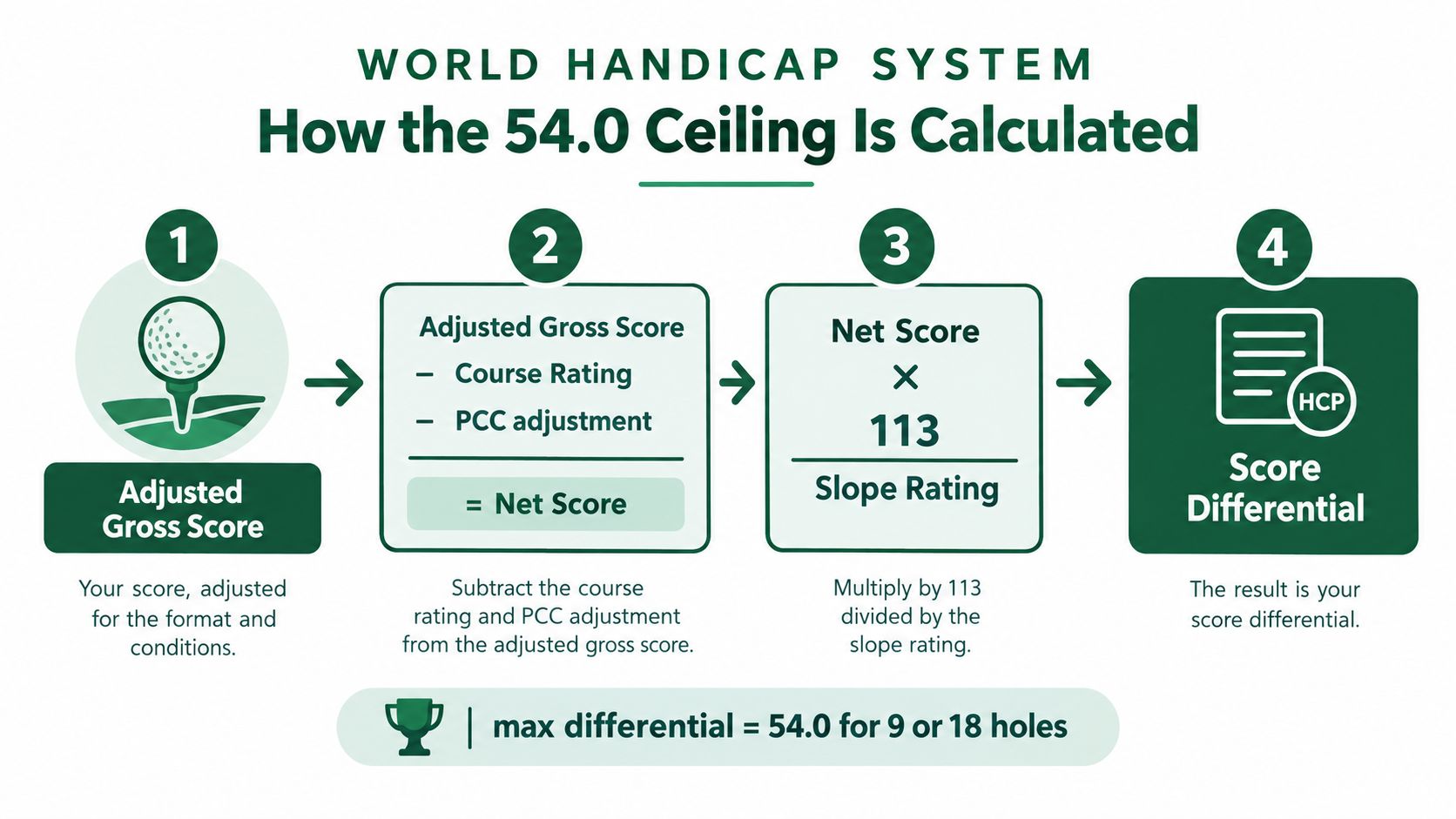
If you want the full mechanics in a simpler walkthrough, this article on how to calculate golf handicaps is a helpful companion for committee members who need the math without a rules seminar.
How the index is built
Once a player has enough scores in the record, the system uses the lowest eight score differentials from the most recent twenty, averages them, multiplies by 0.96, and truncates the result to one decimal place. That's the Handicap Index framework used under WHS.
For most golfers, that detail matters less than the purpose behind it. The system is trying to reflect demonstrated ability, not one lucky round and not one ugly blow-up day either.
Here's the practical organizer's takeaway:
Differentials drive the Index
Recent better scores matter most
The final Index can't exceed 54.0
Where the soft cap and hard cap fit
The soft cap and hard cap don't create the 54.0 maximum. They control how quickly a player's Handicap Index can rise relative to that player's recent low point.
The USGA Rules of Handicapping define the cap procedure with two trigger points. A soft cap begins when a newly calculated Handicap Index rises more than 3.0 strokes above the player's Low Handicap Index, and the hard cap applies if the increase reaches 5.0 strokes after the soft-cap adjustment, according to the 2024 USGA Rules of Handicapping PDF.
A lot of committees confuse the cap system with the max golf handicap. They're different controls. One limits upward movement from a player's own low point. The other is the overall system ceiling.
For a league secretary, that matters because the 54.0 maximum is only one control. A player's Index may also stop climbing sooner because the cap procedure steps in first.
Why organizers should care
If you're setting flights or running net divisions, you don't need to do this math by hand. But you do need to understand what the numbers are telling you.
A player can have a very high pattern of posted scores and still land at 54.0, because that's the top of the Handicap Index scale. Another player might not be near 54.0 at all, but may still be limited by the soft cap or hard cap after a rough stretch.
For organizers, that means two players with similar recent struggles might not arrive at the same competition number for the same reason. One has reached the system ceiling. The other has run into the rise-limiting cap procedure.
Before and After 2020 How the Maximum Changed
A common tournament-day problem starts like this. A player enters with a Handicap Index in the high 40s, and someone on the committee says, “That can't be right. The old max was lower.” If your club has archived signup forms, old bylaws, or longtime members working from memory, that confusion usually traces back to the 2020 switch to the World Handicap System.
Before 2020, the USGA system did not use one top-end limit for everyone.
The old limits versus the current one
Under the pre-2020 USGA system, the maximum Handicap Index was 36.4 for men and 40.4 for women. After the World Handicap System took effect in January 2020, the maximum became 54.0 for all golfers.
System | Men's Max Index | Women's Max Index | Universal Cap | Effective Date |
|---|---|---|---|---|
Pre-2020 USGA system | 36.4 | 40.4 | No | Before January 2020 |
World Handicap System | 54.0 | 54.0 | Yes | January 2020 |
The practical change is easy to miss. The old system had different ceilings by gender. The current system uses one ceiling for everyone, which makes mixed fields easier to administer and easier to explain.
A useful comparison is a building with old door frames and a new code. Under the old code, some doors were built to one height and others to another. WHS reset the standard so every door uses the same measurement. That does not tell you who should walk through that door in your event. It only tells you the maximum size allowed by the handicap system itself.
Why that change mattered to event setup
For players, the update expanded access to an official index at the top end.
For organizers, the bigger question is policy. A system maximum of 54.0 does not require every event to accept entrants all the way to 54.0. It only defines the outer edge of the handicap framework. Your committee can still set a lower entry cap if that fits the format, pace-of-play expectations, prize structure, or the number of strokes a net competition is built to absorb.
That distinction matters because committees often mix up two separate decisions:
System rule: the Handicap Index scale now goes to 54.0 for all golfers
Event rule: your competition may choose a lower limit for entry or for net scoring purposes
Those are not the same rule. One comes from the handicap system. The other comes from the committee.
What organizers should check in old event documents
If you review pre-2020 documents, do not just search for the word “maximum.” Read the sentence around it. Some older materials were describing the handicap system. Others were really setting an event policy, even if they did not label it clearly.
Check for outdated wording in places like:
Entry forms that still list old top-end Handicap Index numbers
Committee manuals that refer to separate men's and women's ceilings
League sheets that copied pre-2020 limits without updating the reason for them
Net competition terms that intended to control fairness, but phrased that control as if it were a system rule
A clean rewrite solves a lot of future arguments. If your event wants a lower cap, say so directly: “This competition accepts entries up to X.X Handicap Index,” or “Net prizes will be calculated using a maximum Playing Handicap of X.” That keeps the committee's design choice separate from the WHS maximum.
That separation becomes even more important once you start dealing with players whose indexes are rising or compressing for other reasons. A player can live under the 54.0 ceiling and still be affected by the handicap controls discussed earlier. For a tournament director, the lesson is simple. First identify the system maximum. Then decide whether your event needs a lower practical maximum of its own.
Per-Hole Scoring Limits That Keep the Cap Honest
A tournament director usually sees this problem on the scorecard first. One player makes a 12 on a par 4, another makes a 10 on a par 3, and someone in the shop asks, “Will those holes blow up their handicap?”
Usually, no. The World Handicap System has hole-by-hole posting limits so one bad hole does not outweigh the rest of the round. That matters for players trying to keep an accurate Handicap Index, and it matters for organizers who need a clean answer when scores are posted after an event.
Established players use net double bogey
For a golfer with an established Handicap Index, the maximum score posted on any hole is net double bogey, according to the USGA FAQ on maximum hole score. In plain terms, start with par, add two strokes, then add any handicap strokes the player receives on that hole.
That sounds technical until you run one example.
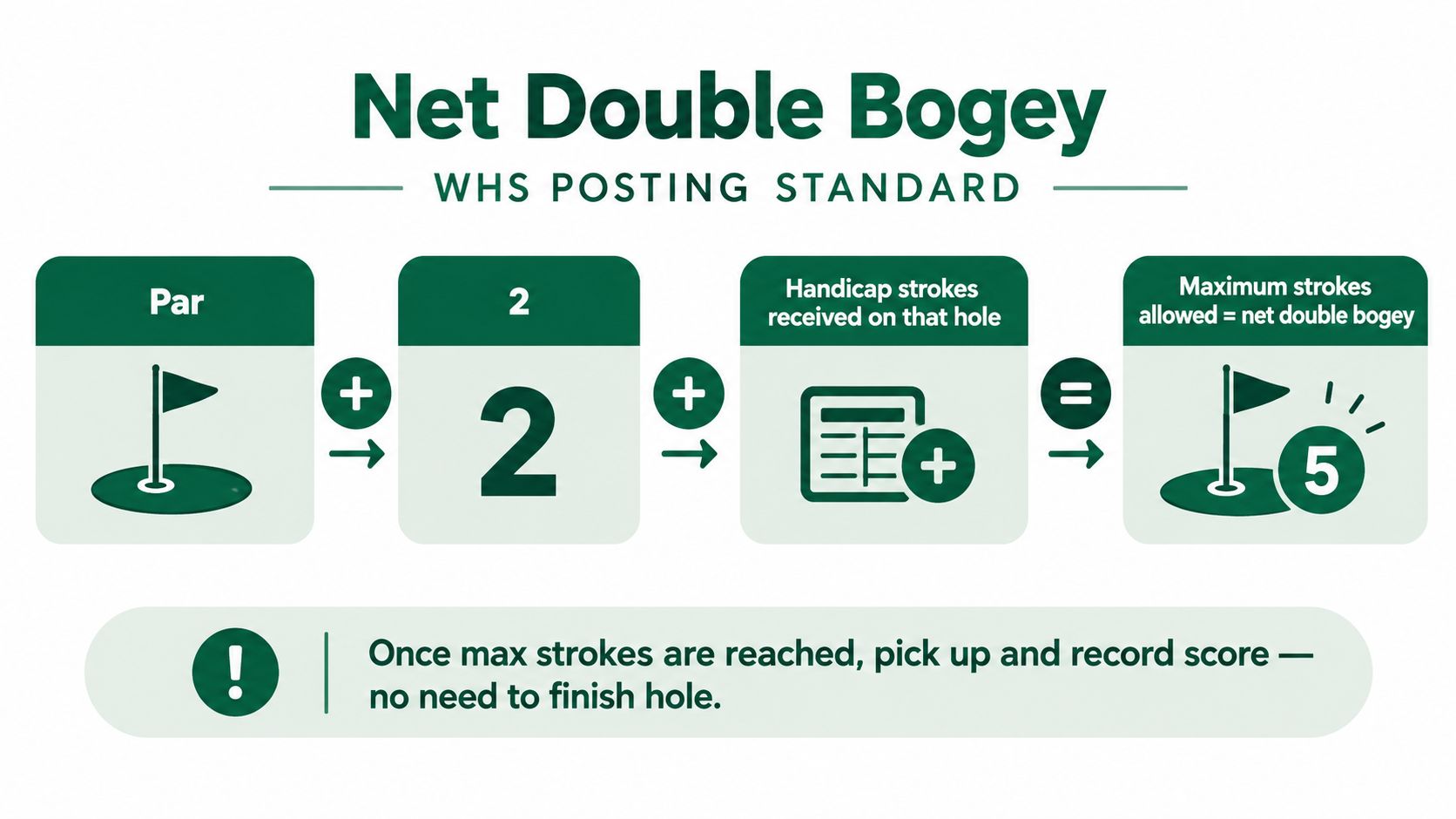
If a player has a Course Handicap of 15 and is on a par 4 with stroke index 10, that player gets one handicap stroke there. So the posting cap is 7. Par 4, plus 2, plus 1 more stroke.
A good comparison is a circuit breaker in an electrical panel. The ugly number still happened in the competition, but the handicap record stops that one hole from overloading the player's scoring history.
New players use par plus five
A player who has not yet established an initial Handicap Index uses a simpler limit. The posting maximum is par plus five on each hole.
That temporary rule helps beginners and the staff helping them. You do not need to calculate handicap strokes hole by hole before the player even has an index. You just use a plain ceiling until enough scores are in the system.
If your volunteers need a plain-language refresher, this guide to golf equitable stroke control and score caps explains how score adjustments work when players post rounds.
Why organizers need to separate posted scores from competition scores
This is the point that creates the most confusion in events. The player's competition score and the player's handicap posting score are related, but they are not always identical.
Record what the player made in the event.
Then apply the hole limit only when the round is posted for handicap purposes. If a player makes 10 on a hole and the posting cap is 7, the event result still shows 10. The handicap record uses 7 for that hole.
For league captains and tournament directors, that distinction solves two common problems:
Handicap records stay reasonable because one disaster hole does not inflate an index more than the system allows
Event administration stays consistent because the committee is not rewriting competition results after the round
This also connects to the practical cap question organizers care about. Per-hole limits keep posted handicaps from drifting too high because of a few blow-up holes. They do not answer whether your event should accept every player up to 54.0. That is a committee choice tied to format, prizes, and the spread of abilities in the field.
Should Your Tournament Set a Lower Cap Than 54
For event design, this is the question. The system maximum exists so golfers can hold a valid Handicap Index up to 54.0. It does not tell you what your event ought to allow.
A good committee treats 54.0 as a safety net, not a default recommendation.
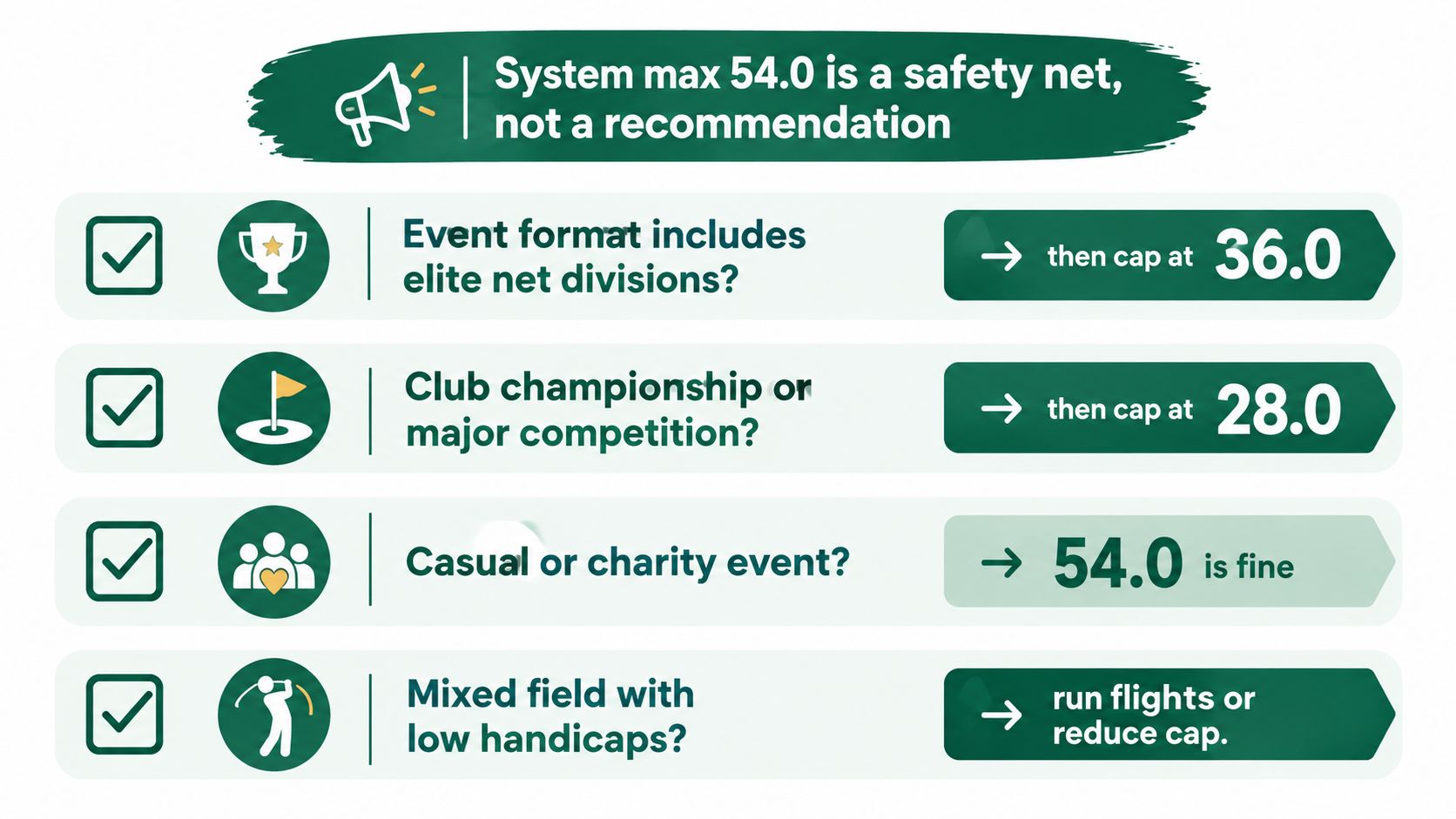
Match the cap to the format
The fairest event policy usually starts with one question: what are you trying to reward?
If you're running a serious club major or a top net division, you're usually trying to identify the strongest competitive performance in a relatively tight field. In that setting, a lower cap often protects the integrity of the division and reduces the strain that wide handicap spreads put on scoring and pairings.
For casual member events, mixed social days, and beginner-friendly formats, inclusivity often matters more. A broader cap makes sense there.
A simple way to consider it
Club championship or serious major
Use a lower cap than the system maximum. Many committees choose a conservative limit for these events.Member-guest or charity outing
A middle-ground cap often balances inclusion with competitive stability.Recreational scramble or welcome event
Using the full max golf handicap can be perfectly reasonable.
Entry cap and playing handicap are separate decisions
A committee also needs to decide whether it is capping the entry or capping the competition number used for scoring.
Those are two different policy tools.
For example, a committee might let every validly handicapped member enter, but cap the Playing Handicap used in a net division. Another committee may set an entry maximum and keep the playing calculation untouched.
Both approaches can work if you publish them clearly before registration opens.
Where soft and hard caps fit into event policy
Soft caps and hard caps don't replace event design. They only regulate how a player's Handicap Index rises within the handicap record.
That means a player who has a valid, capped handicap under WHS may still be too high for one event and totally appropriate for another. Committees shouldn't assume the handicap system has already solved the competition-design problem for them.
Publish two things every time: the maximum handicap allowed for entry, and the exact method used to turn that handicap into the number that will be used for scoring.
A short committee checklist
Before you release the notice for a net event, answer these questions in writing:
Who is this event for
Strong competitors, mixed members, beginners, guests, or charity participantsWhat handicap number controls entry
Handicap Index, Course Handicap, or Playing HandicapWill you set a lower cap than the system maximum
If yes, state the number plainlyHow will the competition number be calculated
Full handicap or a committee allowanceWill you split flights
If the field spans a wide range, flights often solve fairness better than one giant net division
That level of clarity prevents almost every scoring-table dispute later.
Running Inclusive Events With Mixed Handicap Ranges
Mixed-ability golf is normal now. One team may include a player with a low index and another still learning how to manage doubles and triples. That doesn't mean the event is doomed. It means the format and administration have to do more work.
The World Handicap System has also spread broadly across the game. By May 2025, 131 national associations and countries had adopted the system, according to the World Handicap System site. As shorter-course rating and mixed-format updates continue, organizers need practical ways to run inclusive events without turning the scoring into chaos.
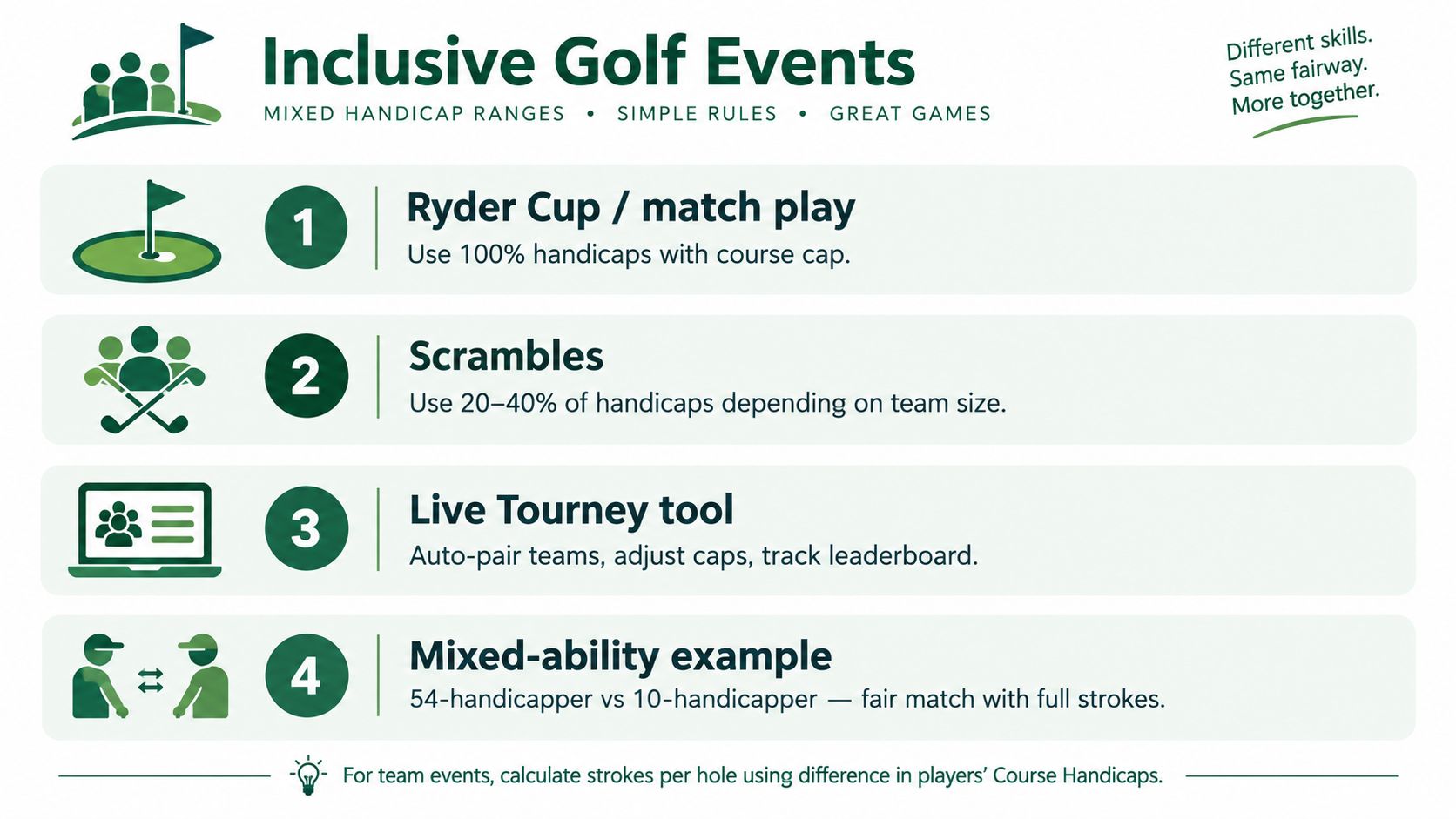
Choose the right format for the handicap spread
A wide handicap gap is easier to manage in some formats than others.
Match play handles mixed ability well because the strokes are distributed hole by hole. A stronger player and a newer player can still have a legitimate contest if the committee uses the proper competition handicaps.
Ryder Cup-style team formats also work well because they spread responsibility across partners and sessions. One uneven pairing doesn't control the whole event.
Scrambles are often the easiest place to be inclusive. The format naturally reduces the effect of one weak hole or one nervous player.
Build structure around the field
If one side of your event includes a player around a 10 index and another includes a player around a 45 index, fairness won't come from one magic cap alone. It comes from structure.
Use some combination of these:
Flights: Split strong net players from developmental players when one leaderboard would create too much spread.
Separate leaderboards: Keep gross and net recognition distinct so beginners feel included without distorting the elite side of the event.
Published allowances: State the event formula clearly before the round.
Pairing logic: Put steady players with newer golfers when pace and scoring confidence matter.
Tools matter when the field gets complicated
This is also where tournament software starts earning its keep. In mixed-ability events, organizers need handicap conversions, format rules, pairings, and live scoring to stay aligned.
One practical option is Live Tourney, which can handle tournament setup, pairings, and live scoring in formats like match play, Ryder Cup, leagues, and outings from a web-based workflow. For clubs that also brand charity or member-guest events, it can help to keep your merchandise planning organized too. If you're coordinating player gifts or team identifiers, this guide to buying golf hats in bulk is a useful operational resource.
Inclusive events don't get easier when you ignore the handicap spread. They get easier when you choose a format that can absorb it.
The goal isn't to pretend every field should use the same cap. The goal is to write conditions that fit the field you have.
If you're building events for players across a wide handicap range, Live Tourney gives you a clean way to manage pairings, scoring formats, and live leaderboards without making players fight the process. It's a practical fit for leagues, net competitions, scrambles, and team events where the max golf handicap is only the starting point and the work is in applying the rules clearly.