Oct 14, 2026
lift clean and place, golf tournament rules, preferred lies, golf local rules, tournament management
Master lift clean and place procedures for golf tournaments. Learn exact steps, local rule wording, and how to manage scoring with modern digital tools.

Rain has settled over the course, carts are moving slowly, and players are asking the same question at the first tee: “Are we playing winter rules today?” For a tournament director, that question needs a precise answer before the first ball is struck. Lift clean and place can protect fair competition and prevent mud from turning every approach into a lottery, but only when the committee defines, announces, and administers it consistently.
The strongest events treat preferred lies as a controlled tournament procedure, not an informal courtesy. The wording on the conditions sheet, the starter's briefing, the scorecard, and the scoring platform should all match.
Understanding the Lift Clean and Place Exception
Golf's central principle is simple: play the ball as it lies and the course as you find it. Lift clean and place is a limited exception to that principle. It gives the committee a way to address adverse conditions, especially when extreme wetness causes mud to adhere to the ball and materially affects play.
The governing rules added an optional provision in 1960 for tournament officials to permit players to lift, clean, and replace a ball when conditions justified it, as described in Golf Digest's historical account of lift, clean and place. The important administrative point is that the provision was discretionary. A player couldn't claim the benefit just because the ball was dirty, and a course couldn't assume that “winter rules” applied throughout the season.
Why the committee must decide
The procedure changes the competitive effect of weather and course maintenance. Without the local rule, mud can alter ball flight, affect lie quality, and make club selection less predictable. With the rule in force, players receive a defined opportunity to restore the ball and, where permitted, move it within a specified relief area.
That difference explains why elite championships have generally avoided the procedure. The USGA has historically declined to use it in the U.S. Open, and the PGA of America and USGA have also avoided it in their championships. Those events generally preserve the challenge of playing the ball as it lies, even in difficult conditions.
For club competitions, leagues, charity outings, and affected courses, the decision is more practical. The committee must judge whether mud is widespread enough to make the competition unfair or whether the rule would offer an unnecessary advantage.
Administrative principle: A dirty ball doesn't activate the rule. The committee's adopted Local Rule does.
The 2004 changes reinforced that formal approach. Players were required to mark the ball before lifting and placing it, and the governing bodies recognized lift, clean and place as a Local Rule option when adverse conditions justify it. That framework gives tournament directors authority, but it also puts the burden of precise administration on the committee. The same discipline used to manage stroke and distance procedures should apply here: define the exception before play and make its limits visible to everyone.
Executing the Correct Procedure on the Course
Once the Local Rule is active, players still have to follow a controlled physical process. Most disputes happen because someone lifts first and tries to reconstruct the original lie afterward. That sequence is backwards.
The player's on-course sequence
Confirm that the Local Rule applies. The rule might cover fairway-height grass or another area specified by the committee. It doesn't automatically extend to the rough, hazards, or every part of the general area.
Identify the original position. The player should establish exactly where the ball lies before touching it. A nearby marker, coin, or tee can make the reference clear.
Mark the ball's position before lifting. Under the preferred-lies procedure, marking is not a courtesy. It protects the original location and gives the committee a reliable reference if another player or official questions the placement.
Lift and clean the ball. Cleaning is permitted because the adopted Local Rule creates that exception for the specified situation. It doesn't create a general right to clean a ball anywhere on the course.
Choose a legal spot within the stated relief area. The ball must remain within the committee's distance, such as six inches, one scorecard length, or one club-length. The chosen spot can't be nearer the hole.
Place the ball once. The player sets the ball down in the selected spot and lets it go. Rolling it with a club, nudging it into position, or repeatedly trying different locations isn't the authorized procedure.
Play the ball as it lies after placement. Once placed, the ball is in play. The player doesn't receive another preferred-lie opportunity for the same stroke.
What staff should reinforce
The most useful pre-round reminder is short: mark first, move only within the stated area, don't move nearer the hole, and place once. Officials should also explain why the procedure matters. Marking protects the original lie, while the single placement limits players from searching for an increasingly favorable position.
Under USGA guidance, failing to mark before lifting or moving the ball by rolling it with a club instead of following the authorized procedure results in a one-stroke penalty. Staff should communicate that consequence without turning the briefing into a rules lecture. A clear demonstration at the practice area or first tee often prevents more confusion than a long announcement.
Drafting the Official Local Rule for Your Event
The committee's wording should answer four questions before a player reaches the first affected lie: when does the rule apply, where does it apply, how far may the ball move, and what procedure must the player follow?
A vague notice such as “winter rules today” leaves players to fill in the gaps. One player may assume the rough is included, another may use a club-length relief area, and a third may roll the ball into place. Those inconsistencies create rulings, delays, and avoidable arguments.
Set the conditions in writing
The committee should decide the rule before the round begins. USGA guidance says preferred lies may be adopted when widespread conditions make fair play difficult or help protect the course, and recommends limiting the rule in duration and deciding it daily. In stroke play, the Local Rule shouldn't be introduced after the round has begun.
The event's conditions sheet and player communications should identify:
Effective status: State plainly that the Local Rule is in force for the round.
Eligible area: Define whether it applies to fairway-height or shorter grass in the general area, or another precisely described area.
Relief distance: Specify the permitted distance, such as six inches, one scorecard length, or one club-length.
Direction restriction: State that the ball may not be placed nearer the hole.
Placement method: Require marking before lifting and one placement within the defined area.
Exclusions: Clarify whether the rule doesn't apply in the rough, penalty areas, bunkers, or on putting greens.
Use the same wording everywhere
Publish the wording on the conditions sheet, include a concise version on the scorecard, and give starters a spoken version they can repeat consistently. The digital scoring page should display the same relief distance and eligible areas, rather than forcing players to search through a separate document.
A practical notice might read:
Preferred Lies Local Rule: When this Local Rule is in effect, a ball in the specified fairway-height area may be lifted, cleaned, and placed within [committee-defined distance], not nearer the hole. The ball's original position must be marked before lifting. The ball must be placed once and may not be rolled or nudged into position. The Local Rule applies only to the areas identified by the Committee.
The bracketed distance and area must be replaced with the event's actual decision. Don't publish alternatives that leave players guessing.
The scoring desk also needs a copy of the final language. That connection matters because accurate tournament scoring procedures depend on staff knowing which conditions governed the round. If a ruling reaches the desk, the official should be able to confirm the rule's status and scope without relying on a verbal recollection.
Navigating Common Misconceptions and Penalties
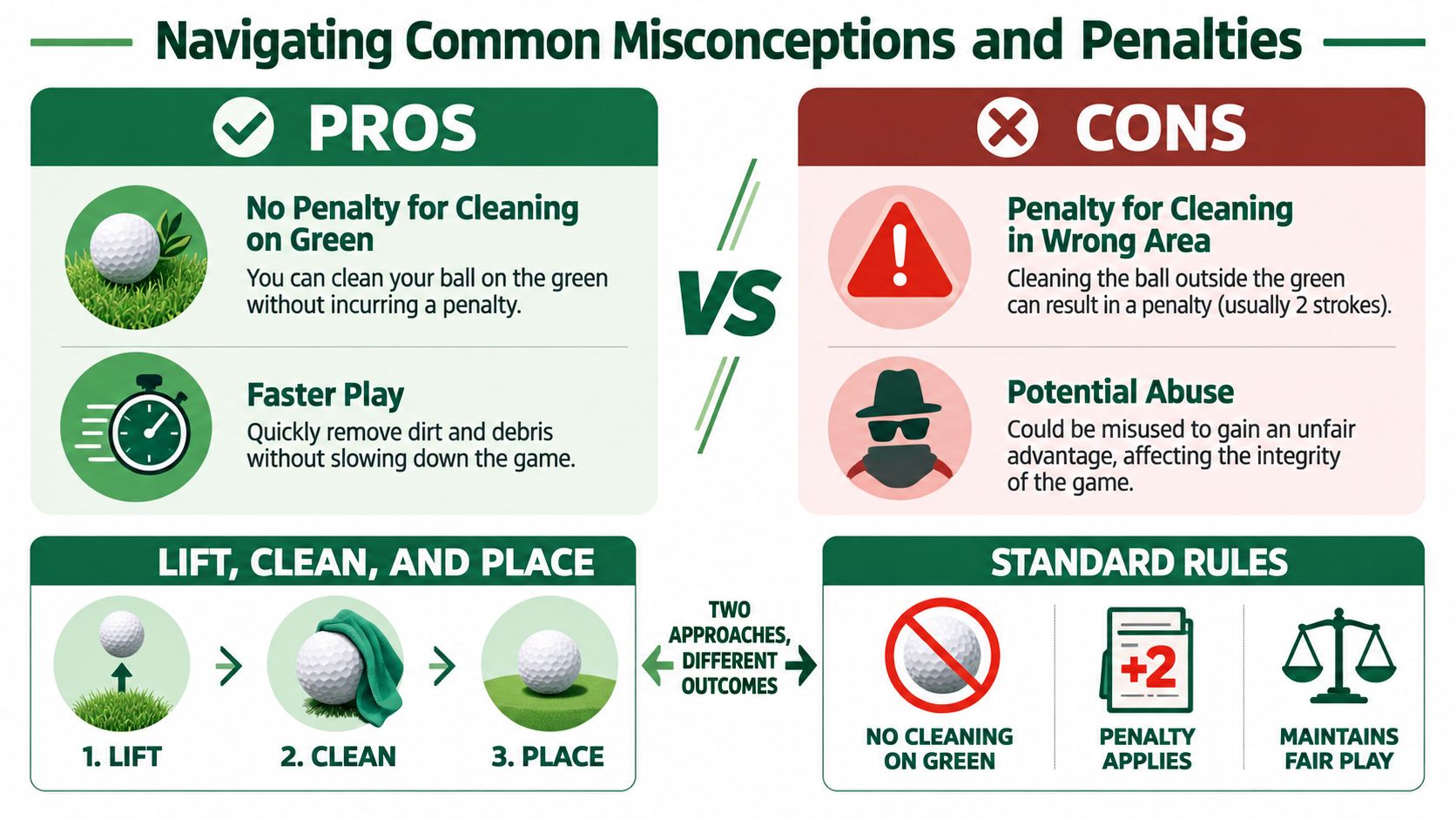
The phrase “lift, clean and place” sounds simple, but players often combine parts of several different rules. A ball on the putting green may be cleaned when lifted under the ordinary rules. A ball lifted to identify it, check for damage, assess interference, or determine a relief condition can carry different cleaning restrictions. Preferred lies are a separate committee-authorized exception.
The easiest way to resolve confusion is to compare the situations directly:
Situation | What controls the procedure |
|---|---|
Ball on the putting green | Standard putting-green rules govern lifting, cleaning, and replacing |
Ball lifted for identification or assessment | The applicable reason for lifting controls whether cleaning is allowed |
Preferred lies in an eligible area | The adopted Local Rule controls cleaning, movement, distance, and placement |
Ball in an area excluded by the committee | The player generally plays it as it lies, subject to another applicable Rule |
Errors officials see most often
Lifting without marking is the classic mistake. A player may remember the original spot perfectly, but the required procedure still calls for marking before lifting when the ball must be replaced or placed under the relevant rule.
Rolling or nudging the ball creates another problem. A player can't use a clubhead to move the ball through the relief area and then claim that the final position was within the limit. The player must place it once.
Moving nearer the hole is prohibited even when the new position looks better only because it avoids a puddle or poor patch of turf. The relief area is a boundary, not a search zone for the most favorable lie.
Cleaning outside the authorized scope also causes disputes. A player in the rough can't assume that a fairway preferred-lies rule follows the ball there. Likewise, the Local Rule doesn't automatically authorize cleaning while a player is lifting for identification or to assess a relief condition.
Rules desk response: First establish why the ball was lifted. Then establish whether the committee's Local Rule covered that location. Only after those two answers should staff evaluate the placement.
Officials should record the facts rather than debate intent. Note the original lie, whether the ball was marked, the area in which it lay, the distance authorized, and what the player did after lifting. That record produces a consistent ruling and helps the committee identify whether a communication problem affected several groups.
Managing Digital Scorecards and Live Leaderboards
A wet morning can turn digital scoring into a liability. Phones get soaked, batteries run down, cellular service drops, and players may not know the scoring interface. Configure the system to display the active Local Rule where players enter or review scores, while the scoring desk keeps the official conditions sheet available for rulings.
A digital scorecard can reinforce the procedure by showing the relief area and eligible locations in the event instructions. See this guide to digital golf scorecards for setup details. Keep the preferred-lie decision in the tournament rules, rather than burying it in a group chat or treating it as an informal scoring note.
Treat live scores as communication, not final authority
A live leaderboard gives players, spectators, and staff useful visibility, but it does not replace marker responsibilities or end-of-round verification. Under the Rules of Golf, the marker must certify the player's scorecard, and the player must certify it before returning it to the committee. That certification process remains the basis for final scoring, even when hole scores appear online during play.
Label the leaderboard unofficial until the committee completes its review. Assign a scoring or rules desk to handle corrections, and limit notifications to meaningful updates so players are not repeatedly checking phones between shots. Real-time access should support the competition without slowing groups or distracting players from their responsibilities.
Build a dual-track fallback
The committee's Conditions of Competition should provide a backup scoring method when digital tools fail or a player cannot use them. Internet access may be needed for login, roster changes, and score submission, so the event should decide in advance how groups record scores during an outage.
Your fallback should be explicit:
No smartphone or dead battery: Provide paper scorecards or an administrator-operated device.
Weak service: Let the group record scores offline or on paper, then submit through the scoring desk.
Incorrect submission: Identify who can correct the entry and retain the original record.
Device failure: Reconcile the backup scorecard before results become official.
Player exclusion: Never penalize a competitor solely because the digital workflow failed.
Digital scoring can remain the primary channel, provided recovery is quick, transparent, and fair. The scoring desk should know who may edit an entry, where the original record is stored, and when a correction has been approved. That preparation protects both the leaderboard and the committee's final results.
Final Checklist for Tournament Directors
A wet morning doesn't have to produce a disorganized competition. Before the first group starts, the committee should be able to answer each point below without hesitation:
Make the decision early: Determine whether conditions justify the Local Rule before play begins.
Define the boundaries: Specify the eligible area, relief distance, exclusions, and no-nearer-the-hole requirement.
Publish one version: Match the conditions sheet, scorecard, starter announcement, and digital instructions.
Brief the field: Tell players to mark, lift, clean, place once, and play from the resulting lie.
Prepare officials: Give the rules desk a written copy and a simple process for recording disputes.
Protect scoring integrity: Label live results unofficial and verify scorecards before posting final results.
Keep a fallback ready: Maintain paper scorecards or an administrator-operated device for connectivity and access failures.
Review the day: Record recurring questions so future conditions sheets become clearer.

A properly managed lift clean and place policy does more than improve lies. It gives players a common procedure, helps officials resolve questions quickly, protects the course from unnecessary wear, and keeps the scoring operation aligned from the first tee to the final result.
Live Tourney helps tournament teams publish clear player instructions, manage digital scorecards, and keep live leaderboards visibly separate from verified results. Visit Live Tourney to see how its app-free scoring and tournament management tools can support a smoother preferred-lies event.