Jun 21, 2026
golf skins calculator, golf tournament software, skins game rules, golf payouts, live tourney
Learn how to calculate golf skins payouts with our step-by-step guide. Covers gross vs. net skins, carryovers, and how to use a golf skins calculator.

You've probably been there. The round is over, players are standing around the grill room, and someone asks the question that turns a fun side game into admin work fast: who won the skins, and who owes whom?
If everyone tied neatly and no handicaps were involved, you could settle it on a napkin. That's not how most real events go. Holes tie, skins carry over, net scoring changes the winner on a hole, and one bad handicap setup can undo the whole game. A good golf skins calculator fixes that, but only if you understand what the calculator is supposed to calculate.
How a Golf Skins Game Really Works
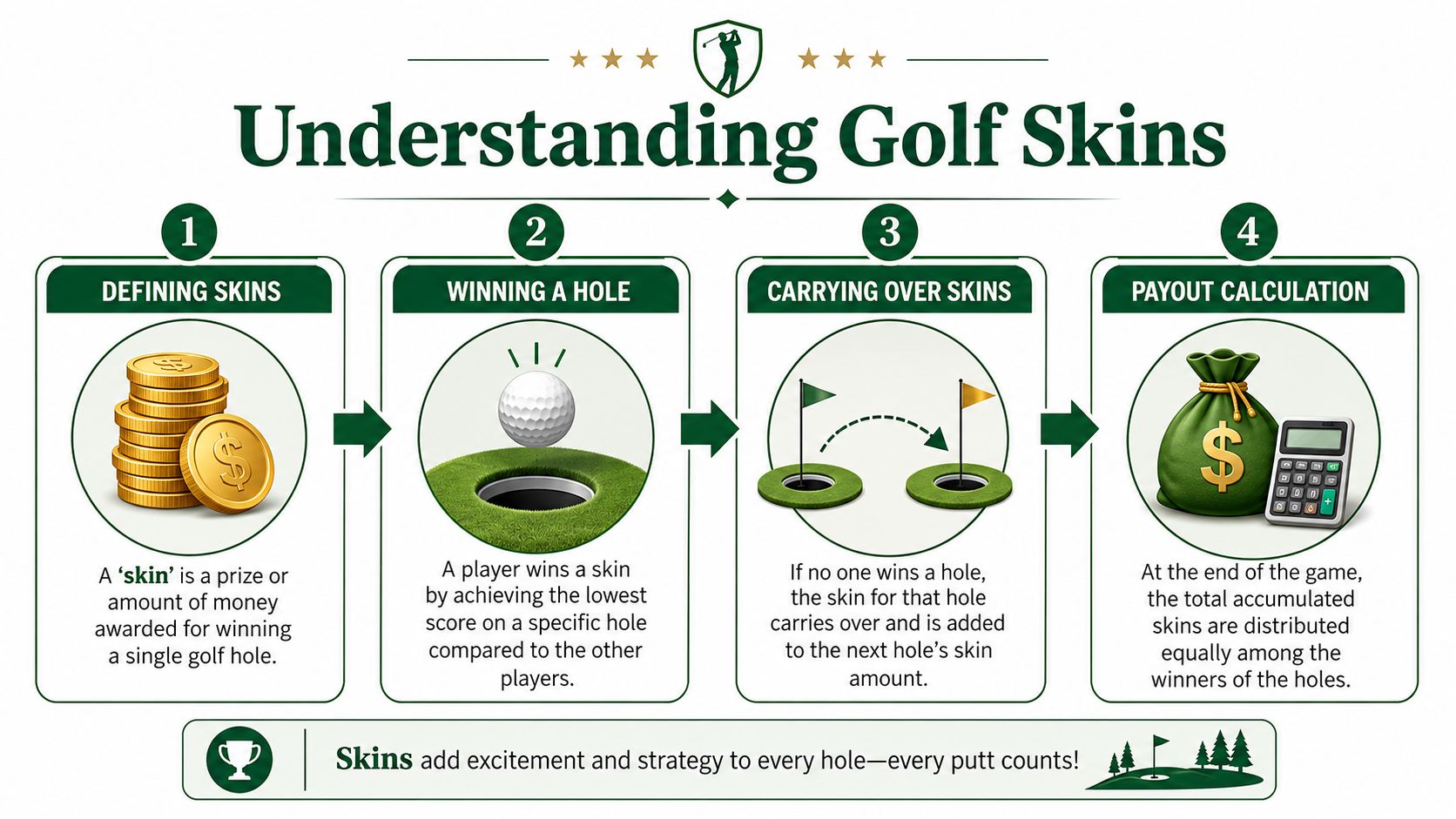
A skin is the prize attached to a single hole. In a skins game, each hole is worth one skin. To win that skin, a player has to win the hole outright. If the hole is tied, nobody wins that skin on that hole, and the value carries over to the next one.
That carryover rule is the entire reason skins are fun and the entire reason they become messy to score by hand. By the end of the round, a single hole can be worth far more than its original value because tied holes keep stacking into the next result.
Published rules summaries describe skins as a hole-by-hole betting game in which each hole is worth one skin, tied holes carry over, and the player with the most skins after 18 holes wins. They also note that the accounting becomes a post-round number-crunching exercise as carryovers accumulate, which is why organizers often rely on a calculator instead of manual score entry and settlement (Cattail Crossing on skins rules and strategy).
For a broader rules refresher, this guide to skins game rules in golf lays out the common structure clearly.
What counts as an outright win
The phrase that matters is outright. If one player posts the low score on the hole, that player wins the skin. If two or more players tie for the low score, the skin rolls forward.
That means a skins game doesn't reward “being tied for best.” It rewards being alone at the top on that hole.
A simple sequence looks like this:
Hole one has one skin available.
Two players tie for the low score. No winner. That skin carries.
Hole two now has the original hole-two skin plus the carried skin from hole one.
One player wins hole two outright. That player takes both skins.
Why manual tracking breaks down
Most scorekeeping mistakes happen because someone tracks scores correctly but tracks carryovers incorrectly. They remember who tied a hole, but they forget that the next hole now has extra value attached to it.
Practical rule: In skins, you're not just scoring holes. You're tracking a moving pot tied to each hole result.
That's why a golf skins calculator has to do more than store scores. It has to follow the hole-by-hole logic exactly, especially when a round includes multiple tied holes in a row.
Gross score and net score change the picture
In a straight gross skins game, the low raw score wins the hole. In a net skins game, handicaps are applied first, then the hole winner is determined based on the net result. That sounds simple until you start allocating strokes hole by hole.
If your event includes mixed ability players, that's where most payout disputes start. Not with the carryover itself, but with a disagreement over whether the right player won the hole.
Choosing Between Gross Skins and Net Skins
The first decision that matters isn't the pot size. It's whether the game is gross or net. Get that wrong and nothing else downstream is trustworthy.
Gross skins are simpler. Net skins are usually fairer.

When gross skins make sense
Gross skins use each player's raw hole score. Lowest score on the hole wins, assuming it's an outright win. This is the cleanest format to run because there's no handicap setup, no stroke allocation, and no debate over whether the calculator applied the competition allowance correctly.
Use gross skins when:
The field is tight in ability. A scratch player and a higher-handicap player usually shouldn't be in the same gross skins pool unless everyone understands the imbalance.
You want speed. Gross scoring is easier for casual groups, member games, and small side pots.
You don't have confidence in handicap data. Bad handicap input ruins net skins much faster than it ruins almost any other side game.
Why most organized events should use net skins
If your event has mixed-ability players, net skins usually produce the fairest competition. The challenge is that many events say they're running net skins without using a clean WHS method.
The proper workflow is straightforward in principle but easy to botch in practice. Organizers need to convert a Handicap Index to a Course Handicap, optionally apply a Playing Handicap allowance such as 95%, then allocate strokes by stroke index before comparing net scores hole by hole. That method is especially important for mixed-ability groups because net skins are commonly used to make the game fairer, but it's also where confusion usually starts (Golf Handicap Calculator on net skins under WHS).
If you need a quick refresher on the scoring side, this explanation of net score in golf is a useful starting point.
The WHS setup that actually works
Most tournament problems come from skipping one of these steps:
Start with the right handicap source. Use the player's Handicap Index from the event's accepted source.
Convert it for the tees being played. Net skins should reflect the tees in use, not a generic handicap number someone remembers from another round.
Decide whether your event uses a Playing Handicap allowance. If your competition policy applies an allowance, define it before play starts and apply it consistently.
Allocate strokes by stroke index. Net skins are won on holes, so hole-by-hole stroke allocation is essential.
If your committee can't explain which handicap number is being used and how strokes are assigned on each hole, the net skins result won't hold up when players question it.
What works and what doesn't
What works is a rules sheet that states the basis clearly. Gross or net. Which handicaps are used. Which tees. Whether an allowance applies. How ties carry.
What doesn't work is saying “we'll just use handicaps” and sorting it out after the round. That approach almost always creates a protest on one or two holes, usually when a carryover makes the disputed hole more valuable.
Here's the blunt version. Gross skins test raw scoring. Net skins test setup discipline. If you want fairness, use net. If you use net, set it up like you mean it.
A Worked Example of Manual Skins Calculation
A manual skins sheet looks easy until the first carryover and the first handicap-adjusted tie land on the same card. Then someone starts erasing.
The example below uses a foursome over a short stretch of holes to show how quickly a simple game becomes a tracking exercise. The structure mirrors the kind of score sheet people still try to run by hand after a member game.
Sample skins table
Hole | Player A Score | Player B Score | Player C Score | Player D Score | Hole Winner | Skins Won | Pot Value Carried Over |
|---|---|---|---|---|---|---|---|
1 | 4 | 5 | 4 | 6 | Tie A and C | 0 | Carries to next hole |
2 | 5 | 4 | 5 | 5 | Player B | 2 | Reset after win |
3 | 3 | 3 | 4 | 4 | Tie A and B | 0 | Carries to next hole |
4 | 5 | 4 | 4 | 5 | Tie B and C | 0 | Carries to next hole |
5 | 4 | 5 | 3 | 4 | Player C | 3 | Reset after win |
6 | 5 | 5 | 5 | 4 | Player D | 1 | Reset after win |
The table title in plain language would be Sample Skins Calculation for a Foursome ($20 Pot, $5/player). You can see the logic even without getting buried in settlement math: tied holes don't disappear. They accumulate.
What the manual scorer has to track
Hole 1 is tied by A and C. No skin is awarded. Hole 2 is now worth the skin from hole 2 plus the carried skin from hole 1. B wins outright, so B takes both.
Hole 3 ties again. Then hole 4 ties again. By the time the group reaches hole 5, there are multiple skins stacked on that result. C wins hole 5 outright and sweeps the accumulated value.
That's the point where paper scoring usually starts to wobble. People can see who birdied the hole. They often lose track of how many skins that birdie just captured.
Why net skins make this harder
Now layer in handicaps. Suppose on hole 4 one player receives a stroke on that hole and another does not. A gross tie may become a net win. A gross win may become a net tie. Once that happens, the carryover path changes.
That's why a reliable golf skins calculator has to model hole-by-hole carryover logic and keep the scoring basis tied to the handicap setup. If no player wins a hole outright, the value has to roll forward and be added to the next hole. The main operational risk is incorrect handicap setup for net skins, and stronger tools address that by integrating handicap settings directly into the skins calculation engine so payout mistakes don't get baked in from the start (Golf Skins Calculator on carryovers and handicap integration).
The dangerous error isn't usually arithmetic. It's a rules error that looks like arithmetic after the fact.
Where groups usually make mistakes
I've seen four recurring failures in manual skins work:
Someone resets the pot too early. A tied hole gets treated like a dead hole instead of a carryover.
A hole winner is determined on gross when the game was set as net. That changes every carryover after it.
Strokes are applied inconsistently. One scorer uses the hole handicap correctly, another uses total handicap loosely.
The final settlement gets reversed. Players know who won holes but not who owes whom after the total is netted out.
Manual scoring can still work, but only under tight conditions
If you're running a very small game, gross only, with everyone clear on the carryover rule, paper can survive. Once you add net scoring, multiple groups, or a side game with any complexity, a golf skins calculator stops being a convenience and starts being a control.
Use manual scoring when the game is simple enough that every player can audit the result at a glance. If that isn't true, the process is already too fragile.
Handling Skins Game Variations and Edge Cases
Standard skins rules are only half the job. Real events always produce the awkward questions. What happens if the last hole ties? What if your groups have different player counts? What if the committee wants a variation that changes carryovers?

Published calculator tools in the market commonly support 2-6 players and can handle gross or net skins, carryovers, and related side-game variations. That flexibility matters because event disputes usually come from inconsistent setup rather than from the basic concept of who won the hole (AthletePath on skins and Wolf calculator options).
The tied final hole problem
If the last hole ties and there's still value in the pot, your committee needs a prewritten rule. Don't leave this to a parking lot discussion.
Common house approaches include:
Carry ends with the round. Unwon skins are split by a stated method.
Validation required. A player must win a later designated condition to claim the carry.
Playoff or designated tiebreak. More common in formal events than in casual games.
The right answer isn't universal. The important part is consistency. If the rule isn't written before the first tee time, players will assume the interpretation that helps them.
No-carryover and validation formats
Some events don't want rolling pots at all. They want a simpler side game. In those cases, the committee may use a no-carryover format or a validation rule.
A no-carryover format keeps each hole self-contained. That reduces complexity but also removes the drama that makes skins attractive in the first place.
Validation rules add another layer. A player may need to win the hole outright and satisfy a separate event condition, depending on house policy. That can be useful in some club games, but it needs to be stated in writing because players won't infer it correctly.
Write the side-game rule the same way you'd write a competition condition. Short, specific, and impossible to reinterpret later.
Different group sizes and mixed formats
Skins doesn't have to be limited to a foursome. The bigger issue is whether your event uses the same rules in every group.
Use this checklist before play starts:
Player count consistency. If some groups have fewer players, decide whether they compete in the same skins pool or a separate one.
Scoring basis alignment. Every group must use the same gross or net method.
Stroke application consistency. Mixed tees and mixed abilities increase the risk of a hole being scored on different assumptions.
Carryover policy. Every group needs the same tie treatment.
If your software or worksheet can't standardize those inputs, it won't matter how clean the score entry is. You'll still end up arguing over rule interpretation instead of settling payouts.
How to Automate Payouts with Live Tourney
Golf has had dedicated skins calculator apps on both iOS and Android for over a decade, which tells you the need isn't new. Organizers have long needed a practical way to calculate who owes whom after a skins round. The difference now is that tournament platforms can fold that job into the same workflow used for setup, scoring, and payout administration (Soft112 listing for Golf Skins Calculator history and app availability).

What automation should handle
A real golf skins calculator needs to do more than total scores. It should handle the parts people get wrong when they're rushed after the round:
Players and groups. Enter the field cleanly and tie the side game to the right participants.
Gross or net basis. The scoring method should be defined before scores arrive.
Hole-by-hole carryovers. The pot should move automatically when a hole ties.
Final settlement. The system should determine who won and who pays whom without a separate spreadsheet.
That's the practical threshold. If a tool still requires staff to rebuild carryovers or handicap strokes manually outside the system, it isn't solving the core problem.
What a cleaner workflow looks like
The better setup is simple.
First, establish the event rules before anyone plays. Decide whether the skins game is gross or net. If it's net, make sure the handicap inputs match the tees and competition policy being used for the event.
Next, enter hole-by-hole scores once. From there, the system should calculate the side game from the same score data instead of forcing staff to re-enter numbers into a separate worksheet or calculator app.
Finally, review the output with one question in mind: does the result reflect the rules the committee announced at the start? If the answer is yes, payout becomes an admin confirmation rather than a debate.
Where Live Tourney fits
For organizers who want that process inside a broader event workflow, Live Tourney includes payout tooling that can sit alongside tournament setup and scoring rather than being handled as a separate afterthought. The practical advantage is that a side game like skins can be managed from the same event environment instead of being split across paper sheets, text threads, and a second calculator.
Its payout approach is most useful when you're already trying to standardize event rules and reduce duplicate entry. That matters even more for skins because one mismatch in gross versus net treatment changes the result hole by hole.
If you're comparing ways to structure side-game settlements, this guide to golf tournament payouts is a useful reference point.
Good automation doesn't replace the rules committee. It enforces the committee's choices consistently.
What not to do
Don't use one system for the main event and a different ad hoc method for skins unless somebody is responsible for validating that both use the same handicaps, player list, and scoring basis.
Don't let each group “keep its own version” of skins and try to reconcile later.
And don't assume that because a tool can display scores, it can calculate side games correctly. In skins, carryover logic and handicap logic are the whole product.
Run a Better Skins Game Today
A skins game should add pressure and fun to the round. It shouldn't create a payout argument when the cards come in.
The basics are simple enough. A skin is attached to a hole. An outright winner takes it. A tie carries value forward. What makes the game hard to administer isn't the concept. It's the combination of carryovers, hole-by-hole scoring, and net handicap application when the field has mixed ability.
That's why the practical question isn't whether you can calculate skins manually. You usually can. The key question is whether your process holds up when there are multiple groups, tied holes, net scoring, and players who want to understand exactly why a hole was won or tied.
Run gross skins when simplicity matters most and the field is comparable. Run net skins when fairness matters and you're prepared to set handicaps up correctly under WHS procedures. In both cases, write the rules before play starts, standardize them across every group, and use a golf skins calculator that follows the same logic your committee intends to enforce.
That's how you keep the focus where it belongs. On the golf, not on post-round accounting.
If you want to run skins, payouts, and live scoring from one place, Live Tourney gives tournament staff a web-based way to manage the event workflow without relying on paper sheets and separate side-game math.