
Aug 1, 2026
sandbagging, golf handicaps, tournament director, handicap cheating, golf integrity
Learn how to identify and prevent sandbagging in golf to ensure fair play and accurate handicaps in your tournaments.

You know the scene. The final net scores are posted, somebody who was never in the conversation wins the club championship flight or the big skins pot, and the room goes quiet because everyone can see the number doesn't match the golf they watched all day. That's sandbagging in golf, and if you run events, you don't get to treat it like gossip. You need a policy, a threshold, and a way to stop paying out before bad handicaps turn into bad prizes.
A lot of golf culture spends too much time on outrage and not enough on process. That's why fair play in football debates is a useful read, because the same basic problem shows up there, too. People can argue about sportsmanship forever, but a director still has to decide who's eligible, what evidence matters, and when a result is final.
What Sandbagging in Golf Really Looks Like at a Tournament
The member who shoots a net 62 in the club championship and walks away with the hardware usually doesn't look like a movie villain. He looks calm, shakes hands, and thanks the committee. The trouble is obvious to everyone who played with him all season, his handicap never matched the score he just turned in.
That's sandbagging in plain English, the deliberate act of misrepresenting skill by keeping a handicap higher than true ability so a player gets extra strokes in net competition. It's a handicap-integrity problem, not a neat little Rules of Golf violation, which is why you won't find the word itself treated like a formal rules term in the official language of golf. A major golf publication notes that the concept is understood through cheating behavior, like posting only bad scores or failing to post good ones, rather than through a specific rules phrase (golf.com on sandbagging and Rules of Golf language).
What the room sees and what the index says
The gap is the whole story. A player's actual scoring pattern says one thing, but the index says another, and sandbagging lives in that space between performance and paperwork. If a golfer keeps showing up with suspiciously high handicaps, then turns around and beats the field by several shots in net play, you're not looking at a hot streak, you're looking at a problem.
This is why directors have to think like auditors, not fan favorites. Net golf rewards honest indexing, so once the handicap is a weapon instead of a measurement, the entire event loses credibility. The fix starts with treating the number on the card as a claim that can be checked, not a truth that must be accepted.
How the World Handicap System Calculates Your Index
The World Handicap System is built to resist average-score games. A golfer's handicap index is based on the best eight scores from the most recent 20 rounds, not a straight average of everything posted, and that is exactly the structure sandbaggers try to exploit (World Handicap System scoring model discussion). The idea is simple, recent good rounds should matter, but the system also assumes players are posting truthfully.
A score differential is the bridge between raw scores and the index. After each posted round, the score is converted into a differential, then the index updates as those recent rounds roll in. Because the index looks at the best recent scores, it should move toward real ability over time if the player posts everything correctly.
Why “best of” math matters
A straight average would punish inconsistency in a different way. The WHS method doesn't do that, because golf handicap systems are meant to predict scoring potential, not reward mediocrity. That's why sandbaggers try to hide low rounds or inflate the ones they do post, they're attacking the very sample the index depends on.
Here's a workable example. If a player has 10 posted rounds, the index is still not built from all 10 equally. It comes from the best eight of those recent scores, so two weak rounds can be ignored in the calculation while the stronger ones keep pulling the index down. If the player has been posting consistently, that system self-corrects. If the player has been cherry-picking or padding, the index stays artificially high long enough to matter in competition.
Practical rule: if you can't explain why a player's last 20 rounds produce the handicap you're seeing, don't let the player explain it to the prize table. Pull the record and compare it against the tournament score.
For a plain-language walkthrough of the math, keep a calculation guide handy, like this internal reference on how to calculate golf handicaps.
The Two Main Methods Sandbaggers Actually Use
Sandbagging usually happens one of two ways. The first is selectively omitting low scores from the posting pool. The second is inflating posted rounds so the handicap stays higher than it should. Both methods do the same job, they keep the index from reflecting real ability.
A player who is really playing to a 6 but wants the strokes of a 12 can do damage in either direction. If that golfer posts an 84 when a 76 differential was available, the index drifts upward and the player gets extra help in the next net event. Over enough rounds, the committee sees a number that looks legitimate on paper but doesn't hold up against tournament scoring.
Omitting good scores versus padding bad ones
The first method is quiet. Good scores never get posted, so the best rounds never enter the calculation. That leaves the index bloated and the player looking more average than they really are.
The second method is more brazen. The golfer posts, but not truthfully, taking extra drops, ignoring gimmes, or padding hole by hole so the posted score never reflects actual ability. That kind of manipulation is easier to catch once you compare the card to the live round, but it still works if nobody checks before payouts.
The opposite behavior exists, too. Vanity handicappers post only good scores, which makes them look better than they are on paper. That hurts equity, but it usually doesn't help them in the same direct way in net events. Sandbagging does.
The index can be gamed in both directions, but only one direction steals prizes.
For a director, the lesson is blunt. If a player's posting pattern keeps drifting away from their tournament results, you're not seeing normal variance. You're seeing a record that needs review.
Real Examples of Sandbagging in Club and Charity Play
A weekly men's league often gives away the first warning sign before anyone says a word. One team shows up with a group index that drops every player by a few strokes on skins night, and by the time the money matters, the same side that looked ordinary all month suddenly owns the best net card in the room. That's not proof by itself, but it's exactly the kind of scoreboard pattern that should make a director pull the file.
The same thing shows up at charity outings when registration is sloppy. A company tells the organizer to “estimate” the CEO's handicap instead of pulling the official number, and the group posts suspiciously low net scores because the starting number was never verified. Nobody has to be plotting in a smoky back room for the result to be wrong. A friendly estimate is enough.
The pattern is usually collective, not theatrical
That matters because sandbagging is rarely a lone-operator drama. More often, a group agrees to a number that feels nicer than reality, and once that number is on the sheet, the whole event inherits the problem. The director's job is to replace trust-by-vibe with a process that checks the number before it controls the payout.
The right reaction is not a personality contest. It's a record check, a deadline, and a standing rule that says the committee can review any score that doesn't fit the player's history. If the event can't support that, then the event is inviting trouble.
How Often Sandbagging Actually Happens
The hard truth is that most golfers aren't sandbaggers. One analysis quotes Donald Knuth as estimating that about 1% to 2% of golfers are sandbaggers, while about 10% fall into the opposite vanity-handicap category (Pope of Slope on detecting sandbaggers). That doesn't make the problem tiny. It makes it concentrated, which is exactly why a few bad records can poison a small event.
The same analysis gives useful odds for suspiciously good tournament play among golfers in the 13-to-21 handicap range. Shooting better than course handicap happens about 1 round in 6. Being 3 strokes better happens about 1 in 43 rounds. Being 6 strokes better happens about 1 in 323 rounds, and being 8 strokes better happens about 1 in 1,138 rounds (Pope of Slope on outlier round odds).
What committees should actually treat as a red flag
Those numbers matter because they change the standard from gut feeling to repeatable review. A player can absolutely spike one excellent round. That's golf. But repeated outlier performances are different, especially when they land in the same event type, against the same kind of pressure, and with the same money on the line.
The same analysis also notes that doing the 8-strokes-better feat twice in 20 rounds has odds of about 1 in 14,912 (Pope of Slope on repeated outlier odds). That's the kind of pattern a committee should stop calling “lucky” and start calling “reviewable.” If the scoring profile keeps producing improbable tournament results, the handicap file deserves a second look before a trophy leaves the table.
A Director's Detection Workflow Before Payout
Start with the official number, not the player's version of it. Pull each competitor's current index from the handicap authority, then compare that index to the tournament round the moment scores are final. If the event software doesn't make that easy, the process is already too slow.
Use the World Handicap System's own trigger logic as your review line. Published analyses describe index reductions when a player's second-lowest tournament differential is at least 3.0 lower than the current index, or when the average of the two lowest tournament differentials is at least 5.5 lower for players with six or more tournament rounds (WHS anti-sandbagging thresholds). That's the kind of gap that should trigger a pause, not a shrug.
A simple five-step check
Verify the index from the official source. Never accept a player-supplied number without checking it.
Compare the tournament differential to the index. Look at the actual gap, not the finish position.
Flag repeat outliers. One spike is golf. Repeated spikes are a pattern.
Pull the 20-round history. Check whether the recent scoring record supports the index.
Escalate before payout. If the record looks wrong, the handicap committee reviews it before the standings go final.
That's also where a proper posting workflow matters, because bad data starts with bad input. A clear posting golf score process gives the committee something solid to inspect instead of a pile of excuses after the fact.
Committee rule: no payout goes out until the reviewed index matches the tournament record, or the committee signs off in writing.
The point isn't to build a courtroom. The point is to stop the money while the evidence is still available. Once the checks are cut, the advantage is gone.
Tournament Policies That Make Sandbagging Harder
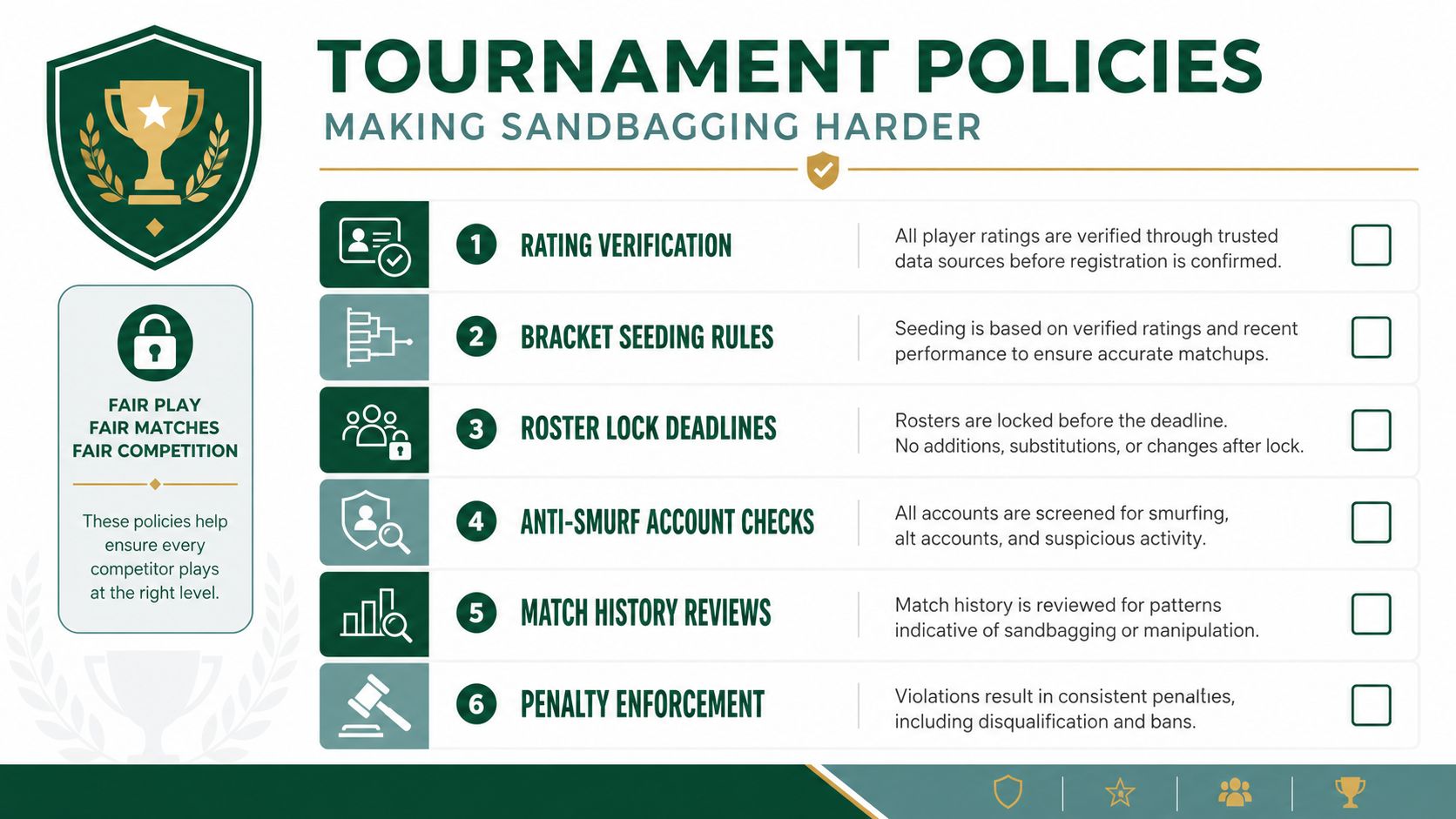
Write the policy so nobody has to guess how a review works. A good handbook clause should be blunt, enforceable, and short enough that a staffer can read it to a player without improvising.
Here's the language I'd put in front of a committee:
Handicap Verification Deadline: The player's official index is locked from the governing handicap authority 48 hours before tee time. No self-reported handicaps will be accepted after that point.
Player Declaration: Each entrant must sign a declaration confirming that the posted index will be used as entered and that manipulation of scores, rounds, or index data may result in disqualification.
Committee Authority: The committee may adjust or reject an index mid-event when documented score history does not support the posted number. The player may appeal within a defined window after notification.
Graduated Penalties: First offense, written warning and score adjustment. Repeat offense, disqualification and referral to the handicap committee.
What makes a policy enforceable
The policy needs teeth, but it also needs a path for fair review. If a committee has authority to question a number, it should also say how the player responds and how quickly the ruling gets made. That keeps the event from becoming a rumor mill.
This is the part many clubs skip, then regret later. A clean clause stops the argument at registration, before anyone is standing at the prize table demanding a second chance. If you want fair net competition, spell out the rules before the first tee shot.
How Technology Stops Sandbagging Before It Pays Out
Good systems don't replace judgment, they make judgment faster. Live scoring gives a director the round in real time, centralized score history keeps the last 20 rounds in one place, and automated differential alerts can flag the same kinds of gaps the handicap system itself uses. That turns sandbagging review from a memory test into a workflow.
A platform built for tournament management can also pull official handicaps directly, which matters because the committee shouldn't be chasing screenshots from players who benefit from the number being wrong. Live Tourney does that kind of event management and handicap pulling in one place, along with live scoring and score-history review, so the director can compare the tournament round against the record instead of chasing fragments across texts and emails. That's the right model for net events, because the answer has to be visible before the payout line.
A practical tournament-day checklist
Verify the index early. Lock the official number before the event starts.
Watch live scoring. Don't wait until the banquet to see the pattern.
Review flagged differentials immediately. Use the same 3.0 and 5.5 gap logic as the review trigger described earlier (WHS anti-sandbagging thresholds).
Hold payouts until clear. If the file is questionable, the money waits.
Document the ruling. Keep the reason for the decision in writing, so the next event has a record.
A software workflow should make this easier, not fancier. The fewer places a suspicious score can hide, the less room sandbagging has to survive.
For a closer look at how live scoring supports that kind of event control, see real-time golf tournament scoring.
If you run tournaments, leagues, or charity outings, stop letting handicap disputes get settled at the prize table. Use a system that verifies indexes, shows live scoring, and flags score patterns before payout, then visit Live Tourney and see how it fits your next event.





