Jul 4, 2026
greensomes golf format, golf formats, tournament golf, golf rules, golf tournament software
Learn the Greensomes golf format with our complete guide. We cover the rules, scoring, handicapping, and strategy tips for players and tournament organizers.

You're usually looking at Greensomes for one of two reasons. Either you want a team format that feels more skillful than a scramble, or you're organizing an event and need something that keeps better players engaged without punishing newer players all day. That's exactly where this format earns its place.
A standard scramble can flatten individual responsibility. Traditional foursomes can feel brutal if one poor tee shot wrecks the hole before the team has settled in. Greensomes sits neatly between those two. It gives every hole a real decision, asks partners to work together, and still leaves enough room for recovery that the round stays fun.
For club events, member-guests, mixed pairings, and family competitions, that balance matters. Players get a format that rewards planning and nerve. Organizers get a game that moves well, produces genuine competition, and doesn't require a rules seminar before the first tee.
Why Greensomes Is Your Next Favorite Golf Format
A familiar scene at many clubs goes like this. Someone suggests a scramble, half the field shrugs, and the better players start worrying the event will turn into a putting contest. Someone else suggests foursomes, and suddenly the mid-handicappers look like they've been handed homework.
Greensomes is the answer when you want competitive golf that still feels social. Both players hit a tee shot, the team picks the better one, and then the hole turns into alternate shot. That single design choice changes everything. The format gives teams a safety net off the tee, but it doesn't remove consequence once the core work starts.
That's why it fits so well in mixed-pair events and member-guest days. One player can offer distance, the other can offer consistency, and both remain involved on every hole. The better team usually isn't the pair with the two longest hitters. It's the pair that chooses smart starting positions and manages the alternating shots without ego.
Greensomes works when players want teamwork with consequences, not teamwork without pressure.
I've found that players who normally lose interest in routine formats pay attention in Greensomes. Every tee shot matters. Every selection creates the next shot. Every hole asks a simple question: which ball gives the team the best chance to finish cleanly?
For organizers, that same appeal translates into better engagement. It's a format that feels fresh without being confusing. If you're comparing options for your next event, this guide to golf tournament formats is useful alongside Greensomes because it helps you match the format to the field, not just tradition.
And if the appeal of golf extends beyond the scorecard, there's something nice about how this format reflects the game's broader culture. Players who enjoy backyard chipping areas and putting spaces will probably appreciate these ideas for a golf-inspired yard, especially if they like building golf into everyday life rather than saving it for weekends.
What Is Greensomes Golf The Core Rules Explained
The easiest way to understand the Greensomes golf format is to think of it as best-drive foursomes. It keeps the alternating-shot DNA of foursomes, but softens the opening blow by giving each team two tee shots to work with.
Historically, it's also been called Scotch foursomes. The key rule is simple and specific. Both players on a two-person team tee off on every hole, the team chooses the better drive, and then they play alternate shots with one ball until it's holed. That definition is consistent with the overview of foursomes and Greensomes at Wikipedia's foursomes page.
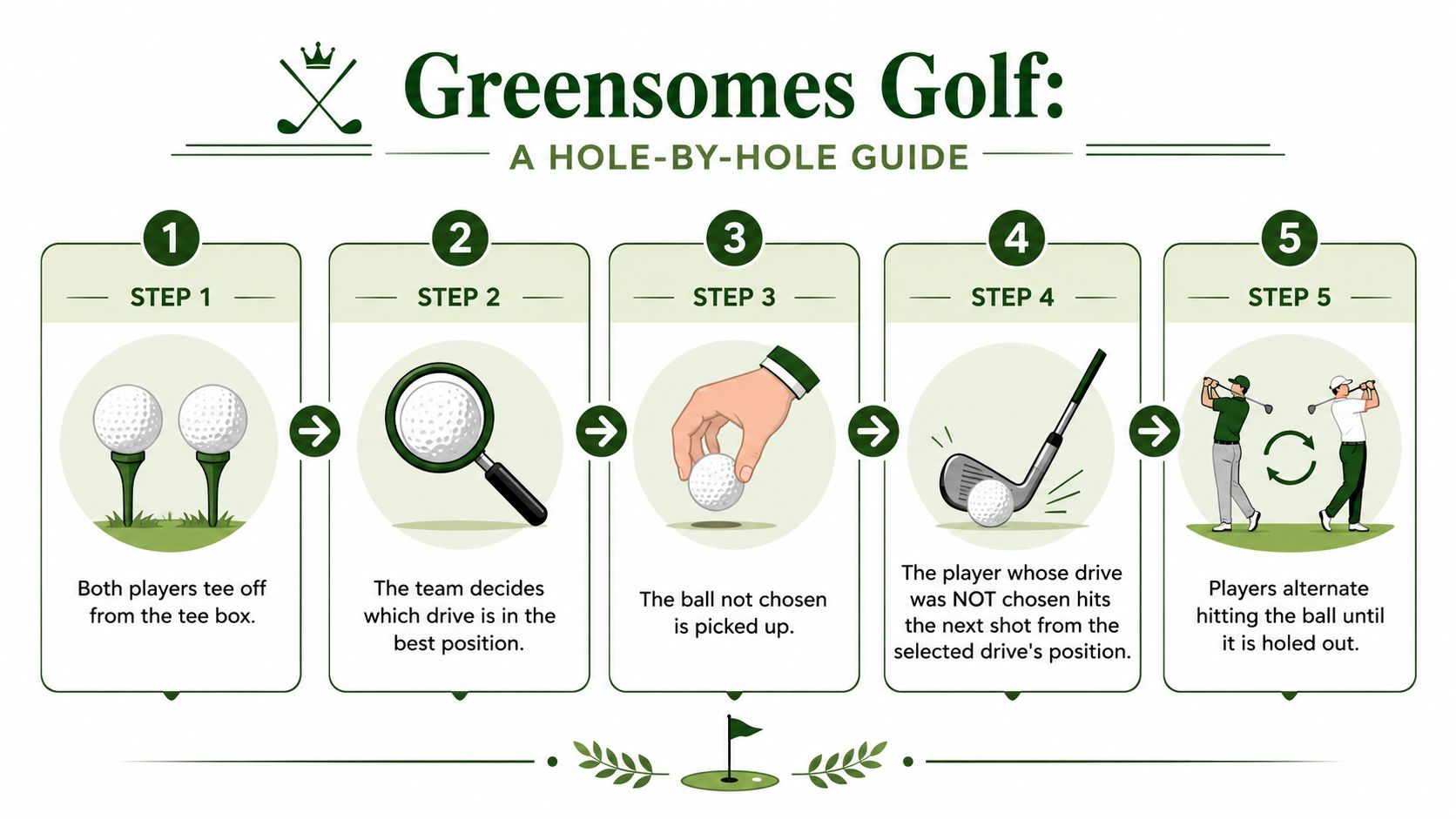
Core rule: Both partners tee off. Pick one drive. The player whose drive was not chosen hits the next shot. After that, the team alternates shots until the hole is finished.
That last part matters more than many players expect. If your drive is selected, you do not hit the second shot. Your partner does. This keeps the alternating-shot structure intact and prevents one player from dominating the hole just because their tee ball was used.
How a Typical Hole Works
A normal hole in Greensomes follows a very clean sequence:
Both players tee off from the teeing ground.
The team evaluates both drives and chooses the better starting position.
The unselected ball is picked up.
The partner whose drive was not chosen plays the second shot from the selected ball's position.
The players alternate shots until the ball is holed.
That's the whole structure. Once players see one hole played correctly, the format usually clicks right away.
Why the Rules Are Built This Way
The two-tee-shot mechanism is what makes Greensomes more forgiving than straight foursomes. In regular foursomes, one bad drive can put the team in immediate trouble. In Greensomes, the second tee shot acts as insurance. That doesn't make the format easy. It makes it fairer and more playable for a wider range of pairings.
This is also why the format shows up so often in mixed events, father-son rounds, and senior-junior pairings. Teams can choose the best opening position without forcing one player's driving profile to define every hole.
A few practical points help avoid confusion on the first tee:
Play one ball after the selection: once the team chooses a drive, the other ball is out of play.
Keep the order straight: if Player A's drive is used, Player B plays the next shot.
Treat each hole as a team score: the side completes the hole with one combined result.
Match Play and Stroke Play
Greensomes works in both formats, but the feel changes.
In match play, the team with the lower score wins the hole. If one side leads by more holes than the other side can recover with the holes remaining, the match ends. In stroke play, the side records a gross score for each hole and adds those together for the round.
If you're teaching the format to a new group, don't start with the name. Start with one hole. Two drives, one choice, alternate shot to the finish.
That practical walkthrough is usually all players need.
How to Calculate Greensomes Handicaps and Scoring
Handicap calculation is where many Greensomes events go sideways. Not because it's difficult, but because organizers leave room for improvisation. This format needs a published method before the event starts.
The official approach is the 60/40 formula. Under CONGU guidance adopted by the World Handicap System, the team handicap is 60% of the lower player's handicap plus 40% of the higher player's handicap. A common example is a team with handicaps of 12 and 20, which produces a team handicap of 15, as explained in this overview of Greensomes handicap calculation.
Why the 60 40 Formula Works
A straight average doesn't reflect how Greensomes is played. The format gives the stronger player a little more influence because both players drive and the team can start from the better ball, but alternate shot still requires the higher handicap player to contribute throughout the hole.
That's why the weighting matters. It balances team equity without pretending both players shape the hole in exactly the same way.
Practical rule: Publish the handicap method on the entry sheet, on the scorecard, and in the player email. If players have to ask on the first tee, you've waited too long.
The Calculation Step by Step
Use this sequence every time:
Identify the lower handicap player.
Multiply that handicap by 0.6.
Multiply the higher handicap by 0.4.
Add the two results.
Round according to your competition terms.
For the common example:
Lower handicap player: 12
Higher handicap player: 20
60% of 12 = 7.2
40% of 20 = 8.0
Total = 15.2
Rounded team handicap = 15
Greensomes Handicap Calculation Example
Player | Handicap | Calculation | Result |
|---|---|---|---|
Player A | 12 | 60% of lower handicap | 7.2 |
Player B | 20 | 40% of higher handicap | 8.0 |
Team | 7.2 + 8.0 | 15.2, rounded to 15 |
If both players have the same handicap, the practical effect is half of the combined total.
For organizers who need a broader refresher on how allowances feed into competition setup, this guide to handicap scoring in golf is a helpful companion.
How Scoring Works in Competition
The team records one score per hole. That score can then be used in different ways depending on the event:
Medal or stroke play: subtract the team handicap from the gross total.
Stableford: use the team handicap to determine the side's points on each hole.
Match play: compare hole-by-hole outcomes between teams.
What doesn't work is leaving the scoring explanation vague. I've seen organizers assume players will “figure it out” because they know four-ball or ordinary alternate shot. They won't. Greensomes has enough similarities to other formats that players often make confident mistakes.
The cleanest event setup includes three things:
A published allowance
A scorecard that shows team, not individual, scoring
A starter's script that confirms who plays second after the selected drive
That last point saves more disputes than one might imagine.
Winning Strategy for Greensomes Players
A common misconception is that Greensomes strategy starts with hitting two good drives. It doesn't. It starts before the round, when partners decide how they'll choose between two usable tee shots.
That decision matters because many holes present two different versions of “good.” One ball may be farther down the fairway but tight to a bunker or blocked by a tree line. The other may be shorter but clean, flat, and open. According to a 2025 analysis cited by Druids, 68% of tee-shot selection disputes stemmed from teams failing to pre-agree on selection criteria, which affected match outcomes in that review of Greensomes decision-making.

Decide Your Selection Rules Before the First Tee
Good teams don't argue over every drive. They create filters.
A practical pairing should discuss questions like these before the round:
Which matters more today, angle or distance: on a tight course, a clean angle into the green often beats an extra few yards.
Who do you want hitting approaches: if one partner is the stronger iron player, choose drives that leave that player the better pattern of second shots.
What's the default under pressure: if both drives are acceptable late in a match, many teams do better choosing the safer ball rather than the heroic one.
That pre-round agreement removes emotion from the choice. It also protects the weaker player from feeling they need to force a risky selection to justify their place on the team.
Pairing Strengths the Smart Way
Greensomes rewards complementary skills more than matching styles. A long hitter and a tidy wedge player can make an excellent side. So can a straight driver paired with a partner who handles bunker shots and pressure putts well.
What doesn't work nearly as well is building a team on one repeated strength. Two aggressive drivers may create exciting openings, but if neither player settles the hole with precise irons or calm lag putting, the format exposes that weakness quickly.
A strong Greensomes pairing often looks like this:
One player creates options off the tee
One player stabilizes the hole from awkward positions
Both players accept that some holes call for restraint
The best drive isn't always the longest drive. It's the drive that gives the team the next shot it wants.
Manage the Alternate Shot Reality
After the drive choice, Greensomes becomes a rhythm game. The team that stays organized gains an edge.
A few habits help immediately:
Talk before each shot: not a lecture, just club, target, and miss pattern.
Support the miss you can survive: if the safe side leaves an easy recovery, choose it.
Reset fast after a poor shot: alternate shot punishes frustration because one player's mood quickly becomes the other player's next swing.
One mistake I see often is teams choosing a drive based only on lie and yardage, without noticing who must play the next shot. That's backwards. In Greensomes, the selected drive determines both the position and the player hitting next. Those two factors should always be considered together.
Common Greensomes Variations and Local Rules
The standard version of Greensomes is straightforward. Local rules are where complexity enters. Some variations add fun. Others are meant to preserve fairness. Both players and organizers need to know the difference.

Gruesomes and Other Competitive Twists
One popular variation is Gruesomes, sometimes called Bloodsome. The basic concept flips the central choice. Instead of your team choosing the better drive, the opposing side chooses which of your drives you must play.
That one change turns the format from collaborative and forgiving into something much more tactical. Suddenly, the goal off the tee isn't only to produce one great ball. It's to avoid producing one ball the other team can exploit by forcing the worse option.
For players, the adjustment is mental as much as technical:
Keep both balls in play: one very poor drive becomes an easy target for the opposition.
Value the solid tee shot more highly: moderate, repeatable tee balls often outperform risky swings in this variation.
Expect momentum swings: holes can turn quickly when the other side controls your starting position.
Minimum Tee Shot Rules
The local rule that matters most in ordinary Greensomes is the minimum tee-shot requirement. Organizers use it to stop one stronger player from effectively driving for the entire team.
This rule isn't rare. A 2024 survey cited by SportsCover Direct reported that 42% of Greensomes events implemented minimum tee-shot rules, usually 3 to 4 per player, while only 12% of organizers provided clear pre-event guidelines, which led to significant player confusion in that summary of Greensomes event rules.
That finding tracks with real tournament experience. The rule itself is manageable. The confusion comes from poor communication.
If your event uses a minimum-drive rule, put it in writing before the draw goes out. Don't rely on the starter to explain it in thirty seconds.
What Organizers Should Specify
A minimum tee-shot rule only works if it's operationally clear. Publish these details in advance:
Exact requirement: say how many drives each player must contribute.
Counting method: clarify whether only selected drives count.
Enforcement point: explain when a team is penalized if it misses the requirement.
Scorecard tracking: give teams a simple way to mark whose drive was used.
Players should also adjust strategy early, not late. If a side waits until the final holes to satisfy a drive minimum, they often force bad decisions under pressure. The better approach is to plan those required selections into the round before the card gets tight.
How to Run a Flawless Greensomes Tournament
A Greensomes event runs smoothly when the organizer removes uncertainty before players arrive. Most problems don't come from the format itself. They come from preventable gaps in administration.
Start with the competition notice. State the format, the handicap allowance, the scoring method, and any local rule that changes normal play. If you use minimum selected drives, write the exact requirement in plain language. If the event is match play, explain how results should be reported. If it's medal or Stableford, make sure the scorecard reflects a team score on every hole.
Operational Checklist for Tournament Staff
A reliable setup usually includes these steps:
Build balanced pairings based on the event's purpose. Mixed ability is fine if the allowance and local rules are clear.
Prepare scorecards that match the format. Players should never have to guess whether to enter individual or team scores.
Brief starters and shop staff so they give the same explanation every time.
Publish rules before event day by email or player notice, not only on a board near the tee.
Create a simple dispute path so teams know who makes a ruling if a question comes up.

What Usually Goes Wrong
The most common mistakes are administrative, not competitive.
Unclear handicap handling: staff know the formula, but players never see it.
Weak scorecard design: the card looks like a singles event, so teams record scores inconsistently.
Late rule communication: local rules are announced on the tee instead of in advance.
No live visibility: players finish without knowing where they stand, which drains energy from the event.
For a broader event-day framework, this guide on how to run a golf tournament is useful because it covers the planning discipline that matters regardless of format.
A well-run Greensomes tournament feels simple to players even though it requires a bit more structure behind the scenes. That's the right outcome. The staff handles the complexity once. The field enjoys a cleaner competition all day.
Live Tourney helps organizers run formats like Greensomes without the usual spreadsheet cleanup and scorecard confusion. If you want faster setup, app-free live scoring, and a cleaner experience for staff and players, take a look at Live Tourney.