
Sep 15, 2026
golf games points, golf scoring formats, Stableford scoring, live golf scoring, tournament management
Master golf games points with clear format breakdowns, allocation tables, and live scoring strategies to run faster, more engaging tournaments.

The scoring sheet is printed, the first groups are on the tee, and three players have already asked different questions about the points game. One thinks the event is Stableford, another expects skins, and the committee has never agreed on how ties should be settled. That confusion can turn a well-run tournament into a slow exercise in score reconciliation.
The phrase golf games points covers several very different formats. Stableford converts hole scores into points against par, match play can award points for segments, and informal games such as skins or Six Point depend on rules the group agrees before play begins. The scoring method matters, but the operational details matter just as much. Players need a clear target, staff need consistent inputs, and the leaderboard must reflect the published rules without manual correction.
Why Points Formats Save Tournament Pace and Sanity
A stroke-play event can become difficult to manage when one player reaches a disastrous hole and insists on completing every shot. In a mixed-skill field, that player may be trying to protect a net result, satisfy a scorecard requirement, or avoid an unclear pickup rule. The group behind waits, the halfway house sees fewer players on schedule, and the scoring desk receives a card that may require several conversations before it can be posted.
Points formats change that behavior because the player's objective is no longer to preserve a running stroke total. In Stableford, a double bogey or worse generally earns zero points, while a bogey earns one, par two, birdie three, and eagle four. That structure compresses the damage from a poor hole and gives the player a reason to move on rather than spend extra time rescuing a score that has already lost its point value. The scoring logic and its effect on tournament engagement are described in this explanation of golf tournament scoring.
The operational payoff
A player who has no realistic stroke-play chance after a blowup may still have points available on every remaining hole. That keeps the group engaged through the back nine and supports a more decisive pace. The format also makes aggressive but controlled play more attractive, because a birdie or eagle has a clear point value instead of merely reducing a cumulative total.
Practical rule: If the format lets a player pick up after reaching the zero-point threshold, publish that rule before the first tee time.
This isn't a license to make the event informal. The committee still needs to define how players record a pickup, how penalties are handled, and whether the main competition uses gross or net scores. Stableford rules recognize that a player's hole score includes penalty strokes, and a player who doesn't hole out under the Rules receives zero points on that hole. The USGA Stableford rule also permits a Committee to set a fixed score from par rather than using par as the target.
Pace improves when the player, marker, and scorer all understand the same threshold. Directors should also address movement between tee boxes, lost-ball procedures, and ready-golf expectations. For practical movement guidance, these course pace tips for walkers are useful when preparing player communications.
The best points format doesn't merely produce an exciting leaderboard. It removes avoidable decisions from the course, protects the schedule, and gives players a reason to keep competing after a poor hole.
Mastering Stableford and Modified Point Allocations
Stableford is the clearest starting point for most individual points events. The traditional system was created by Dr. Frank Barney Gorton Stableford to reduce the chance that golfers would abandon a round after bad holes. It was tried informally at Glamorganshire Golf Club in Penarth, Wales, in 1898, then used in official competition at Wallasey Golf Club in England on May 16, 1932, as recorded in the history of Stableford.
The modern version usually uses net score against par. Organizers should confirm whether the competition uses the standard table or a modified allocation, then explain the table on the invitation, scorecard, and first-tee briefing.
Standard Stableford Point Allocation
Score vs Par | Points Awarded |
|---|---|
Double bogey or worse | 0 |
Bogey | 1 |
Net par | 2 |
Birdie | 3 |
Eagle | 4 |
Albatross | 5 |
The usual benchmark is 36 points over 18 holes. A player scoring 36 has played to handicap under the standard allocation. A total above 36 indicates performance better than handicap, while a lower total indicates the player finished below that benchmark. The structure is easy to communicate because every hole contributes a small, visible result rather than adding another stroke to a long cumulative number. For a player-facing explanation, use this guide to Stableford scoring in golf.
Set the handicap logic before publishing
The committee should decide how handicap strokes are distributed, identify the stroke index used by the course, and verify that the scoring platform applies the same allowance to every player. A net par earns two points only after the player's handicap strokes have been applied correctly. If the allowance is wrong, the point total may look clean while the competition remains unfair.
Modified Stableford formats can use different values or a different fixed score from par. That flexibility is useful for charity outings, aggressive formats, or competitions designed around birdies, but it increases the need for written instructions. Don't describe a modified event as ordinary Stableford if the table changes.
Penalty strokes remain part of the hole score. A player who fails to hole out receives zero points, regardless of the reason, unless the Committee has established a rule that governs the situation under the Rules. Staff should avoid trying to repair an incomplete hole by guessing what the player “would have made.” The published rule should drive the entry.
Scoring desk check: Confirm the player's allowance, the hole's stroke index, the score relative to the fixed target, and the resulting points before resolving a disputed total.
The point table should appear wherever players enter scores. A simple reference prevents repeated questions and helps markers catch errors before the group leaves the green.
Navigating Skins, Match Play Points, and Side Games
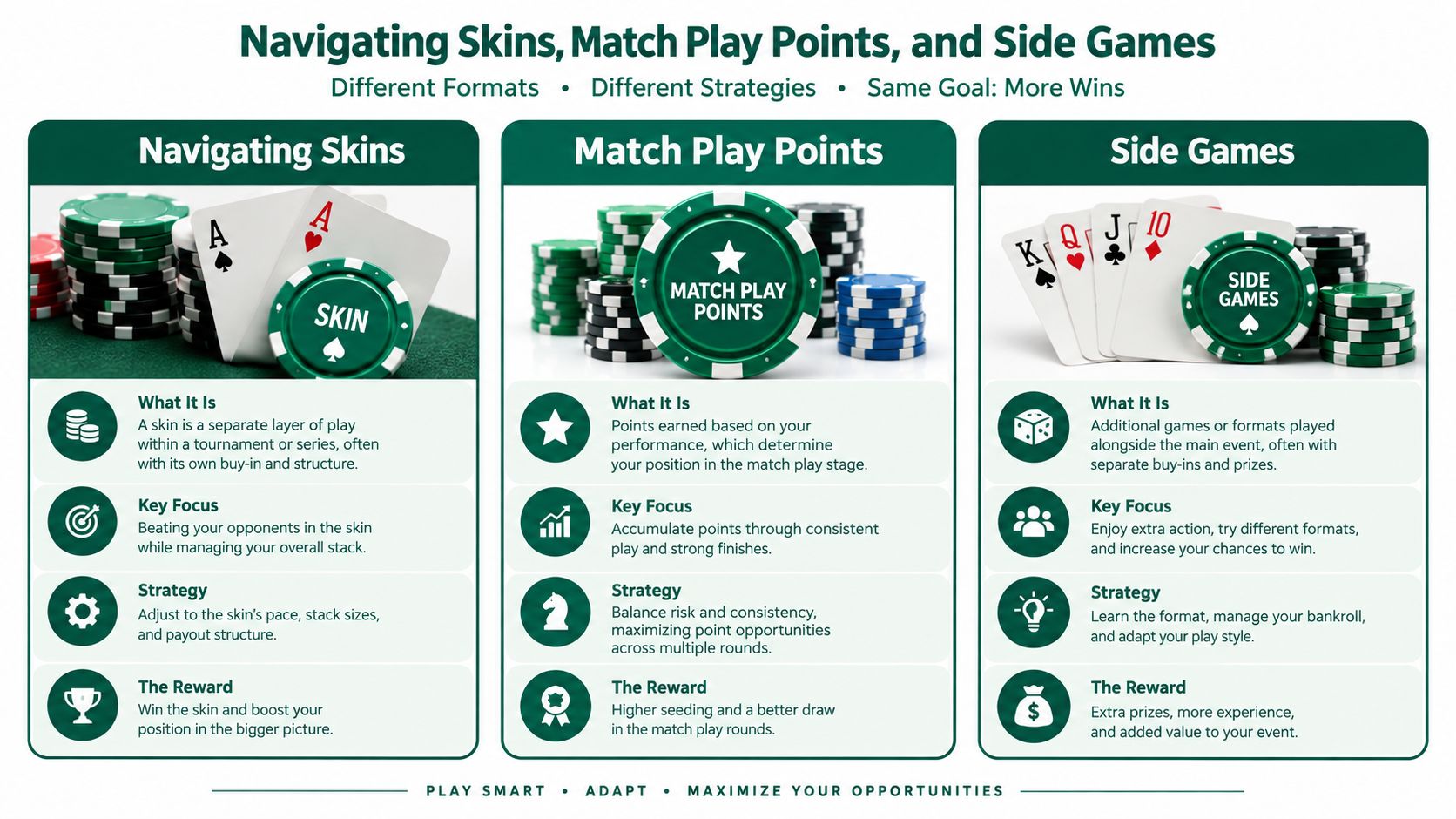
The main leaderboard may use Stableford, while the group's real excitement comes from a separate side game. That arrangement works well when the committee treats each game as its own contract. A skins game rewards winning individual holes, a Six Point game distributes a fixed pool among players, and a match-play conversion awards points for defined segments. Combining these systems without separating their settlement rules is where disputes begin.
Match play with a points overlay
A straightforward match-play points structure awards one point for the front nine, one point for the back nine, and one point for the overall match, for a maximum of three points. A tied segment gives each player one-half point. The format preserves match play's hole-by-hole pressure while ensuring that a player who falls behind early can still compete for later segments. The published match-play rules and reminders provide that exact structure.
This is different from a skins game. In skins, the group must decide whether tied holes carry forward, how a carryover is recorded, and whether the settlement is based on gross or net results. In match-play points, the committee can post three distinct results and settle each segment independently.
Choose the side game by group and purpose
For a small group, a segment game is easy to explain and monitor. For a larger field, individual side games can create a heavy administrative burden unless the platform records them automatically. A team game may be more suitable when players have different handicaps or when the event wants every member contributing to a shared result.
The golf skins game rules are useful when deciding how to handle ties, carryovers, and player eligibility. Keep the language practical. State who can win, what score counts, whether handicaps apply, and when the game settles.
A side game also needs a clear value, whether that value is a point, a prize position, or an agreed monetary unit. Don't let players discover the settlement logic after the round. Print it on the registration material, repeat it at check-in, and give the scoring desk one authoritative version.
Settlement principle: Separate the competition result from the side-game result, even when both use the same hole scores.
That separation protects the main event from informal variations. It also lets the pro shop support social golf without forcing every player into the same format.
Handling Ties and Season-Long League Accumulation
A one-day event can survive a manual tie decision. A season-long league can't rely on improvised judgment after every round. The committee needs a written allocation method that explains how finishing positions become league points and how tied players affect the standings.
One representative framework combines net and gross finishes, awards points independently by flight, and splits the points for tied positions rather than applying a points tiebreaker. A separate tiebreaker can then determine prize distribution through USGA back-nine, back-six, and back-three logic. Those mechanisms serve different purposes. The points table records competitive accumulation, while the tiebreaker identifies a prize recipient when the rules require one. The framework is described in this example of golf points allocation.
Split points and penalty points produce different races
Split-points systems reduce volatility. If tied positions share the available points, players remain sensitive to consistent finishes and one unusually strong round doesn't distort the entire season as sharply. That approach is often easier for players to accept because the standings reflect the result that occurred, including the tie.
Penalty-point systems create more separation lower in the field. A comparable tour approach can split tied-place points evenly and apply negative points to lower finishes. That design differentiates participation and performance more aggressively, but it can also make the league standings harder to explain to casual players.
Neither system is automatically correct. The committee should choose based on the league's purpose, then keep the rule unchanged for the season. A scheduling resource such as this sports league scheduling guide can help administrators think through recurring fixtures, availability, and season structure, but the scoring policy still needs to come from the golf committee.
Configure ties before the first round
Write down three separate decisions:
Position allocation: Decide whether tied players split the points assigned to their places.
Prize tiebreaking: State whether a back-nine, back-six, or back-three comparison determines a prize.
Leaderboard display: Show the underlying points and the tiebreak result separately.
Digital scoring should store the tied finish rather than overwrite it with a manually chosen winner. If the league awards points by gross and net categories, create those categories explicitly and prevent a player from being counted twice unless the rules intend that result.
League administration works best when the standings can be audited from the published table without asking the scorer to explain an exception.
A transparent system keeps the season competitive without turning the final event into a mathematical argument.
Implementing Live Scoring for Points-Based Events
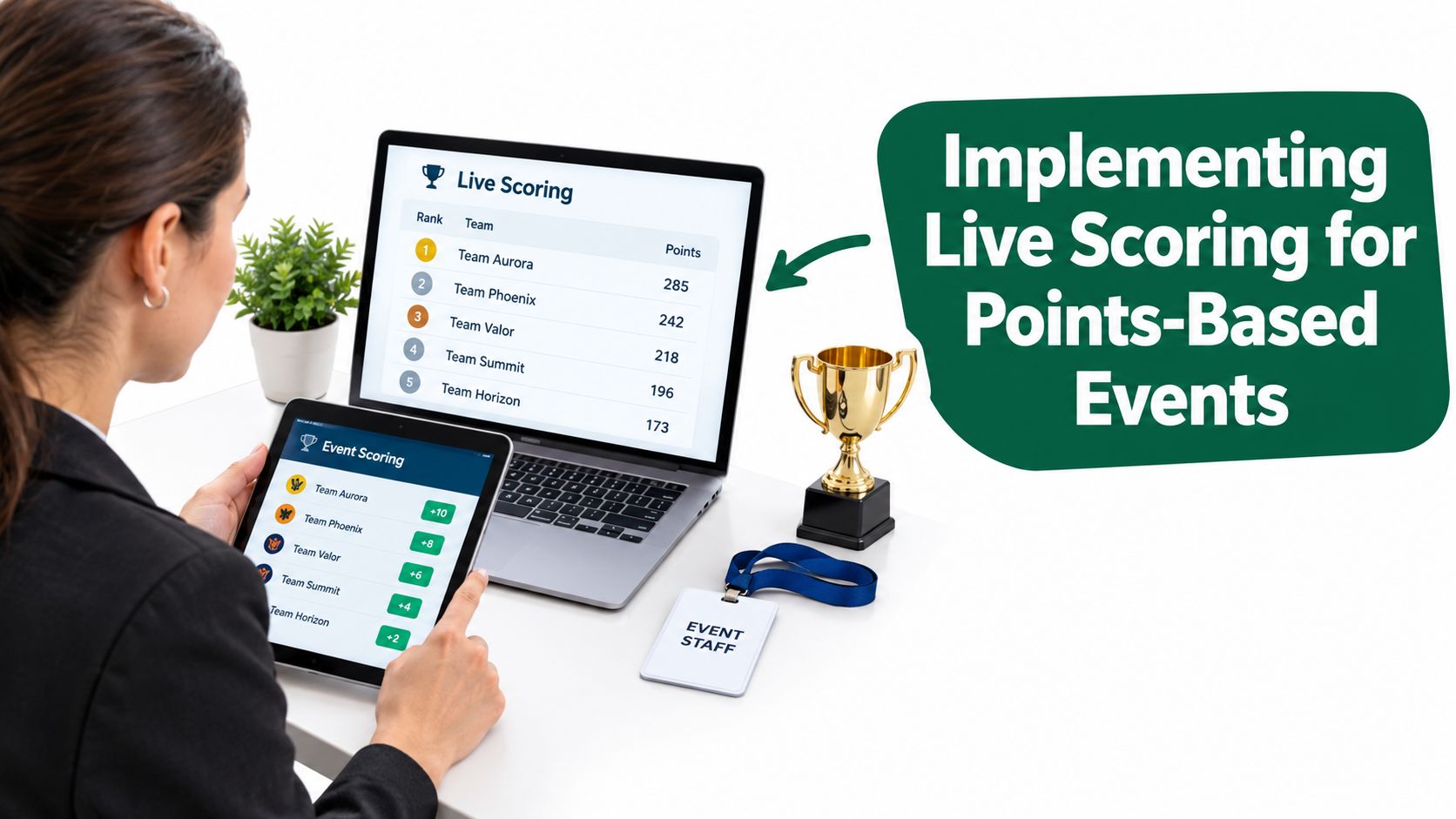
A points format only feels simple to players when the scoring system performs the conversion correctly. The setup should begin with the rules, not the leaderboard design. Write the allocation table, handicap method, tie policy, and pickup rule first. Then enter those decisions into the scoring platform and test them with sample hole results before players arrive.
A clean setup sequence
Build the roster. Import or enter player names, tees, divisions, handicaps, and starting groups. Check spelling before publishing the player link because corrections become harder once scores are live.
Define the competition. Select Stableford, match play, team points, or the relevant custom format. Add the course, tees, hole pars, and stroke indexes so the system can determine net results.
Enter the allocation table. Confirm the values for double bogey or worse, bogey, net par, birdie, eagle, and albatross. If the Committee has chosen a modified fixed score from par, record that target instead of assuming ordinary par.
Add side games separately. Skins, Nassau-style segments, and team games should have their own configuration and settlement rules. Don't bury a side game inside a general notes field where staff must calculate it manually.
Test edge cases. Enter a hole with a penalty stroke, a hole where the player doesn't hole out, a tied segment, and a handicap stroke on the correct index. Verify the displayed points and the final ranking.
The golf tournament live scoring guide is a useful reference when planning hole-by-hole entry and leaderboard publication.
Remove friction for players
App-free browser access reduces the number of instructions staff must give at check-in. Players can open a scoring link on a phone, enter hole results, and follow the leaderboard without installing software. That matters in corporate outings and charity events, where the field may include occasional golfers who won't download an unfamiliar app for one round.
Live posting also gives the scoring desk an early chance to spot missing groups, improbable entries, or a leaderboard that doesn't match the printed rules. A digital calculator can handle side-game totals and payout preparation, but staff should still verify the rules and final results before announcing winners.
Live Tourney is one web-based option that supports tournament and league management, hole-by-hole scoring, live leaderboards, side games, payouts, and formats including Stableford and match play without requiring app downloads. Use any platform that makes the rules visible, the entry process clear, and the audit trail accessible.
Test the event as a player. Open the scoring link on a phone, enter a complete sample round, and check what a marker sees before the first group tees off.
Elevating the Player Experience Through Smart Formats
The scoring format controls more than the final ranking. It shapes how players respond to trouble, how long groups remain interested, and how much work the staff must do after the last card arrives. Stableford suits an individual mixed-skill field that needs resilience. Match-play points suit a smaller group that wants defined contests across the round. Team points suit outings where contribution and social interaction matter more than a single individual score.
Match the format to the audience
A club competition with experienced players can handle a detailed handicap structure, a published tie policy, and a formal Stableford table. A charity outing may need fewer rules, larger visual explanations, and a team format that keeps every golfer involved. Junior events often benefit from straightforward targets and immediate feedback rather than a complicated side-game settlement.
The decision should also reflect the course schedule. If the event prioritizes pace, use a format that lets players stop pursuing a hole once no points remain. If the event prioritizes head-to-head drama, segment-based match-play points create several meaningful results without requiring one player to dominate every hole.
Design the experience around visibility
Players engage more when they can see how their scores matter. A live leaderboard should show points, not just a converted stroke total, and it should make divisions, teams, and side games easy to distinguish. Staff should announce the format in plain language:
Individual Stableford: Your net score on each hole produces points, and the highest total wins.
Match-play points: The front nine, back nine, and overall match are separate contests.
Team points: The published team rule determines which individual or combined results count.
Side games: Ties, carryovers, and settlement values follow the rules issued before play.
Don't add a side game merely because it sounds entertaining. Every extra calculation creates another opportunity for a dispute, especially when players have different handicaps or teams change during a league season. A small number of clearly explained formats usually produces a better day than a crowded menu of games nobody can reconcile.
Points-based golf works when the rules, pace expectations, scoring entry, and settlement process all agree. When those pieces fit, players keep competing after a poor hole, staff spend less time correcting cards, and the post-round presentation has a result everyone can understand.
Live Tourney gives tournament directors a web-based way to configure points formats, collect hole-by-hole scores, publish live leaderboards, and manage side games without app downloads. Visit Live Tourney to review the scoring tools and set up a smoother points-based event for your next field.





