
Aug 23, 2026
equitable stroke control, golf handicap rules, net double bogey, tournament scoring, golf ESC
Master golf equitable stroke control rules, scoring caps, and modern Net Double Bogey updates. Practical guidance for tournament and league administrators.

The scorecard is on the counter, the leaderboard is open, and a player has just asked why the 12 on a par 4 doesn't appear to count the same way in the handicap record as it did on the course. That question is where tournament administration gets complicated. The player's gross score must remain accurate for competition, while the score used for handicap purposes may require a hole-by-hole adjustment.
That distinction is the practical heart of golf equitable stroke control. Administrators need to protect the integrity of the event without making players feel that their actual round has been rewritten. The process works well when the software, scorecard, and player instructions all use the same definitions.
Why Equitable Stroke Control Matters for Your Events
A 15-handicap player turns a difficult par 4 into a 12. The gross result remains 12 for a gross competition, and every stroke belongs on the event scorecard. For handicap posting, however, leaving that hole untouched can give one blow-up hole too much influence over the player's record.
Equitable Stroke Control, or ESC, limits individual hole scores used for handicap purposes. The objective is to represent a player's scoring potential more consistently while preserving the actual round for competition records. The cap changes the submitted handicap score, not the strokes taken on the course.
Tournament staff must keep those records separate. The leaderboard should display the gross score or the correctly calculated net competition score. The handicap workflow should use the applicable adjusted hole scores. If software replaces the gross value instead of storing both, players may reasonably believe the event result has been changed.
Practical rule: Preserve every actual hole score first. Apply ESC only to the handicap-posting calculation.
ESC is a required part of the handicap workflow whenever the score is used for handicap purposes. It is not an optional courtesy adjustment that a club applies only when a hole looks unusually bad. The adjustment may apply on multiple holes in the same round. The ESC rules and score-posting mechanics outline how the cap and score-posting process operate.
For directors and league administrators, the operational checklist is straightforward:
Confirm the player's Course Handicap before scoring.
Configure the system to retain gross hole scores and adjusted handicap values separately.
Tell players in advance that a handicap report may show a lower hole score than the event card.
Review the leaderboard and handicap export independently before results are finalized.
A short player briefing prevents the most common dispute: a participant sees a reduced hole in the handicap record and assumes the tournament standings are wrong. Administrators can also direct players to this practical overview of handicap scoring in golf.
Clear communication supports the broader event experience too, whether the tournament team is preparing rules materials, sponsor information, or thoughtful golf outing gifts. The rule works best when the card, software, and explanation all use the same distinction between competition scoring and handicap posting.
The ESC Cap Table and Worked Scoring Examples
The legacy ESC table uses the player's Course Handicap, not just the Handicap Index shown in a profile. Once the Course Handicap is established, the administrator identifies the maximum score that may be posted for any hole. Any actual score above that limit is reduced for handicap purposes.
ESC maximums by Course Handicap
Course Handicap | Maximum Hole Score |
|---|---|
9 or less | Double bogey |
10 to 19 | 7 |
20 to 29 | 8 |
30 to 39 | 9 |
40 or higher | 10 |
These caps apply to scores used for handicap purposes, including tournament scores. If a player doesn't have an established Handicap Index, some handicap guides state that the maximum Handicap Index used for the calculation is 36.4 for men or 40.4 for women, converted to a Course Handicap. This handicap score-adjustment guide provides that specific administrative treatment.
A nine-hole example
Take a player with a Course Handicap of 14. Under the table, the maximum posted score is 7. The player records these nine gross hole scores:
5, 4, 6, 7, 4, 8, 5, 12, 6
The gross total is 57. That number remains the player's actual nine-hole result. For handicap posting, the 12 on hole 8 exceeds the allowable maximum and becomes 7, producing an adjusted total of 52.
The administrator should retain both values:
Gross score: 57, the strokes taken.
Adjusted handicap score: 52, the score after the hole cap.
The 8 on hole 6 remains 8 in this example because it doesn't exceed the player's maximum of 7? No, it does exceed 7, so it must also be reduced to 7. The correct adjusted sequence is therefore 5, 4, 6, 7, 4, 7, 5, 7, 6, for an adjusted total of 51. This is exactly why hole-by-hole processing is safer than asking staff to make a rough adjustment from the round total.
The adjustment is made when the actual or most likely score is above the applicable limit, and administrators can adjust more than one hole in the same round. Chicago District Golf Association's explanation of score adjustment reinforces that the cap is applied hole by hole, not as a single round-level deduction.
How ESC Evolved from Club Practice to Standardized Rule
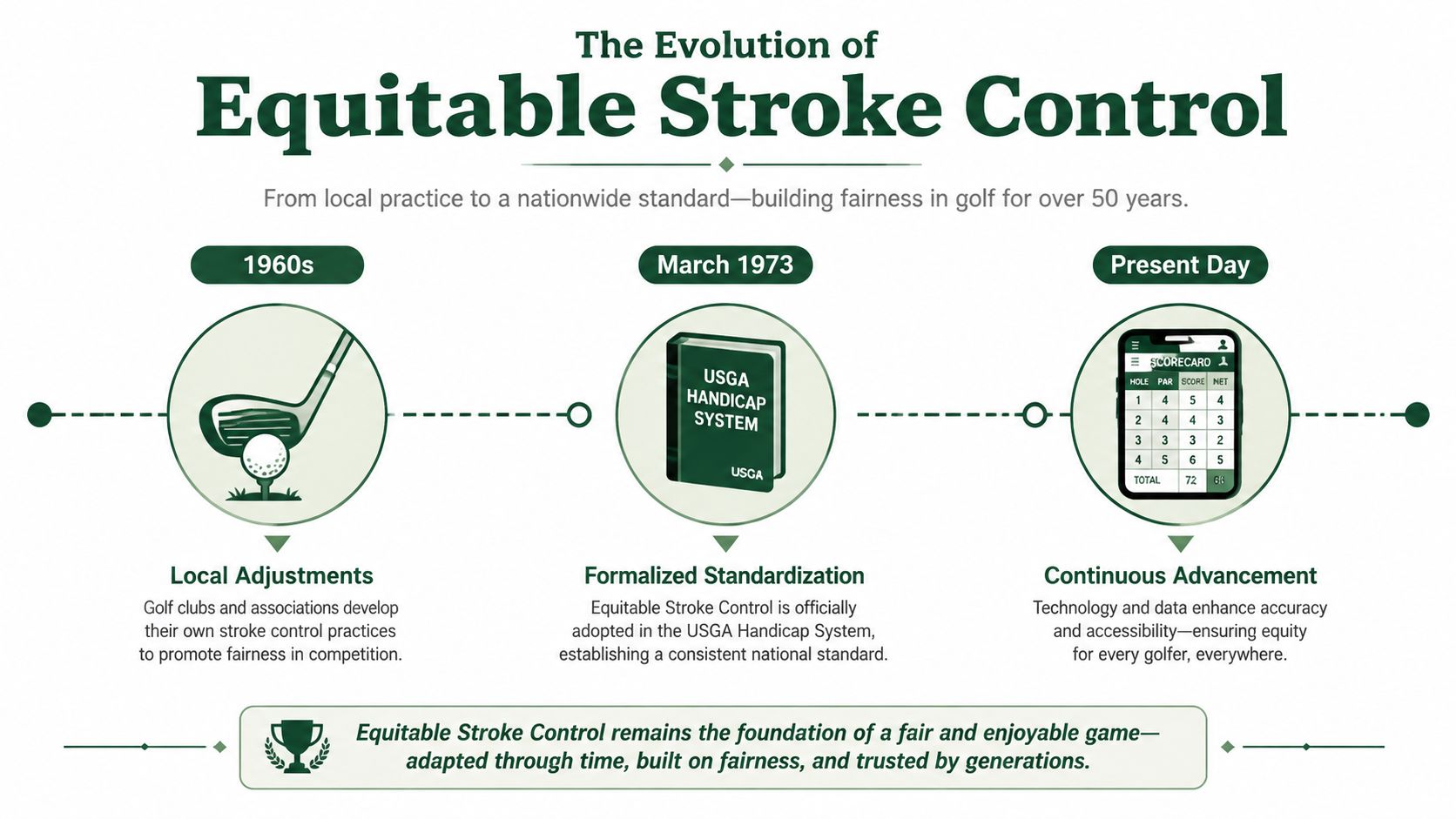
一場比賽中,球員在某洞打出 15 桿,可能讓工作人員、球員和排行榜都產生同一個問題:這個分數應否完整進入差點紀錄?ESC 的起點,正是球會需要處理這類爆洞的實務問題。它先用來避免單一災難洞誇大球員的潛在能力,後來才成為正式的全國差點制度。
USGA Handicap System 在 1973 年 3 月採用 Equitable Stroke Control,把原本常見的球會做法納入標準化調整規則。USGA 在 1990 年代進行後續檢討,發現當時的 ESC 程序使 18 洞平均成績降低 1.6 桿。這說明調整會實際影響差點計算。The documented history of ESC 記錄了這兩項發展。對賽事管理員而言,這段歷史也解釋了為何舊系統需要在軟件中保存原始桿數與調整後桿數,否則排行榜和差點提交紀錄可能混在一起。
為何早期表格有用
1993 年後的表格為不同能力範圍設定可預期的上限。Course Handicap 介乎 10 至 19 的球員,一洞最多可提交 7 桿。較高的 Course Handicap 範圍則使用逐步提高的上限。這解決了基本的行政問題:差點應反映球員的潛在得分能力,而不應讓一個嚴重失誤主導整份紀錄。
表格也讓球會處理更一致。工作人員不必逐洞判斷某個 10、12 或 15 桿是否足以代表球員能力,只要按 Course Handicap 範圍套用上限,並在需要時調整該洞。設定比賽軟件時,管理員應確認系統按照每位球員的 Course Handicap 讀取正確範圍,並在輸出排行榜前核對調整結果。
低差點球員的修訂
最重要的修訂週期發生於 1997 年至 1999 年。USGA 在 1997 年於 12 個州及地區高爾夫協會測試修訂程序。一年後,USGA 表示 Handicap Index 結果沒有重大變化,但仍為低差點球員採用更公平的調整方式。
Course Handicap 為 9 或以下的球員,改為任何一洞最多提交 雙柏忌,取代該組別原先按標準桿計算的上限。USGA 表示,這項改動只會令單位數差點球員的平均 Handicap Index 增加 0.15 桿。修訂版在 1998 年屬選用安排,並於 1999 年 1 月 1 日起,對發出 USGA Handicap Index 的球會成為強制要求。The recorded revision history 詳細記錄了這次轉變。
加拿大高爾夫後來在 2012 年採用 USGA ESC 表格,顯示這套模式的影響力不限於美國。對管理員來說,重點很實際:每次修訂都在爆洞保護與真實反映球員潛力之間重新取捨。制度沿革也提醒賽事團隊,舊表格、軟件標籤和球員說明若未同步更新,最容易在成績公布和差點提交時引起誤解。
ESC Versus Net Double Bogey in the World Handicap System
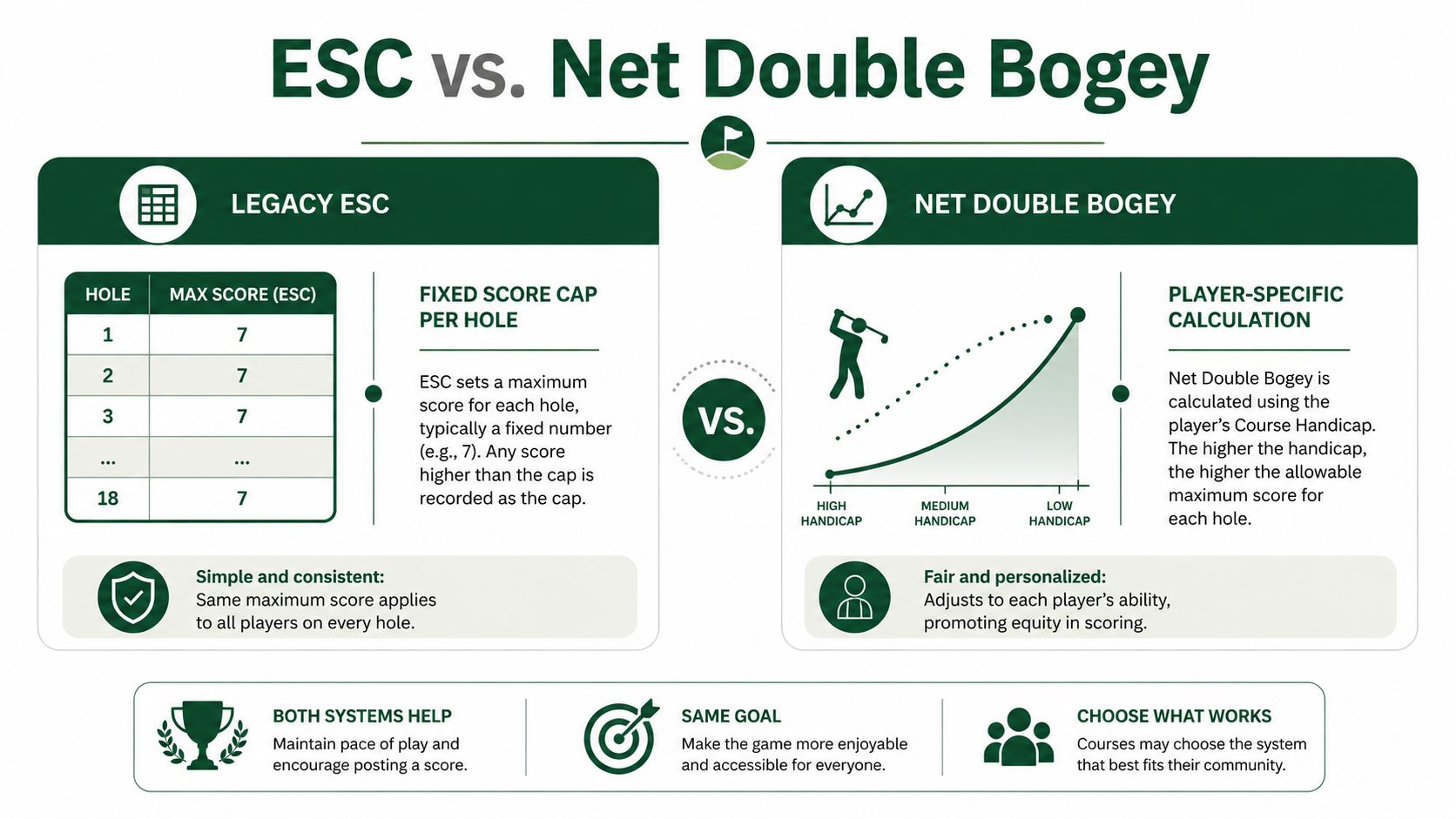
Many current event administrators still encounter the phrase “ESC” in club documents, software labels, and older player guides. Under the modern World Handicap System, the universal cap is Net Double Bogey, which uses the hole's par, the player's handicap strokes on that hole, and a fixed double-bogey limit.
The formula is:
Maximum score = par + two strokes + any handicap strokes received on that hole
That makes Net Double Bogey dynamic. The maximum depends on both the hole and the player. Legacy ESC, by contrast, used a fixed maximum number across a Course Handicap range.
The operational difference
Consider Golf Canada's policy change effective January 1, 2020, when it replaced older over-par-based caps with a maximum Net Double Bogey standard. An 18-handicap golfer receiving one stroke on every hole could post up to a triple bogey on a hole. A 10-handicap golfer could count a triple bogey only on the 10 hardest holes, because those are the holes where the player receives a stroke. Golf Canada's revised score-cap guidance provides those examples.
That is more precise than assigning the same numerical cap to every hole. On a hole where the player receives no stroke, the maximum is lower. On a hole where the player receives a stroke, the maximum rises accordingly. The system follows the course's handicap allocation rather than relying only on a broad handicap band.
What directors should check
A club that still uses legacy labels may not necessarily be using the wrong calculation, but the administrator should verify the actual formula in the software. The important questions are whether the system knows the player's Course Handicap, reads the hole stroke index correctly, and stores the adjusted result separately from the gross result.
Administrators comparing old forms with current reports can use this explanation of how to calculate golf handicaps as a practical reference. The terminology may differ, but the administrative principle remains constant: handicap adjustments must be calculated consistently and must not alter the strokes used to determine the competition leaderboard.
Implementing Score Adjustments in Tournament Operations
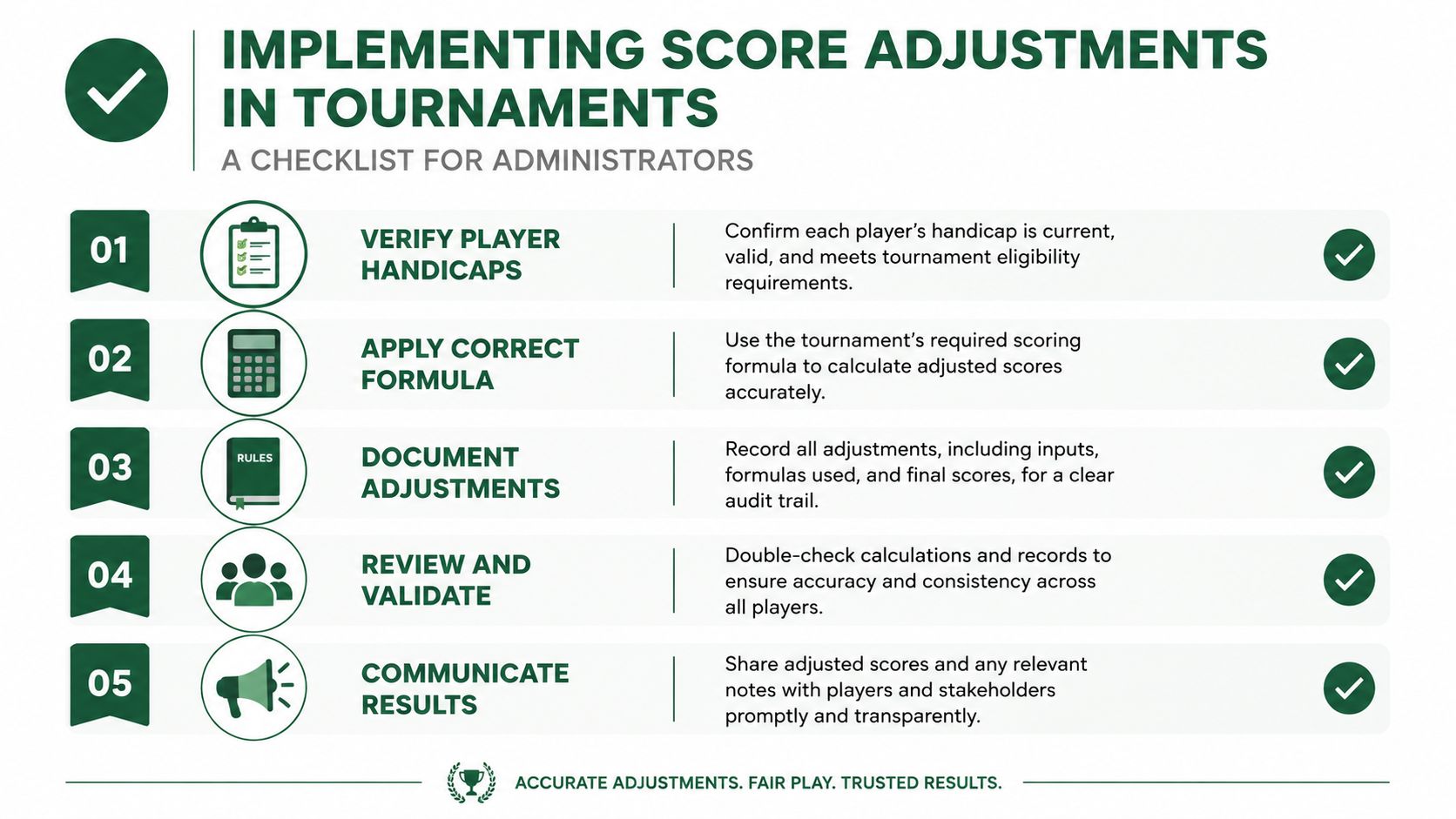
The cleanest event setup treats scoring as two related records, not one. The first is the player's gross hole-by-hole score, which records what happened on the course. The second is the handicap-adjusted score, calculated under the applicable rule for handicap posting.
If a system replaces the gross value with the adjusted value, the leaderboard can become wrong. A player's actual round total must remain available for gross results, score verification, and any format that relies on the strokes taken.
Build the workflow before the first tee time
Start with the player roster and handicap source. Confirm the Course Handicap used for the event, then make sure the course's par and hole handicap allocations are loaded correctly if the event uses Net Double Bogey.
Use a short operational checklist:
Capture gross scores: Require hole-by-hole entry rather than only a round total when the event needs accurate adjustments or automated checking.
Calculate separately: Apply ESC or Net Double Bogey in a handicap-posting field, never by overwriting the gross field.
Review exceptions: Flag missing handicaps, unusual scores, incomplete cards, and players whose handicap status needs administrator review.
Publish clearly: Tell players that a capped score affects handicap posting and doesn't erase the strokes recorded for the competition.
Audit the export: Before results are final, compare the leaderboard values with the gross score record and the handicap-adjusted record.
The leaderboard answers, “What did the player shoot?” The handicap record answers, “What score should be posted under the handicap rules?” Those answers must remain separate.
The same discipline applies to leagues. A weekly league may use net scores for standings while also submitting rounds for handicap purposes. Staff should confirm which value drives the league result and which value is sent to the handicap record. A system that labels both values as “score” invites errors.
Communicate before confusion starts
Put the rule on the registration page, player information sheet, and scoring instructions. Keep the wording direct: players enter the strokes they took, and the system applies the handicap adjustment for posting where required.
For administrators using web-based tournament software, Live Tourney is one option that supports real-time scoring, live leaderboards, roster management, and tournament formats through a browser without requiring an app download. Its guidance on posting golf scores is relevant when staff need to connect event scoring with handicap-posting procedures.
The Fairness Debate Around Score Caps for Beginners
Score caps improve handicap integrity, but they don't tell the whole story about a beginner's game. A new golfer may produce a card with several difficult holes, and reducing the highest scores can make the handicap record more usable while also hiding the scale of the player's current inconsistency.
That tension matters most in beginner-heavy leagues, junior programs, and charity outings. The event may need a fair handicap calculation, but the coach or organizer may also want to see whether a player is improving at avoiding major mistakes. The adjusted score can show one thing, while the gross card shows another.
Where the cap helps
A fixed cap can prevent one lost ball, penalty sequence, or unplayable lie from overwhelming a player's handicap record. For a lower handicap golfer, the double-bogey limit under legacy ESC keeps a single severe hole from producing an adjustment that no longer reflects normal scoring potential. For higher-handicap players, the larger numerical caps recognize that difficult holes are more common parts of their scoring pattern.
The rule also creates consistency. Administrators don't have to decide whether a beginner's 11 was “realistic” or whether a 9 should be ignored. They apply the prescribed calculation and document the difference.
Where administrators should stay alert
The adjusted score can understate true volatility. If a player's gross scores are falling because they're learning course management, the handicap record may not show every step of that progress in the same way the raw scorecard does. Conversely, a player may appear more competitive on a net leaderboard because the cap compresses the worst holes, even though the gross performance remains far behind the field.
That isn't an argument for ignoring the rule. ESC and Net Double Bogey exist for handicap purposes, and informal events shouldn't create their own substitute system while calling the result handicap compliant. The better approach is to show players both figures and explain why they differ.
For beginner events: use the official adjustment for handicap calculations, but retain gross hole scores for coaching conversations, format decisions, and transparent communication.
Key Takeaways for Running Handicap-Compliant Events
Administrators can avoid most score-cap disputes by keeping a few principles visible during setup and scoring.
Before play
Identify the governing standard: Determine whether the event is operating under legacy ESC documentation or the current World Handicap System's Net Double Bogey procedure.
Verify Course Handicap data: Don't apply a cap from memory or from the player's Handicap Index alone.
Load the course correctly: Net Double Bogey depends on par and the holes where handicap strokes are received.
Tell players what to enter: Players should record actual strokes, not pre-adjusted numbers.
During scoring
Preserve gross scores: The actual round total belongs on the competition record.
Create a separate adjusted value: Apply the handicap cap only to the score used for handicap purposes.
Allow multiple hole adjustments: ESC doesn't limit the number of holes that can be reduced in a round.
Handle unknown handicaps carefully: Use the established club or governing-body procedure for players without an established index, including the applicable maximum-index treatment where required.
Before publishing results
Review the leaderboard against the gross record. If a player's posted handicap score differs, make that distinction visible rather than allowing the player to assume the tournament system changed the round.
Net Double Bogey is now the central standard under the World Handicap System, while legacy ESC tables still appear in older club materials and workflows. The practical solution isn't more manual arithmetic. It's a scoring process that captures hole-by-hole gross scores, calculates the adjustment with the correct handicap data, and keeps both outputs available for review.
Modern tournament tools have made this once error-prone task much easier to manage. With the right configuration, the calculation runs in the background while staff focus on pairings, player service, pace of play, and a clean presentation of the event.
Live Tourney gives golf facilities and event organizers browser-based registration, roster management, real-time scoring, live leaderboards, and handicap-aware tournament workflows without requiring players to download an app. Visit Live Tourney to see how it can keep gross scores, adjusted scores, and event results organized in one system.





