Oct 3, 2026
charity golf tournament rules, golf fundraiser, scramble format, golf tournament management, charity golf events
Learn the key charity golf tournament rules for a successful 2026 event. This guide covers scoring, formats, and organizer tips to boost participation and

You've booked the course, secured sponsors, opened registration, and promised players a memorable day for a good cause. Then someone asks a simple question: “Are mulligans allowed in the team score, and what happens if two teams tie?” Suddenly, the event needs more than a shotgun start and a printed scorecard.
Charity golf tournament rules have to balance three competing priorities: an enjoyable experience for casual golfers, credible competition for experienced players, and compliance with amateur-status and gaming requirements. The strongest events make those decisions before registration opens. They don't leave prize eligibility, handicap disputes, or side-game rules for the morning of the tournament.
Understanding Charity Golf Tournament Formats
A committee often starts with a familiar idea: four players, one team, a charity, and a scramble. The confusion begins when sponsors request a hole-in-one contest, competitive players ask for net scoring, and someone suggests adding skins or a Ryder Cup-style afternoon match. Each addition changes the operating rules.
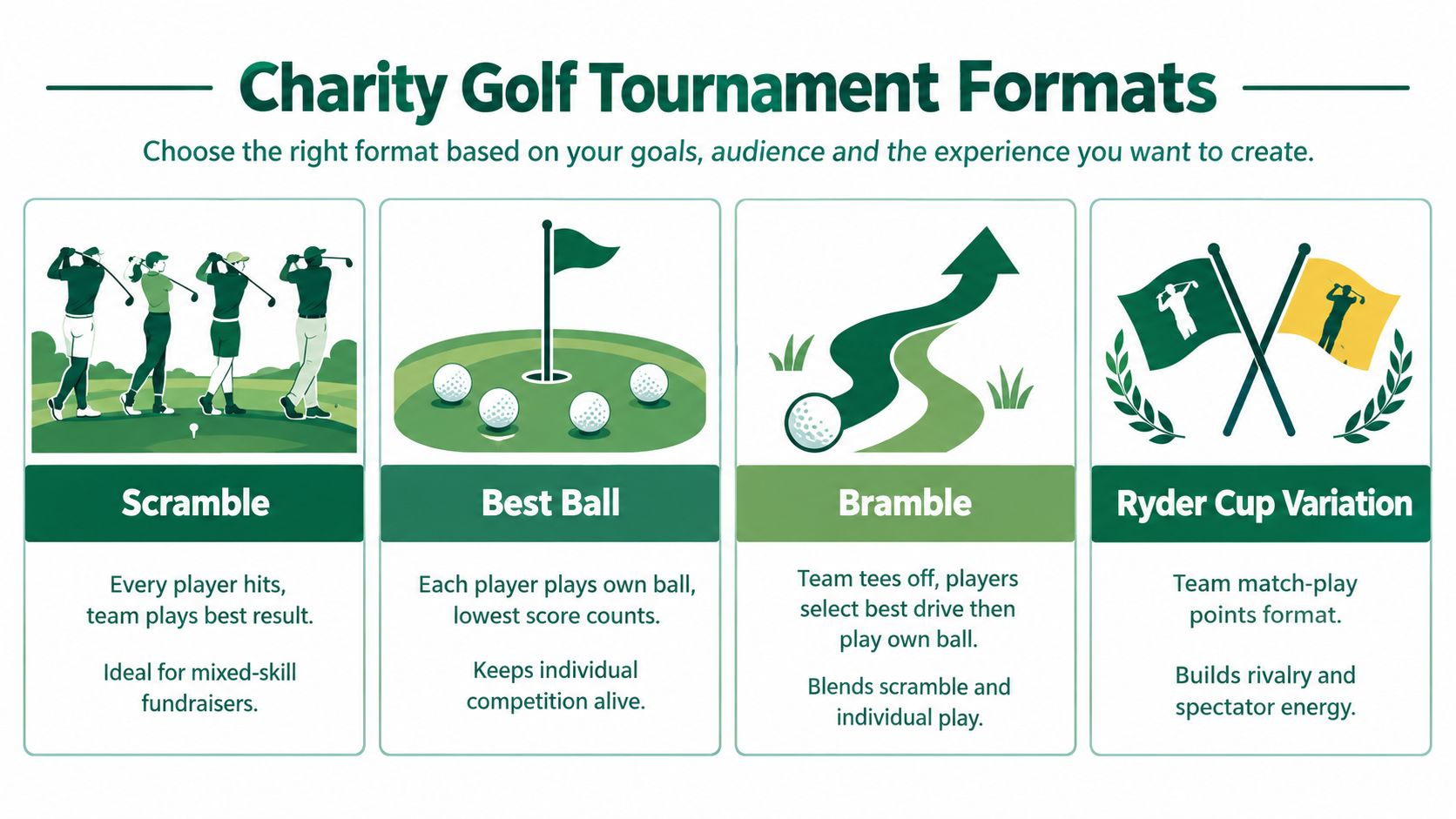
The scramble remains the most practical choice for mixed-skill charity fields. Every player hits, the team selects the preferred result, and everyone plays from that location. That format lets a newer golfer contribute without carrying the pressure of an individual score, while stronger players still have opportunities to shape the team result. It also helps groups maintain momentum because players aren't waiting for every person to complete a separate hole.
A best ball format creates a different experience. Each golfer plays their own ball, and the team's lowest score counts. It preserves individual responsibility and gives competitive players a score they can evaluate personally, but it can feel less forgiving for casual participants. It also requires more careful score collection because the team must track each player's result rather than one shared ball.
Choosing a format that fits the field
A bramble combines team and individual play. Players select a preferred drive, then continue with their own balls from that position. It gives participants the social ease of a team opening shot while asking better golfers to manage their own approach and putting decisions.
A Ryder Cup variation works best when the event is built around rivalry, spectators, or a second competitive session. Match-play points, team colors, and head-to-head pairings create energy, but the format needs more explanation than a standard scramble. It also demands a clear method for assigning matches and resolving unfinished or tied results.
Side games should support the main format, not compete with it. Closest-to-the-pin contests are easy to understand when the eligible hole and measurement method are printed clearly. Skins can add interest for serious players, but carryovers and ties require a visible payout rule. Hole-in-one pools may attract sponsors and donations, yet they need separate eligibility and gaming review.
Practical rule: Choose the main format first. Add only the side games that volunteers can explain, record, and reconcile without delaying play.
Your format also affects sponsor inventory. A branded contest hole needs space, staff, and a defined prize or donation structure. Even a practical item such as Branded Golf Umbrellas with Logo Printing can work well as a weather-ready sponsor gift, provided you classify it as recognition or merchandise rather than an unreviewed player prize.
For a side-by-side comparison of competition structures, the formats for golf tournaments guide can help your committee match the format to the field. The key decision is simple: use a scramble for broad accessibility, best ball for individual accountability, bramble for a hybrid experience, and a Ryder Cup variation when match-play drama is part of the event's purpose.
Setting Local Rules and Pace of Play Controls
A charity event shouldn't pretend to be a professional tournament. It should, however, publish rules that are consistent enough for every group to play and score the same way. The local rule sheet is where you decide what happens when a ball is lost, a player wants a mulligan, or a group reaches a difficult hole and starts falling behind.
Start with the scoring convention. Many charity scrambles use a maximum team score of double bogey to prevent one bad hole from consuming the afternoon. A different event may stop recording at bogey. The American Legion Charity Golf Tourney rules provide a concrete example, requiring teams to record bogey, or par plus one, once that score is reached, and stating that the first ball holed counts for the team score. You can use the American Legion scramble scoring rules as a reference when drafting your own language.
Compare the common local-rule choices
Decision | More relaxed approach | More controlled approach |
|---|---|---|
Mulligans | Allow them on any shot | Limit them to tee shots or defined holes |
Preferred lies | Permit movement in a stated area | Allow only fairway or closely mown areas |
Lost balls | Use a local drop option | Require the standard procedure |
Putting | Allow short putts to be conceded | Require every putt to be holed |
Hole scores | Let teams finish naturally | Cap the score at bogey or double bogey |
Drives | No minimum requirement | Require a stated number of drives from each player |
Mulligans are common in fundraising outings, but unlimited do-overs undermine the credibility of the leaderboard and can slow groups as players debate where they apply. Sell them as a defined add-on, state whether they can be used by the whole team or only the purchaser, and decide whether they apply to contests. Don't allow a player to use a mulligan on a hole-in-one attempt unless the contest terms expressly permit it.
A minimum-drive rule can encourage every team member to contribute, but it creates disputes if you don't record drives during play. If you use one, put the requirement on the scorecard and ask team captains to mark selected drives as they happen.
Build pace controls into the format
Threesomes and foursomes don't behave identically. A threesome may move efficiently, but it can lose an advantage if your format requires a fixed number of selected drives or scores. Decide whether a threesome follows the same scoring rule, receives a compensating stroke, or uses a different minimum contribution. Publish the answer before registration so players don't negotiate it on the first tee.
Use a marshal or course contact to identify groups that are creating a gap. A courteous intervention works better than a vague warning. Tell the group what needs to change, point them toward the score cap or pickup rule, and give them a direct contact for questions.
The best rule sheet is short enough to read at check-in. Put format, score cap, mulligans, preferred lies, lost balls, tie-breakers, and pace expectations on the front page. Keep unusual exceptions off the course unless they protect safety, fairness, or compliance.
Navigating USGA Amateur Status and Prize Rules
Prize planning is where a friendly charity outing can create an avoidable eligibility problem. A donated television, travel package, or large gift card may have excellent fundraising value, but that doesn't automatically make it a compliant player prize.
The USGA states that an amateur golfer must not accept prize money or prize vouchers above the applicable competition limit. For most prize or voucher awards, the current retail-value cap is US$750, as explained in the USGA amateur-status prize guidance. Treat that limit as a design constraint, not as an administrative detail to check after the sponsor has delivered the item.
Review every incentive before publishing it
Use a written inventory with four columns:
Item and retail value: Record what the player could receive and its retail value.
Recipient: Identify whether it goes to a competition winner, contest winner, raffle participant, auction buyer, or donor.
Competition type: Note whether it relates to tee-to-hole scoring, a skills contest, a hole-in-one attempt, or a noncompetitive fundraising activity.
Approval decision: Have the tournament committee, governing body, or qualified adviser confirm the treatment before promotion.
The distinction between a prize and a fundraising item matters. A high-value sponsor donation may be more safely positioned as an auction item, raffle item, or direct charitable contribution rather than an award for the lowest gross or net score. That approach can preserve the item's fundraising potential without attaching its value to a player's amateur competition result.
Hole-in-one awards can receive special treatment under the amateur rules, but organizers shouldn't assume every contest qualifies. Confirm the contest structure, eligibility, and value before printing sponsor signage. The same caution applies to closest-to-the-pin, longest-drive, putting, and other skills contests because they may not receive identical treatment to standard gross or net scoring.
Check the 2016 rule change
A foundational change took effect on January 1, 2016, when the USGA and R&A introduced Rule 3-1b. It allowed an amateur golfer to compete in an event where prize money or its equivalent was donated to a recognized charity, provided the organizer obtained prior approval from the governing body. The USGA and R&A announcement on Rule 3-1b explains why charity competition must be connected to governance and advance approval.
That rule doesn't give organizers permission to improvise. The prize must go directly to a predetermined recognized charity, and approval must be secured in advance. Build approval into the event calendar, document the charity recipient, and keep copies of the prize terms with the final rules.
Prize test: If a player can win it because of a score, classify it before you advertise it. If a donor can buy it or contribute to it without winning the competition, consider a fundraising structure instead.
Implementing Handicap Systems and Net Scoring
Net scoring can make a charity tournament feel fairer, but only when the handicap data is reliable. A team can't challenge a result constructively if one player submitted an old estimate, another used a club handicap, and a third entered nothing at all.
Decide whether your event will use gross scoring, net scoring, or both. Gross scoring is simpler for a casual scramble. Net scoring gives players with different abilities a way to compete, but it requires a published handicap method, a submission deadline, and a fallback when information is missing.
Verify before the pairings are final
Require players to submit a GHIN or GAM handicap through registration when the event uses net scoring. A charity invitational at Treetops provides a useful operational example: players must submit a GHIN or GAM handicap, a missing current handicap results in a scratch, or zero, handicap, and the event caps handicaps at 18 for men and 27 for women. Its charity invitational handicap requirements show how a tournament can make verification part of registration rather than a last-minute argument.
A cap can prevent an unusually high submitted handicap from dominating a team result, but it also changes the experience for higher-handicap golfers. State the cap prominently and explain whether the event will use the player's full verified handicap, the cap, or a scratch fallback.
For scramble scoring, write down how handicap strokes are allocated. Possible methods include applying a team allowance, using a percentage of combined handicaps, or running the event as gross-only. Don't combine methods casually. The scorecard, live leaderboard, and awards sheet must use the same formula.
Make disputes impossible to hide
A registration form should collect the handicap source and the date it was verified. The scoring team should be able to see whether a number was confirmed, capped, or replaced with zero. Captains should receive the applied handicap before play, not after the awards ceremony.
The handicap scoring guide is a useful reference when your committee is choosing between gross and net approaches. Whichever method you select, explain how ties are broken and whether a team with incomplete data can remain eligible for awards.
Net scoring doesn't make a tournament fair by itself. Verified inputs, consistent allocation, and visible fallback rules create the fairness players can trust.
Understanding Legal Boundaries for Charity Gaming
A mulligan sale can look like a harmless fundraiser. A paid skins game can look like a competition. A hole-in-one pool can look like a sponsor activation. Legally, those descriptions may not be enough.
The right question isn't just whether money supports a charity. Ask what participants pay, what chance or skill determines the outcome, who can participate, whether a prize is offered, and which organization controls the funds. Then separate the activity from the golf score if the legal analysis requires it.
Use an activity-by-activity review
Activity | Compliance question |
|---|---|
Mulligans | Does payment buy a defined do-over, or does it create a chance to win a prize? |
Skins | Is the outcome based on skill, and are entry and payout terms disclosed? |
Hole-in-one pool | Does the contest meet the applicable insurance and gaming requirements? |
Raffle tickets | Does the charity have authority to conduct the raffle in that jurisdiction? |
Paid contest game | Is it a skill contest, sweepstakes, or regulated gaming activity? |
Auction | Is the buyer purchasing an item rather than entering a chance-based drawing? |
State law can change the answer. A Washington legislative summary explains that bona fide charitable organizations may conduct certain golf sweepstakes without a permit only in limited circumstances. The Washington legislative summary on charitable golf sweepstakes is a useful reminder that an exception in one jurisdiction shouldn't become a national template.
USGA guidance also addresses sweepstakes and says the amount of money involved must not be excessive. That phrase requires judgment, which is exactly why a committee should have counsel or the relevant state regulator review unusual formats before registration opens.
Set a decision rule for staff
Don't ask volunteers to make legal judgments at check-in. Give them a simple escalation process:
Approved: The activity, terms, jurisdiction, and payment flow have been reviewed.
Restricted: The activity may proceed only under stated limits, with specific signage or eligibility.
Not offered: The committee removes it rather than improvising.
Keep raffle entries, mulligan purchases, auction bids, and contest fees in separate transaction categories. That separation helps the charity reconcile money and gives reviewers a clear record of what participants bought.
“It supports the cause” is not a complete compliance analysis. The payment mechanism and outcome still matter.
Building Effective Rule Sheets and Player Communication
Most players don't ignore rules because they want to cause trouble. They ignore rules because the information arrives in a dense PDF, changes at check-in, or uses language that only a tournament professional understands.
A rule sheet should answer the questions a captain will ask while standing beside the cart: How do we score this hole? Can we use a mulligan? What happens to a lost ball? Do all putts count? Who decides a tie?
Write for a player holding a scorecard
Put the operational rules first:
Format: State whether the event is a scramble, best ball, bramble, or match-play variation.
Scoring: Explain the selected ball, score cap, putt requirement, and score submission method.
Mulligans: State who can use them, where they apply, and whether they affect contests.
Handicaps: Identify the accepted source, cap, deadline, and scratch fallback.
Tie-breakers: Specify whether you use a scorecard playoff, a designated hole, or another published method.
Local conditions: Explain preferred lies, out-of-bounds, lost balls, and relief.
Prizes: Separate competition awards from raffles, auctions, sponsor gifts, and fundraising items.
Pace: Tell teams how to respond when they fall behind and whom to contact.
Don't hide a controversial rule in an FAQ. If minimum drives matter, print the requirement on the scorecard. If every putt must be holed, say it at the captain's briefing and on the digital rules page. If a threesome follows a different scoring treatment, explain it before pairings are released.
Repeat only what prevents disputes
A week-of email can carry the complete rules and arrival instructions. At the captain's meeting, highlight the rules most likely to affect scoring. On the course, use tee signs for a special drop zone, contest restriction, or sponsor activation. A single hotline or tournament phone prevents players from receiving conflicting answers from multiple volunteers.
Collect questions during registration and turn them into a short FAQ. If three players ask whether a mulligan can be used on a contest hole, the answer belongs in the next communication, not only in a volunteer's memory.
Communication should also protect the awards process. Tell players when scores close, how corrections are handled, and when the committee's decision becomes final. Clear expectations reduce pressure on staff and make legitimate corrections easier to accept.
Leveraging Modern Tournament Software for Compliance
Compliance fails most often at handoffs. A player enters a handicap in one form, a volunteer copies it into a spreadsheet, a scorer uses a different team list, and the awards table receives a third version. Digital tools won't replace judgment, but they can reduce the number of places where a rule is retyped incorrectly.
A useful system connects registration, waivers, add-ons, handicap fields, pairings, scoring, side games, and payouts. It should let the organizer define the format and scoring method once, then reuse those settings in player communications, scorecards, tee sheets, and leaderboards.
Match software features to rule risks
Registration controls should capture player names, contact details, team information, handicap data, waivers, and purchased add-ons. If a handicap is required for net scoring, the form should make that field visible and allow staff to identify incomplete records before the event.
Pairing and roster tools should preserve the approved teams and expose changes. A last-minute substitution shouldn't remove a player from a contest list without notice or create an unverified handicap.
Live scoring can show teams how scores are being entered and give staff an opportunity to correct obvious errors before the awards ceremony. Side games and payout calculations should remain tied to defined eligibility rules rather than manual notes.
Reports and print materials matter when the course needs physical cart signs, tee sheets, scorecards, or bag tags. Consistent outputs prevent one version from showing an old mulligan rule while another shows the updated one.
For committees comparing platforms, this overview of the best golf tournament software provides a useful checklist for evaluating registration, scoring, reporting, and event administration. Budget owners should also compare pricing models for fundraising software, because the lowest subscription price isn't necessarily the lowest total cost once payment handling, staff time, and manual reconciliation are included.
Live Tourney offers web-based registration, optional payment collection, roster and pairing management, handicap and format configuration, side games, real-time scoring, live leaderboards, payout calculations, and customizable event reports. Those functions give an organizer one workflow for the rules that players see and the records staff use.
Live Tourney helps golf courses and charity event coordinators manage registration, handicaps, pairings, scoring, side games, payouts, and live leaderboards without requiring players to download an app. Visit Live Tourney to set up a more consistent rule workflow and reduce the manual errors that create tournament-day disputes.