
Sep 14, 2026
automated payment processing, golf tournaments, payment gateways, recurring billing, tournament software
Learn how automated payment processing simplifies registrations, boosts cash flow, and secures every transaction for golf tournament organizers.

At 6:15 a.m., the registration tent is already becoming a bottleneck. A volunteer is balancing a cashbox, paper waivers, clipboards, handwritten receipts, and a Square reader that keeps timing out while the line grows behind the coffee urn. One foursome's card declines twice, a sponsor insists a check was mailed weeks ago but their team isn't on the roster, and a last-minute walker writes another check for the skins game.
That scene is familiar to anyone who has run a charity scramble, league event, or corporate outing. Automated payment processing doesn't eliminate every tournament-day problem, but it moves predictable payment work out of the tent and into a controlled workflow. Teams register before arrival, payments connect to rosters, recurring dues draft on schedule, and staff spend their morning solving exceptions instead of rekeying transactions.
Tournament Morning at the Registration Tent
The volunteer at the tent has three jobs, but none of them is really registration. She needs to confirm who has arrived, collect missing payments, and answer questions about mulligans, skins, cart assignments, and the charity receipt. Instead, she's trying to read a card number over the noise of golf carts, locate a sponsor check in a folder, and keep a cashbox open without losing track of the next player.
The first problem is the declined foursome. The reader times out after the second attempt, so the volunteer writes the team name on a clipboard and asks them to come back later. The sponsor payment creates a different problem. The check exists, but nobody connected it to the team list, which means the registration desk has to call the event chair before assigning carts. Then the walker-up wants into the skins game, so someone writes a new receipt and adds the amount to a spreadsheet that may not be reconciled until next week.

The same morning with fewer moving parts
With a properly configured system, the registration tent handles arrivals, not data entry. Pre-registered teams have cards captured during signup, so the volunteer scans a QR code with an iPad, confirms the roster, and marks the group as checked in. The system displays the registration status, selected add-ons, and payment record in one place.
A declined card still needs attention, but it no longer creates a paper trail. The volunteer opens the payment record, updates the method or sends a secure payment request, and confirms the result from the refunds or transaction screen. The resolution can happen while the foursome is standing there, rather than becoming an unpaid note buried among receipts.
Registration-desk rule: If a volunteer has to calculate, copy, and reconcile the same payment details during check-in, the workflow belongs before tournament morning.
Automation also gives the event chair a clearer answer to basic questions. Which teams are paid? Which sponsors need follow-up? How much was collected for the side games? Those answers should come from a live transaction record, not from three clipboards and a cashbox that someone hopes balances after the last cart leaves.
What Automated Payment Processing Actually Means
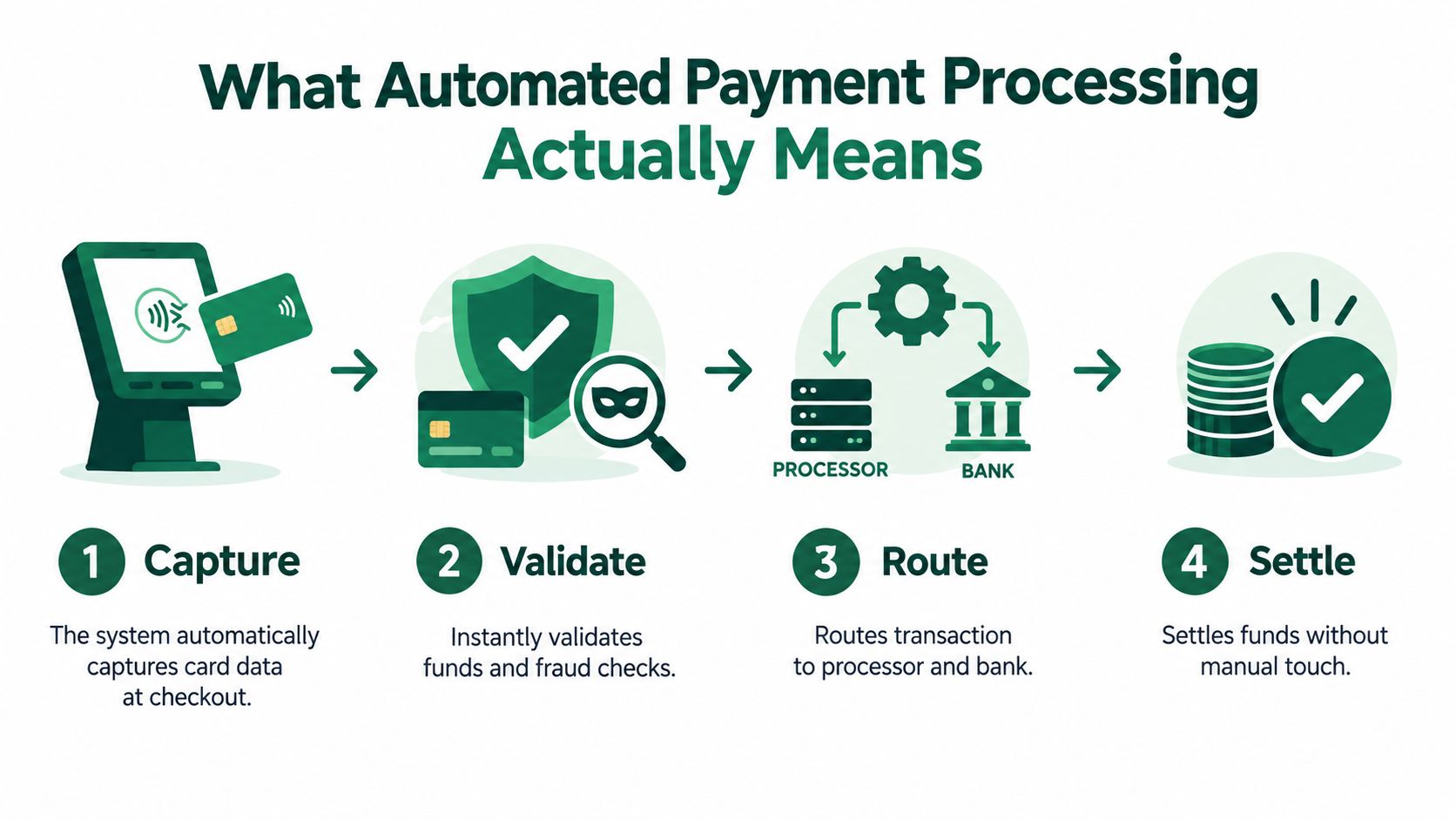
Think of the difference between a cashier and a self-checkout. At a cashier station, a person swipes the card, types the amount, checks the result, writes a receipt, and later matches the sale to a report. At self-checkout, the customer still initiates the purchase, but the system captures the details, validates the transaction, routes it through the payment network, and records the result without another person touching each step.
A tournament payment workflow follows the same principle. Someone still chooses a registration package and submits payment, but the system handles the routine movement afterward.
The four pieces behind the screen
Payment gateway. This is the digital doorway between the registration form and the card networks. It sends transaction details for authorization and returns an approval, decline, or review status.
Merchant account. This is the account structure used to receive card funds before they reach the organizer's bank account. The event operator should know who controls it and where settlement reports can be found.
Recurring billing engine. League dues, installment plans, and season-long memberships need more than a one-time checkout. A recurring billing tool stores the payment permission securely and attempts future drafts according to the schedule you set.
Confirmation step. A webhook or equivalent notification tells the registration system that the payment succeeded, failed, was refunded, or needs attention. That status should update the player record without a volunteer manually changing a spreadsheet.
The key phrase is without manual intervention after setup, not without oversight. Staff still define prices, refund rules, approval thresholds, and the people allowed to issue refunds. They also monitor failed payments, review unusual activity, and correct bad roster data.
Why identifiers matter
Straight-through processing works when initiation, posting, and reconciliation carry the same persistent end-to-end identifier, along with structured remittance data. Software can then match the expected registration payment to a bank statement or status message instead of asking a staff member to compare names and amounts manually. ISO 20022 reconciliation guidance explains why machine-readable status and statement formats make this matching practical at scale.
For a golf event, that identifier might connect a team registration, a sponsor invoice, a side-game entry, and the eventual settlement record. Without that connection, automation stops at checkout and the finance work reappears in a different spreadsheet.
Why Tournament Organizers Feel the Difference
The first improvement usually appears before the shotgun start. A paid golfer scans a code, the staff member confirms the roster, and the player moves toward the carts. Nobody searches for a check, types a card amount, or waits for a receipt printer to recover.
That change matters because tournament registration happens in waves. A charity classic may have sponsors arriving early, volunteers checking in teams at different entrances, and players adding mulligans or side games after their original registration. A good payment workflow keeps each transaction attached to the correct person, team, or fund.
What changes at the desk and in the office
Task | Manual Process | Automated Process |
|---|---|---|
Team registration | Staff retype names, amounts, and add-ons | The system connects the payment to the submitted roster |
Check-in | Volunteers search paper lists and receipts | Staff scan or search the paid registration |
Side-game collection | Cash, checks, and separate spreadsheets | Add-ons appear with the player or team record |
Refunds | Staff calculate the amount and locate the original payment | An authorized user applies the policy to the original transaction |
Reconciliation | Someone compares deposits with forms and handwritten notes | Settlement reports and transaction records provide the audit trail |
Card updater services can also refresh expired or replaced cards in recurring billing workflows, which helps prevent avoidable failures when league dues or installment payments run. That doesn't mean every declined payment will recover, and it doesn't remove the need to contact a player when the account lacks funds.
Cash flow improves for the same reason. Online registration sends money through the configured processor and settlement process instead of leaving the organizer dependent on mailed checks and manual deposits. The exact availability window depends on the provider and account, so the event chair should confirm it in writing rather than assume every processor follows the same schedule.
The bookkeeping benefit is less visible on tournament morning but more valuable afterward. A charity board receives cleaner reports, the treasurer can separate entry fees from donations and side-game money, and the event director doesn't need to reconstruct the weekend from receipts. Organizers comparing broader tournament platforms can review golf tournament management software features alongside payment requirements, roster management, scoring, and payouts.
The wider payment infrastructure shows why this model is no longer unusual. ACH volume in the United States exceeded 1 billion payments in 1988, while Same Day ACH processed 347.2 million payments valued at $460.1 billion in 2020, according to Nacha's history of the ACH network. In Canada, AFT debits rose from 1,012,746,276 in 2021 to 1,178,636,330 in 2025, with value increasing from $1.09 trillion to $1.61 trillion over that period, as the same source describes.
Payment Gateways, Recurring Billing, and Other Integration Options
Match the payment tool to the tournament, not the other way around. A thirty-six-player Saturday scramble doesn't need the same architecture as a four-hundred-golfer charity classic with sponsor invoices, registration waves, recurring league dues, and several side-game funds.
Four practical paths
A full payment gateway fits an event with a custom registration form, multiple packages, add-ons, and a need to connect payments to player records. Stripe, Authorize.Net, and Square are familiar examples. Setup usually involves connecting the account, configuring webhooks or equivalent confirmations, testing receipts, and defining refund permissions. Fees normally combine a transaction charge with processor pricing, so request the complete schedule rather than comparing only the headline rate.
A hosted checkout page is simpler for a one-off outing. The director can email a payment link, place it on an invitation, and let the provider host the card-entry page. This reduces setup and technical maintenance, but it can leave staff manually matching payments to teams unless the checkout collects a unique registration reference.
Recurring billing suits a season-long league that collects monthly dues or installments. The system handles scheduled drafts and failed-payment notifications, while the league administrator manages cancellations, changes, and exceptions. Test the cancellation and replacement-card process before enrolling a full membership list.
ACH or debit acceptance can make sense for large sponsorship invoices, charity contributions, or other payments where card pricing and card limits create friction. ACH has its own return and settlement considerations, so it shouldn't be presented as instant just because it is electronic.
Integration Type | Best For | Typical Fees | Setup Effort |
|---|---|---|---|
Full gateway | Custom registrations and add-ons | Transaction and processor fees | Moderate |
Hosted checkout | One-off outings and simple payment links | Provider transaction fees | Low |
Recurring billing | League dues and installment plans | Recurring transaction fees and possible account charges | Moderate |
ACH or debit | Sponsorship invoices and selected charity payments | Network or transaction fees | Moderate |
Operators who also manage concessions or equipment payments may find the overview of modern vending payment tech useful because it shows how unattended payment environments handle connectivity, authorization, and customer access. The hardware context differs from tournament registration, but the operational lesson is similar: design for the moment when nobody is standing beside the transaction.
Tournament software bundles can embed payment collection directly into a registration form. That removes a reconciliation layer and keeps roster data connected to payment status, but it also locks the organizer into the platform's fee schedule, refund controls, and settlement reporting. Before choosing that route, confirm whether the system supports the event's side games, sponsor workflows, and payment methods. A practical starting point is an event registration form with payment that matches the way players sign up.
Security and Compliance Considerations You Cannot Skip
The cheapest payment workflow is the one that doesn't create a security incident or a compliance problem. Before collecting real money, determine where card data enters the system, who can access the merchant dashboard, and which vendor carries the technical responsibility.
Keep card data away from tournament laptops
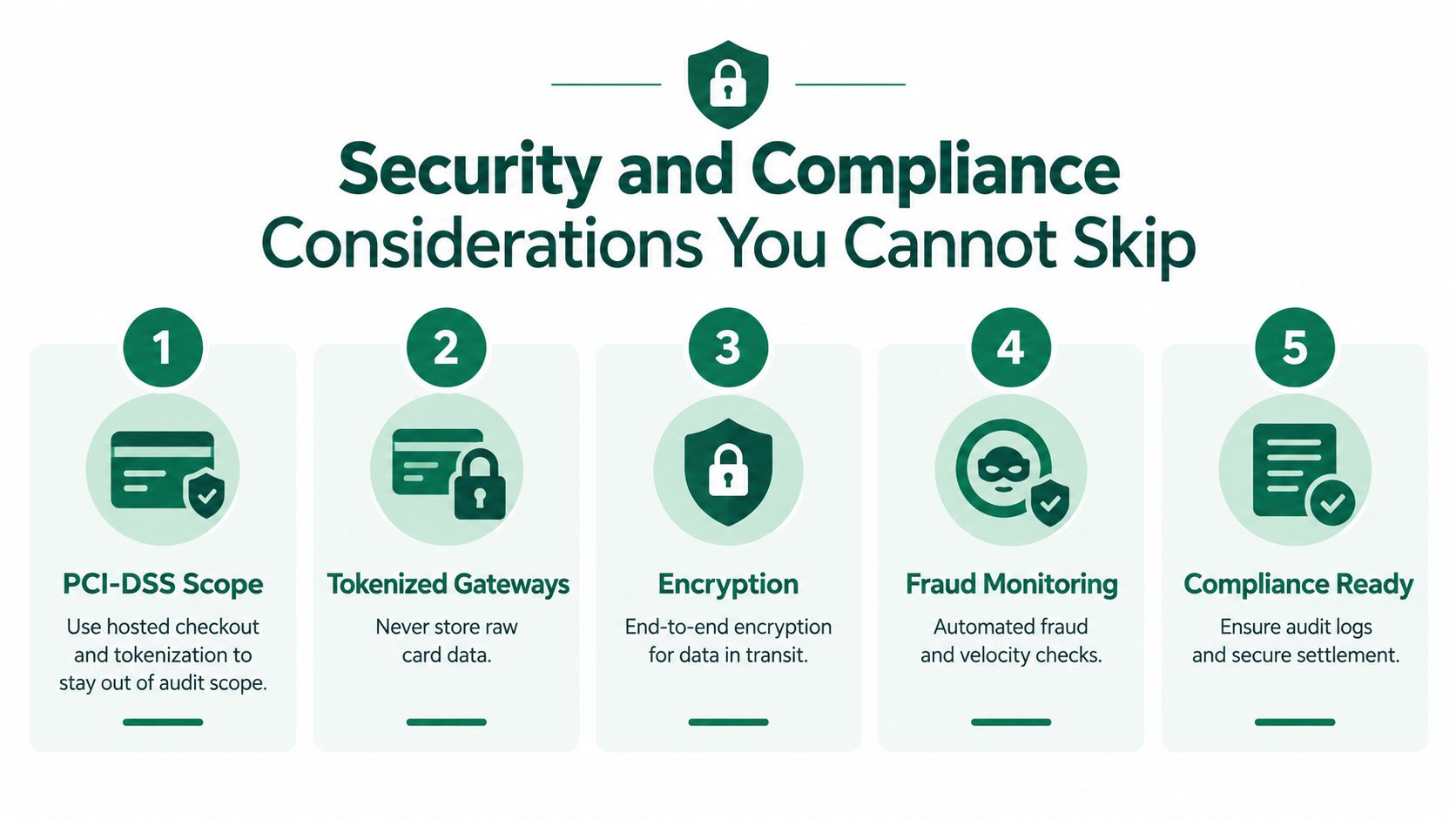
Hosted checkout pages and tokenized gateways can keep most organizers outside the heaviest PCI-DSS handling requirements. Storing raw card numbers in a laptop, exported CSV, email, or shared drive does the opposite. It turns a registration spreadsheet into sensitive payment data and expands the controls your organization must maintain.
An SAQ-A generally supports a model where the payment provider handles the card-entry environment and the merchant has a narrower validation task. An SAQ-D applies to merchants with broader involvement in cardholder data handling and therefore a more demanding assessment. The exact questionnaire depends on the implementation, so ask the processor which SAQ applies and why.
Use these checkpoints before launch:
Hosted checkout and tokenization: Keep raw card numbers out of volunteer devices and exported registration files.
Encryption: Require HTTPS on every registration and payment page, not only the final checkout screen.
Authentication: Turn on two-factor login for the merchant dashboard and limit access by role.
Transaction monitoring: Configure fraud and velocity checks, but route unusual legitimate sponsor payments for human review instead of blocking them automatically.
Retention and records: Set a policy for deleting exported files that contain payment-related details, while preserving the transaction records needed for accounting and disputes.
Verify the vendor, not just the checkout screen
Ask every provider for a current Attestation of Compliance, a written data-processing agreement, and proof of insurance. Also ask where audit logs live, how long transaction records remain available, who can issue refunds, and how the provider handles account closure.
Disputed charges need more than a successful authorization. Features such as 3-D Secure can add authentication evidence, but they don't replace clear registration terms, receipts, and attendance records. State-specific sales-tax treatment can also apply to entry fees or taxable add-ons, so have the charity, club, or accounting adviser confirm the correct treatment before publishing prices.
For teams that need outside help assessing payment environments, satisfy PCI DSS with ThreatExploit AI provides context on penetration-testing requirements and related compliance work. Treat that as a technical resource, not a substitute for the processor's formal compliance documentation.
Handling Edge Cases From Refunds to Chargebacks
Automation earns its keep when the clean registration flow breaks. A foursome may split one registration across three cards, a player may withdraw ten days before the event, or a weather cancellation may require refunds across an entire roster.
Four situations that test the setup
Split payment. The registration form should allow the organizer to associate multiple payments with one team or allocate shares across sub-accounts. Without that structure, the volunteer has to maintain a side ledger and explain why the team appears unpaid even though the total arrived.
Partial cancellation. If the policy allows a partial refund, the authorized staff member selects the original transaction, applies the defined amount, and sends the refund to the original card. The system should retain the registration history and refund reason, rather than forcing the director to issue a new payment and delete the old record.
Side-game settlement. Skins, closest-to-the-pin entries, and mulligan bundles should have their own categories or ledgers. That separation lets the treasurer distinguish tournament revenue from money collected for later payouts. A dedicated golf tournament payouts calculator can support the distribution work, but it shouldn't replace written rules and approval controls.
Chargeback after the event. Six weeks later, a cardholder's spouse may not recognize the tournament's billing descriptor. A strong system gives staff the receipt, registration terms, attendance record, timestamp, and relevant transaction evidence in a dispute packet. Manual teams often search email threads and paper forms under a deadline, while an automated record keeps the evidence connected.
The right goal isn't zero human involvement. Staff should approve unusual refunds, review sensitive customer communications, and decide whether a dispute response is accurate. Automation handles the repetitive assembly and routing so the director can spend time on the judgment call rather than hunting for proof.
Best Practices and a Pre-Tournament Implementation Checklist
A payment system shouldn't debut with the first real registration. Run a final dry test using a $1 transaction on every payment method you plan to accept, then refund each test payment. This confirms that the gateway, receipt email, roster update, settlement record, and refund path work together before players arrive.
Lock the operating details early
At least two weeks before the event, freeze registration fee tiers and test every add-on. Set recurring league drafts for a predictable midweek date, then reconcile payouts the morning after each registration deadline. Send confirmation and reminder emails that state the refund cutoff in plain language, including what happens if the event is canceled or a player withdraws.
Keep a written vendor comparison beside the contract. Ask for:
Per-transaction pricing: Identify the fee for each payment method and whether a separate platform charge applies.
Monthly minimums: Confirm whether the account incurs a charge during quiet months.
Chargeback costs: Ask who pays the dispute fee and whether the provider supplies evidence tools.
Funds availability: Get the settlement and withdrawal window in writing, including weekends and holidays.
Refund handling: Confirm whether refunded processor fees return to the organizer or remain charged.
The registration crew needs a short operational briefing, not a technical manual. Explain how to respond to a declined card without reading sensitive information aloud, keep a tablet with cellular fallback at check-in, and export the transaction ledger the night before tee times. That last review catches duplicate registrations, missing sponsor payments, and unexpected add-ons while there's still time to fix them.
The broader business case supports focusing on exceptions instead of pretending every payment can run unattended. One 2026 industry summary reported that only 5% of accounts-payable teams had fully automated invoice and payment processes, while 23% of organizations described payment processing as mostly or fully automated. The same B2B payment statistics summary reported that automated AP teams process invoices about 4x faster, reduce cost per invoice from $12 to $30 to $2 to $5, and lower payment error rates by approximately 67%. Those figures concern AP rather than golf registration, but they illustrate why organizers should automate repeatable work and reserve people for judgment.
For tournament payment governance, the caution is equally important. A 2026 survey of 1,001 financial professionals found that 24% wanted a fully automated AI payment-reminder workflow, 31% preferred human review before anything was sent, and only 8.3% said they were actively using AI for payments or AR. Accuracy and errors ranked as the top concern at 31%, ahead of security at 20%, according to eBizCharge's payment-processing survey. The practical lesson is simple: automate the registration mechanics, but set approval thresholds for refunds, customer messages, and unusual transactions.
Live Tourney offers registration and payment management for golf tournaments and leagues, with online payments handled through its registration workflow and support for roster, side-game, payout, and event administration tasks. Visit Live Tourney to see whether its payment-connected tournament tools fit your next scramble, charity outing, or recurring league.





